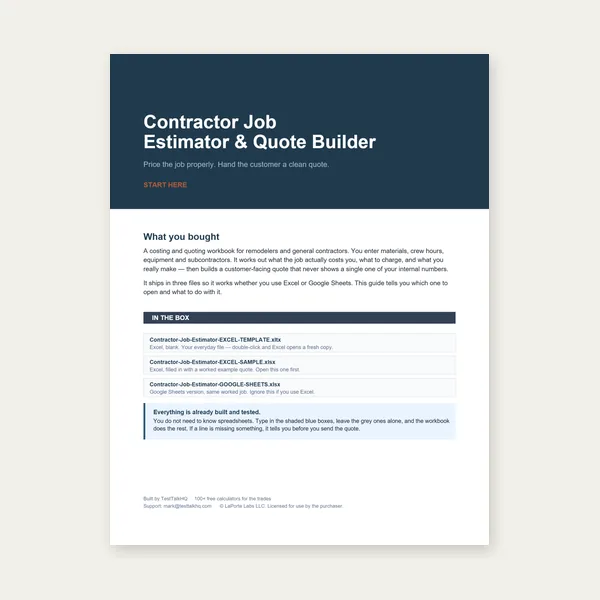
Contractor Job Estimator
Price remodels and GC work, then send a quote with no internal numbers.
Excel or Google Sheets. Best on a computer.
$29.00
BuyLockout/Tagout (LOTO) is how shops keep unexpected startup and stored energy from injuring people during service and maintenance. This guide covers what LOTO is, the six OSHA-based steps, when it is required, and who is authorized to perform it.
Control of hazardous energy under OSHA 29 CFR 1910.147 means isolating machines from energy sources and securing those isolation points so they cannot be re-energized while someone is exposed. Energy is not only electrical — hydraulic pressure, compressed air, gravity, springs, heat, and chemicals all count when they can do work.
Lockout uses a lock that physically prevents an energy-isolating device from being moved to the unsafe position. Tagout uses a warning tag that forbids operation but does not by itself provide the same physical restraint. Use the interactive LOTO Safety Checklist as you walk a job, and read Lockout vs Tagout when you need the feasibility distinction.
LOTO applies when employees perform servicing or maintenance where unexpected energization, startup, or release of stored energy could cause injury. Typical shop triggers: changing tooling on a press brake, clearing a jam on a conveyor, repairing a plasma table drive, working inside a compressor cabinet, or opening a hydraulic power unit.
Normal production operations that are routine, repetitive, and integral to production may use alternative measures under the standard’s exceptions — but “we do this every day” is not an automatic free pass. If your body is exposed to hazardous energy during the task, treat LOTO as required until a competent person and written program say otherwise.
Training, periodic inspections, and machine-specific procedures are program requirements — not paperwork theater. Pair LOTO with process PPE from the PPE Selection Guide and hot-work controls from the Hot Work Permit Checklist when welding or cutting is part of the repair.
Run the interactive checklist Check each OSHA-based step and energy-source sub-item, then download a completed PDF for the job packet.
LOTO Safety Checklist →No. Lockout physically prevents operation. Tagout is a warning system used when lockout is not feasible under your written program — see Lockout vs Tagout.
Use company-issued LOTO locks that meet your program. Personal hardware-store locks create key-control and identification failures — covered in LOTO Troubleshooting.
Shop calculators offline on Android — settings, gas, deposition, and more.
Price remodels and GC work, then send a quote with no internal numbers.
Excel or Google Sheets. Best on a computer.
$29.00
BuyCheckout opens in a new tab.