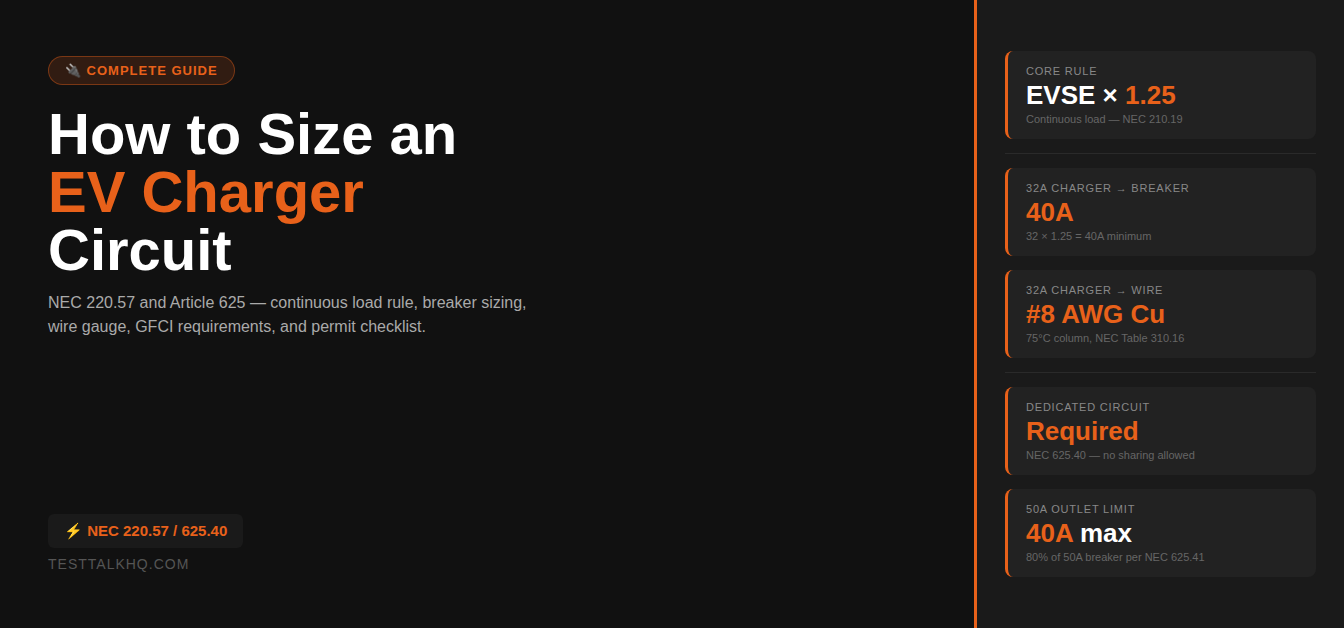
EV charger installations are booming, and so are failed inspections from undersized circuits. The rule is simple — EV chargers are continuous loads, so every circuit must be sized at 125% of the charger’s rated output — but the implications of getting it wrong are expensive. This guide walks through every step, from picking a charger to pulling the permit.
Circuit Sizing Table — Level 2 EVSE Quick Reference
| EVSE Output (Amps) | Min Circuit Ampacity (×1.25) | Breaker Size | Copper Wire (75°C) | Aluminum Wire (75°C) |
|---|---|---|---|---|
| 16A | 20A | 20A | 12 AWG | 10 AWG |
| 24A | 30A | 30A | 10 AWG | 8 AWG |
| 32A | 40A | 40A | 8 AWG | 6 AWG |
| 40A | 50A | 50A | 6 AWG | 4 AWG |
| 48A | 60A | 60A | 4 AWG | 3 AWG |
| 80A | 100A | 100A | 1 AWG | 2/0 AWG |
Useful Gear for EV Charger Circuit Work

Fluke 117 Electricians True RMS Multimeter
- Dead-front checks before energizing EVSE
- Non-contact voltage detection
- CAT III 600 V for panel work

Klein Tools CL800 Digital AC/DC Clamp Meter
- Confirm EVSE draw after install
- True RMS for accurate loads
- High-amp branch troubleshooting

Klein 1000V Insulated Screwdriver Set
- IEC 60900 rated insulation
- Breaker and EVSE terminations
- Multiple profiles in one kit
As an Amazon Associate, TestTalkHQ earns from qualifying purchases. Prices and availability subject to change.
🔌 Calculate Your EV Charger Circuit Size
Enter your charger’s rated output and run our EV Charger Circuit Sizing Calculator for a complete breakdown — breaker size, wire gauge, voltage drop check, and NEC compliance summary.
Level 1 vs. Level 2 — Understanding What You’re Installing
Level 1 (120V): Plugs into a standard 20A outlet. Adds roughly 3–5 miles of range per hour. Works for drivers who don’t drive far daily or have a plug-in hybrid. No special circuit required in most cases — just a dedicated 20A outlet per NEC 625.40.
Level 2 (240V): This is what most EV owners actually want. Adds 15–30+ miles of range per hour depending on the charger’s output. Requires a dedicated 240V circuit. Output ranges from 16A (basic) up to 80A (commercial-grade). The most common residential Level 2 charger is 32A — charging a typical EV overnight from near-empty.
The Core Rule — NEC 220.57 and the 125% Continuous Load Requirement
NEC 220.57 (added in the 2023 NEC) explicitly states that EVSE load shall be calculated at either 7,200 VA or the nameplate rating of the equipment, whichever is larger. More importantly, EV charging is a continuous load — it runs for more than 3 hours (overnight charging) — which triggers the continuous load rule in NEC 210.19 and 215.2.
Minimum Circuit Ampacity = EVSE Rated Amps × 1.25
This is the core calculation. Everything else follows from this number.
A 32A charger needs a 40A circuit minimum (32 × 1.25 = 40A). A 48A charger needs 60A. A 40A charger needs 50A. The breaker and the conductors must both be rated for this calculated ampacity — not just the charger’s output rating.
⚠️ The Most Common Mistake — Sizing to Charger Output, Not 125%
People buy a 32A charger, put it on a 32A breaker with wire sized for 32A, and fail inspection. The breaker must be rated for the full calculated ampacity (40A), and the wire must be sized for that breaker. There are no shortcuts here — inspectors know this rule cold.
NEC Article 625 — The EVSE-Specific Requirements
While NEC 220.57 handles the load calculation side, Article 625 handles the installation requirements for the EVSE equipment itself. Key sections:
- NEC 625.40: EV charging must be on a dedicated branch circuit. No sharing with other loads. Period. This is the most commonly violated requirement on residential installs.
- NEC 625.41: Overcurrent protection must be sized for continuous duty at 125% of the charger’s maximum output current.
- NEC 625.42: If you’re installing multiple chargers, load management systems can allow reduced circuit sizing — but the chargers must be listed for this and set up accordingly.
- NEC 625.54: GFCI protection is required for any receptacle used to connect EVSE. Hardwired connections are not specifically called out, but many AHJs require GFCI on the circuit regardless.
Checking Your Panel Before You Buy a Charger
Before ordering a 48A charger and a 60A breaker, you need to verify your panel can actually support the load. Three things to check:
1. Available Ampacity in Your Panel
Find your main breaker size (typically 100A, 150A, or 200A). Run a basic load calculation per NEC Article 220 to see how much of that capacity is already committed. A 200A service with a well-loaded house may only have 30–40A of headroom — enough for a 32A charger but not a 48A unit.
2. Available Breaker Spaces
A 40A two-pole breaker needs two spaces in your panel. A 60A two-pole breaker also needs two spaces. Check how many double-wide spaces you have available. Tandem (half-size) breakers generally cannot be used for EVSE circuits — they’re limited to 15A or 20A.
3. Wire Run Length and Voltage Drop
For runs longer than 50 feet, you need to check voltage drop. On a 50-foot run with 8 AWG copper at 32A, voltage drop is about 1.6% — fine. At 100 feet, it doubles to 3.2% — above the NEC 210.19 informational note recommendation of 3% for branch circuits. Consider upsizing to 6 AWG copper for runs over 75 feet to keep drop under 2%.
✅ Smart Move: Run a Bigger Circuit Now
If you’re installing conduit anyway, pull wire for a 60A circuit even if your current charger only needs 40A. The wire costs incrementally more upfront. Upgrading later means opening walls, pulling new wire, and swapping the breaker — way more expensive than sizing up now.
Conduit vs. NM Cable — Which to Use
NM cable (Romex): Permitted in dry locations like finished garages. Must use the 60°C column for ampacity, which means you need larger wire than THHN in conduit. For a 40A circuit in NM cable, you need 8 AWG at the 60°C column (still 40A) — same wire size, just fewer options on longer or outdoor runs.
THHN/THWN-2 in conduit: Use the 75°C column for ampacity sizing (since most panels have 75°C terminals). This is the preferred method for outdoor runs, garage walls subject to physical damage, long underground runs, or anywhere wet locations are involved. Conduit protects the wire and allows future upgrades without opening walls.
For the charging location itself: If the charger is in a wet location (outdoor, exposed area), the conductors in that section must be wet-rated. THWN-2 in conduit handles wet locations. NM cable is not rated for wet locations.
Plug-In EVSE vs. Hardwired — The Outlet Question
Most Level 2 chargers can be either hardwired directly to the circuit or plugged into a NEMA 14-50 outlet (50A, 240V, 4-wire). There are real trade-offs:
| Factor | NEMA 14-50 Outlet | Hardwired |
|---|---|---|
| Flexibility | Can unplug and take charger with you | Charger stays with the house |
| Max circuit size | 50A circuit (charger limited to 40A output per NEC) | Any size up to 100A |
| GFCI requirement | Yes — NEC 625.54 requires GFCI on receptacle | AHJ-dependent, often not required |
| Code compliance | Straightforward — outlet + dedicated circuit | Must be listed for hardwire installation |
| Future-proofing | Limited to 40A charger output (50A circuit) | Can go up to 80A output (100A circuit) |
💡 The 50A Outlet Limitation
Per NEC 625.41, a cord-and-plug connected EVSE on a NEMA 14-50 outlet is limited to 80% of the 50A breaker = 40A charger output. If you want a 48A or higher charger, you must hardwire it. This is why the Tesla Wall Connector, Chargepoint Home Flex at 48A, and similar high-output chargers are hardwired.
The Permit — Why You Need One and What to Expect
Every jurisdiction requires a permit for EVSE installation on a dedicated circuit. The inspector will check:
- Circuit sized at 125% of charger output (continuous load rule)
- Dedicated circuit — no shared breakers
- Wire gauge appropriate for the breaker size and temperature rating
- GFCI where required by NEC 625.54
- Proper grounding at the charger location
- Charger listed (UL listed) for the installation
Pull the permit. It protects you when you sell the house, confirms insurance coverage in the event of a fire, and ensures the work was done correctly. Most electrical permits for EVSE installs cost $50–150.
After Sizing — Diagnose Failures or Choose Upgrade vs Load Management
This guide sizes the branch. When a “correct” circuit still trips, under-delivers, or the panel fights you, use
EV Charger Circuit Troubleshooting.
When spare service capacity is the real fork, use
Panel Upgrade vs EV Load Management.
Frequently Asked Questions
What size breaker do I need for a Level 2 EV charger?
Multiply the charger’s rated output by 1.25 and round up to the next standard breaker size. A 32A charger needs a 40A breaker. A 48A charger needs a 60A breaker. A 40A charger needs a 50A breaker. This is the NEC continuous load rule — non-negotiable on any EVSE installation.
Can I use a 50 amp outlet for a 48 amp EV charger?
No. A NEMA 14-50 outlet on a 50A circuit limits cord-and-plug EVSE to 40A output per NEC 625.41 (80% of 50A). A 48A charger must be hardwired to a dedicated 60A circuit. This is a common point of confusion when spec’ing out higher-output chargers like the Tesla Wall Connector or ChargePoint Home Flex at full 48A output.
Do I need a dedicated circuit for an EV charger?
Yes. NEC 625.40 requires EVSE to be supplied by a dedicated branch circuit. No sharing with other loads, no exceptions. This is one of the most consistently enforced inspection points on EVSE installations.
What wire do I need for a Level 2 EV charger?
It depends on the charger size and installation method. A 32A charger on a 40A circuit needs 8 AWG copper (THHN in conduit at 75°C) or 8 AWG copper NM-B. A 48A charger on a 60A circuit needs 4 AWG copper. Always size wire for the breaker, not the charger’s output rating, and use the appropriate temperature column per NEC 310.16 based on your terminal ratings.
Can I install an EV charger myself?
In most jurisdictions, homeowners can pull an electrical permit and do their own work. However, the work must still be inspected and must comply with all NEC requirements. If you’re not comfortable with panel work, conduit, and proper GFCI installation, hire a licensed electrician. The cost of a proper installation ($500–1,500 for most residential Level 2 installs) is much less than the cost of undoing a bad one.
What is NEC 220.57 and why does it matter for EV charger installations?
NEC 220.57, added in the 2023 NEC, specifically addresses how EV charger loads are calculated in service and feeder load calculations. It requires that EVSE load be calculated at either 7,200 VA or the nameplate rating, whichever is larger. This matters when you’re doing a full load calculation to verify your panel can support the charger — particularly relevant in older homes with smaller services or high existing loads.