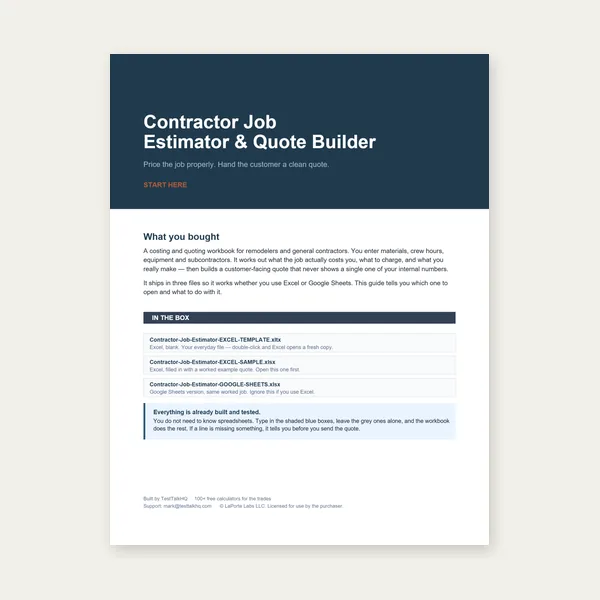
Contractor Job Estimator
$29.00
BuyTrip computer vs two fill-ups, why pump price and mpg both set cost per mile, and how to use those numbers for commute cost planning
Run the fill-up math in the MPG calculator (miles ÷ gallons, or EPA combined from city and highway). The trip fuel cost calculator then turns that mpg into gallons and dollars. Garbage mpg in, garbage dollars out. This page is how to get a number that belongs to your car, not the window sticker.
Receipt higher than calculated: troubleshooting. Which EPA rating to type: city vs highway mpg. Automotive index: hub.
Have miles and gallons from a fill-up?Run actual mpg or EPA combined here, then price the trip if you want dollars.
Open MPG Calculator →Most late-model dashboards show instantaneous and average mpg. That is convenient and often close enough for a highway run. It is also an estimate from fuel-injector pulse width, MAF/MAP, and whatever smoothing the OEM wrote. Reset it at a fill-up and read it at the next fill-up if you want the computer and the pump to argue about the same miles.
Treat a trip computer as a live hint, not a receipt. Short trips after a cold start, a roof box, and a headwind will all move the number before the next tank is empty. If the dash says 34 mpg and two fill-ups say 29, believe the fill-ups for cost planning.
$29.00
BuyCheckout opens here — you stay on this page.
The calculator turns miles, mpg, and pump price into gallons and dollars. A gas can covers a reserve, a pressure gauge and inflator keep rolling resistance honest, and an OBD reader helps you grab the trip-computer mpg you actually plug in.
Reserve fuel for a long trip or a remote fill. The calculator tells you gallons needed; the can is how you carry a measured extra without guessing at the pump.
View on Amazon →
Underinflated tires raise rolling resistance and burn more fuel than the mpg you typed. Check cold PSI against the door sticker before you trust a commute-cost number.
View on Amazon →
Set door-sticker pressure after a temperature swing. Soft tires are a common reason actual dollars run higher than gallons × pump price from window-sticker mpg.
View on Amazon →
Live data and stored codes on most 1996+ OBD2 vehicles. Pair it with fill-up math when the dash trip computer and the window sticker disagree.
View on Amazon →
Miles, mpg, and $/gallon. Gallons needed, total cost, cost per mile. Round-trip and multi-trip commute modes.
Open Trip Fuel Cost Calculator →
Diameter % and speedometer error from two size codes. Size and pressure both move real-world mpg.
Open Tire Size Calculator →As an Amazon Associate, TestTalkHQ earns from qualifying purchases.
Fill the tank. Reset the trip odometer (or note the odometer). Drive normally. Fill the same tank the same way — same pump side, same click-off, no topping off into the vapor space. MPG = miles driven ÷ gallons pumped on the second fill.
One tank is noisy. Average three fill-ups on the commute you actually run. Do not mix a tank of interstate with a tank of winter errands and call it “the car’s mpg.”
Cost per mile is pump price divided by mpg. Raising mpg and cutting pump price both help, and they multiply. A 28 mpg car at $3.50/gal is $0.125/mi. Drop to 24 mpg at the same price and you are at $0.146/mi — about 17% more per mile before you have gone anywhere. The calculator shows that rate next to total dollars so a cheap-looking long trip does not hide an expensive car.
Gallons and total cost scale with distance, round-trip, and trip count. Cost per mile does not. That is why a 500-mile round trip at 28 mpg and $3.49/gal costs twice a 250-mile one-way, but still the same cents per mile.
Enter one-way miles to work. Flip round-trip. Set number of trips to the workdays in the month (often 20–23). The result is a monthly fuel envelope, not a tax deduction and not a company-car policy. If your commute is mixed city and highway, use fill-up mpg from those days, or pick the EPA number that matches the worse half of the drive — see city vs highway mpg.
Only as a first guess. Combined is a 55% city / 45% highway mix on the EPA label. Your commute is probably not that mix. Fill-up mpg on those roads is better.
No. It doubles gallons and total cost for the same mpg and price. Cost per mile stays pump price ÷ mpg.
Yes. One-way miles, round-trip on, trips = workdays. That is the trip fuel cost calculator.