If you’ve ever needed to figure out how much a piece of steel weighs for a job quote, shipping estimate, or crane capacity calculation, you know it’s not as simple as it should be. Different metals weigh different amounts. Different shapes have different formulas. And if you screw up the math, you either overbid and lose the job or underbid and lose money.
I’ve been fabricating for 10 years, and I still see experienced guys pulling out calculators trying to remember if the formula for tubing is OD squared minus ID squared or something else entirely. Most of the time, they just guess and add a fudge factor.
Here’s the better way: understand the basic formulas once, use the Metal Weight Calculator for speed, and know when your numbers actually matter versus when close enough is good enough.
Let’s break down exactly how to calculate metal weight for every common shape you’ll run into in the shop.
Why Metal Weight Actually Matters
Weight isn’t just academic. Here’s where it impacts real fabrication work:
Material Costs: Steel is sold by the pound. If you’re estimating material for a bid and you’re off by 20%, you just donated your profit margin to the customer.
Shipping and Handling: Freight companies charge by weight. Underestimate by 500 pounds and you’re eating the extra shipping cost. Or worse, the truck shows up and can’t legally haul your load.
Structural Capacity: Building a frame that needs to support equipment? You better know the dead load of the steel itself before you calculate live loads and safety factors.
Crane and Rigging: Try to lift a piece that’s 2,000 pounds heavier than you calculated and you’re looking at dropped loads, damaged equipment, or worse.
Getting weight right isn’t optional. It’s part of the job.
Understanding Material Density
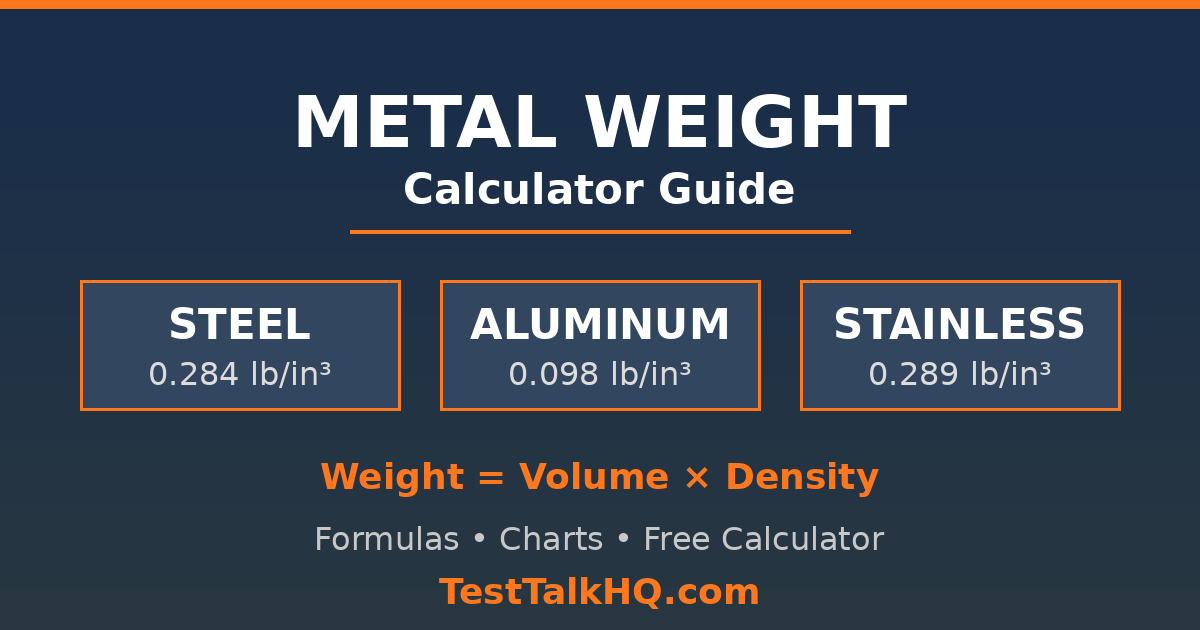
Every metal has a specific density – how much one cubic inch weighs. Once you know the volume of your piece and the density of your material, calculating weight is straightforward multiplication.
Here are the densities you’ll use most often:
| Material | Density (lb/in³) | Common Uses |
|---|---|---|
| Mild Steel (A36) | 0.284 lb/in³ | Structural steel, general fabrication |
| Stainless Steel (304) | 0.289 lb/in³ | Food equipment, marine, corrosion resistance |
| Aluminum (6061) | 0.098 lb/in³ | Lightweight structures, aerospace |
| Copper | 0.324 lb/in³ | Electrical, plumbing, art |
| Brass | 0.308 lb/in³ | Fittings, decorative, bearings |
| Bronze | 0.318 lb/in³ | Bearings, marine hardware |
Notice that aluminum is about one-third the weight of steel for the same volume. That’s why it’s popular for weight-critical applications even though it costs more per pound.
Use the Metal Weight Calculator and it handles all these density values automatically – you just pick your material and enter dimensions.
Calculating Weight for Flat Plate and Sheet
This is the easiest calculation. Flat plate is just length × width × thickness × density.
The Formula
Weight (lb) = Length (in) × Width (in) × Thickness (in) × Density (lb/in³)
Example: 4′ × 8′ × 1/4″ Steel Plate
Let’s say you need to know the weight of a standard 4×8 sheet of 1/4″ mild steel plate.
First, convert everything to inches:
- Length: 48 inches
- Width: 96 inches
- Thickness: 0.25 inches
- Steel density: 0.284 lb/in³
Now multiply:
Weight = 48 × 96 × 0.25 × 0.284 = 326.9 pounds
That’s a heavy sheet. You’re not hand-carrying that to the welding table. This is where knowing weight matters for shop layout and material handling.
Quick Reference: Common Steel Plate Weights
| Thickness | Weight per Square Foot | 4′ × 8′ Sheet Weight |
|---|---|---|
| 1/8″ (0.125″) | 5.1 lb/ft² | 163 lb |
| 3/16″ (0.1875″) | 7.65 lb/ft² | 245 lb |
| 1/4″ (0.25″) | 10.2 lb/ft² | 327 lb |
| 3/8″ (0.375″) | 15.3 lb/ft² | 490 lb |
| 1/2″ (0.5″) | 20.4 lb/ft² | 653 lb |
For odd sizes or different materials, the calculator saves you from doing the math manually.
Calculating Weight for Round Bar and Rod
Round bar is common for shafts, pins, and structural bracing. The calculation uses the formula for cylinder volume.
The Formula
Weight (lb) = π × (Diameter/2)² × Length × Density
Or simplified: Weight = 0.7854 × Diameter² × Length × Density
(The 0.7854 is just π/4, which accounts for radius squared)
Example: 1″ Diameter × 12″ Long Steel Rod
Let’s calculate a 1-inch diameter steel rod that’s 12 inches long.
- Diameter: 1 inch
- Length: 12 inches
- Steel density: 0.284 lb/in³
Weight = 0.7854 × 1² × 12 × 0.284 = 2.67 pounds
For a quick mental estimate, remember that 1-inch diameter steel rod weighs about 2.67 pounds per foot. A 2-inch rod weighs four times that (10.68 lb/ft) because diameter is squared in the formula.
Quick Reference: Steel Round Bar Weights
| Diameter | Weight per Foot (Steel) | Weight per Foot (Aluminum) |
|---|---|---|
| 1/2″ | 0.67 lb/ft | 0.23 lb/ft |
| 3/4″ | 1.50 lb/ft | 0.52 lb/ft |
| 1″ | 2.67 lb/ft | 0.92 lb/ft |
| 1-1/2″ | 6.01 lb/ft | 2.07 lb/ft |
| 2″ | 10.68 lb/ft | 3.68 lb/ft |
Calculating Weight for Tubing and Pipe
Tubing and pipe are hollow, so you need to subtract the inner volume from the outer volume. This is where most people mess up the formula.
The Formula
Weight (lb) = π × (OD²/4 – ID²/4) × Length × Density
Or simplified: Weight = 0.7854 × (OD² – ID²) × Length × Density
Where OD = Outside Diameter and ID = Inside Diameter
Example: 2″ × 0.125″ Wall × 10′ Steel Tube
Let’s calculate a 2-inch outside diameter steel tube with 1/8″ wall thickness and 10 feet long.
First, find the inside diameter:
- OD: 2.0 inches
- Wall thickness: 0.125 inches
- ID: 2.0 – (2 × 0.125) = 1.75 inches
- Length: 120 inches (10 feet)
- Steel density: 0.284 lb/in³
Weight = 0.7854 × (2² – 1.75²) × 120 × 0.284
Weight = 0.7854 × (4 – 3.0625) × 120 × 0.284 = 25.0 pounds
That’s for 10 feet. Per foot, this tube weighs about 2.5 pounds.
Quick Reference: Common Steel Tubing Weights
| Size (OD × Wall) | Weight per Foot | Type |
|---|---|---|
| 1″ × 0.065″ | 0.87 lb/ft | Light structural |
| 1-1/2″ × 0.083″ | 1.59 lb/ft | Medium structural |
| 2″ × 0.125″ | 2.50 lb/ft | Heavy structural |
| 3″ × 0.120″ | 4.33 lb/ft | Column/post |
| 4″ × 0.125″ | 6.03 lb/ft | Heavy column |
The Metal Weight Calculator lets you enter OD and wall thickness directly – no need to calculate ID or mess with the formula.
Calculating Weight for Square and Rectangular Tubing
Square and rectangular tubing (HSS – Hollow Structural Section) is everywhere in structural fabrication. The calculation is similar to round tube but uses different geometry.
The Formula for Square Tubing
Weight (lb) = (Outside² – Inside²) × Length × Density
Where Outside = outside dimension and Inside = outside dimension – (2 × wall thickness)
Example: 2″ × 2″ × 0.125″ Wall × 8′ Steel Square Tube
- Outside: 2.0 inches
- Wall: 0.125 inches
- Inside: 2.0 – (2 × 0.125) = 1.75 inches
- Length: 96 inches
- Steel density: 0.284 lb/in³
Weight = (2² – 1.75²) × 96 × 0.284
Weight = (4 – 3.0625) × 96 × 0.284 = 25.5 pounds
The Formula for Rectangular Tubing
Weight (lb) = [(H × W) – (Hi × Wi)] × Length × Density
Where H = height, W = width, Hi = inside height, Wi = inside width
Example: 2″ × 4″ × 0.125″ Wall × 10′ Rectangular Tube
- Outside height: 2.0 inches
- Outside width: 4.0 inches
- Wall: 0.125 inches
- Inside height: 2.0 – (2 × 0.125) = 1.75 inches
- Inside width: 4.0 – (2 × 0.125) = 3.75 inches
- Length: 120 inches
Weight = [(2 × 4) – (1.75 × 3.75)] × 120 × 0.284
Weight = (8 – 6.5625) × 120 × 0.284 = 49.0 pounds
Quick Reference: Common HSS Weights
| Size | Weight per Foot | Common Use |
|---|---|---|
| 1″ × 1″ × 0.065″ | 0.81 lb/ft | Light frames |
| 2″ × 2″ × 0.125″ | 3.19 lb/ft | General structural |
| 2″ × 4″ × 0.125″ | 4.08 lb/ft | Beams, posts |
| 3″ × 3″ × 0.188″ | 7.11 lb/ft | Heavy structural |
| 4″ × 4″ × 0.250″ | 12.21 lb/ft | Columns, heavy posts |

Calculating Weight for Angle Iron and Channel
Angle iron and channel are structural shapes. You could calculate them from scratch using geometric formulas, but honestly, nobody does that. These shapes have published weights per foot that you look up in tables or use the calculator.
Here’s why: an angle iron isn’t just two flat pieces at 90 degrees. The corner has a radius. The legs might taper. The published weights account for all of this.
Common Angle Iron Weights
| Size (Leg × Leg × Thickness) | Weight per Foot |
|---|---|
| 1″ × 1″ × 1/8″ | 0.80 lb/ft |
| 2″ × 2″ × 1/8″ | 1.65 lb/ft |
| 2″ × 2″ × 1/4″ | 3.19 lb/ft |
| 3″ × 3″ × 1/4″ | 4.90 lb/ft |
| 4″ × 4″ × 1/4″ | 6.60 lb/ft |
Common Channel Weights
| Size (Depth × Flange Width) | Weight per Foot |
|---|---|
| C3 × 4.1 | 4.1 lb/ft |
| C4 × 5.4 | 5.4 lb/ft |
| C6 × 8.2 | 8.2 lb/ft |
| C8 × 11.5 | 11.5 lb/ft |
For these shapes, just use the published weight per foot multiplied by your length. The Metal Weight Calculator has these common sizes built in.
Real-World Application: Estimating a Fabrication Project
Let’s put this all together with a real project estimate. Say you’re building a small steel frame structure – a 10′ × 10′ equipment platform 8′ tall.
Material List
- 4 corner posts: 3″ × 3″ × 0.188″ square tube × 8′ long
- 8 horizontal beams: 2″ × 4″ × 0.125″ rectangular tube × 10′ long
- Decking: 1/4″ steel plate, 10′ × 10′
Weight Calculation
Corner posts: 7.11 lb/ft × 8 ft × 4 posts = 227.5 lb
Horizontal beams: 4.08 lb/ft × 10 ft × 8 beams = 326.4 lb
Decking: 10.2 lb/ft² × 100 ft² = 1,020 lb
Total structure weight: 1,574 pounds
Now you know:
- Material cost estimate (multiply by current steel price per pound)
- Crane or forklift capacity needed for installation
- Trailer or truck size for delivery
- Foundation loading for engineering calculations
Without accurate weight calculations, you’re just guessing on all of these critical factors.

Common Mistakes in Weight Calculations
Mistake #1: Mixing Units
You measure dimensions in feet but use density in pounds per cubic inch. Now your answer is off by 1,728 (the number of cubic inches in a cubic foot). Keep everything in inches or convert everything to feet – don’t mix.
Mistake #2: Forgetting Wall Thickness is Double
When calculating tubing, the wall thickness comes off both sides. A 2″ OD tube with 0.125″ wall has an ID of 1.75″, not 1.875″. Subtract 2 × wall thickness, not just wall thickness.
Mistake #3: Using Wrong Density
Not all steel weighs the same. Stainless is slightly heavier than mild steel. Aluminum is way lighter. Using the wrong density throws your entire calculation off.
Mistake #4: Ignoring Cutoffs and Waste
You calculated that you need 237 pounds of steel. Great. But you’re buying stock lengths, making cuts, and generating drops. Add 10-15% for waste when you’re ordering material.
Mistake #5: Not Accounting for Coatings
Galvanized steel weighs more than bare steel because of the zinc coating. Hot-dip galvanizing adds about 2-3% to the weight. Not huge, but it matters on large structural jobs.
When Precision Matters (And When It Doesn’t)
Not every weight calculation needs to be exact. Here’s when you can round and when you need precision.
Close enough is fine:
- Material ordering (add waste factor anyway)
- General handling and shop logistics
- Cost estimates (steel prices fluctuate more than your calculation error)
Precision matters:
- Structural engineering calculations
- Crane lift plans and rigging
- Weight-limited shipping (trucks, shipping containers)
- Aircraft or weight-critical applications
- CNC programming where material weight affects cycle time
For everyday shop work, being within 5% is usually good enough. For engineered structures, you want to be within 1-2%.
Using the Metal Weight Calculator
Look, you can do all this math by hand. But why would you when the Metal Weight Calculator does it in 10 seconds?
Here’s how it works:
- Select your material (steel, aluminum, stainless, etc.)
- Pick your shape (plate, round bar, tube, square tube, etc.)
- Enter dimensions (varies by shape)
- Enter length or quantity
- Get instant weight
It handles all the formulas, density values, and unit conversions automatically. And it’s free.
The calculator is especially useful when you’re pricing jobs. You can quickly run multiple material options and compare weights and costs without pulling out formulas and a calculator.
Material Weight and Welding Heat Input
Here’s a connection most people don’t think about: material weight affects how much heat you need when welding.
Thicker, heavier material acts as a heat sink. You need more amperage or preheat to get proper fusion. Thin, light material overheats easily and burns through.
If you’re welding 1″ plate (40.8 lb/ft²), you might need to preheat to 200°F and run high amperage. If you’re welding 16-gauge sheet (2.66 lb/ft²), you need to dial way back or you’ll blow holes.
Check out our other calculators for welding settings based on material thickness:
Tips for Accurate Field Measurements
Calculating weight from drawings is one thing. Verifying actual material in the field is another. Here’s how to get accurate dimensions:
For thickness: Use calipers or a micrometer. Don’t trust nominal sizes – a “1/4 inch” plate might actually be 0.242″ or 0.257″ depending on mill tolerances.
For tubing ID: You can’t easily measure inside diameter directly on finished tube. Measure OD accurately, then calculate ID from the known wall thickness marked on the material.
For length: Account for cuts, notches, and holes. These reduce weight. A 10-foot beam with 2 square feet of holes cut out weighs less than the solid calculation suggests.
For verification: If you have access to a scale, weigh a piece. Calculate what it should weigh. If you’re more than 5% off, check your measurements or material type.
Converting Between Weight and Material Cost
Steel prices change constantly, but here’s how to use weight calculations for cost estimates.
As of late 2024, rough pricing:
- Mild steel: $0.60-$0.90 per pound
- Stainless 304: $2.50-$4.00 per pound
- Aluminum 6061: $3.00-$5.00 per pound
These are ballpark numbers and vary by region, quantity, and market conditions. Always get current quotes from your supplier.
To estimate material cost:
Material Cost = Weight × Price per Pound × Waste Factor
Use 1.10-1.15 for waste factor (10-15% extra for cutoffs and drops).
Example: That 1,574-pound equipment platform we calculated earlier, using $0.75/lb for steel:
Cost = 1,574 lb × $0.75/lb × 1.15 = $1,357 in material
Now you can add labor, consumables, and markup for a complete estimate.

Final Thoughts on Metal Weight Calculations
Look, metal weight calculations aren’t complicated once you understand the basic formulas. But in a busy shop, nobody wants to be pulling out geometry equations when they’re trying to quote a job or load a truck.
Use the Metal Weight Calculator for speed and accuracy. Keep a reference table handy for common shapes you use frequently. And remember that getting within 5% is usually good enough for most applications.
Where weight really matters – structural calculations, crane lifts, shipping – that’s when you double-check your numbers and add appropriate safety factors.
For more fabrication tools and resources, visit the Welding Calculators and Tools page.
Disclaimer: Weight calculations should be verified for critical applications. Material properties and densities can vary by grade and supplier. For structural engineering applications, consult qualified engineers and follow applicable building codes. See our full disclaimer.
Metal Weight Troubleshooting · Metal Weight vs Pipe/Tube Calculator
Any trade
Contractor Job Estimator
Price remodels and GC work, then send a quote with no internal numbers.
Excel or Google Sheets. Best on a computer.
$29.00
BuyCheckout opens in a new tab.