Everything a compressor data sheet tells you is measured near sea level, in air held at a fixed temperature and humidity, and quoted against a standard the sheet often does not name. Move that machine to 6,000 ft and every one of those assumptions changes at once. This is the order to work in so that the compressor you buy is the compressor you needed, and the reasoning to keep in your back pocket when a supplier tells you altitude does not really matter.
First, find out what standard your nameplate is quoting
This sounds like pedantry and it is the single most common way a high-altitude specification goes wrong before any elevation arithmetic even begins. A compressor rated "18 CFM" can legitimately mean three different quantities of air, and the gap between them is the same order as the gap people argue about between brands.
| Basis | Reference pressure | Reference temp | Reference humidity | Usually seen on |
|---|---|---|---|---|
| ISO 1217 / CAGI / PNEUROP | 14.504 psia (1 bar) | 68°F (20°C) | 0% RH | Industrial compressor data sheets |
| ASME standard air | 14.696 psia (1 atm) | 68°F | 36% RH | Older US literature, fan and blower work |
| US gas-industry SCFM | 14.696 psia | 60°F | 0% RH | Gas flow, instrumentation, some tool specs |
| ACFM / displacement | whatever the inlet is | whatever the inlet is | whatever the inlet is | Pump displacement figures, DIY spec sheets |
Two of these are close enough to live with. Strip 36 percent humidity at 68°F off the ASME figure and you are left with 14.574 psia of dry air, within half a percent of the ISO 1217 reference. The gas-industry basis is the outlier, because its 60°F reference temperature makes the same physical machine read about one and a half percent smaller.
The fourth row is the one that causes real damage at altitude, and it is covered properly in SCFM vs ACFM vs ICFM. A displacement figure is an inlet volume, and inlet volume barely changes with height. If a supplier quotes you displacement and you read it as delivered air, altitude will take a bite out of a number that was already optimistic.
Second, derate for the air the machine will actually breathe
A positive-displacement compressor — piston or rotary screw — sweeps a fixed volume per revolution. Take it up a mountain and it still sweeps that volume. What falls is the density of what is inside it, and delivered air falls in exact proportion.
Three things set that density, and shops routinely account for only the first:
- Barometric pressure. Roughly 14.7 psia at sea level, 12.1 in Denver, 10.1 at 10,000 ft. This is the headline term and the one everybody knows about.
- Inlet temperature. Absolute temperature is in the denominator, so 95°F air is about five percent thinner than 68°F air. Compressor rooms are usually warmer than the outside, and thin mountain air swings further between night and day than coastal air does.
- Humidity. Water vapour takes up part of the inlet pressure and delivers no useful air. At 60°F this is under two percent even when saturated. At 100°F it is over six percent, and at altitude that vapour pressure is a larger share of a smaller total.
Pdry = Ptotal − (relative humidity × saturation pressure)
The common workshop shortcut is three percent per thousand feet. That is a fair approximation of the pressure term alone and it is genuinely useful for a sanity check. It is not good enough to buy on, because it silently assumes your inlet air sits at the rating temperature and is bone dry. A Denver shop at 90°F and 40 percent humidity loses about 22 percent, not the 16 percent the rule of thumb promises.
Size on the worst day, not the average one
Air density is worst when it is hot, and hot is when the shop is busiest. Take the summer design temperature for your area, not the annual mean, and use the inlet temperature the compressor room actually reaches rather than the outdoor figure. If the machine sits in a closed room with its own heat rejection, that difference is frequently ten to fifteen degrees.
The reverse trap catches people commissioning in winter. A machine that comfortably makes its numbers in February at 20°F can be eight percent short of that same performance in August, and the complaint arrives months after everyone has signed off on the installation.
Gear that decides whether the numbers hold
Nothing here recovers the lost air — nothing can. What these do is let you specify honestly, drive the pump at elevation, and measure what is really arriving.
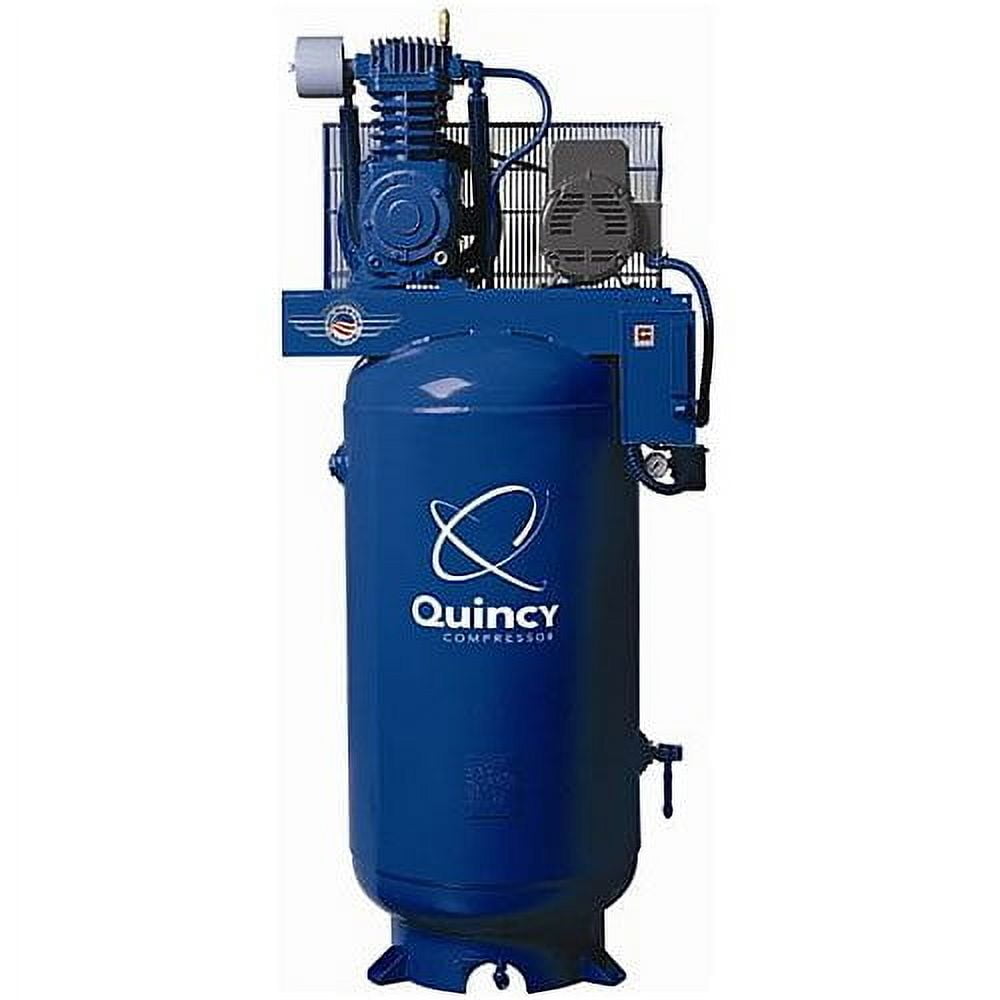
Quincy QT-7.5 7.5 HP 80-Gallon
- At elevation the honest answer is usually a size up
- Two-stage shares the higher compression ratio
- 80 gallons of storage covers what thin air cannot
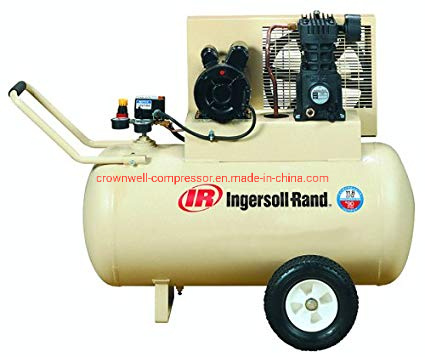
Ingersoll Rand SS3J5.5GK-WB Gas Drive
- High mountain work with no power on site
- Naturally aspirated engines derate steeply too
- Two separate deratings to check, not one
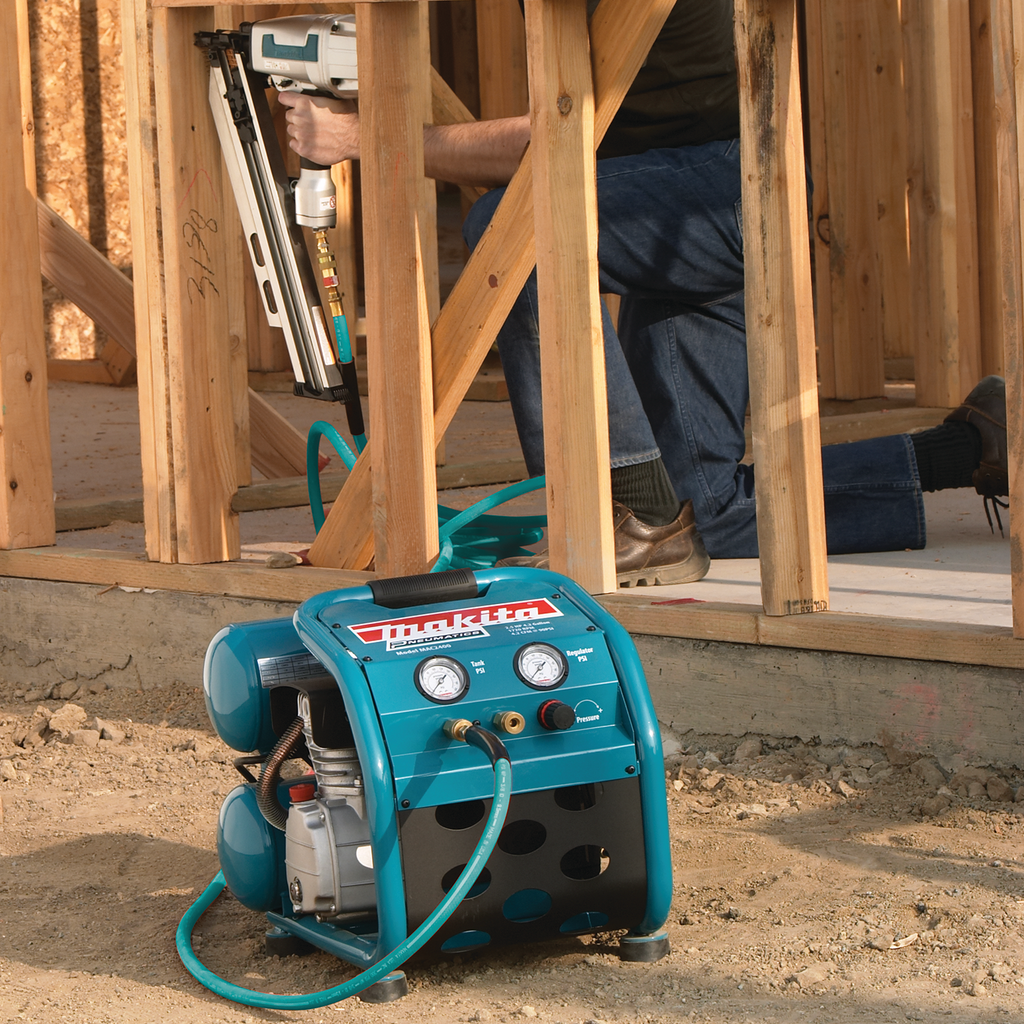
Makita MAC2400 2.5 HP Big Bore
- More displacement per nameplate horsepower
- Displacement is what altitude cannot take away
- Portable enough for mountain trim work
Regulator & Flow Control 0-150 PSI
- Hold the tool pressure the calculation assumed
- Gauge reads against the local atmosphere
- Cheapest way to see the sag as it happens
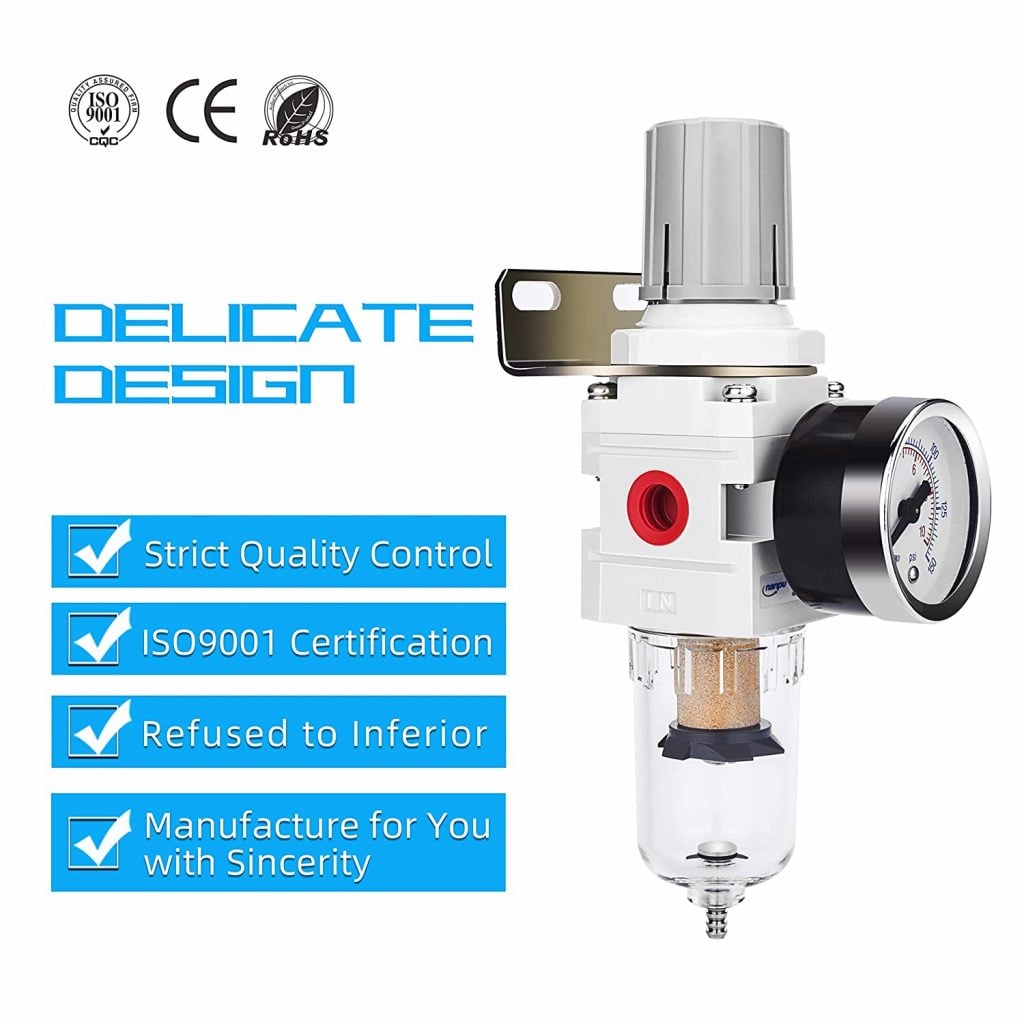
Filter / Regulator Combo
- Hot thin air carries a bigger vapour fraction
- Keeps condensate out of tools already working harder
- Mounts at the tool, where regulation belongs
As an Amazon Associate, TestTalkHQ earns from qualifying purchases. Prices and availability can change.
Third, remember the drive derates separately
Compressor capacity and drive capability are two different ratings with two different rulebooks, and at altitude both are in play.
Electric motors
NEMA MG 1 bases standard motor temperature ratings on operation at altitudes up to 3,300 ft (1,000 m) with an ambient of 40°C. Above that, the thinner air carries less heat away from the frame and those nameplate assumptions no longer hold — the usual remedies are a lower maximum ambient, a service factor above 1.0, or a motor specifically rated for the altitude. This is a manufacturer question, not something to estimate: get the high-altitude guidance for the specific motor rather than applying a generic percentage you found online.
The practical upshot is that if your site is above about 3,300 ft, you should be confirming the motor rating explicitly, not just the air rating.
Petrol and diesel engines
Naturally aspirated engines lose power with altitude considerably faster than a compressor loses air capacity, because the engine is fighting the same density loss and the reduced oxygen available for combustion. A gas-drive jobsite unit at 9,000 ft is therefore squeezed from both ends: the pump wants more work per pound of air because the compression ratio is higher, and the engine has less power to give. Turbocharged diesels hold up considerably better, which is why hire fleets serving mountain work skew that way.
Fourth, expect the higher compression ratio and design for the heat
Gauge pressure is measured against the local atmosphere. That means holding the same 90 psig at the tool is a bigger squeeze at altitude than it is at sea level:
Sea level: (90 + 14.70) / 14.70 = 7.12 : 1
Denver: (90 + 12.10) / 12.10 = 8.44 : 1
An 18 percent higher ratio means more work per pound of air delivered, a hotter discharge, and all of it happening in thinner cooling air. Three design consequences follow:
- Ventilation gets more important, not less. A compressor room sized on a sea-level rule of thumb is undersized at altitude, because each cubic foot of ventilation air removes less heat.
- Two-stage machines earn their premium. Splitting the ratio across two stages with an intercooler between them keeps discharge temperatures sane. The density derate still applies, but the thermal penalty largely does not.
- Duty cycle assumptions shift. Delivering less air per minute means longer run times to refill the same receiver, which means more heat generated over the hour, on a machine that is already rejecting heat less effectively.
If you are specifying for a hot, high site, the combination of two-stage compression and generous ventilation is usually a better spend than buying an even larger single-stage machine.
Storage and distribution do not escape either
A receiver stores mass, and the mass it stores between cut-in and cut-out pressure is set by the pressure difference and the tank volume. That part is unchanged by altitude. What changes is the refill rate, because the compressor is now delivering less air per minute — so the same tank buys you the same burst of work but takes longer to be ready for the next one. Where a machine short-cycled at sea level, it will run longer and cycle less at altitude. Where storage was marginal, it is now the binding constraint. The tank size calculator handles the storage half of the sum.
Pipe sizing follows the same pattern. A one psi drop is still a one psi drop, but it is a larger fraction of an already-lower absolute pressure, so tools feel it sooner. If you were running close to your drop target at sea level, revisit it with the pipe size calculator rather than assuming the design carries over.
Fifth, commission with a measurement
Every figure above is a calculation. Once the machine is installed, spend an hour converting it into a measurement, because that is the number you will rely on the next time someone wants to add a station.
- Record the conditions. Station barometric pressure from an absolute gauge (not a weather app — those report sea-level-corrected pressure), the inlet temperature at the compressor intake, and relative humidity. Without these, any later comparison is meaningless.
- Run a pump-up test. Time the machine filling an empty receiver from zero to cut-out pressure with all outlets closed. Compare against the same test at a known condition, or against the manufacturer’s figure derated by your calculated factor.
- Check the discharge temperature against the manufacturer limit at full load on a hot day, not a cool morning.
- Watch a real tool. Put a gauge at the tool and run the most demanding continuous consumer you own for two minutes. The number that matters is the pressure it settles at, not the pressure it starts at.
- Write the derate factor on the machine. Literally — a label inside the cabinet door saying "rated 18 SCFM ISO 1217, site factor 0.78, expect 14 SCFM" will save the next person a week of confusion.
Related reading: how to size an air compressor covers the demand side of this in full, and altitude troubleshooting deals with a machine that is already installed and disappointing somebody.
Frequently asked questions
At what elevation do I need to start worrying about this?
The physics starts at the first foot, but the point where it changes a purchasing decision is usually somewhere around 2,000 to 3,000 ft. Below that the derate is under ten percent and normally disappears into the margin you were carrying anyway. Above 3,300 ft you also cross the altitude at which NEMA MG 1 bases standard motor ratings, so that is a sensible threshold for taking the whole question seriously.
Can I fit a bigger pulley or run the pump faster to make up the difference?
Sometimes, and it is worth asking the manufacturer rather than doing it yourself. More speed is more displacement, which does directly recover capacity. It also means more heat, more wear, and a motor that may now be outside its rating on a machine already handicapped on cooling. Manufacturers who offer a high-altitude variant have usually changed exactly this, with matched cooling and motor selection.
Do rotary screw compressors handle altitude better than piston machines?
The density derate is identical — both are positive-displacement machines. Screws often cope better in practice because they are typically supplied with more capable cooling packages and are more frequently available in high-altitude variants, and because they do not carry a reciprocating machine’s additional clearance-volume efficiency loss at higher compression ratios. That is a difference in degree, not in kind.
Does a compressed air dryer need resizing for altitude?
Dryers are rated in inlet volume flow at stated conditions, so a dryer following a derated compressor is seeing less mass but is also being asked to work at conditions its rating table may not cover. Hot, humid, high-altitude inlet air is the worst case for both moisture load and dryer capacity correction, and the manufacturer’s correction factors for inlet temperature and pressure are the right source. Do not assume the dryer that matched the compressor at sea level still matches it here.
Why does everyone quote three percent per thousand feet?
Because it is a decent approximation of the barometric term on its own and it is easy to remember. Across the first 5,000 ft it tracks the real pressure loss within a couple of percent. It fails when inlet temperature or humidity are far from the rating conditions, which at a hot high site is most of the summer.