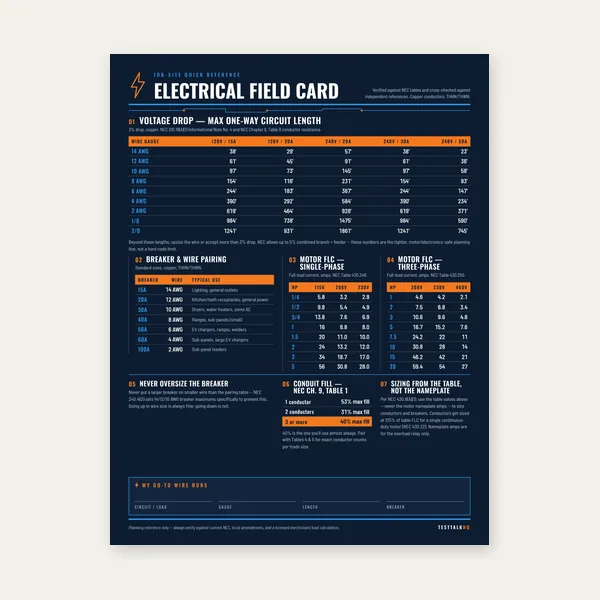
Electrical Reference Card
One page. Voltage drop lengths, breaker and wire pairing, motor FLC.
$3.99
BuyThe round-trip voltage-drop formula, circular-mil resistance, and how to apply it on a winch, light bar, or stereo amp
This is the method behind the 12V DC wire gauge calculator. It is not the NEC 120 V branch-circuit note and not welder cable sizing. Automotive accessory copper is short, hot, and unforgiving of millivolts.
One-way length is what you measure. Current goes out and comes back, so resistance sees twice that length. With table resistance in ohms per 1,000 feet:
I is amps. R is copper Ω/kft for that AWG (NEC Chapter 9 Table 8 uncoated copper at 75°C — the same table the site’s AC drop calculator uses). L is one-way feet. Divide by 1,000 because R is quoted per thousand feet. Percent drop is V_drop / V_system × 100. On 12 V, 3% is 0.36 V. On 24 V, 3% is 0.72 V — same current, twice the allowable volts, so you can often drop a gauge size.
R is also 10.37 / CM at 20°C for annealed copper (CM = circular mils). Table 8 at 75°C is higher, which is the right direction for an engine bay. If you compute R from circular mils at 20°C you will undersize slightly compared with this site’s calculator.
Allow 0.36 V. 14 AWG (R = 3.14): V_drop = 10 × 3.14 × 2 × 12 / 1000 = 0.754 V (6.3%) — fail. 12 AWG (1.98): 0.475 V (4.0%) — still fail. 10 AWG (1.24): 0.298 V (2.5%) — pass. That is why a “12 AWG is fine, it’s only 10 amps” bumper-light job still looks yellow at the far lamp. Confirm with the calculator if your path is not 12 ft.
Watts / 12 V is not the input current; amplifiers are inefficient. Use the fuse the amp maker put on the chassis or a clamp reading. 8 AWG at 8 ft: 40 × 0.778 × 2 × 8 / 1000 = 0.498 V (4.1%) — fail. 6 AWG: 0.314 V (2.6%) — pass. Big-3 upgrades exist because the factory charge path is another voltage drop in series with this number.
Winch makers often publish cable size for a short battery lead, not a 20 ft bumper-to-bed run. 150 A × 0.194 × 2 × 6 / 1000 = 0.349 V on 2 AWG (2.9%). At 3% you still pass; at a 20 ft one-way bed mount you do not — 2 AWG yields 1.16 V (9.7%). That is the slow-winch complaint in the troubleshooting article, not a weak motor.
1) Current. 2) Real route length, not a straight tape. 3) 3% unless the device specifies otherwise. 4) Smallest copper AWG that passes. 5) Fuse or breaker at the source, sized to the wire. 6) Copper ground of the same gauge if you are not trusting painted sheet metal. Protection device type is a separate decision: fuse vs circuit breaker.
Common lengths without a keyboard: 12V wire gauge ampacity chart by length. House wiring is NEC voltage drop and how to calculate voltage drop — keep those for 120 V homeruns.
One page. Voltage drop lengths, breaker and wire pairing, motor FLC.
$3.99
Buy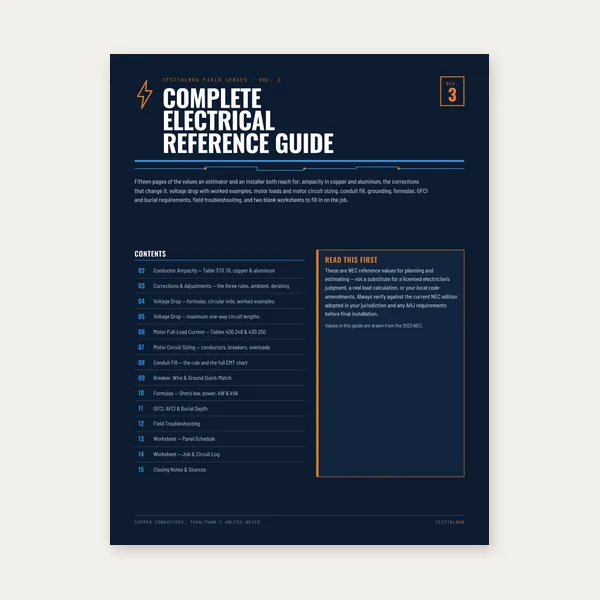
15 pages. Ampacity, corrections, voltage drop, motor circuits, conduit fill.
$12.99
Buy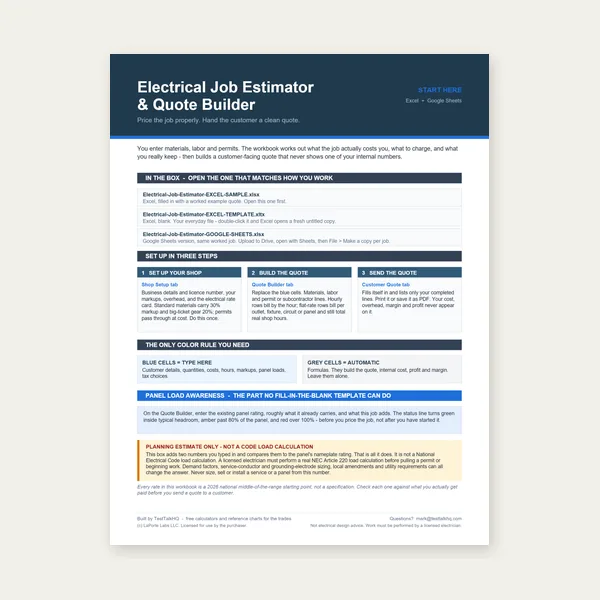
Quote electrical work and flag panel headroom before you price it.
Excel or Google Sheets. Best on a computer.
$29.00
Buy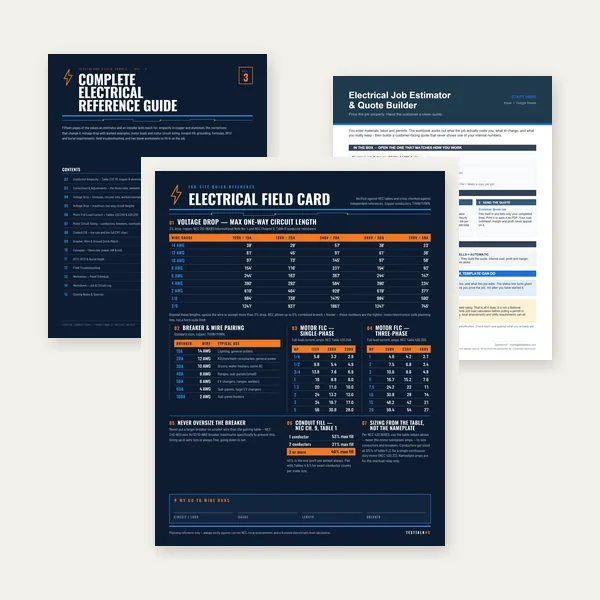
Card, 15-page guide and the estimator workbook. All six files.
Excel or Google Sheets. Best on a computer.
$34.99
$45.98 if bought separately — save $10.99
BuyCheckout opens in a new tab.