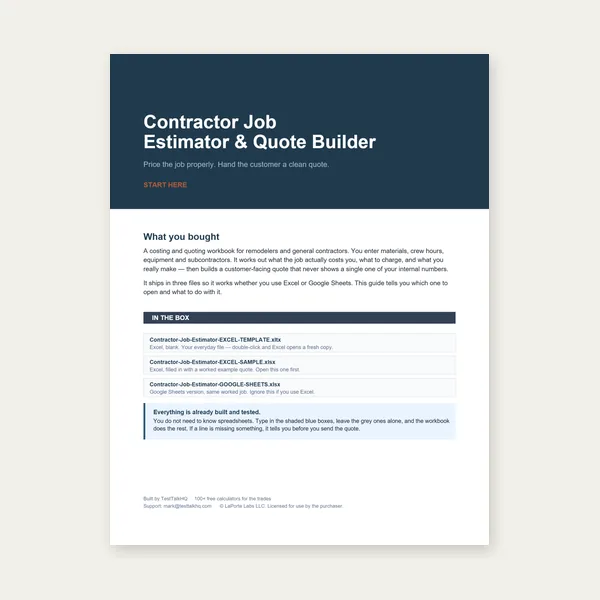
Contractor Job Estimator
Price remodels and GC work, then send a quote with no internal numbers.
Excel or Google Sheets. Best on a computer.
$29.00
BuyCheck leg tension and system capacity from rated WLL, sling angle, and load weight
Enter the sling tag rated capacity (WLL per leg), number of legs, angle from horizontal, and planned load weight. This educational tool applies the standard sine angle factor to estimate whether the rigging arrangement stays within rated limits — always verify against manufacturer tags, ASME B30.9, OSHA 1910.184 / 1926.251, and a competent rigger before any lift.
Need hitch type guidance? See Choker vs Basket vs Vertical Hitch and the Sling Angle Load Guide.

Price remodels and GC work, then send a quote with no internal numbers.
Excel or Google Sheets. Best on a computer.
$29.00
BuyCheckout opens in a new tab.
Rated slings, shackles, and below-the-hook hardware for safe lifts
Affiliate catalog gap: no rated slings/shackles listed yet. Always source lifting gear from manufacturers with current WLL tags and traceable ratings — do not substitute uncertified chain, cable, or strap for rated rigging.
When a bridle sling lifts a load, each leg shares vertical support based on the sine of the angle from horizontal. At 90° (vertical), sin(90°) = 1.0 and each leg carries its fair share of the load weight. At 45°, sin(45°) ≈ 0.707 — system capacity drops to about 71% of the vertical rating. At 30°, sin(30°) = 0.5 — capacity is halved and leg tension doubles relative to the vertical case for the same load. This is why riggers avoid low angles and why OSHA emphasizes angle reduction in sling capacity tables.
The angle factor applied to each leg is sin(θ) where θ is measured from horizontal:
System capacity = Rated WLL × Number of legs × sin(θ)
Tension per leg = Load weight ÷ (Number of legs × sin(θ))
Pass when load weight ≤ system capacity. Hitch type derates (choker, basket) are separate from angle factor — see the Sling Angle Load Guide and hitch decision page.
OSHA 29 CFR 1910.184 (general industry) and 1926.251 (construction) require employers to ensure slings are used within rated capacity, including angle reductions. ASME B30.9 covers sling fabrication, inspection, and marking. A competent person or qualified rigger must evaluate each lift plan — this calculator is a planning aid, not a substitute for tagged equipment, inspection records, or site-specific lift procedures.