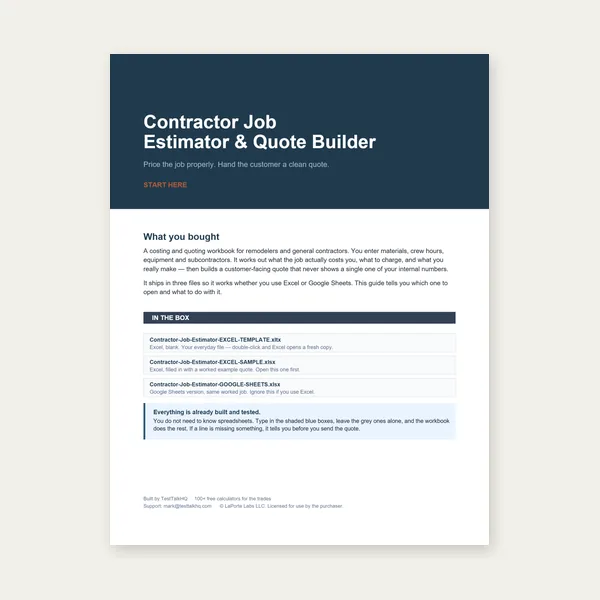
Contractor Job Estimator
Price remodels and GC work, then send a quote with no internal numbers.
Excel or Google Sheets. Best on a computer.
$29.00
BuyCapacity tradeoffs, load stability, and when each hitch mode is the right call — then run angle math on the geometry you actually rig
The Sling Angle Load Guide covers angle factor and tag reading. This page is the hitch fork: vertical for plumb picks, basket for long balanced loads, choker for bundles and friction-dependent grips. After you pick a hitch, use the Sling Angle Load Calculator for bridle angle reduction — hitch derate and angle factor stack, not replace each other.

| Load situation | Prefer | Why | Watch-out |
|---|---|---|---|
| Single pick point over CG; pad eye on top | Vertical | Full vertical WLL; predictable tension path | Any CG offset tilts load immediately |
| Long I-beam, pipe, or skid — CG centered | Basket | Two legs share vertical load; high capacity when legs vertical | Legs flatten → angle factor drops capacity |
| Bundle of pipe or stacked lumber | Choker | Choke cinches bundle; no separate pick point needed | Roll-out on smooth round stock; use tag choker WLL |
| Finished paint / soft surfaces | Basket or vertical with padding | Spread load; avoid choke pinch scarring | Edge protection still required on sharp corners |
| Unknown or shifting CG | Re-rig — often vertical from relocated pick | Stability beats nominal capacity | Do not "hope" a choker will hold a rolling load |
| Heavy load near capacity on paper | Vertical or basket with verified angle | Margin for calculation error | Run calculator — see troubleshooting |
Vertical gives the baseline WLL printed on the tag — use this as 100% reference. Choker trades capacity for gripping force around the load; plan at 75–80% unless your tag states otherwise. Basket can reach ~200% of single-leg vertical WLL when both legs are vertical and load share is even — but the moment legs angle outward, sin(θ) applies and the "double capacity" story disappears fast.
Example: 2,000 lb vertical WLL sling in basket mode might allow ~4,000 lb vertically with perfect geometry. Same sling at 45° leg angle from horizontal: sin(45°) ≈ 0.707 → effective system capacity ≈ 2,828 lb before any other derates.
The highest-capacity hitch on paper is worthless if the load rolls, slides, or inverts. Stability checks come before capacity checks:
When a lift failed despite "enough capacity," walk the forks in Sling Angle Load Troubleshooting.
Multi-leg bridles combine hitch mode with angle geometry. A two-leg vertical bridle on a spreader bar is not the same as a two-leg basket under a beam — leg tension paths differ. For any bridle:
Pick vertical, choker, or basket from load shape and stability. Enter tag WLL, leg count, angle from horizontal, and load weight for pass/fail with explicit formulas.
Sling Angle Load Calculator → Sling Angle Load Guide →Price remodels and GC work, then send a quote with no internal numbers.
Excel or Google Sheets. Best on a computer.
$29.00
BuyCheckout opens in a new tab.