A sub-panel is a feeder panel — not a second service. Size the feeder demand and conductors first, then pick a panel ampacity with room to grow, and finish grounding/bonding correctly at a detached structure.
What You Are Actually Sizing
Three related numbers get confused on garage and shop jobs:
- Feeder demand / ampacity — what the conductors and supplying breaker must carry (NEC 215.2: continuous loads at 125%).
- Panel rating — the bus ampacity of the sub-panel enclosure (often sized equal to or larger than the feeder for future circuits).
- Main / service size — capacity of the dwelling or building service that feeds the sub-panel; verify headroom with a dwelling or commercial load calc before adding a large shop feeder.
General feeder ampacity math lives in the feeder / service entrance guide. This guide focuses on the outbuilding / addition sub-panel workflow the sub-panel sizing calculator is built for.
NEC Basis for Sub-Panel Feeders
Article 220 builds the load list (lighting, receptacles, welders, compressors, EVSE, HVAC). 215.2 sizes feeder conductors: non-continuous + 125% of continuous. 240 sets OCPD. 250 governs EGC size, GEC at separate buildings, and the critical rule that the neutral and equipment ground are not bonded together again in a sub-panel fed by a 4-wire feeder.
Feeder with grounded conductor + EGC (4-wire for 120/240V), disconnecting means at the structure, and a grounding electrode system (typically rods) at the outbuilding — verify current NEC 250.32 and local amendments.
Load List Before Wire Size
List every load that can run together in the garage or shop: general lighting (usually continuous), receptacle circuits, air compressor, welder, dust collector, heater, Level 2 EVSE. Welders and motors need nameplate or Article 630 / motor rules — do not guess from “20A outlet.”
If the sub-panel is part of a whole-house upgrade, run the dwelling optional method first (residential load guide, residential load calculator) so the main service can support the new feeder. Commercial annexes use the commercial load calculation guide.
Ampacity can pass while VD fails. Runs over ~100 ft often need larger conductors than Table 310.16 alone. Check with the voltage drop calculator after you pick a gauge.
How to Apply Calculator Results
- Take recommended feeder amps and wire size as a planning baseline (Cu vs Al, distance adjustment).
- Protect the feeder with a two-pole breaker in the main panel sized to the conductors.
- Install a sub-panel rated at least for that feeder; many shops use a larger bus (e.g. 100A or 125A panel on a 60–100A feeder) for spare spaces.
- Build the circuit directory with the panel schedule calculator / panel schedule guide.
- Size EGC per 250.122 and GEC per 250.66 / electrode type — use the grounding calculators linked below.
Common Mistakes
- 3-wire feeder to a sub-panel — bonding neutral and ground at both ends creates objectionable current on metal paths; modern practice is 4-wire with isolated neutral bar.
- No disconnect / no electrodes at detached building — fails inspection even when wire gauge is correct.
- Sizing only to “panel amps” — buying a 200A sub-panel does not make a 60A feeder into a 200A feeder.
- Skipping continuous 125% — lighting and EVSE feeders undersized for heat.
- Ignoring main-panel headroom — a legal sub-panel feeder can still overload an already-maxed 100A service.
Size the garage or shop feeder Enter loads, voltage, distance, and Cu/Al — get panel amps, feeder gauge, and breaker guidance.
Frequently Asked Questions
Can the sub-panel be rated higher than the feeder breaker?
Yes. Panel bus rating is a maximum. The upstream feeder breaker protects the conductors; a higher-rated panel simply leaves expansion room.
Do I need ground rods at a detached garage?
Usually yes — a grounding electrode system at the separate building, plus an equipment grounding conductor with the feeder. Confirm NEC 250.32 and AHJ rules.
How is this different from the feeder sizing guide?
The feeder guide covers NEC 215.2 ampacity generally. This guide is the outbuilding sub-panel job: load list, panel vs feeder rating, and grounding/bonding gotchas for garages and shops.
VoltKit — Electrical Calculators Offline
Sub-panel demand, load calc, grounding, voltage drop — offline on Android.
Related Calculators & Guides
Electrical
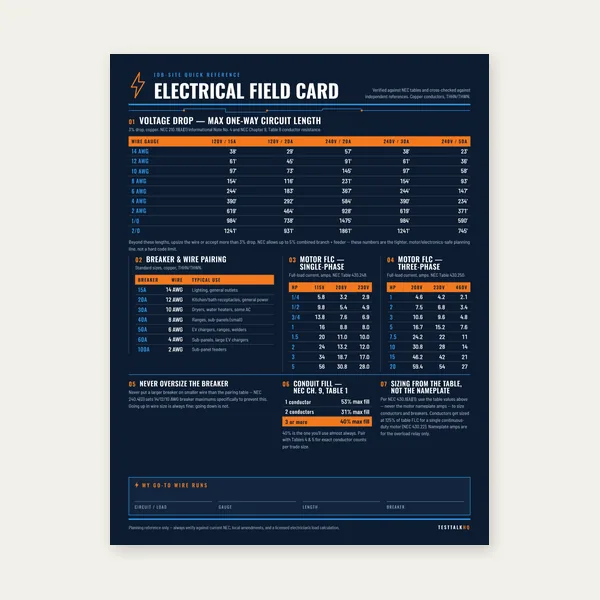
Electrical Reference Card
One page. Voltage drop lengths, breaker and wire pairing, motor FLC.
$3.99
Buy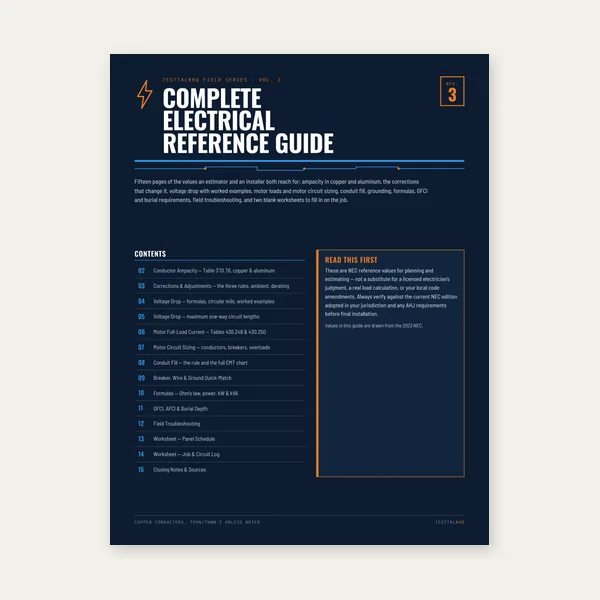
Complete Electrical Reference Guide
15 pages. Ampacity, corrections, voltage drop, motor circuits, conduit fill.
$12.99
Buy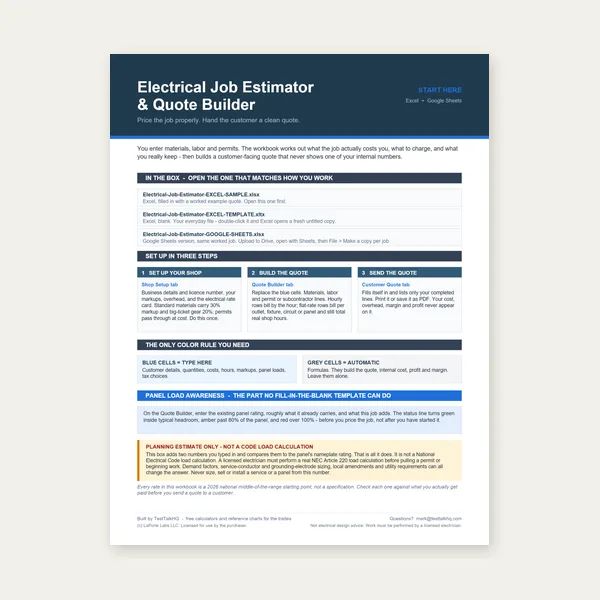
Electrical Job Estimator
Quote electrical work and flag panel headroom before you price it.
Excel or Google Sheets. Best on a computer.
$29.00
Buy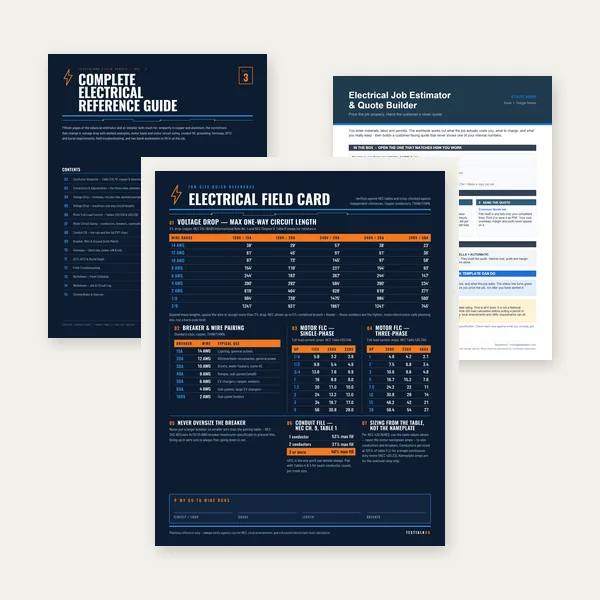
Electrical Complete Bundle
Card, 15-page guide and the estimator workbook. All six files.
Excel or Google Sheets. Best on a computer.
$34.99
$45.98 if bought separately — save $10.99
BuyCheckout opens in a new tab.