OSHA Table G-16 style reference: when sound level goes up, allowed exposure time comes down. Use this chart for quick checks, then calculate mixed-level dose with the noise exposure calculator.
What This Chart Shows
Under OSHA’s occupational noise framework, the permissible exposure limit is 90 dBA as an 8-hour TWA, using a 5 dB exchange rate. That means every 5 dB increase halves the permissible duration at a constant level. The table below is the classic duration-by-level reference (Table G-16 style) for steady noise at a single level.
Real shops are not single-level. Grinders, plasma, and compressors create varying dose — use the noise exposure calculator for combinations. Background: noise exposure guide.
This is an educational reference patterned on OSHA Table G-16 concepts. Always follow current OSHA regulations, your hearing conservation program, and calibrated dosimetry. NIOSH REL uses a 3 dB exchange rate and is more protective — do not mix criteria.
OSHA Permissible Exposure Duration by dBA
| Sound level (dBA) | Permissible duration per day | Notes |
|---|---|---|
| 90 | 8 hours | PEL reference for 8-hr TWA |
| 92 | 6 hours | |
| 95 | 4 hours | +5 dB → half time vs 90 |
| 97 | 3 hours | |
| 100 | 2 hours | |
| 102 | 1.5 hours | |
| 105 | 1 hour | |
| 110 | 30 minutes | |
| 115 | 15 minutes | Approach ceiling concerns |
Levels above the table’s upper end require specialized assessment; impulsive/impact noise has additional considerations under the standard.
Action Level Reminder
The 85 dBA 8-hour TWA action level triggers hearing conservation (monitoring, audiometric testing, training, HPDs) even when the PEL is not exceeded. Many fab shops sit between 85 and 90 dBA TWA once grinding is averaged in.
| Threshold | Level (8-hr TWA) | Typical requirement |
|---|---|---|
| Action level | 85 dBA | Hearing conservation program |
| PEL | 90 dBA | Must not exceed without controls/PPE per standard |
How to Use the Chart on the Floor
- Measure representative dBA for the task (or use known equipment data).
- If exposure is essentially continuous at one level, read allowed hours from the table.
- If levels change, compute dose/TWA with the calculator — do not average dB arithmetically.
- Select hearing protectors per your program and the PPE selection guide by process.
OSHA: 5 dB. NIOSH: 3 dB. Using the wrong exchange rate misstates remaining allowable time.
Dose — Why You Cannot Average Decibels
If a welder spends 2 hours at 95 dBA and 6 hours at 85 dBA, you do not average to 87.5 dBA. Sound energy (and OSHA dose) is logarithmic. Each segment contributes a fraction of the daily allowable dose; those fractions add. Two hours at 95 dBA alone is already 50% of the daily dose under the 5 dB table (2 hours is half of the 4-hour allowance at 95). The quieter hours still add more dose on top.
That is why a “quick grind” next to an 8-hour quiet assembly bench can push a worker over the action level even when the daily average “feels” moderate. Document tasks, use a dosimeter when the program requires it, and treat intermittent high-level work as the controlling exposure.
Typical Fab-Shop Sound Levels (Awareness Only)
| Source | Typical range (dBA) | Chart implication |
|---|---|---|
| Conversation / quiet bay | 60–70 | Well below action level alone |
| MIG welding (near operator) | 80–90 | May approach action level as TWA |
| Angle grinder | 95–110 | Minutes matter — use HPDs |
| Plasma cutting | 100–115 | Short durations still high dose |
| Air tools / needle scaler | 100–115+ | Treat as high-intensity task |
Ranges vary with distance, enclosure, and tool condition. Use them to decide when to pull a meter — not as compliance measurements.
Hearing Protection and the Chart
The duration table assumes unprotected exposure. When hearing protectors are required, your program still uses measured or estimated levels to select NRR and to decide double protection. Do not “extend” Table G-16 times by subtracting NRR casually without following the employer’s derating method. For process-based PPE pairing (grinding vs welding vs machining), use the PPE selection guide.
Calculate mixed noise dose Enter multiple levels and durations for TWA / dose vs OSHA-style limits.
WeldKit — Welding & Shop Tools
Shop and welding calculators offline on Android.
Related Calculators & Guides
Any trade
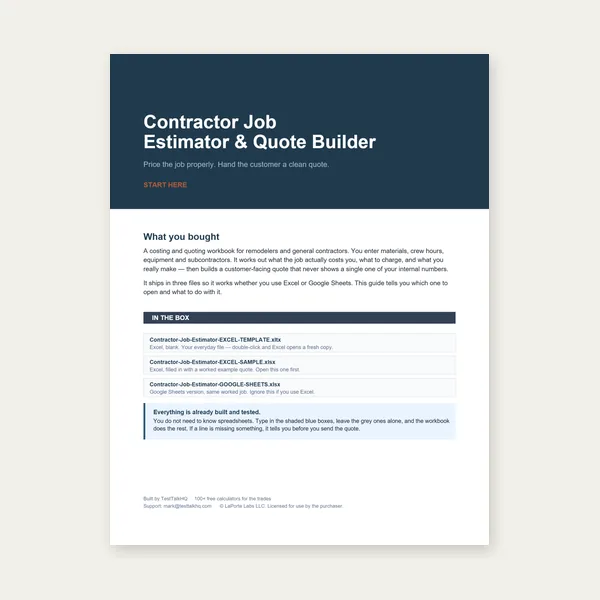
Contractor Job Estimator
Price remodels and GC work, then send a quote with no internal numbers.
Excel or Google Sheets. Best on a computer.
$29.00
BuyCheckout opens in a new tab.