
TestTalkHQ.com — Electrical
Wire Ampacity and Derating Explained
How to Size Conductors the Right Way
📅 March 2026
⏱ 9 min read
🔌 Electrical / Wire Sizing
You sized the wire by looking up its ampacity in the table — 10 AWG THHN, rated 40 amps at 60°C. Done, right? Not if that wire is bundled with seven others in a conduit, or running through an attic that hits 140°F in August. Ampacity isn’t a fixed number. It changes based on temperature and how many conductors are sharing the same space. Here’s how to get the real number before the wire goes in the wall.
What Ampacity Actually Means
Ampacity is the maximum current a conductor can carry continuously without exceeding its temperature rating. That temperature rating isn’t arbitrary — it’s the point at which the insulation begins to degrade. Push a conductor beyond its ampacity long enough and the insulation softens, cracks, and eventually fails. That failure is a fire hazard.
NEC Article 310 governs conductor ampacity. The base ampacity values come from NEC Table 310.12 for 120/240V residential wiring and NEC Table 310.16 for general wiring. These tables give you the starting number — the ampacity assuming the conductor is installed in conduit with no more than three current-carrying conductors, at an ambient temperature of 86°F (30°C).
Change either of those conditions and the base ampacity must be adjusted. That adjustment is called derating, and it’s where most sizing errors happen.
🔥 Wire Ampacity — Two Factors That Reduce the Safe Limit
The Base Ampacity Tables — Where You Start
NEC Table 310.16 lists ampacity values for common conductor sizes at three temperature ratings: 60°C, 75°C, and 90°C. The temperature column you use depends on the lowest temperature rating of any component in the circuit — the conductor, the breaker terminals, and the equipment terminals all have ratings, and the weakest link governs.
Most residential panelboard breaker terminals are rated 60°C or 75°C. Most commercial panels are 75°C. If a breaker terminal is rated 75°C, you use the 75°C ampacity column even if you’re running 90°C THHN wire — the terminal is the limiting component. The only time 90°C ampacity applies directly is when all terminations are listed for 90°C, which is uncommon in standard residential and commercial work.
📋 NEC Table 310.16 — Copper Conductor Ampacity (Simplified)
| Wire Size (AWG) | 60°C Ampacity | 75°C Ampacity | 90°C Ampacity | Common Use |
|---|---|---|---|---|
| 14 AWG | 15A | 20A | 25A | 15A branch circuits |
| 12 AWG | 20A | 25A | 30A | 20A branch circuits |
| 10 AWG | 30A | 35A | 40A | 30A circuits, dryers |
| 8 AWG | 40A | 50A | 55A | Ranges, large HVAC |
| 6 AWG | 55A | 65A | 75A | Subpanels, EVSE |
| 4 AWG | 70A | 85A | 95A | Large feeders |
| 3 AWG | 85A | 100A | 115A | 100A feeders |
| 2 AWG | 95A | 115A | 130A | Large feeders |
| 1 AWG | 110A | 130A | 145A | Service entrance |
| 1/0 AWG | 125A | 150A | 170A | 150A service |
| 2/0 AWG | 145A | 175A | 195A | 200A service (alum) |
| 3/0 AWG | 165A | 200A | 225A | 200A service copper |
ℹ NEC 310.12 vs. 310.16 — Which Table?
NEC 310.12 was added in the 2020 NEC specifically for single-family dwellings and single-phase service entrance conductors. It uses simplified ampacity values based on the 75°C column with built-in assumptions about residential loading. For commercial work, multi-family, and industrial, use Table 310.16. Our calculator applies the correct table based on installation type.
Temperature Correction Factors
When ambient temperature exceeds 86°F (30°C), you must multiply the base ampacity by a correction factor from NEC Table 310.15(B)(1). This comes up constantly in real-world installations: attic wiring, rooftop conduit runs, equipment rooms, and anywhere in the South or Southwest where summer temperatures are extreme.
🔥 Temperature Correction Factors — NEC Table 310.15(B)(1) — 90°C Insulation
An attic in a hot climate can easily reach 140°F or more in summer. A 10 AWG THHN conductor rated 40A at 90°C gets derated to 40A × 0.71 = 28.4A effective ampacity in that environment. If you sized the circuit assuming full rated ampacity and the attic hits 140°F on a hot day, the wire is running over its thermal limit every time the circuit is under load.
Get Your Derated Ampacity in Seconds
Our free wire ampacity calculator applies both temperature correction and bundling derating simultaneously. Enter your wire size, insulation rating, ambient temp, and conductor count — get the final derated ampacity and NEC compliance check.
Bundling Derating — NEC 310.15(C)(1)
When more than three current-carrying conductors share a conduit, raceway, or are bundled together for more than 24 inches, NEC 310.15(C)(1) requires ampacity derating. The logic is the same as temperature correction — bundled conductors trap each other’s heat, raising the effective ambient temperature at each conductor’s insulation.
📋 Bundling Derating Factors — NEC Table 310.15(C)(1)
| Number of Current-Carrying Conductors | Derating Factor | Effect on 10 AWG @ 75°C (35A base) |
|---|---|---|
| 1 – 3 | 1.00 (no derating) | 35A — full ampacity |
| 4 – 6 | 0.80 | 28A derated ampacity |
| 7 – 9 | 0.70 | 24.5A derated ampacity |
| 10 – 20 | 0.50 | 17.5A derated ampacity |
| 21 – 30 | 0.45 | 15.75A derated ampacity |
| 31 – 40 | 0.40 | 14A derated ampacity |
| 41+ | 0.35 | 12.25A derated ampacity |
⚠ What Counts as a Current-Carrying Conductor
Equipment grounding conductors (grounds) do NOT count toward bundling derating — they carry current only during fault conditions, not continuously. Neutral conductors in balanced 3-phase systems typically don’t count either. However, neutral conductors in single-phase circuits DO count, and neutrals carrying harmonic currents (from non-linear loads like variable-speed drives, switching power supplies, and LED drivers) count even in 3-phase systems. When in doubt, count the neutral — the conservative calculation is always safer.
Applying Both Corrections Together — Worked Example
This is where it gets real. You’re running 9 circuits through a single conduit in a commercial space where the ceiling temperature runs 104°F. Each circuit is 12 AWG THHN on a 20A breaker. Is 12 AWG adequate?
📒 Worked Example — 18 Conductors in Hot Ceiling (104°F Ambient)
The math is brutal: 12 AWG that starts at 30A base ampacity ends up with only 13.7A effective capacity after both corrections. A 20A breaker on that wire is going to allow more current than the wire can safely handle under those conditions. The fix is upsizing to 8 AWG in that conduit, or splitting the circuits into two conduits to reduce the bundling factor.
💡 Pro Tip — Use 90°C Ampacity as Your Starting Point
Even when your terminal ratings cap you at 75°C for the final circuit ampacity, you can still use the 90°C column as your starting number when applying temperature correction and bundling derating factors, per NEC 310.15(B). This often means you end up with a higher final derated ampacity than if you started from the 75°C column — and may allow you to use a smaller wire size. This is an intentional provision in the code; using the 90°C insulation’s superior heat tolerance benefits you during the derating calculation even when the termination rating limits your final result.
Common Ampacity Sizing Mistakes
- Using the wrong temperature column. Running 90°C THHN to a breaker with 60°C terminals and using the 90°C ampacity? That’s a violation. The termination rating governs the column you use for final circuit sizing.
- Ignoring attic and rooftop conditions. Wire running through unconditioned attic spaces routinely sees temperatures 40–50°F above ambient — sometimes much more. This requires real temperature correction, not the base table ampacity.
- Not counting neutral conductors in single-phase circuits. Every single-phase circuit’s neutral is a current-carrying conductor. Count it toward bundling.
- Assuming the breaker rating equals the wire rating. A 20A breaker doesn’t mean 12 AWG is always adequate. After derating, 12 AWG in a heavily bundled hot installation may only be safe at 13 or 14 amps — requiring a larger wire on the same breaker.
- Not applying both corrections simultaneously. Temperature correction and bundling derating stack — you multiply both factors against the base ampacity. Applying only one is a partial calculation and may still result in an undersized conductor.
Tools for Ampacity and Load Verification
🔧 Measure What’s Actually Running Through the Wire
Calculate the limit, then verify actual current draw in the field
Top Pick

Klein Tools CL800 Digital Clamp Meter
- Measure actual load current without disconnecting wire
- True RMS — accurate on non-linear loads
- AC/DC current up to 600A
- Verify circuits are within derated ampacity
View on Amazon →
Wire Up
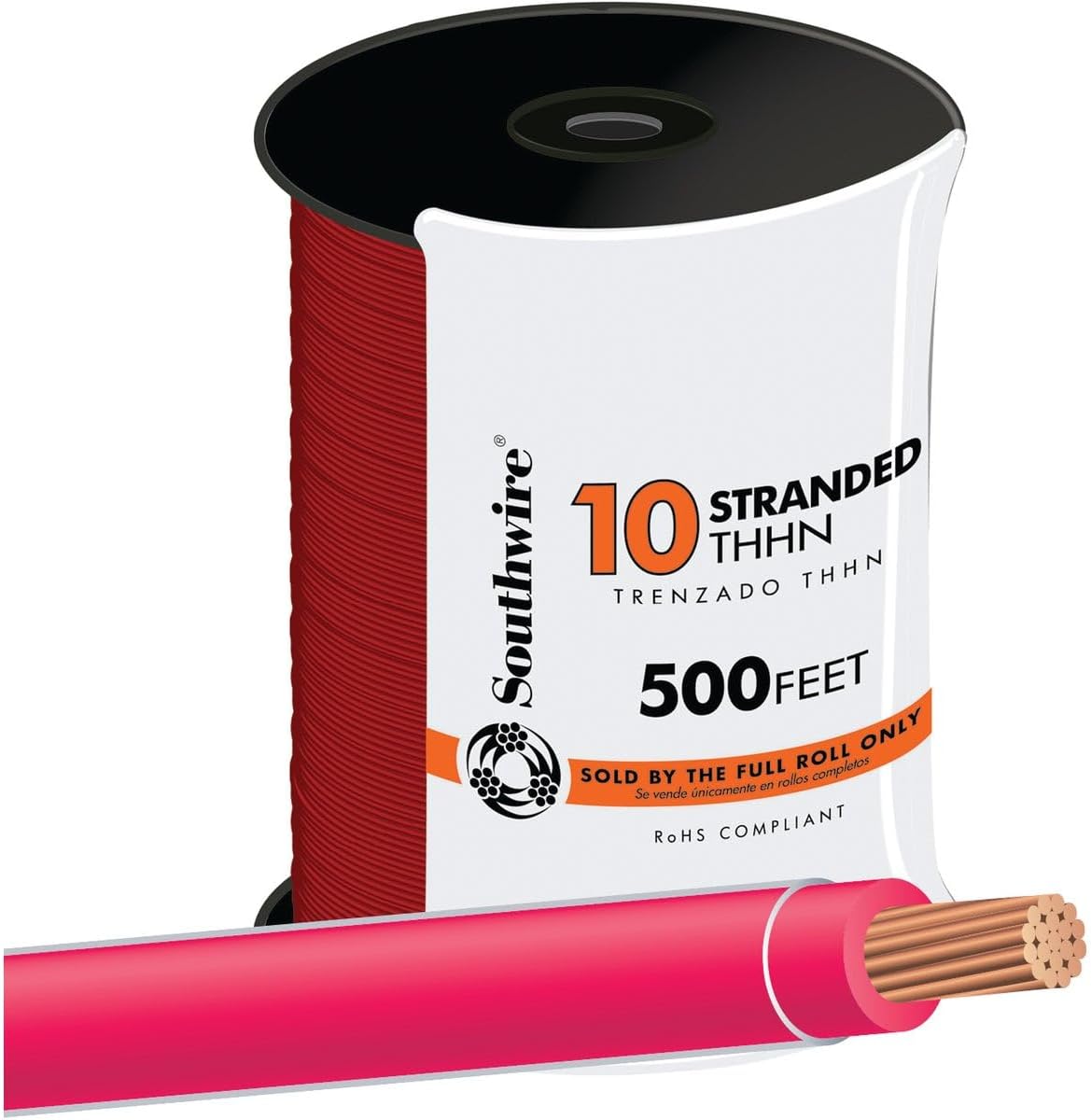
Southwire THHN 10 AWG Stranded Copper — 500ft
- 10 AWG — 90°C rated THHN insulation
- Stranded — easier to pull in conduit
- 500ft spool for larger jobs
- UL listed, NEC compliant
View on Amazon →
Pro Grade
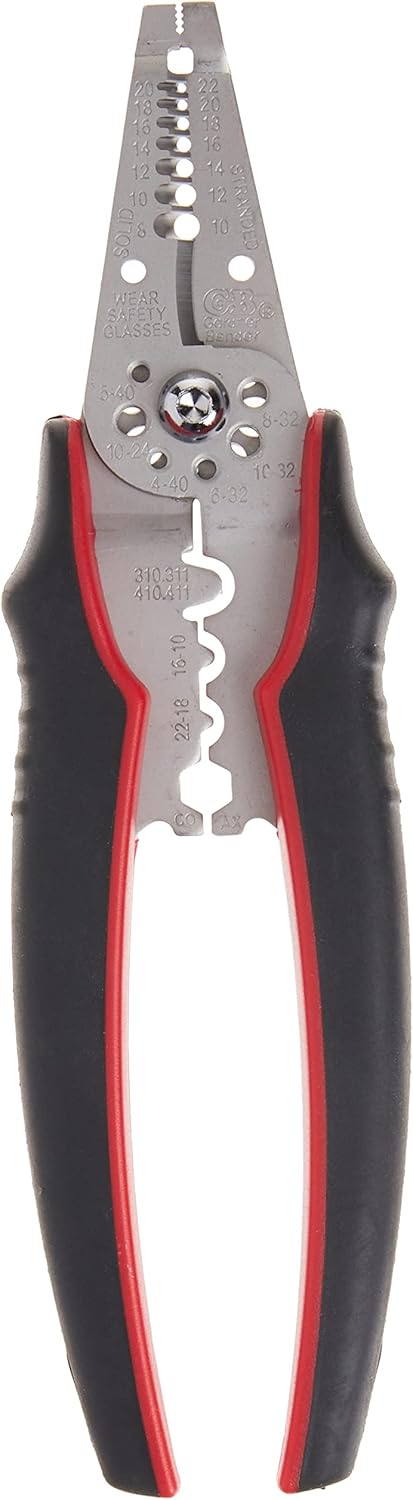
Gardner Bender GESP-70 Professional Wire Stripper
- Strips 10–20 AWG solid and stranded
- ArmorEdge blade — clean cuts without nicking
- Built-in crimper and loop former
- Pro-grade tool for daily use
As an Amazon Associate, TestTalkHQ earns from qualifying purchases.
When Correct Ampacity Math Still Fails
Calculation steps and worked examples are above. For field symptoms—hot conductors after a pass, AHJ disagreements, wrong terminal columns, NM-B caps, neutral-count errors, and resistive terminations—use Wire Ampacity Troubleshooting.
When the choice is ampacity versus long-run voltage performance, use Voltage Drop vs. Ampacity. For quick tables, copper/aluminum columns, and correction factors, use the existing NEC Wire Ampacity Tables.
Run the complete adjustment chain with the Wire Ampacity & Derating Calculator.
FAQ
Do I use the 60°C, 75°C, or 90°C ampacity column?
Use the column that matches the lowest temperature rating of any component in the circuit — conductor insulation, breaker terminal, or equipment terminal. Most residential breaker terminals are rated 60°C or 75°C. Most commercial panels are 75°C. Running 90°C THHN wire to a 75°C terminal means you use the 75°C column for final circuit sizing, even though the wire itself is rated higher. You can use 90°C as a starting point for derating calculations (per NEC 310.15(B)) but must cap the final result at the terminal rating.
Does the ground wire count toward bundling derating?
No. Equipment grounding conductors are excluded from the bundling count for derating purposes per NEC 310.15(C)(1). They only carry current during fault conditions, not continuously, so they don’t contribute meaningfully to heat buildup in normal operation. Count only current-carrying conductors — hots and neutrals that carry load current continuously.
Does the neutral count as a current-carrying conductor?
In single-phase circuits, yes — always. The neutral carries return current equal to the unbalanced load. In balanced 3-phase circuits, the neutral carries only unbalanced current and typically doesn’t count. However, in 3-phase circuits with significant non-linear loads (computers, VFDs, LED drivers), triplen harmonic currents flow in the neutral even in a balanced system — in those cases the neutral must be counted. When uncertain, the conservative (and safer) approach is to count the neutral.
Can I apply temperature correction and bundling derating together?
Yes — and you must when both conditions apply. Apply both factors multiplicatively to the base ampacity: Derated Ampacity = Base Ampacity × Temperature Factor × Bundling Factor. They stack. A wire in a hot ceiling with many bundled conductors gets both corrections applied simultaneously, which can dramatically reduce the effective ampacity compared to the table value.
What qualifies as “bundled” for derating purposes?
NEC 310.15(C)(1) applies to conductors in a conduit, raceway, cable tray, or bundled together and secured with ties for more than 24 inches. Conductors in separate conduits that happen to run parallel do not trigger bundling derating between conduits — derating applies within a single conduit or bundle. This is why splitting circuits into separate conduits can reduce or eliminate bundling derating requirements.
Does ampacity derating apply to NM-B (Romex) in walls?
Yes and no. NM-B cable in walls typically isn’t subject to bundling derating if cables are spread out and not bundled together. However, NM-B running through a 60°C-rated space (like inside insulation) does require temperature correction. NM-B cable is rated 60°C for ampacity purposes per NEC 334.80, which is also why you use the 60°C ampacity column for NM-B circuits even if the wire says 90°C on the jacket — the cable assembly installation method caps the column to 60°C.
Run Your Ampacity Calculation Now
Ampacity sizes the conductor. The pull still has a tension limit: Wire Pulling Tension Calculator and the Wire Pulling Tension Guide.
Our free wire ampacity and derating calculator applies temperature correction and bundling derating simultaneously. Enter your conductor size, insulation rating, ambient temperature, and conductor count — get your final derated ampacity and pass/fail result.
⚡ Open Ampacity Calculator →
Data per NEC 310.12, 310.15, 310.16, Table 310.15(B)(1), and Table 310.15(C)(1). Always verify with current NEC edition and local jurisdiction requirements. TestTalkHQ.com — free tools for tradespeople.
Electrical
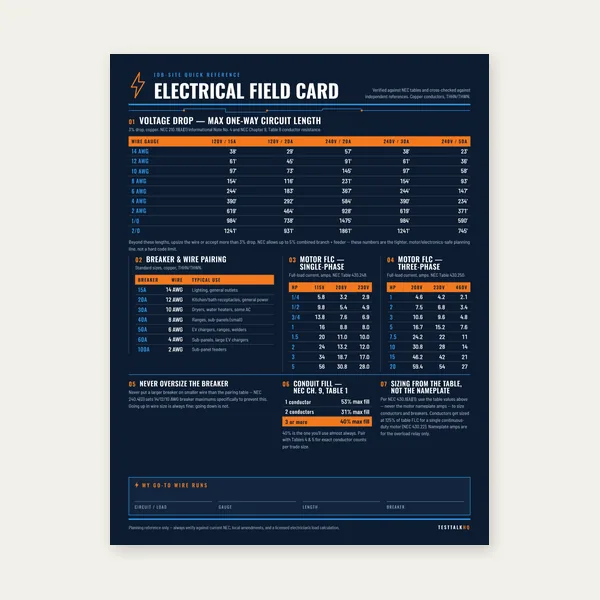
Electrical Reference Card
One page. Voltage drop lengths, breaker and wire pairing, motor FLC.
$3.99
Buy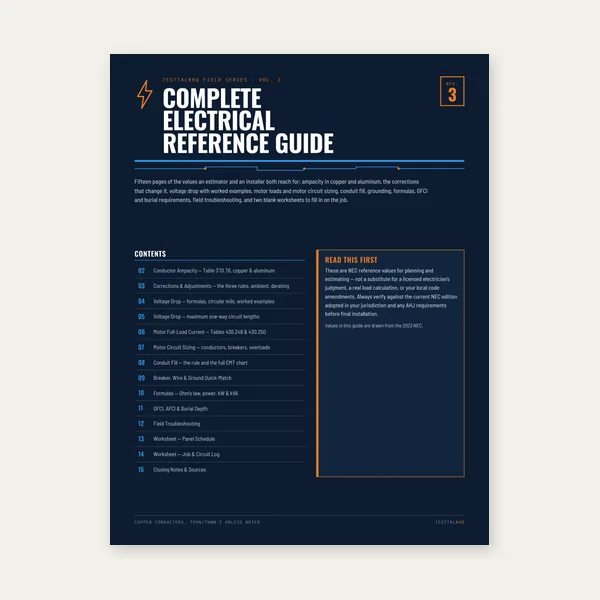
Complete Electrical Reference Guide
15 pages. Ampacity, corrections, voltage drop, motor circuits, conduit fill.
$12.99
Buy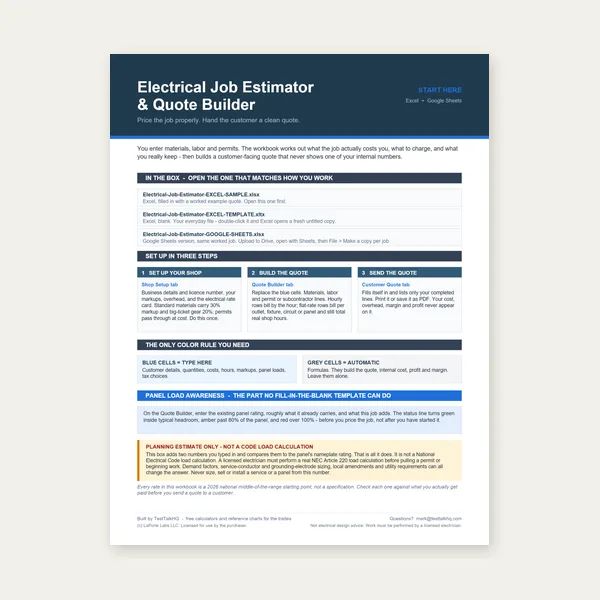
Electrical Job Estimator
Quote electrical work and flag panel headroom before you price it.
Excel or Google Sheets. Best on a computer.
$29.00
Buy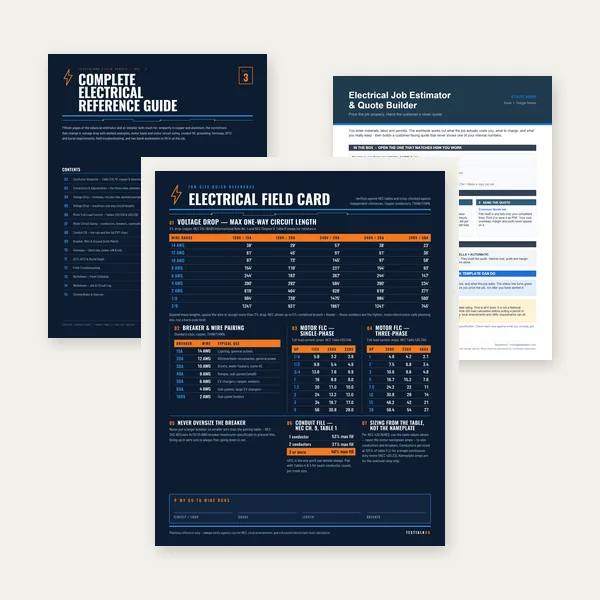
Electrical Complete Bundle
Card, 15-page guide and the estimator workbook. All six files.
Excel or Google Sheets. Best on a computer.
$34.99
$45.98 if bought separately — save $10.99
BuyCheckout opens in a new tab.