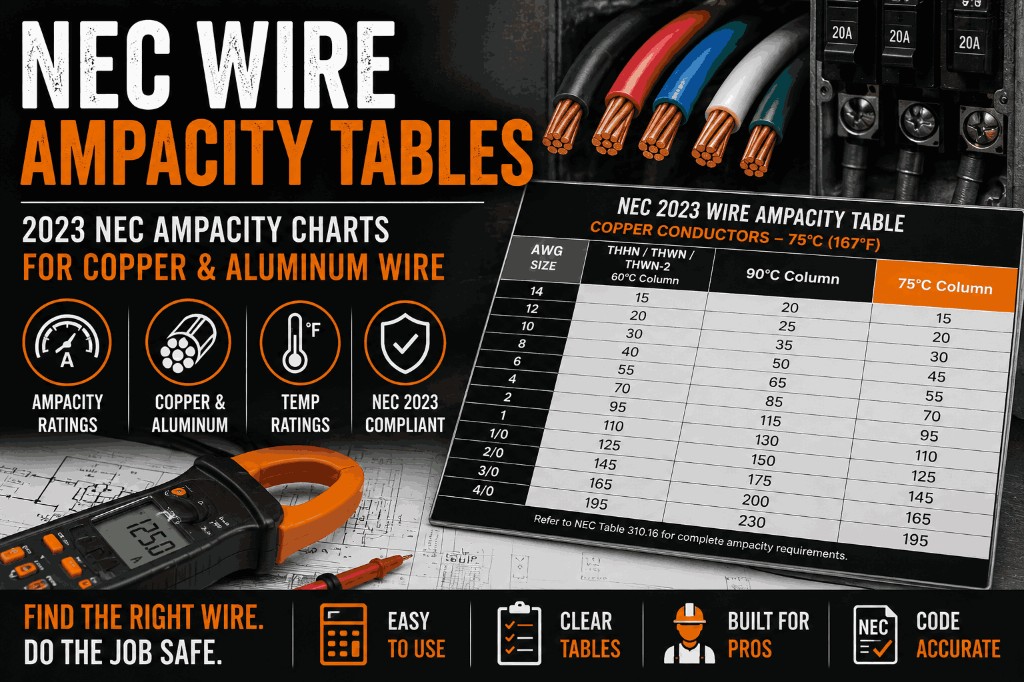
NEC Wire Ampacity Tables — THHN, THWN, Copper & Aluminum Reference
⚡ NEC Wire Ampacity Tables
NEC Table 310.16 — allowable ampacities for insulated conductors rated up to 2000V in raceway, cable, or earth. Copper and aluminum. Includes temperature correction and conduit fill derating factors.
Copper — THHN / THWN-2 (90°C)
Copper
| AWG / kcmil | Area (in²) | 60°C Amps | 75°C Amps | 90°C Amps | Common Use |
|---|---|---|---|---|---|
| #14 AWG | 0.0097 | 15 | 20 | 25 | Lighting, general circuits |
| #12 AWG | 0.0133 | 20 | 25 | 30 | 20A circuits, receptacles |
| #10 AWG | 0.0211 | 30 | 35 | 40 | 30A circuits, dryers, EV |
| #8 AWG | 0.0366 | 40 | 50 | 55 | 40-50A circuits, ranges |
| #6 AWG | 0.0507 | 55 | 65 | 75 | 60A sub-panels, AC |
| #4 AWG | 0.0824 | 70 | 85 | 95 | 100A feeders |
| #3 AWG | 0.0973 | 85 | 100 | 110 | 100A service |
| #2 AWG | 0.1158 | 95 | 115 | 130 | 100-125A service |
| #1 AWG | 0.1562 | 110 | 130 | 150 | 150A feeders |
| #1/0 AWG | 0.1855 | 125 | 150 | 170 | 150-200A service |
| #2/0 AWG | 0.2223 | 145 | 175 | 195 | 200A service |
| #3/0 AWG | 0.2679 | 165 | 200 | 225 | 200A service entrance |
| #4/0 AWG | 0.3237 | 195 | 230 | 260 | 200-400A service |
| 250 kcmil | 0.3970 | 215 | 255 | 290 | Large feeders |
| 300 kcmil | 0.4608 | 240 | 285 | 320 | Large feeders |
| 350 kcmil | 0.5242 | 260 | 310 | 350 | 400A service |
| 400 kcmil | 0.5917 | 280 | 335 | 380 | Large commercial |
| 500 kcmil | 0.7073 | 320 | 380 | 430 | Large commercial service |
Even though THHN is rated 90°C, NEC 110.14(C) limits you to the 75°C column when terminations (breakers, lugs, connectors) are rated 75°C — which is almost always the case. Use the 75°C column for sizing. Use 90°C only for derating calculations.
Aluminum — XHHW-2 / THWN-2 (90°C)
Aluminum
| AWG / kcmil | Area (in²) | 60°C Amps | 75°C Amps | 90°C Amps | Copper Equiv. |
|---|---|---|---|---|---|
| #12 AWG | 0.0133 | 15 | 20 | 25 | #10 Cu |
| #10 AWG | 0.0211 | 25 | 30 | 35 | #8 Cu |
| #8 AWG | 0.0366 | 30 | 40 | 45 | #6 Cu |
| #6 AWG | 0.0507 | 40 | 50 | 60 | #4 Cu |
| #4 AWG | 0.0824 | 55 | 65 | 75 | #3 Cu |
| #3 AWG | 0.0973 | 65 | 75 | 85 | #2 Cu |
| #2 AWG | 0.1158 | 75 | 90 | 100 | #1 Cu |
| #1 AWG | 0.1562 | 85 | 100 | 115 | #1/0 Cu |
| #1/0 AWG | 0.1855 | 100 | 120 | 135 | #2/0 Cu |
| #2/0 AWG | 0.2223 | 115 | 135 | 150 | #3/0 Cu |
| #3/0 AWG | 0.2679 | 130 | 155 | 175 | #4/0 Cu |
| #4/0 AWG | 0.3237 | 150 | 180 | 205 | 250 kcmil Cu |
| 250 kcmil | 0.3970 | 170 | 205 | 230 | 300 kcmil Cu |
| 300 kcmil | 0.4608 | 190 | 230 | 255 | 350 kcmil Cu |
| 350 kcmil | 0.5242 | 210 | 250 | 280 | 400 kcmil Cu |
| 400 kcmil | 0.5917 | 225 | 270 | 305 | 500 kcmil Cu |
| 500 kcmil | 0.7073 | 260 | 310 | 350 | — |
Aluminum conductors require anti-oxidant compound at all terminations to prevent oxidation and maintain connection integrity. Never use aluminum for branch circuits — feeders and service entrance only. Always use terminals rated for aluminum (marked AL or AL/CU).
Derating Factors
Reference
Equipment grounding conductors (EGC) do not count as current-carrying conductors for the purpose of conduit fill derating. Neutrals count only if they carry harmonic currents (e.g. in circuits with nonlinear loads like VFDs). For standard circuits, the neutral does not count.
Quick Breaker Size Reference
Quick Ref
| Breaker Size | Min Copper Wire | Min Aluminum Wire | Voltage Drop Note |
|---|---|---|---|
| 15A | #14 AWG | N/A (no Al branch) | Under 50ft — fine. Over 100ft — go to #12 |
| 20A | #12 AWG | N/A (no Al branch) | Under 75ft — fine. Over 150ft — go to #10 |
| 30A | #10 AWG | #8 AWG Al | Under 100ft — fine. Long runs size up |
| 40A | #8 AWG | #6 AWG Al | Check voltage drop on runs over 75ft |
| 50A | #8 AWG | #6 AWG Al | Check voltage drop on runs over 75ft |
| 60A | #6 AWG | #4 AWG Al | Always check voltage drop |
| 100A | #4 AWG | #2 AWG Al | Always run voltage drop calc |
| 125A | #2 AWG | #1/0 AWG Al | Always run voltage drop calc |
| 150A | #1 AWG | #2/0 AWG Al | Always run voltage drop calc |
| 200A | #3/0 AWG | #4/0 AWG Al | Always run voltage drop calc |
| 400A | 350 kcmil | 500 kcmil Al | Large commercial — always engineer |
How to Read These Tables
The ampacity values in NEC Table 310.16 assume three conditions: ambient temperature of 30°C (86°F), no more than 3 current-carrying conductors in a raceway, and the conductor type shown. If any of those conditions differ on your job, you must derate.
- Which column to use — use the 75°C column for almost all termination work. NEC 110.14(C) limits you to 60°C or 75°C at terminations depending on the equipment rating. Modern breakers and panels are typically rated 75°C, so the 75°C column applies. Use the 90°C column only when calculating derated ampacity starting point.
- More than 3 conductors in conduit — apply the conduit fill derating factor from NEC Table 310.15(C)(1). Multiply your base 90°C ampacity by the factor, then confirm the result doesn’t exceed the 75°C column value.
- High ambient temperature — apply the temperature correction factor. Attics, boiler rooms, rooftop conduit in summer — these environments push ambient temperature well above 30°C and require derating.
- Both derating factors apply — when you have both more than 3 conductors AND high ambient temperature, apply both factors. Multiply the 90°C base ampacity by both correction factors. The result is your corrected ampacity.
Copper vs Aluminum — When to Use Each
Aluminum wire is significantly cheaper than copper for the same ampacity but requires one to two gauge sizes larger. For service entrances and large feeder runs, aluminum is standard practice and cost-effective. For branch circuits, copper is required — aluminum branch wiring in homes has a documented history of connection failures and is not used in modern construction.
- Use copper for — branch circuits (15A, 20A, 30A), motor circuits, any circuit where connection integrity is critical, short runs where the cost difference is minimal
- Use aluminum for — service entrance conductors, large feeder runs (100A+), sub-panel feeds, anywhere copper cost is significant and proper termination is ensured
- Aluminum termination rules — use anti-oxidant compound, terminals rated AL or AL/CU, proper torque per manufacturer spec. Never use aluminum with terminals rated CU only.
VoltKit — Electrical Calculators for the Job
Wire ampacity derating, voltage drop, conduit fill, load calculation, and more. Free on Android. Works offline on the job site.
Related Calculators
When a table value or calculated derating still disagrees with an inspector or the field, use Wire Ampacity Troubleshooting. Re-run the adjustment chain with the Wire Ampacity & Derating Calculator.