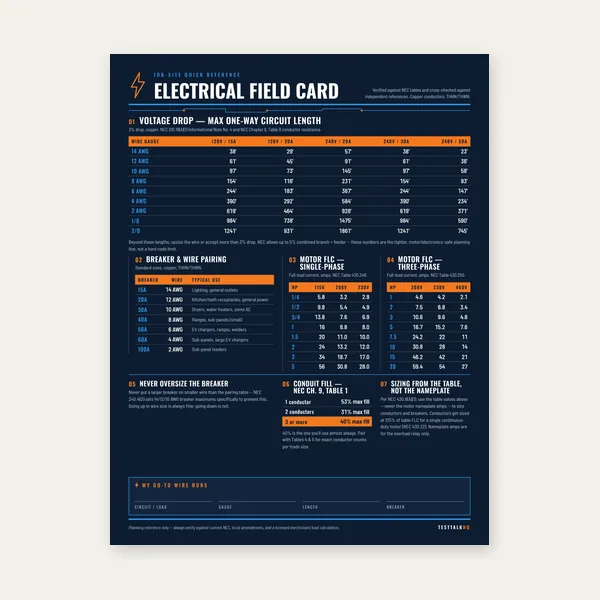
Electrical Reference Card
One page. Voltage drop lengths, breaker and wire pairing, motor FLC.
$3.99
BuyYou ran 150 feet of 12 AWG to the garage subpanel and now the lights dim every time the compressor kicks on. That's voltage drop — and by the time you feel it, the wire is already in the wall. Run the formula below, or skip to the voltage drop calculator for any AWG and length.
Single-phase, three-phase, and DC with NEC 3%/5% pass/fail and the next wire size up. This page is the formula and circular-mil chart.
Open Voltage Drop Calculator →Every conductor has resistance. When current flows through that resistance, some electrical energy converts to heat — and the voltage available at the far end of the run is lower than what left the panel. That loss is voltage drop, and it gets worse the longer the run and the higher the current.
For short runs under 50 feet or so, voltage drop is usually insignificant and not worth calculating. But run that same circuit 150 feet to a garage, barn, or shop subpanel, and suddenly you might be losing 6 or 8 volts before a tool even plugs in.
The real-world consequences aren't subtle:
You'll see the "3 percent" and "5 percent" rules thrown around constantly in electrical work. Here's the honest version: these are recommendations, not requirements — at least for most installations.
NEC 210.19 Informational Note No. 4 states that branch circuit conductors should be sized to prevent voltage drop exceeding 3% at the farthest outlet, and that the combined feeder plus branch circuit drop shouldn't exceed 5%. NEC 215.2 says the same thing for feeders.
ℹ NEC Code Clarification Per NEC 90.5(C), Informational Notes are explanatory material and are not enforceable as code. An inspector cannot fail you solely for a 3.5% voltage drop — unless your local jurisdiction has adopted those notes as law, or unless the equipment manufacturer specifies a minimum voltage at its terminals (in which case NEC 110.3(B) makes it mandatory). Fire pump circuits under NEC 695.7 and sensitive electronic equipment under Article 647 have mandatory voltage drop limits.So why follow them? Because the equipment cares, even if the inspector doesn't. Motors, VFDs, EVSE chargers, and most modern electronics have tight voltage windows. Operating consistently below those windows shortens service life and voids warranties. The 3%/5% guideline exists because it's where equipment starts to be affected — not because someone picked a random number.
Professional electricians generally target:
Our free voltage drop calculator handles single-phase, three-phase, and DC circuits with NEC pass/fail results and next-size-up wire recommendations.
⚡ Open Voltage Drop Calculator →The formula for single-phase and DC circuits is straightforward once you understand what each variable means:
📐 Voltage Drop Formula — Single Phase & DCThe "2" in the formula accounts for the round trip — current travels out through the hot conductor and returns through the neutral, so the effective conductor length is doubled. For three-phase circuits you use 1.732 (√3) instead, because the three phases share the return path.
The circular mils (CM) value comes from NEC Chapter 9, Table 8. Common values:
📋 Common Wire Sizes — Circular Mils (NEC Table 8)| Wire Size | Circular Mils | Max Amps (75°C) | Common Use |
|---|---|---|---|
| 14 AWG | 4,110 | 20A | 15A lighting circuits |
| 12 AWG | 6,530 | 25A | 20A general circuits |
| 10 AWG | 10,380 | 35A | 30A circuits, long runs |
| 8 AWG | 16,510 | 50A | Dryers, ranges, feeders |
| 6 AWG | 26,240 | 65A | Subpanels, EVSE |
| 4 AWG | 41,740 | 85A | Large feeders |
| 2 AWG | 66,360 | 115A | Service entrance, large feeders |
| 1/0 AWG | 105,600 | 150A | Service entrance |
| 2/0 AWG | 133,100 | 175A | 200A service (aluminum) |
| 3/0 AWG | 167,800 | 200A | 200A service copper |
Say you're running a 20-amp, 120V single-phase circuit to a detached shop 120 feet away. You plan to use 12 AWG copper.
Step 1 — Gather your variables: K = 12.9 (copper), I = 20A, L = 120 feet (one-way), CM = 6,530 (12 AWG)
Step 2 — Apply the formula: VD = (2 × 12.9 × 20 × 120) / 6,530 = 61,920 / 6,530 = 9.48 volts
Step 3 — Calculate percentage: 9.48 / 120 = 7.9% — way over the 3% recommendation
That's nearly 8 percent voltage drop on a circuit the code says should be under 3. Your tools will struggle and your lights will be visibly dim.
Upsize to 10 AWG: VD = (2 × 12.9 × 20 × 120) / 10,380 = 61,920 / 10,380 = 5.96 volts = 4.97%
Still over 3% but under the combined 5% threshold. Acceptable for most applications.
Upsize to 8 AWG: VD = (2 × 12.9 × 20 × 120) / 16,510 = 61,920 / 16,510 = 3.75 volts = 3.1%
Right at the 3% guideline. This is the wire to use.
📊 Wire Size Comparison — 20A, 120 Feet, 120VYou'll hear experienced electricians say "upsize one gauge every 100 feet" as a quick-and-dirty rule. It shows up constantly on Mike Holt forums and ElectricianTalk — some guys say every 75 feet, some say every 100.
Here's the honest reality: this rule only holds roughly true for 120V, 15A and 20A circuits. It completely falls apart for 240V circuits (where voltage drop is half the percentage for the same wire size and distance), for three-phase systems, for higher-current feeders, and for aluminum conductors. The 100-foot rule for a 120V/20A circuit doesn't apply at all to a 240V/30A circuit — which needs the calculation.
💡 Pro Tip — When to Always Run the Calculation Any time the one-way run length in feet approaches or exceeds the system voltage — 120 feet on a 120V circuit, 240 feet on a 240V circuit — do the math. It takes 30 seconds with a calculator and saves you from pulling the wrong wire. Long runs to detached garages, workshops, agricultural buildings, and outdoor panels are where this catches people most often.| Wire Size | 15A Load | 20A Load | 30A Load | Result |
|---|---|---|---|---|
| 14 AWG | 57 ft | 43 ft | 29 ft | Very limited range |
| 12 AWG | 92 ft | 69 ft | 46 ft | Short to moderate runs only |
| 10 AWG | 147 ft | 110 ft | 73 ft | Better — still limited at 20A+ |
| 8 AWG | 234 ft | 175 ft | 117 ft | Solid range for detached buildings |
| 6 AWG | 370 ft | 278 ft | 185 ft | Long runs, subpanels |
| 4 AWG | 590 ft | 442 ft | 295 ft | Agricultural, large buildings |
Calculate first, verify after — here's what makes it happen
Top Pick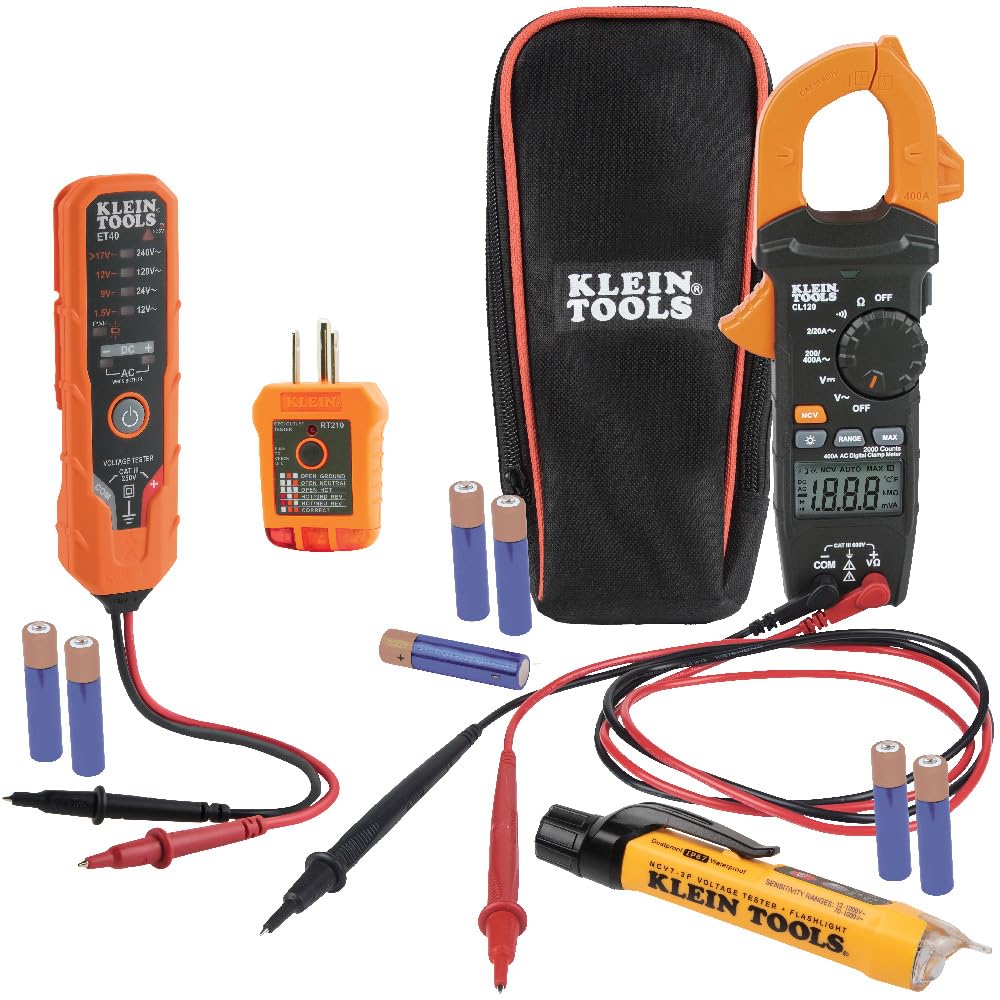
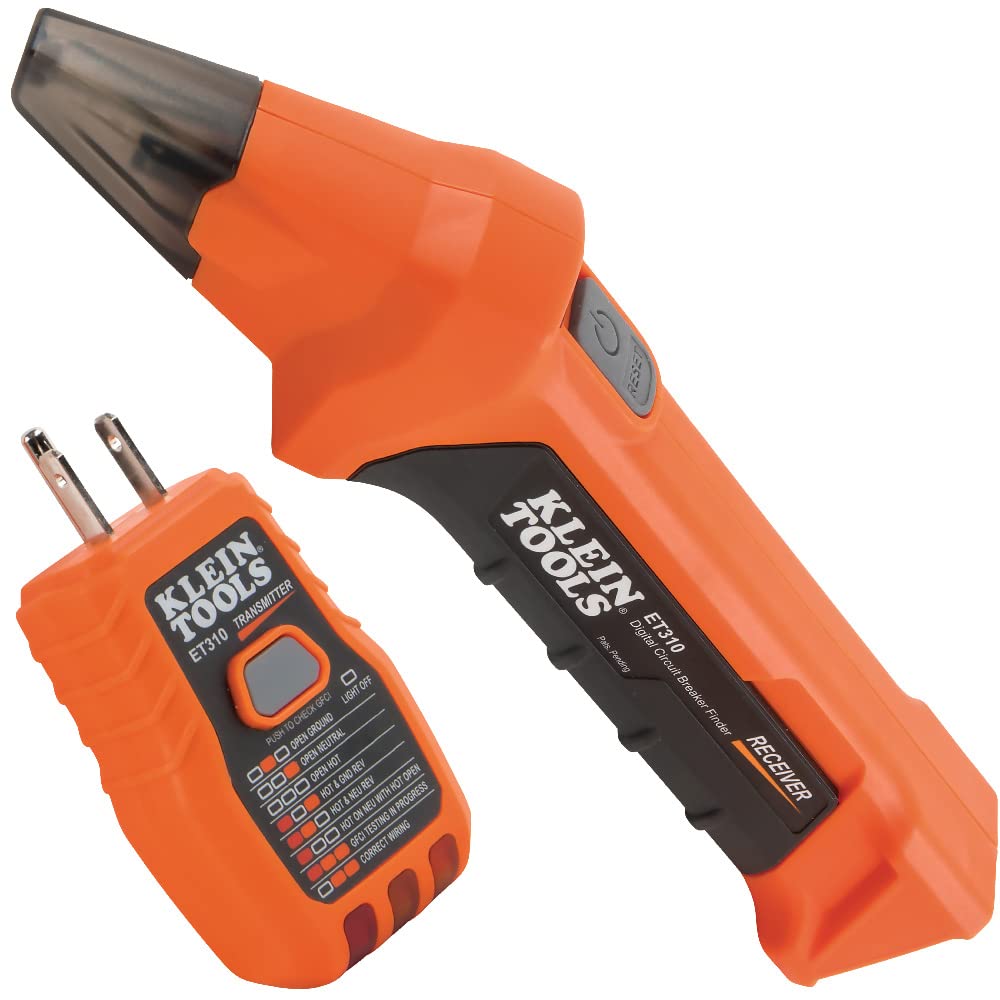
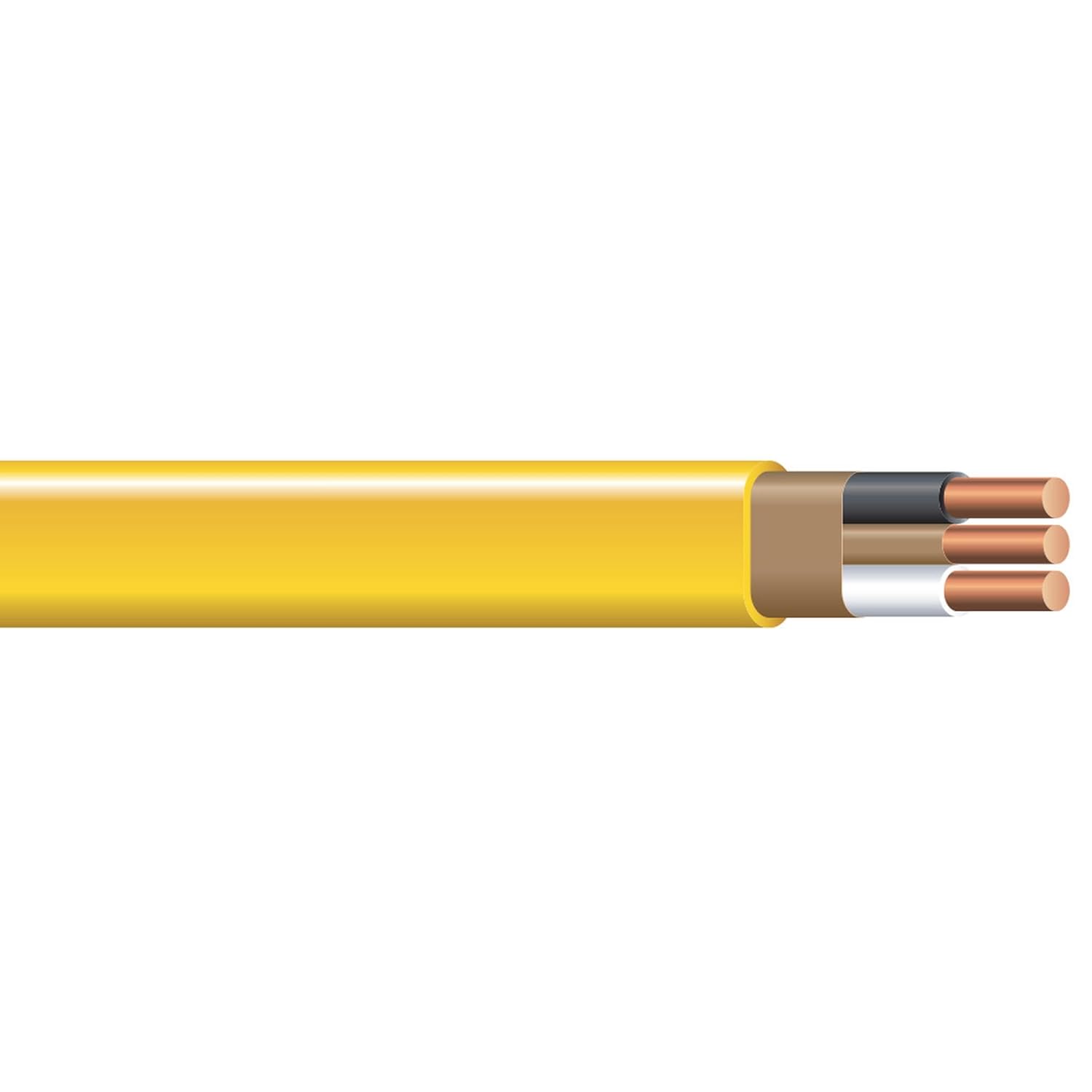
As an Amazon Associate, TestTalkHQ earns from qualifying purchases.
There are scenarios where a professional electrician will upsize wire not because code requires it, but because it's the right installation. Here's when to reach for the next gauge up automatically:
Our free voltage drop calculator handles single-phase, 3-phase, and DC circuits. Enter your wire size, run length, and load — get your drop percentage, pass/fail, and next-wire-size recommendation.
⚡ Open Voltage Drop Calculator → Data per NEC 210.19, 215.2, 90.5, Table 8, and Table 9. Always verify with current NEC and local code requirements. TestTalkHQ.com — free tools for tradespeople.One page. Voltage drop lengths, breaker and wire pairing, motor FLC.
$3.99
Buy
15 pages. Ampacity, corrections, voltage drop, motor circuits, conduit fill.
$12.99
Buy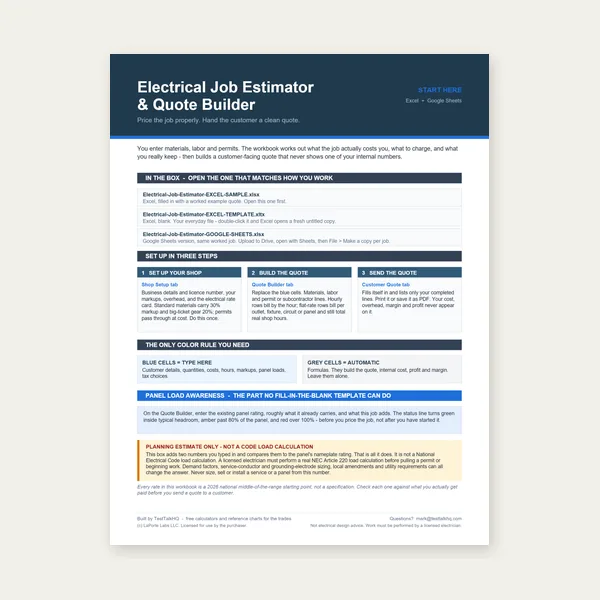
Quote electrical work and flag panel headroom before you price it.
Excel or Google Sheets. Best on a computer.
$29.00
Buy
Card, 15-page guide and the estimator workbook. All six files.
Excel or Google Sheets. Best on a computer.
$34.99
$45.98 if bought separately — save $10.99
BuyCheckout opens in a new tab.