NEC Voltage Drop Requirements
What the code actually says, what’s mandatory vs. recommended, and how inspectors treat it in the field.
The 3% and 5% voltage drop figures are cited everywhere — but most electricians treat them as hard code requirements when they aren’t. This guide explains what the NEC actually mandates, what’s only an informational note, and when voltage drop becomes a real code violation.
Use the Voltage Drop Calculator to check your circuits against NEC guidelines.

What the NEC Actually Says About Voltage Drop
The NEC addresses voltage drop in two primary locations for general wiring: Section 210.19(A)(1) Informational Note No. 1 for branch circuits, and Section 215.2(A)(1) Informational Note No. 2 for feeders. Both notes use nearly identical language. The branch circuit note reads:
"Conductors for branch circuits as defined in Article 100, sized to prevent a voltage drop exceeding 3 percent at the farthest outlet of power, heating, and lighting loads, or combinations of such loads, and where the maximum total voltage drop on both feeders and branch circuits to the farthest outlet does not exceed 5 percent, will provide reasonable efficiency of operation."
The feeder note in 215.2(A)(1) mirrors this: it recommends that voltage drop on feeders not exceed 3 percent, with a combined feeder-and-branch-circuit drop not exceeding 5 percent.
That is the extent of what the NEC says about voltage drop for most installations. No tables. No mandatory sizing charts. No hard requirement that your conductors achieve any particular voltage level at the load end. The 3% and 5% figures that every electrician has heard cited as "code" appear only in informational notes — and the distinction between an informational note and a code requirement matters enormously.
Informational Notes Are Not Enforceable Requirements
NEC Section 90.5 defines the structure of the code and is explicit on this point: "Mandatory requirements of this Code are characterized by the use of the word 'shall.' Informational Notes are explanatory material. Informational Notes are not enforceable as requirements of this Code."
The 3%/5% voltage drop language does not use the word "shall." It describes what "will provide reasonable efficiency of operation" — explanatory guidance, not a mandate. An inspector cannot fail a residential or commercial installation solely because the calculated voltage drop on a feeder is 4.2% instead of 3%, because the code does not require it to be 3%. The informational note is the NEC's way of telling you what good practice looks like without making it a condition of inspection approval.
This is the part most working electricians get wrong — not because they are wrong about the numbers, but because they treat the 3%/5% recommendation as if it carries the same weight as a mandatory code section. It does not. It is engineering guidance embedded in the code, not a compliance threshold.
That said, ignoring it is poor practice for reasons that go beyond inspection approval. Equipment that runs on undervoltage fails earlier, runs hotter, and operates less efficiently. Designing to 3% on branch circuits and feeders is the right call regardless of whether the inspector measures it.
When Voltage Drop Does Become a Mandatory Code Requirement
For specific installation types, the NEC moves voltage drop out of informational notes and into mandatory text. These are the situations where voltage drop is genuinely a code violation, not just a recommendation miss.
Article 647 — Sensitive Electronic Equipment
Article 647 covers technical power systems serving sensitive electronic equipment — recording studios, broadcast facilities, data centers using technical power distribution. Section 647.4(D) requires that the voltage drop on any branch circuit not exceed 1.5% and that the combined feeder-and-branch-circuit drop not exceed 2.5%. These are "shall" requirements, fully enforceable. A 647 installation with a 3% branch circuit drop is a code violation.
Article 695 — Fire Pumps
Section 695.7 requires that the voltage at the fire pump motor terminals not drop below 115% of the motor's nameplate voltage rating under locked-rotor conditions, and not drop below the nameplate voltage under running conditions. Fire pump feeders must be sized not just for ampacity but to deliver adequate voltage under the worst-case starting scenario. This is a hard requirement — undersizing the feeder conductor on a fire pump installation is a direct code violation.
Emergency and Standby Systems — Articles 700, 701, 702
Emergency systems, legally required standby systems, and optional standby systems all have voltage drop requirements built into their respective articles. The language varies, but the common thread is that conductors must be sized to deliver adequate voltage under the loads those systems serve, particularly under motor starting conditions.
Motor Circuits and Equipment Listings
Section 430.52 and the broader Article 430 require motor branch circuits to be sized to carry the motor's locked-rotor current without triggering the overcurrent device, which indirectly constrains how much voltage can drop during starting. More directly, motors and equipment are listed to operate within specific voltage tolerances — typically ±10% of nameplate voltage. When a motor receives voltage outside that tolerance because of conductor voltage drop, the installation does not comply with the equipment's listing. NEC Section 110.3(B) requires that listed equipment be installed and used in accordance with its listing and labeling. A motor that can't start because the circuit voltage has dropped 15% due to undersized conductors is not installed in compliance with its listing — which is an NEC violation, regardless of whether anyone calculates the voltage drop explicitly.
Energy Codes and Local Amendments
Some jurisdictions have adopted mandatory voltage drop requirements through energy codes or local amendments that the NEC itself does not impose. California's Title 24 Energy Code, for example, requires that branch circuits longer than 100 feet be upsized one AWG beyond the minimum ampacity requirement. Other states reference ASHRAE 90.1 or the IECC, which contain conductor efficiency requirements that translate into effective voltage drop limits. Before assuming the NEC informational notes represent the only applicable standard, check your jurisdiction's adopted codes. On commercial projects, the answer is sometimes that the energy code is more restrictive than the NEC.
How Inspectors Actually Treat Voltage Drop in the Field
On residential work, inspectors almost never calculate voltage drop and rarely ask about it. They verify conductor gauge against the breaker, check that wire is protected and terminated properly, and move on. A residential home run that drops 4% will pass inspection in virtually every jurisdiction because there is no mandatory threshold to fail against.
On commercial and industrial work, the picture is different. Engineering drawings submitted for permit typically include load calculations, and larger projects may include voltage drop calculations as part of the design documentation. Where a licensed engineer or EOR stamps the drawings, they are responsible for ensuring the design meets applicable standards — including the 3%/5% recommendations and any energy code requirements. An inspector reviewing stamped commercial drawings may flag apparent voltage drop issues if the conductor sizing looks obviously inadequate for the run length and load shown.
Where inspectors do commonly enforce voltage drop is on systems where it is mandatory: fire pumps, emergency systems, sensitive electronic equipment installations, and motor circuits where the conductor sizing is clearly inadequate to maintain rated voltage during starting. If a motor branch circuit is sized at the absolute ampacity minimum and the run is 300 feet, an experienced inspector may ask for documentation that the circuit can deliver adequate voltage under locked-rotor conditions.
The practical takeaway: on residential work, you will not fail inspection over voltage drop. On commercial work with stamped drawings, your engineer will have already addressed it. On specialty systems — fire pumps, emergency panels, VFD drives, sensitive equipment — treat voltage drop as a mandatory requirement, because the code sections governing those systems effectively make it one.
Calculating Compliance with NEC Guidelines
Whether you are designing to the informational note recommendations or to a mandatory limit under Article 647 or 695, the calculation method is the same. The single-phase voltage drop formula:
VD = (2 × K × I × L) / CM
Where K is 12.9 for copper (21.2 for aluminum), I is load current in amps, L is one-way run length in feet, and CM is the circular mil area of the conductor. For three-phase circuits, replace 2 with 1.732.
Percentage drop is then: (VD / Supply Voltage) × 100
For a quick check on any single-phase or three-phase circuit, the Voltage Drop Calculator at TestTalkHQ handles the formula automatically — enter your conductor, material, run length, current, and voltage and it returns both the drop in volts and as a percentage, with a clear indication of whether you're inside or outside the 3% and 5% thresholds.
For more complex scenarios — parallel conductors, multiple load points along a run, three-phase distribution with unbalanced loads, or circuits where you need to model both the feeder drop and branch circuit drop simultaneously — use the Advanced Voltage Drop Calculator at TestTalkHQ, which handles multi-segment circuits and parallel conductor configurations that the basic formula doesn't address cleanly.
Real Examples: Feeder Sizing, Branch Circuits, and Motor Circuits
Feeder Sizing — Commercial Tenant Buildout
A 200-amp feeder running 175 feet from the main switchgear to a tenant panel in a commercial building. The engineer specifies 3/0 AWG copper in conduit. Resistance of 3/0 AWG is 0.0766 Ω/1000ft. At 160 amps of continuous load (80% of 200A):
VD = 2 × 0.0766 × 160 × 175 / 1000 = 4.29 volts on 208/120V three-phase
On a 208V line-to-line voltage, that is 2.06% — well within the 3% feeder recommendation. The engineer has left margin for the branch circuit drop in the tenant panel to add up to the 5% combined limit without exceeding it. If the same feeder were run at 250 feet, 3/0 AWG would drop 6.14V on 208V — 2.95% — still within the 3% feeder limit but with almost nothing left for branch circuit drop. At 250 feet, a prudent design specifies 250 kcmil to bring the feeder drop to 2.34%, leaving a reasonable margin for branch circuits.
Branch Circuit Sizing — Long Home Run in a Large Building
A 20-amp branch circuit running 120 feet from a panel to a receptacle in a warehouse. Minimum ampacity calls for 12 AWG. Voltage drop on 12 AWG at 16 amps of continuous load (80% of 20A) on 120V:
VD = 2 × 1.98 × 16 × 120 / 1000 = 7.60 volts = 6.34% on 120V
More than double the 3% recommendation. Step to 10 AWG:
VD = 2 × 1.24 × 16 × 120 / 1000 = 4.76 volts = 3.97%
Still over. Step to 8 AWG:
VD = 2 × 0.778 × 16 × 120 / 1000 = 2.98 volts = 2.49% ✓
The code minimum of 12 AWG won't fail inspection, but it will drop more than 6% of supply voltage on every connected load. The right answer is 8 AWG — two sizes above the ampacity minimum — which is exactly the kind of situation the informational note exists to prevent.
Motor Circuit — 50 HP at 480V, 200 Feet
A 50 HP, 480V three-phase motor with a full-load amp rating of 65A. Branch circuit minimum is 65A × 1.25 = 81.25A, calling for 4 AWG copper (85A at 75°C). The run from the MCC to the motor is 200 feet. Check voltage drop on 4 AWG at full load:
VD = 1.732 × 0.308 × 65 × 200 / 1000 = 6.93 volts = 1.44% on 480V
Within limits on voltage drop at full load. But check locked-rotor current — code-type E motor, locked-rotor code letter F, locked-rotor kVA between 5.0 and 5.59 kVA per HP × 50 HP = up to 279.5 kVA. At 480V three-phase, that is up to 336A of locked-rotor current. The branch circuit overcurrent device handles that; the voltage drop during starting on 4 AWG at 336A over 200 feet:
VD = 1.732 × 0.308 × 336 × 200 / 1000 = 35.8 volts = 7.46% on 480V
During starting, the motor terminals are seeing 444V instead of 480V — an 8% reduction, just within the ±10% motor listing tolerance. If this were a longer run or a harder-starting load, the calculation would indicate a conductor upgrade or a reduced-voltage starter to limit inrush. This is the kind of analysis Article 430 pushes you toward even if it doesn't spell out the voltage drop math explicitly.
Frequently Asked Questions
Can an inspector fail my work because of voltage drop?
On most residential and standard commercial work, no — because the 3%/5% limits in 210.19 and 215.2 are informational notes, not mandatory requirements. An inspector has no enforceable code section to cite if your branch circuit drops 4% on 120V and your installation otherwise meets all mandatory requirements. The exceptions are specialty systems: fire pumps under Article 695, sensitive electronic equipment under Article 647, and emergency systems under Articles 700–702, where voltage drop limits are written as "shall" requirements and are fully enforceable. Local energy code amendments can also make voltage drop limits mandatory in jurisdictions that have adopted them.
Where exactly do the 3% and 5% numbers come from?
They originate from engineering standards predating the NEC's current form — primarily from ANSI/IEEE recommendations on power quality and from historical equipment tolerance ranges. Most electrical equipment is designed to operate within ±10% of rated voltage; 5% total system drop leaves a comfortable margin below that tolerance. The 3% branch circuit limit assumes a feeder that itself may drop 2%, so that the combined drop stays within 5%. The numbers were incorporated into the NEC as informational guidance rather than mandatory requirements partly because what constitutes "acceptable" voltage drop varies by application — a 5% drop on a lighting circuit is annoying; a 5% drop on a motor circuit during starting may prevent startup entirely.
Do motor circuits have different voltage drop requirements than lighting circuits?
Not explicitly in the NEC text, but effectively yes. Motors are more sensitive to low voltage than resistive loads like heaters or incandescent lighting. An induction motor's starting torque is proportional to the square of the applied voltage — a 10% voltage reduction cuts starting torque by nearly 20%. The practical requirement comes from the equipment listing: motors must be installed so they can operate within their rated voltage tolerance, which the NEC enforces through 110.3(B). A motor circuit designed to the bare ampacity minimum on a 200-foot run may produce a voltage drop that prevents reliable starting under load, which means the equipment is not being installed in compliance with its listing. This is why motor circuits on long runs should be calculated for both ampacity and voltage drop, treating both as design constraints.
Does the NEC require voltage drop calculations to be submitted with permit drawings?
The NEC itself does not require voltage drop calculations as part of permit submissions. However, local jurisdictions often do for commercial and industrial projects, and any engineer stamping drawings takes responsibility for ensuring the design meets applicable standards — including the informational note recommendations and any energy code requirements that may be mandatory in that jurisdiction. On projects with stamped engineering drawings, voltage drop calculations are typically included in the calculation package submitted with the permit application. On residential work, no calculation submittal is required and voltage drop is rarely reviewed by plan check staff.
Recommended Voltage Testing Tools
Verify wiring, measure under load, and confirm run lengths before sizing conductors
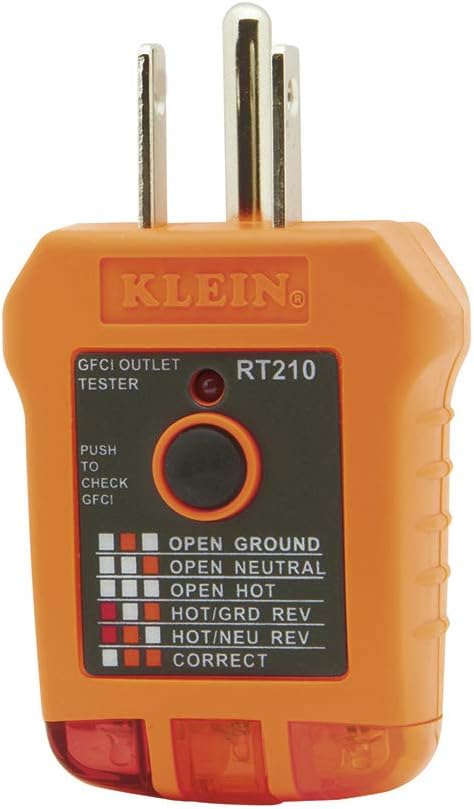
Klein Tools RT210 GFCI Outlet Tester
A quick outlet test before any voltage drop investigation rules out wiring errors that look like voltage drop problems. The Klein RT210 checks open ground, open neutral, open hot, reversed polarity, and GFCI function in seconds. Know what you’re actually dealing with before pulling wire.
Check Price
Fluke 117 Digital Multimeter
Confirming NEC voltage drop compliance on an existing circuit means measuring actual voltage at the load under operating conditions. The Fluke 117 reads true RMS voltage accurately — check supply at the panel and load voltage at the far end simultaneously to get the real drop number, not a calculation estimate.
Check Price
Klein Tools NCVT-6 Non-Contact Voltage Tester with Laser Distance
Verify live conductors safely before measuring and use the laser distance meter to confirm actual run lengths. Accurate run length measurement is the foundation of an accurate voltage drop calculation — estimating the distance introduces error that compounds through the entire sizing decision.
Check PriceAs an Amazon Associate, TestTalkHQ earns from qualifying purchases.
How to Document Voltage Drop Compliance for an Inspection
If an inspector asks about voltage drop on a commercial or industrial project, the right response is a calculation, not an explanation. Show the one-way run length, the conductor size and material, the design load current, and the resulting voltage drop percentage. The Voltage Drop Calculator produces all of those outputs — print the results and have them in your permit package. On projects where the spec explicitly calls out the 3%/5% NEC recommendation as a design requirement, include the calculation in your submittals alongside your panel schedule and load calculations.
Voltage Drop in Motor Circuits — Why NEC Article 430 Changes the Math
Motor circuits have additional NEC requirements that interact with voltage drop in ways that can trip up even experienced electricians. NEC 430.52 sets minimum conductor ampacity at 125% of motor full-load amps for continuous duty — and that same 125% factor applies to voltage drop calculations if you want to be conservative. A motor that draws 20 FLA needs a circuit sized for 25 amps, and voltage drop should be calculated at 25 amps, not 20. More importantly, locked-rotor current at startup — typically 6–8× FLA — creates a momentary voltage drop that can prevent motor starting if the conductors are undersized. Design motor circuits for running current and verify starting voltage separately.
The Difference Between a Code Violation and a Bad Installation
An installation can be code-compliant and still perform poorly. A feeder with 4.9% voltage drop technically meets the NEC’s 5% combined recommendation, but it leaves essentially no margin for branch circuit drop, termination resistance, or load variation. Passing an inspection is not the same as building something that will serve the load well for 30 years. The NEC is a minimum safety standard, not a performance specification. Design to the 3% branch circuit recommendation as a target, not an upper limit. The extra wire costs a fraction of what a service call to replace failed motors costs five years into the installation’s life.
When Specs Override the NEC — Commercial and Industrial Projects
On commercial and industrial projects, the contract documents — drawings and specifications — often impose stricter voltage drop requirements than the NEC informational notes. A spec that says “voltage drop shall not exceed 2% on any branch circuit” is a contractual requirement, not an NEC requirement, and failing to meet it is a contract deficiency even if the installation passes inspection. Always read the electrical specifications before designing circuits on bid projects. Some owners, particularly in manufacturing and data center work, specify 1% or less on sensitive circuits. The NEC sets the floor; the spec sets the actual requirement on commercial work.