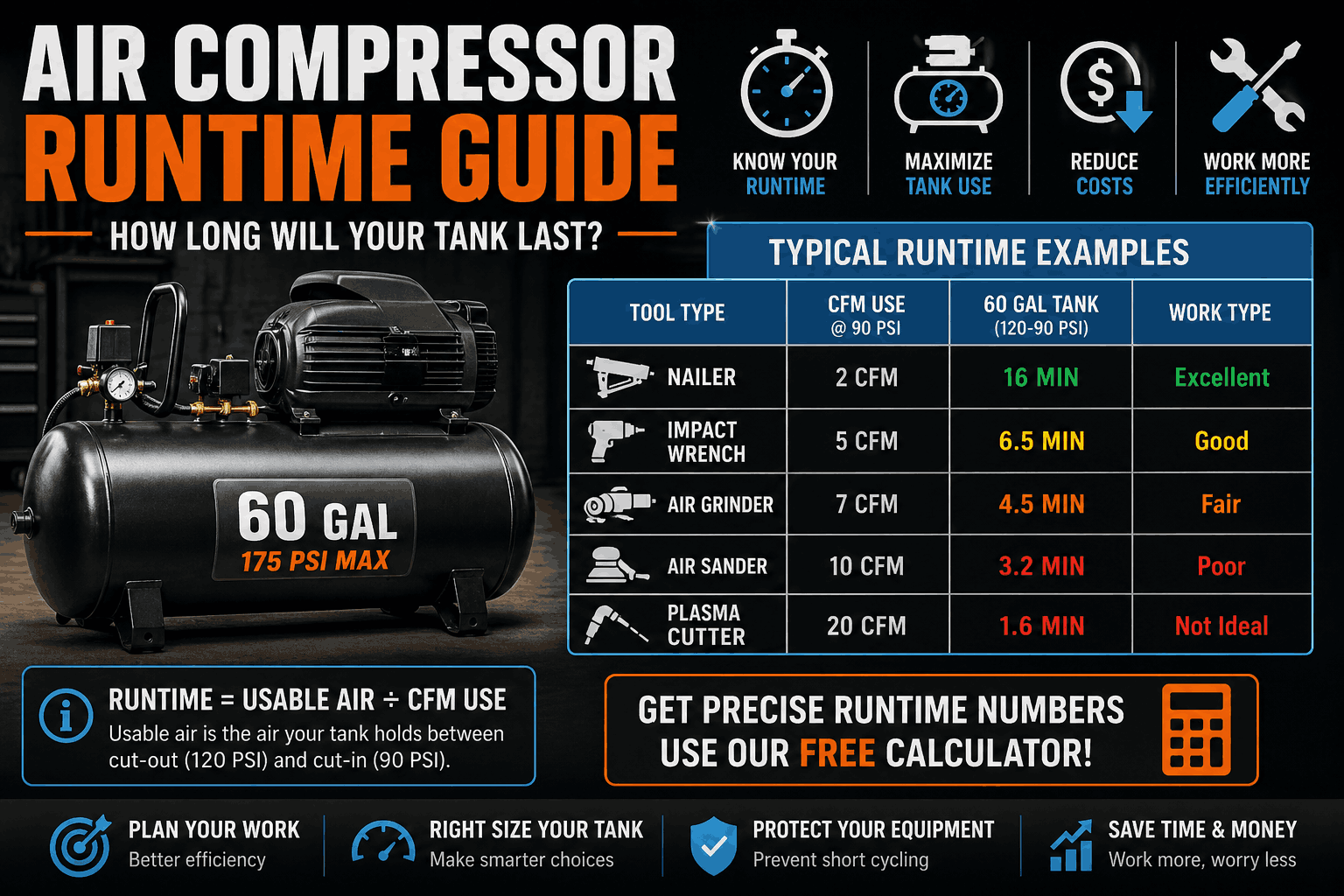
Air Compressor Runtime Guide: How Long Will Your Tank Last?
Tank gallons are not minutes of air. Runtime comes from usable compressed air between your cut-out and the lowest PSI your tools still work at, divided by tool CFM (and how often the trigger is actually open). Nailers feel immortal; grinders and plasma eat a 60-gallon tank in minutes.
You’re halfway through plasma cutting a 20-foot section of steel when your compressor kicks on—again—and you have to stop and wait while pressure rebuilds. Your 60-gallon tank gave you maybe 90 seconds of continuous cutting before running out of air, and you’re wondering: is this normal, or is something wrong with my compressor? The answer is both frustrating and predictable: a 60-gallon tank at 90 PSI holds about 6.75 actual cubic feet of compressed air, and a plasma cutter consuming 5 CFM burns through that in just 81 seconds. The tank isn’t broken—it’s just too small for continuous plasma cutting without recovery time.
Air compressor runtime—how long your tank lasts before needing to refill—determines whether you can work continuously or spend half your time waiting for pressure to rebuild. A sandblaster might drain a 60-gallon tank in 30 seconds. A framing nailer might run for 20 minutes on the same tank. The difference is CFM consumption rate, and understanding this relationship prevents buying undersized compressors that can’t keep up with your tools or oversized tanks you’ll never fill to capacity.
This guide shows you how to calculate air compressor runtime using tank size, pressure range, and tool CFM consumption, explains why “gallons” is a misleading measurement (actual usable air depends on PSI), and gives you runtime formulas for plasma cutters, grinders, impact wrenches, sanders, and other air tools. You’ll learn how recovery time affects productivity, when a larger tank actually helps (and when it doesn’t), and five ways to extend runtime without buying a bigger compressor. For operating-cost and leak angles, see our compressed air cost guide.
Rough continuous trigger-on time at ~90–120 PSI usable band (typical portable/shop). Real jobs mix duty cycle—nailers stretch forever; sanders don’t.
Tank size
Usable ΔPSI (example)
Tool CFM
~Continuous runtime
Reality check
6 gal (pancake)
~90–120 (typical)
5 CFM
~20–40 sec
Fine for nailers—not a grinder factory.
20 gal
90–120
5 CFM
~1.1 min
Same CFM math as charts below.
60 gal
90–120
5 CFM
~3.3 min
Plasma still feels short—normal.
60 gal
90–120
3 CFM
~5.5 min
Lower demand = longer per cycle.
60 gal
90–150
5 CFM
~6.5 min
Wider PSI band stores more without more gallons.
Numbers assume you actually get to use the full pressure swing your switch allows and your tool still runs at the low end. Plug your real cut-in/cut-out and tool into the runtime calculator.
Need the numbers, not the lecture?
Use the calculators below when you want runtime, tank sizing, or compressor CFM without guessing.
Air compressor runtime directly impacts productivity. Too short and you spend more time waiting for pressure to rebuild than actually working. Too long and you’ve invested in excess tank capacity you’ll never use.
The Productivity Cost of Short Runtime
Example: plasma cutting with undersized compressor
Total time: Actual cutting ~10 minutes; waiting for pressure ~15 minutes; total job ~25 minutes (~60% waiting). With a properly sized compressor (higher CFM output), the same job takes ~12–13 minutes because the compressor keeps up with demand.
Real-World Runtime Expectations
Tool type
CFM usage
60 gal runtime
Work pattern
Framing nailer
2–3 CFM
15–20 min
Excellent—rarely waits
Impact wrench
3–5 CFM
8–12 min
Good—occasional pauses
Die grinder
4–6 CFM
6–10 min
Fair—frequent pauses
Plasma cutter
5–7 CFM
1.5–2.5 min
Poor—constant waiting
Sandblaster
8–15 CFM
30–90 sec
Terrible—nearly unusable
When Runtime Matters Most
High-priority scenarios: continuous tools (plasma, sandblasters, die grinders); production work; time-sensitive jobs.
Usable air (cu ft) = Tank volume (cu ft) × [(Max PSI − Min PSI) ÷ 14.7]
Where Max PSI = compressor shutoff (often 120–150 PSI), Min PSI = lowest useful pressure at the tool (often ~90 PSI), 14.7 = standard atmospheric pressure (PSIA reference in this simplified model).
Runtime (minutes) ≈ Tank gallons ÷ (Tool CFM × 2.5)
Assumes a typical 90–120 PSI band; often within ~10–15% for planning. Example: 60 gal, 5 CFM → 60 ÷ 12.5 ≈ 4.8 minutes (slightly high vs the exact ~3.3 min example—use it as a bracket, not gospel).
This is the most misunderstood aspect of air compressor runtime: a 60-gallon tank does not contain 60 gallons of usable compressed air.
Why Tank Size is Misleading
Tank size (gallons) measures physical volume. What matters for runtime is compressed air volume at useful pressure. People think “60 ÷ 5 CFM = 12 minutes”—reality is closer to a few minutes for continuous 5 CFM because you only spend down the allowed pressure window.
Actual Usable Air by Tank Size
Tank size
Tank volume (cu ft)
Usable air @ 90–120 PSI
Usable %
20 GAL
2.67 cu ft
5.45 cu ft
27%
30 GAL
4.01 cu ft
8.18 cu ft
27%
60 GAL
8.02 cu ft
16.36 cu ft
27%
80 GAL
10.70 cu ft
21.83 cu ft
27%
120 GAL
16.04 cu ft
32.72 cu ft
27%
Key insight: In the 90–120 PSI band, usable stored air tracks about 27% of the tank gallon rating expressed the way people incorrectly think about “gallons of air.”
Why You Can’t Use All the Air
Tool minimum pressure: below ~90 PSI many tools quit doing real work—even though pressure still reads “something.”
Pressure drop during use: you budget to the regulator/tool floor, not zero PSI.
Compressor switch band: you live between cut-out and cut-in—not the whole nameplate max if your switch never goes there.
Higher Pressure = More Usable Air
Increasing maximum pressure increases usable air without changing tank size:
Pressure range
60 GAL usable air
Runtime (5 CFM)
90–120 PSI
16.36 cu ft
3.3 min
90–135 PSI
24.54 cu ft
4.9 min
90–150 PSI
32.72 cu ft
6.5 min
90–175 PSI
46.35 cu ft
9.3 min
This is why industrial systems often run higher working pressures—more stored work per gallon.
Pressure Range and Runtime
The pressure range (maximum minus minimum operating pressure) determines how much air you can actually use from your tank.
Typical Pressure Ranges
Residential/portable: max 120–135 PSI; cut-in ~90–100 PSI; usable band often ~20–45 PSI of useful swing depending on setup.
Professional/industrial: max 150–175 PSI; cut-in higher; wider stored energy options—still respect tank rating and relief hardware.
Why Wider Pressure Range Helps
Wider allowed range = more air per pump cycle before restart. Same 60-gallon tank at 5 CFM: narrow 90–120 → ~3.3 min; wide 90–150 → ~6.5 min—double runtime without more steel.
Adjustable Pressure Switches
Some compressors allow adjusting cut-in/cut-out. Caution: never exceed the tank’s stamped maximum working pressure—over-pressurizing is how people become statistics.
CFM Consumption by Tool Type
Different tools consume air at dramatically different rates, directly affecting runtime.
Why small tanks “die” on grinders, sanders, and impacts
Continuous air hogs pull CFM the whole time the lever is down. A 6-gallon pancake can be correct for a brad nailer and still feel broken on a 6″ grinder because the tool outruns storage—then the motor chases pressure all afternoon.
Low CFM Tools (1–3 CFM)
Pneumatic nailers/staplers: framing ~2–3 CFM @ 90 PSI; finish ~1–2; brad ~0.5–1. Pattern: 1–2 second bursts every 5–30 seconds → clock runtime looks short on paper, real shift time is long because duty cycle is tiny.
Medium CFM Tools (3–6 CFM)
1/2″ impact ~4–5 CFM; 3/8″ ratchet ~3–4; die grinder ~4–6; angle grinder ~5–8; orbital sander ~6–9. On a 60-gallon tank, continuous window often ~3–8 minutes—then recovery math decides if you’re happy.
Small sandblaster ~8–12; production sandblaster ~15–25; commercial tire gear can be huge. On portable compressors these are often nearly unusable without serious stored volume and pump CFM—or you work in bursts and hate the job.
Runtime Charts for Common Tools
These charts show actual runtime for common compressor/tool combinations (90–120 PSI band unless noted).
Note: Nailers are intermittent—real shift time is often 10–30× longer than “continuous” charts imply because the valve is open in seconds, not minutes.
Recovery Time vs. Runtime
Runtime tells you how long the tank lasts. Recovery time tells you how long you wait for it to refill. Both matter for productivity.
Recovery Time Formula
Recovery time (minutes) ≈ Air consumed (cu ft) ÷ Compressor CFM output
Example: 60-gallon tank depleted 120 → 90 PSI: ~16.36 cu ft consumed; 5 CFM pump → 16.36 ÷ 5 ≈ 3.27 minutes to replace that stored chunk (idealized—real pumps vary with pressure).
Runtime vs. Recovery Comparison
Tool
CFM use
60 gal runtime
Recovery (5 CFM)
Productivity
Framing nailer
3 CFM
5.5 min
3.3 min
Excellent
Impact wrench
5 CFM
3.3 min
3.3 min
Good (1:1)
Die grinder
6 CFM
2.7 min
3.3 min
Fair (more wait than work)
Plasma cutter
7 CFM
2.3 min
3.3 min
Poor (~43% more wait)
Continuous Operation Requirement
For truly continuous operation (no waiting), compressor delivered CFM at working pressure should meet or exceed tool demand. Undersized pump: tool draws 7, pump makes 5 → net drain → stop and wait. Sized right: tool 7, pump 8 → tank can actually climb while you work.
Calculate required compressor size with our CFM Calculator.
Continuous vs. Intermittent Tool Use
Usage pattern dramatically affects how long a compressor “feels” adequate even with limited runtime.
Intermittent Tools (Nailers, Impact Wrenches)
Bursts of 1–5 seconds with 10–60 second pauses. Framing nailer might show ~5.5 minutes “continuous” on 60 gallons—but real-world framing runs for hours because you’re not pulling air except during the hit.
Continuous Tools (Plasma Cutters, Grinders)
Trigger held minutes at a time. You feel the full tank math—2–3 minutes means 2–3 minutes.
Semi-Continuous Tools (Sanders, Spray Guns)
Short breaks for reposition add partial recovery—effective work can land ~3–4× longer than a pure continuous estimate if you’re disciplined about pauses.
How Tank Size Affects Runtime
Bigger tanks provide longer runtime between cycles, but the relationship isn’t magic—and if pump CFM already exceeds tool CFM, tank size stops being the bottleneck.
Runtime Scaling by Tank Size
Tank size
Runtime (5 CFM)
Runtime increase
20 GAL
1.1 min
Baseline
30 GAL (+50%)
1.6 min
+45%
60 GAL (+200%)
3.3 min
+200%
80 GAL (+300%)
4.4 min
+300%
120 GAL (+500%)
6.5 min
+491%
Key insight: Runtime scales roughly with tank volume for the same pressure band—but only matters when the pump cannot keep up with average demand.
When Larger Tanks Help
Tool CFM exceeds pump CFM: bigger storage stretches minutes between mandatory stops (doesn’t fix the deficit forever—just buys time).
When Larger Tanks Don’t Help
Pump already exceeds tool demand: the tank may barely move off cut-out because the compressor refills faster than you consume—extra gallons mostly buy floor space, not throughput.
If you’re stuck with your current compressor and need more runtime, try these strategies:
1. Increase maximum pressure (if tank allows)
Example: 90–120 vs 90–135 on a 60-gallon, 5 CFM tool can move ~3.3 → ~4.9 minutes—meaningful. Never exceed stamped tank MAWP.
2. Reduce tool CFM demand (when quality allows)
Lower regulated pressure on a plasma gun can drop CFM—trade speed/kerf for minutes if the cut still meets spec.
3. Fix air leaks
A “small” 1 CFM leak is a huge tax on a 5–6 CFM portable. Soap, listen, replace worn couplers.
4. Use intermittent work patterns
Cut/plasma in chunks with marks/layout pauses—lets pressure climb instead of pegging motor thermal limits.
5. Upgrade compressor CFM output
The real fix for continuous hogs is more SCFM at the working pressure, not fantasies about pancake tanks. See compressor upgrade options when you’re ready to spend money once instead of frustration every Saturday.
Knowing when to upgrade versus “making do” saves time and frustration.
Signs You Need a Bigger Compressor
Constant cycling: motor runs ~70%+ of work time → undersized / leaking / both.
Waiting ~40%+ of clock time on recovery → you bought a hobby rhythm for a production job.
Continuous tools unusable (sandblast/HVLP/long plasma) → tank hits empty in under a minute repeatedly.
Upgrade Decision Matrix
Tool type
Current runtime
Recommendation
Nailers, staplers
Any
Usually fine—fix leaks, not ego
Impact wrench
<3 min continuous feel
60+ gal and/or more pump CFM
Plasma cutter
<2 min
120+ gal or 8+ SCFM class pump
Sandblaster
<60 sec
Industrial air or stop pretending
Tank vs. CFM Upgrade
Tank: when pump nearly keeps up and you want fewer interruptions. CFM: when pump clearly loses a CFM race to the tool. Both: high sustained demand + multiple users.
Frequently Asked Questions
How long will a 60-gallon air compressor tank last?
A 60-gallon tank lasts ~3–4 minutes with a plasma cutter (5–6 CFM), ~5–8 minutes with an impact wrench (4–5 CFM), or ~15–20 minutes with a framing nailer (2–3 CFM) under continuous flow assumptions. Intermittent nailers stretch to hours. Use our Runtime Calculator for your pressures and tool.
Usually: tool demand > pump output, leaks, narrow usable PSI band, or you’re running a continuous tool like it’s a nailer.
Is a 60-gallon tank big enough for a plasma cutter?
For short cuts and hobby cadence, maybe. For production long cuts, you want pump CFM to match/exceed the torch—not just more gallons.
What size air compressor do I need to run continuously?
Delivered CFM @ your working pressure ≥ tool CFM. Tank becomes secondary once the pump truly keeps up.
Does a bigger tank mean more CFM?
No. Tank stores; pump produces. A big tank on a small pump still refills slowly.
How long does it take to fill a 60-gallon air compressor?
Ballpark refill of the same usable air chunk: usable cu ft ÷ pump CFM → minutes class answer (same math as recovery).
Why can’t I use all the air in my tank?
Tools stop being useful as pressure falls; switches restart the pump before you hit vacuum; physics doesn’t let “every gallon” be at tool pressure.
Can I increase air compressor runtime without buying a new compressor?
Wider safe pressure band (within ratings), leak repair, better duty pattern, second tank in parallel—each buys a little; continuous hogs still want CFM.
What’s better for plasma cutting: bigger tank or higher CFM compressor?
Higher CFM at the torch pressure wins continuous work. Tanks stretch pauses; pumps fix the balance.
Conclusion: Match Runtime to Your Work Pattern
Air compressor runtime isn’t about having the biggest tank—it’s about matching stored usable air and pump output to how your tools actually consume CFM. A 60-gallon tank is plenty of nailer life and painfully short for continuous plasma unless the pump is doing real work.
Key takeaways:
Budget with usable air between cut-out and tool floor—not raw gallons.
Wider safe PSI band stores more minutes without more tank steel.
Leaks are stolen runtime—fix them before upgrading ego.
When you’re out of air every couple minutes, check CFM match first, tank second.
For hobbyists and intermittent users, 30–60 gallons with 4–6 SCFM class output covers a lot of garages. For production or continuous high-CFM tools, invest in pump flow, not just storage.