Mounting is the one cylinder decision with a sixteen-to-one consequence that almost nobody costs out. One question settles most installations. For the rest, here is what each arrangement actually does to the rod, the cases that are not obvious, and a decision order that survives contact with a real machine.
The question that settles it
Before anything about buckling loads or effective lengths: does the line between the two attachment points stay in one place while the cylinder works?
If the cylinder pushes something that travels in a straight line along the cylinder’s own axis, that line never moves, and a rigid mounting — flange, foot, side lug — is available to you. If the cylinder drives something that swings, pivots, or follows an arc, the line between the attachment points rotates as the stroke progresses, and a rigid mounting is not a choice at all. Forcing one on will bend the rod, not because the load is too high but because the geometry is impossible.
That disposes of most installations in one sentence. What follows is for the cases where both are genuinely available, and for the very common situation where somebody has assumed that rigid means strong.
How each one behaves
Rigid mounting
The cylinder body is bolted solidly to the machine: a front or rear flange, foot brackets, side lugs. The body cannot rotate. Whether that is good or bad for the rod depends entirely on what is happening at the far end.
A rigidly mounted cylinder with a completely unrestrained rod end is the worst case in the whole table. The rod is effectively a cantilever: fixed at the gland, free at the tip, and it behaves like a column twice its actual length. This is Festo’s default assumption, and it is why their published graph uses a buckling length of two times the stroke.
A rigidly mounted cylinder whose rod end is pivoted or guided is among the best cases. Same body, same bolts — the difference is entirely at the other end.
Pivot mounting
The cylinder hangs on a rear clevis or on trunnions, free to swing in at least one plane. The body can rotate, so it cannot carry any bending moment; it can only push along its own line. The rod end on such an installation is essentially always pivoted too, because that is what the arrangement is for.
Pin-ended at both ends is the classical reference case. It is four times better than rigid-with-a-free-end, and half as good as rigid-with-a-pivoted-end.
Side by side, in the only currency that matters
Hänchen publishes the installation factors as a table. They map exactly onto the classical effective length factors, and the last column is what the choice is actually worth:
| Cylinder body | Rod end | Factor x | Effective K | Relative capacity |
|---|---|---|---|---|
| Rigid — flange, foot, side lug | Free / unguided | 0.25 | 2.0 | ×1 — the baseline |
| Pivoted — clevis or trunnion | Pivoted | 1 | 1.0 | ×4 |
| Rigid | Pivoted | 2 | 0.707 | ×8 |
| Pivoted — clevis or trunnion | Guided in a bearing | 2 | 0.707 | ×8 |
| Rigid | Guided in a bearing | 4 | 0.5 | ×16 |
Same rod. Same stroke. Same pressure. Sixteen times the allowable load between the top row and the bottom one, because the critical load depends on the square of the effective length and the effective length varies four to one across the table.
Any trade
Contractor Job Estimator
Price remodels and GC work, then send a quote with no internal numbers.
Excel or Google Sheets. Best on a computer.
$29.00
BuyCheckout opens in a new tab.
The gear this argument actually needs
Everything on this page comes down to three measurements and one adjustment: the rod diameter, the free span, whether the rod is still straight, and the pressure you are feeding it. The first two decide the answer, the third settles whether you have a problem at all, and the fourth is the only lever you can pull on an installed cylinder without changing hardware.
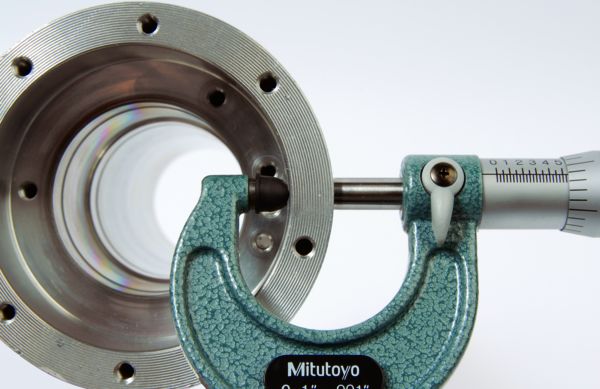
Mitutoyo 103-177 Outside Micrometer 0–1 in
- Buckling capacity goes as the fourth power of rod diameter
- A hard-chromed rod is ground under the plating — the finished size carries the load
- Also measures plating loss and wear on a rod that has been in service
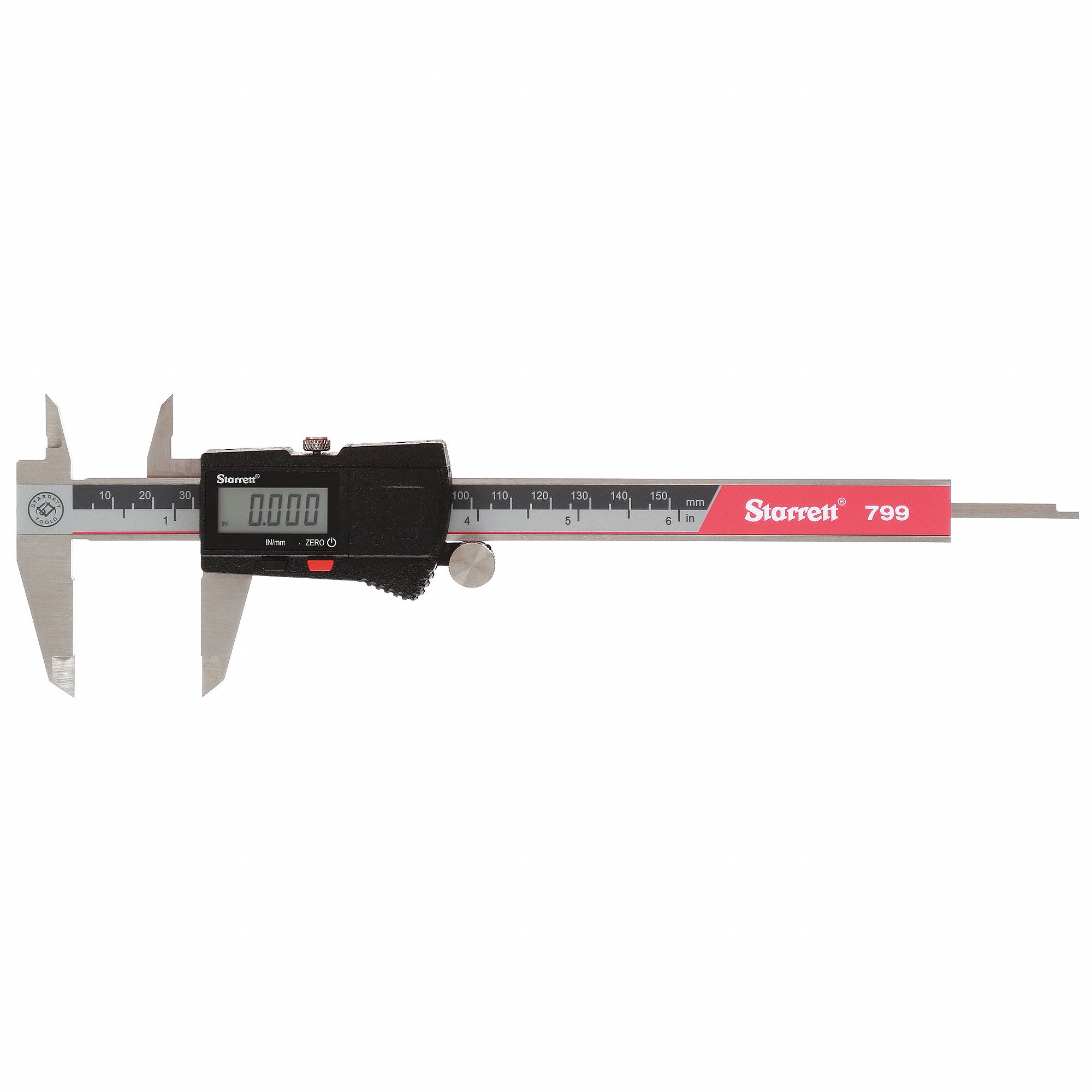
Starrett EC799A Electronic Caliper 0–6 in
- Free span is stroke plus every extension, clevis and coupling nut on the end
- Checks rod, pin bore and clevis in one pass
- Inch and metric together, which is the whole problem on an imported cylinder
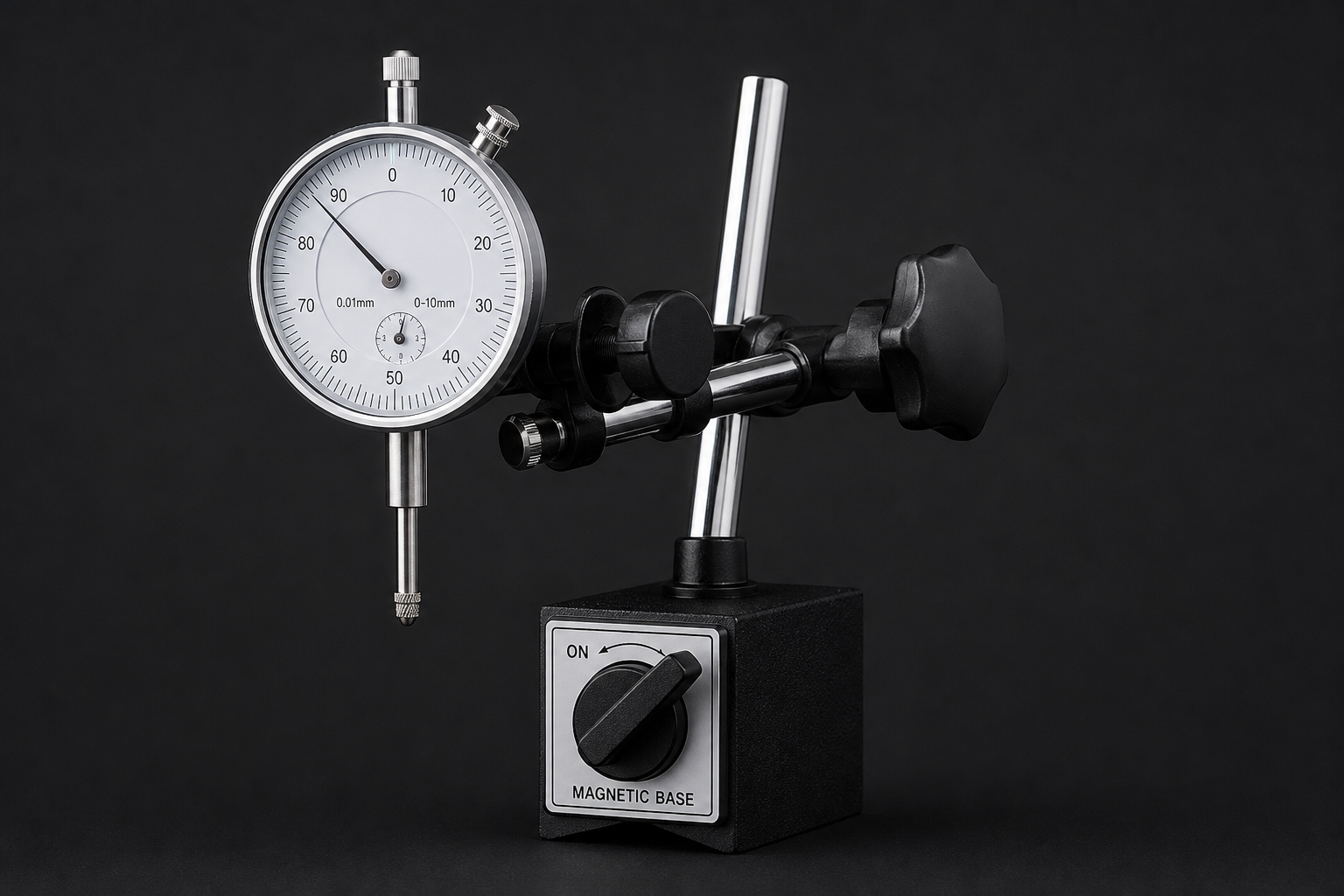
Dial Indicator Set with Magnetic Base
- Runout on an extended rod settles the “is it bent” argument with a number
- Magnetic base clamps to the machine frame, so you read against the real datum
- Finds the difference between a bowed rod and a worn gland

LE LEMATEC Regulator & Flow Control Valve
- Take a third off the pressure and you take a third off the load on the rod
- Flow control also takes the end-of-stroke shock out
- 0–150 psi covers ordinary shop supply
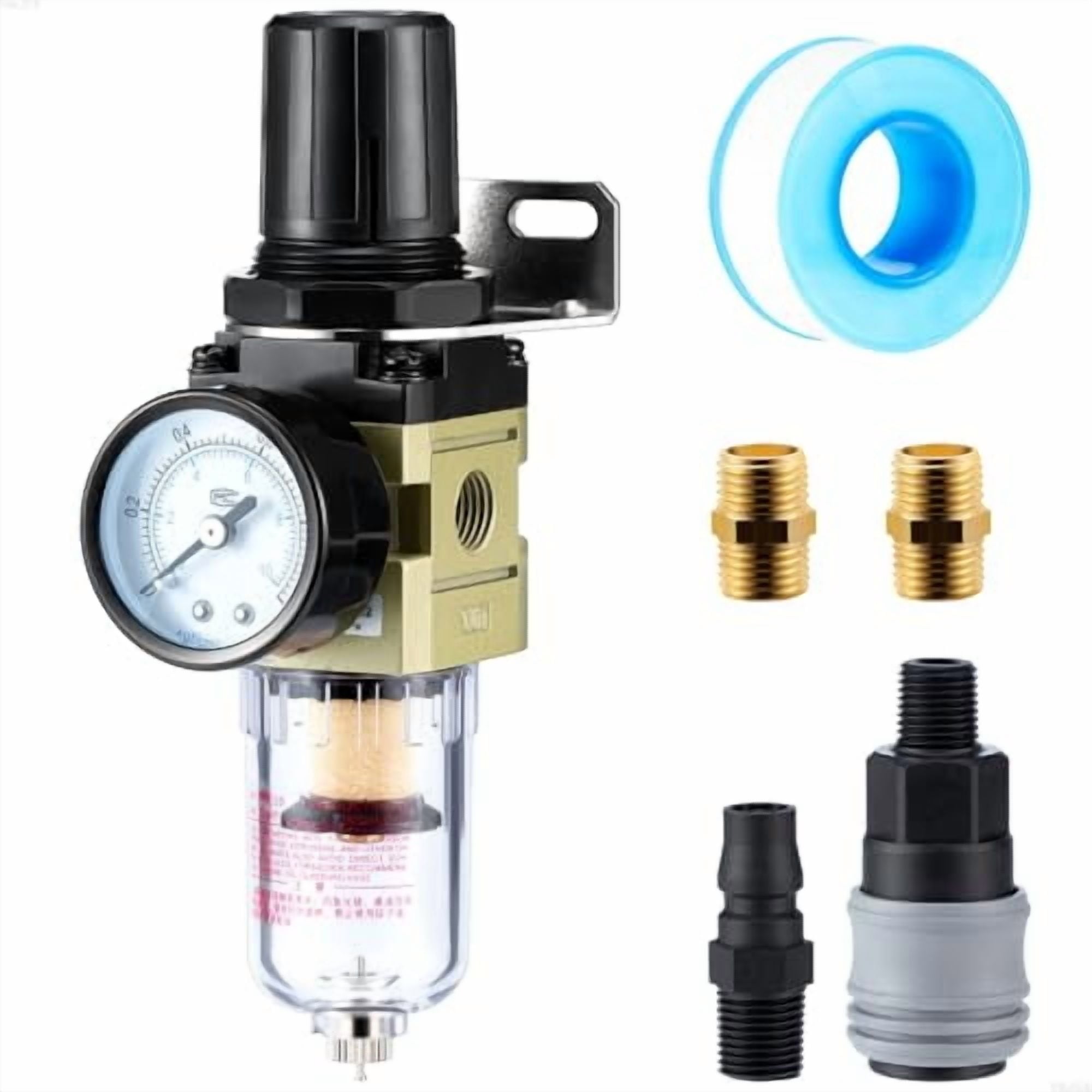
Hromee 1/4 in Filter Regulator AW2000-02
- A regulator at the cylinder is the only way to know what it really sees
- Header pressure with the rod stalled on a stop is the load it must survive
- Filtration keeps the gland and rod surface out of the failure story
As an Amazon Associate, TestTalkHQ earns from qualifying purchases. Prices and availability can change.
The cases that are not obvious
The load runs on its own guide, and everybody forgets to say so
A cylinder pushing a slide, a carriage on linear rails, a gate in a track — if that guide genuinely carries the load and stops it moving sideways or tilting, the rod end is guided, and you are in the best row of the table. A great many installations are sitting on a factor of four or sixteen that nobody has claimed, and are being specified with rods two sizes larger than they need.
Be strict about it, though. Guided means the load has its own bearing arrangement carrying it. A bush somewhere in the vicinity is not a guide. A worn linear bearing with visible play is not a guide. And if the guide can become a guide-in-name-only through wear, dirt or a loose fixing, then the rod is relying on maintenance to stay inside its rating, which is a different kind of design decision and worth making consciously.
A rod eye is pivoted, not guided
The most common over-claim. A rod eye on a pin stops the rod end wandering sideways, which is what “pivoted” means and it is worth a real factor. It does not stop the end rotating, so it is not guided. The difference between those two rows is a factor of two, and claiming the wrong one is how a rod that passed on paper ends up bowed.
Pivoting solves a problem the buckling table cannot see
The table is about column capacity. It says rigid-with-pivoted-rod is twice as good as pivoted-at-both-ends, which makes rigid look like the obvious pick whenever it is available. But a rigid body puts every misalignment straight into the rod as a bending moment, and misalignment is a far more common cause of bent rods than column buckling. A cylinder hanging on a clevis can align itself; a bolted flange cannot.
So the honest ranking is not simply the table. It is: rigid mounting is stronger on paper, and pivot mounting is more forgiving in a real machine. If the installation is machined, square, and demonstrably axial, take the rigid capacity. If it is a fabricated frame with slotted holes and a load that might not be exactly where the drawing says, the self-aligning arrangement is often the better engineering even though the number is lower.
Trunnions are a pivot with a catch
Trunnion mounting pivots the body about a point partway along it rather than at the end. Hänchen lists body trunnions and rod-side trunnions in the same rows as a rear clevis, so the factor is the same. What changes is the load path into the frame: trunnion bearings take the full thrust as a shear load at that point, and they need supporting properly. A trunnion mount on a flexible bracket is a pivot that also moves, which is the worst of both.
The arc case, where there is no choice
A cylinder driving a lever, a damper, a tailgate, a swinging arm. The angle between the cylinder and the load changes continuously through the stroke. Both ends must pivot, and any attempt to fix either of them means the rod is bent a little on every cycle. This is not a buckling question at all — it is a side load question, and side load is the more dangerous of the two because it accumulates rather than announcing itself.
A decision order that works
- Does the load path rotate through the stroke? If yes, pivot both ends. Stop here; there is no decision to make.
- Does the load already run on its own guide? If yes, say so and claim the factor — it is worth more than any other single choice available to you, and it removes side load as well. Rigid body plus guided load is the best row in the table.
- Is the installation genuinely square and axial? Machined mounting faces, a load that cannot wander, alignment you can measure. If yes, rigid mounting with a pivoted rod end gives you twice the capacity of pivoting both ends.
- Is it a fabricated frame with some slop in it? Then pivot both ends and take the lower number. A self-aligning arrangement that lives is better than a rigid one that bends rods.
- Run the arithmetic for the case you actually chose, not the one you hoped for. The rod buckling calculator carries all five rows; switching between them on the same rod and stroke shows the consequence immediately.
- Then check side load separately, from the cylinder manufacturer’s published figure for that series. The mounting choice changes it, and no general calculation covers it.
Frequently asked questions
Is rigid or pivot mounting stronger for a cylinder?
Neither, on its own — it depends on the rod end. Rigid mounting appears as both the worst case in the table (rigid body, free rod end, factor 0.25) and the best (rigid body, guided rod end, factor 4). Pivoting both ends sits in the middle at factor 1. The pair of end conditions sets the answer, never one of them alone.
When must I use a pivot mounting?
Whenever the line between the two attachment points rotates during the stroke — a cylinder driving a lever, a damper, a gate on a hinge, any swinging arm. Fixing either end in that situation feeds a bending moment into the rod on every cycle, and that is a side load problem rather than a buckling one.
What counts as a “guided” rod end?
The load has its own linear guide — a slide, rails, a bearing block — that carries it and prevents it from moving sideways or tilting, so the rod only ever pushes. A rod eye on a pin is pivoted, not guided; it stops the end wandering but lets it rotate. The difference between those two rows is a factor of two.
How much difference does the mounting really make?
Up to sixteen times the allowable rod load, for the same rod, the same stroke and the same pressure. The critical buckling load depends on the square of the effective length, and the effective length factor ranges from 2.0 down to 0.5 across the published table.
Are trunnion mounts treated as pivots?
Yes. Hänchen lists both body trunnions and rod-side trunnions with the same installation factors as a pivoted cap-side mounting. The difference is in the supporting structure: trunnion bearings carry the full thrust as a shear load at that point and need to be properly supported, or you have a pivot that also deflects.
Can I use a rigid mounting on a fabricated frame?
You can, but it is often the wrong call. A rigid body transmits every bit of misalignment straight into the rod as bending. If the frame is fabricated with slotted holes and the load is not demonstrably axial, a self-aligning pivot arrangement with a lower published capacity will frequently outlive a rigid one with a higher one.
Does the mounting choice change the air consumption?
No. Air consumption depends on bore, stroke and pressure, which the mounting does not touch — the cylinder air consumption calculator covers that separately. What the mounting can change is whether you need a bigger bore at all, and a bigger bore does raise the air bill on every cycle for the life of the machine.
If I guide the load, can I use a smaller rod?
Often yes, and it is the most effective single change available. Check it rather than assuming, though: cutting the effective length by four can drop a short-stroke rod below the slenderness transition, where the gain is real but smaller than the table’s factor of sixteen suggests. The calculator flags that when it happens.