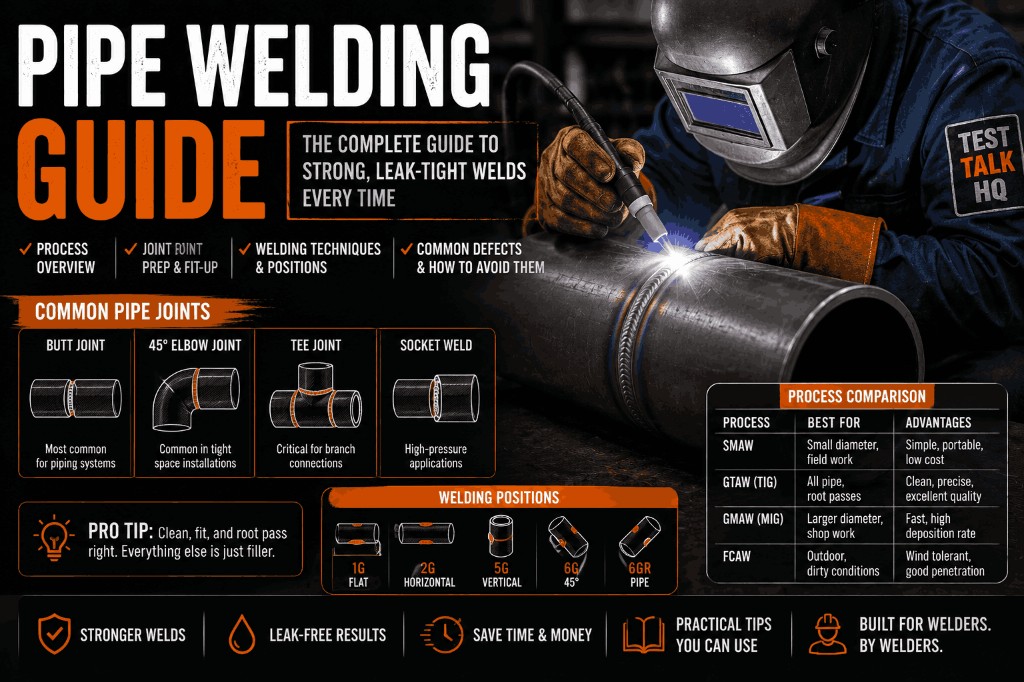
Pipe welding is where the money is — and where most welders get humbled. The joint doesn’t move, you do. Here’s how to approach it correctly from joint prep through the cap pass.
Pipe Welding Positions — What They Mean
Pipe welding positions are defined differently than plate positions. The number tells you how the pipe axis is oriented, and the letter tells you whether the pipe rotates.
A 6G certification qualifies you to weld in all positions on pipe. Most pipe welding certifications for structural and process piping require 6G. If you can pass a 6G test, contractors can put you anywhere on the job.
Joint Preparation
Pipe joint prep is not optional and not approximate. The AWS D1.1 structural code and ASME B31 pressure piping codes specify exact bevel angles, root face dimensions, and root opening gaps. Deviating from the WPS (Welding Procedure Specification) on a code job gets your welds rejected.
Standard V-Groove Bevel Specifications
| Wall Thickness | Joint Type | Bevel Angle (each side) | Root Face | Root Opening |
|---|---|---|---|---|
| Under 3/16″ | Square groove | 0° | Full wall | 0–1/16″ |
| 3/16″ – 3/4″ | Single V-groove | 37.5° | 1/16″ – 1/8″ | 1/16″ – 1/8″ |
| 3/4″ – 1-1/2″ | Single V-groove | 37.5° | 1/8″ | 3/32″ – 1/8″ |
| Over 1-1/2″ | Double V or U-groove | 37.5° (or per WPS) | Per WPS | Per WPS |
Cut bevels with a pipe beveling machine, angle grinder with a flap disc, or oxy-acetylene torch followed by grinding. Machine-cut bevels are more consistent. Grinder bevels work but require more care to hit the right angle and keep the root face consistent.
A poor fit-up on pipe is harder to fix than on plate because you can’t easily clamp the pipe straight after tacking. Check root opening at 12, 3, 6, and 9 o’clock positions. Consistent gap around the full diameter is more important than hitting the exact target — variation in root opening causes burn-through in some spots and lack of fusion in others.
Process Selection for Pipe Welding
The right process depends on the application — structural vs pressure, schedule (wall thickness), accessibility, and whether the job requires a specific WPS.
- E6010 or E6011 root pass (DC+, cellulosic)
- E7018 fill and cap (low hydrogen)
- Works in all positions and conditions
- No shielding gas — wind tolerant
- Slower deposition than FCAW
- Preferred on structural steel pipe per AWS D1.1
- TIG root pass — full penetration, smooth inside bead
- SMAW or GMAW fill and cap
- Required on most process and pressure pipe
- ASME B31.1 and B31.3 code work
- Slower — but the root quality is unmatched
- Purge gas (argon) required on stainless and alloy pipe
- High deposition rate for fill passes
- Not suitable for root pass on most pipe
- E71T-1 or E71T-8 common choices
- Wind sensitive — needs windscreens outdoors
- Good for large diameter, heavy wall pipe
- Spray transfer for fill on thick wall
- Short circuit for thin wall and root
- Wind sensitive — shop use primarily
- Not accepted on all pipe codes
- Faster than SMAW when conditions allow
Root Pass — The Most Critical Pass
The root pass determines the quality of everything that comes after it. A poor root — lack of fusion, burn-through, excessive concavity — cannot be fixed by subsequent passes. It has to be gouged out and redone.
SMAW Root Pass with E6010
E6010 is the electrode of choice for SMAW root passes on structural pipe. It runs on DC+ (DCEP), has a forceful, penetrating arc, and works well in all positions including vertical-down on thin wall. The cellulosic coating burns off quickly and produces a fast-freezing slag that supports the puddle overhead and vertical.
For SMAW root with E6010 3/32″ on Schedule 40 pipe: start at 70A. If you’re burning through, drop to 65A. If you’re not getting penetration, go to 75–80A. Wall thickness matters more than pipe diameter for root amperage selection.
GTAW Root Pass
TIG root passes on pressure pipe require consistent torch angle, consistent travel speed, and a steady filler addition rhythm. The inside bead must be smooth and slightly convex — concavity (suck-back) fails inspection on pressure pipe. Use ER70S-2 or ER70S-6 filler on carbon steel pipe.
Purge the inside of the pipe with argon before starting the root pass on stainless steel, chrome-moly, or any alloy pipe where oxidation on the inside bead is a code concern. The purge maintains a positive argon pressure inside the pipe during welding — typically 5–10 CFH flowing through the pipe from one end while the other end is sealed.
Fill and Cap Passes
Once the root is complete and cleaned, fill passes build the joint up to near-flush with the base metal. The cap pass finishes the joint and must meet the profile requirements of your welding code — typically a slight crown of 1/16″ to 1/8″ above the base metal surface with full tie-in to both pipe edges.
| Pass Type | Electrode / Filler | Amperage Range | Key Technique Point |
|---|---|---|---|
| Root (SMAW) | E6010 3/32″ | 65–90A | Maintain keyhole, consistent travel |
| Hot pass | E6010 1/8″ | 90–120A | Burns out trapped slag from root, use immediately after root |
| Fill (SMAW) | E7018 1/8″ | 110–150A | Weave or stringer — keep interpass temp in range |
| Fill (SMAW) | E7018 5/32″ | 140–180A | Larger electrode for faster fill on heavy wall |
| Cap (SMAW) | E7018 3/32″ or 1/8″ | 90–130A | Full tie-in to both toes, 1/16″–1/8″ crown |
On structural pipe per AWS D1.1, maximum interpass temperature is typically 400–500°F. On chrome-moly and alloy pipe, interpass limits are tighter and material-specific. Check your WPS before starting fill passes — letting the joint cool too much or get too hot both cause problems.
Common Pipe Welding Problems and Fixes
- Burn-through on root pass — reduce amperage, increase travel speed, reduce root opening if it’s on the wide side. On thin wall, switch from 3/32″ to 1/16″ electrode.
- Lack of fusion at root — increase amperage slightly, slow travel speed, verify root opening is sufficient (minimum 1/16″). Make sure root face is not too large.
- Concavity (suck-back) on root — most common on TIG root passes. Slightly increase filler addition or reduce travel speed to add more weld metal to the root. Also occurs when cooling too fast — preheat if needed.
- Slag inclusions in fill passes — incomplete slag removal between passes. Always chip and brush. On difficult-to-reach areas (narrow groove, overhead), use a needle scaler or pointed chisel.
- Undercut at cap toes — too high amperage for the cap pass, or torch angle too steep into the toes. Reduce amperage and direct the arc more toward the weld center on the cap.
- High-low misalignment — poor fit-up. Fix it before welding. High-low creates a stress concentration that fails under fatigue loading. The code limit is typically 1/8″ maximum mismatch.
Pipe Welding Certification Tests
Pipe welding certifications are issued per welding procedure, position, process, and material group. A single certification doesn’t cover everything — you may need multiple tests for different job requirements.
| Test | Positions Qualified | Code | Common Application |
|---|---|---|---|
| 2G pipe test | 1G, 2G | AWS D1.1, ASME | Fixed horizontal pipe, rotating pipe |
| 5G pipe test | 1G, 5G | AWS D1.1, ASME | Fixed horizontal structural pipe |
| 6G pipe test | All positions | AWS D1.1, ASME | Any pipe welding application |
| 6GR pipe test | All positions + restricted | ASME only | Restricted access joints, boilers |
Test pieces are typically 6″ Schedule 40 (0.280″ wall) carbon steel pipe. After welding, test coupons are cut from the pipe and subjected to bend tests — face bend and root bend — and sometimes radiographic (X-ray) or ultrasonic testing depending on the code.
Need amperage, electrode size, and bevel specs for your pipe? Use our pipe welding calculator — enter pipe schedule, diameter, and process to get starting parameters.
WeldKit — Welding Calculators for the Shop
Pipe welding parameters, heat input, preheat temperature, wire feed, deposition rate, and more. Free on Android. Works offline on the job.
Related Calculators & Guides
When starting amps matched the chart but welds still fail, see Pipe Welding Troubleshooting.
Welding
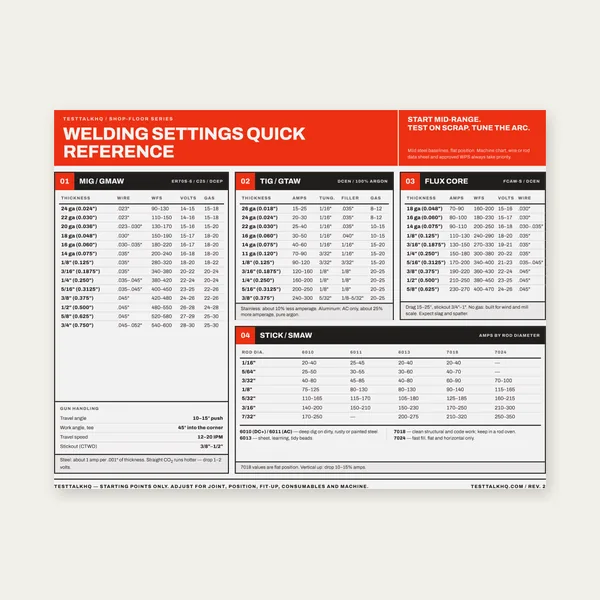
Welding Reference Card
One page. MIG, TIG, stick and flux core settings by thickness.
$3.99
Buy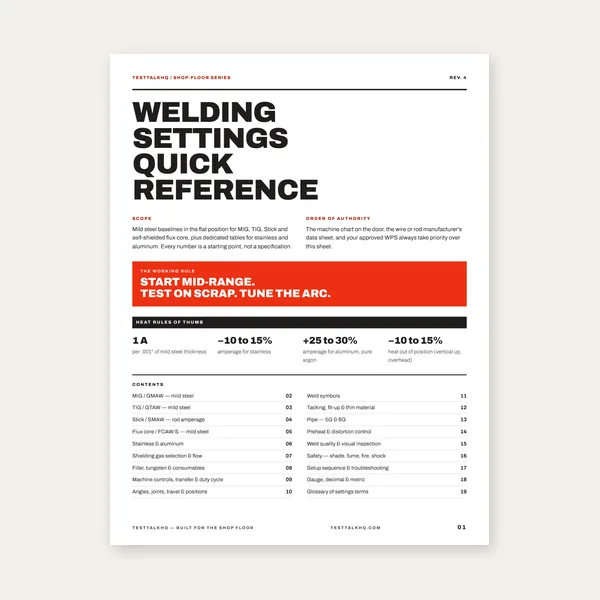
Complete Welding Settings Guide
19 pages. Four processes, stainless and aluminum, symbols and inspection.
$12.99
Buy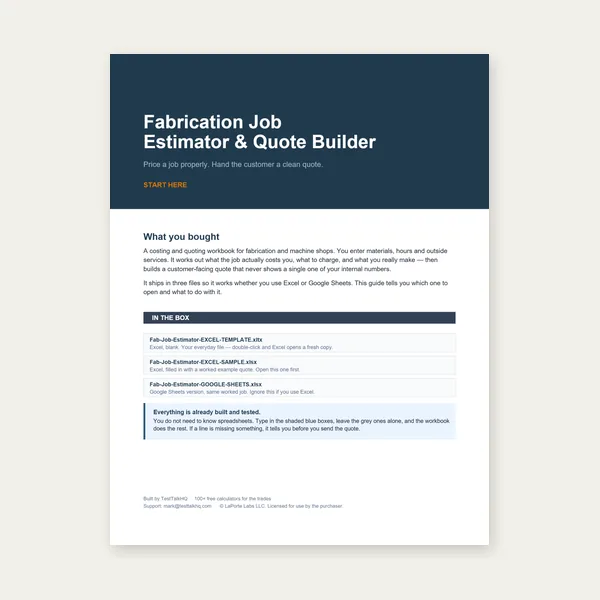
Welding Job Estimator
Price the job, then hand over a quote with no internal numbers.
Excel or Google Sheets. Best on a computer.
$29.00
Buy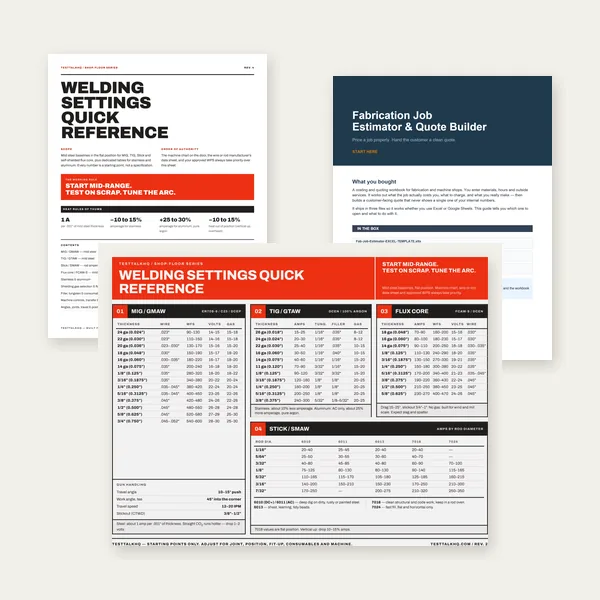
Welding Complete Bundle
Card, 19-page guide and the estimator workbook. All six files.
Excel or Google Sheets. Best on a computer.
$34.99
$45.98 if bought separately — save $10.99
BuyCheckout opens in a new tab.