
Pipe schedule wall thicknesses, bevel/root defaults, and process electrode stacks from the pipe welding calculator.
How to Use This Chart
Wall thickness (not NPS OD) drives amps and pass count. Starting points only — weld to a qualified WPS on code work. Calculator: pipe welding calculator. Guide: pipe welding guide.
Schedule Changes Wall — Wall Changes Bevel and Root Gap
NPS is a name, not a thickness. 4″ Sch 10 and 4″ Sch 80 share an outside diameter; the bore and the weld joint do not. Heat input, number of passes, and whether you can get away with a square groove are all functions of wall, not of “four-inch pipe.” That is why the first table is wall by NPS and schedule, and the second table splits at 0.187″ (about 3/16″).
Below about 3/16″ wall, a square groove or a light 37.5° bevel with little or no land is common because there is not enough thickness to machine a full V without starving the remaining wall. Root opening still matters: too tight and you lack penetration; too wide and you burn through or leave a sunk root that fails visual and RT. At 3/32″ opening with a 0–1/16″ face, the idea is a keyhole you can close with the root process you actually qualified — not a universal gap for every shop.
At 0.187″ and up, the 37.5° bevel (75° included) with a 1/16″ land and 3/32″ opening is the shop default this chart inherits from the calculator. The land (root face) keeps the root from melting out; the opening lets the root pass consume the land and fuse the ID. If you grind the land off “to be sure of penetration,” you often get a drop-through icicle instead. If you close the gap to zero on heavy wall, you get lack of fusion at the root that only shows on RT. Fit-up tolerance of ±1/32″ on opening is already enough to change amperage and rod angle; treat the table as the target, not a range you can ignore.
Heavier schedules (Sch 80, Sch 160) do not automatically want a steeper bevel. They want more fill passes, tighter heat-input control, and often a different root process. The bevel angle stays in the same neighborhood so the welder’s technique transfers; the extra metal is deposited, not cut away by grinding a 20° included angle that nobody can see into.
How Process Choice Shifts the Numbers
The electrode-stack table is four qualified-looking combinations, not a menu you mix mid-joint. SMAW root / SMAW fill (E6010 root, E7018 fill) is the classic downhill or uphill stick pipe joint. E6010’s digging arc and fast-freeze slag can run a root in a 3/32″ gap that 7018 would bridge or stick in. You pay for that with more skill on the keyhole and more hydrogen/moisture discipline on the 7018 fill. Amps for the root are set by 3/32″ 6010, not by wall thickness — wall only changes how many 7018 passes follow.
GTAW root / SMAW fill (ER70S-2 root, E7018 fill) is what shops run when the ID must be clean, the root pass must be radiographable, or the WPS forbids cellulosic rod. A TIG root wants a tighter, more consistent gap, argon purge on stainless and often on carbon when the ID finish matters, and a slower travel speed. You typically do not open the gap extra “because TIG is colder”; you fit to the WPS and let the puddle wet the land. The 7018 fill after a TIG root is the same as after 6010 only in electrode class — the joint is already closed, so fill technique is about tie-in, not about saving a missed root.
GTAW / GTAW is all-TIG: common on stainless sanitary, small-bore, and thin wall where a 7018 cap would be overkill or prohibited. Argon on both sides. SMAW / FCAW is a production fill after a stick root — faster fill, different slag and gas (or self-shielded FCAW, which this chart’s “FCAW gas” row does not fully cover). Do not substitute FCAW for the root unless the WPS says so; most pipe codes still want an open-root process that can prove ID fusion.
If the chart and the WPS disagree, the WPS wins. If you do not have a WPS, you are not on code work — scrap-tune, then write the procedure before you weld the spool.
1G–6G Positions (Why the Chart Does Not Change)
Pipe positions are not plate 1F–4F. 1G is pipe rolled, axis horizontal, weld at the top — the easy shop position. 2G is pipe axis vertical, weld a horizontal groove. 5G is pipe axis horizontal, pipe fixed (weld goes from overhead through vertical to flat as you travel). 6G is pipe axis at 45°, fixed — the qualification position that covers the others for many codes. 6GR adds a restriction ring.
This chart’s bevel, gap, and electrode stacks do not change with position. What changes is amperage (often slightly lower overhead), travel, and whether you can even run 6010 downhill. A 6G coupon uses the same 37.5° / 3/32″ starting geometry as 1G; the welder’s qualification is the variable. Do not flatten the bevel or widen the gap to “make 6G easier” unless the engineer changed the WPS.
Selected NPS Wall Thickness (in)
| NPS | Sch 10 | Sch 40 | Sch 80 | Sch 160 |
|---|---|---|---|---|
| 2″ | 0.109 | 0.154 | 0.218 | 0.344 |
| 3″ | 0.120 | 0.216 | 0.300 | 0.438 |
| 4″ | 0.120 | 0.237 | 0.337 | 0.531 |
| 6″ | 0.134 | 0.280 | 0.432 | 0.719 |
| 8″ | 0.148 | 0.322 | 0.500 | 0.906 |
Bevel / Root Defaults
| Wall | Bevel | Root face | Root opening |
|---|---|---|---|
| Wall < 0.187″ | Square groove or 37.5° | 0–1/16″ | 3/32″ |
| Wall ≥ 0.187″ | 37.5° (75° included) | 1/16″ | 3/32″ |
Process Electrode Stacks
| Process | Root | Fill/cap | Gas |
|---|---|---|---|
| SMAW / SMAW | E6010 3/32″ | E7018 1/8″ | No |
| GTAW / SMAW | ER70S-2 3/32″ | E7018 1/8″ | Argon root |
| GTAW / GTAW | ER70S-2 3/32″ | ER70S-2 1/8″ | Argon |
| SMAW / FCAW | E6010 3/32″ | E71T-1 .045″ | FCAW gas |
Amps, electrodes, bevel, and pass sequence
WeldKit — Welding Calculators Offline
MIG, TIG, Stick, speeds/feeds, and more on Android.
Related Calculators & Guides
Welding
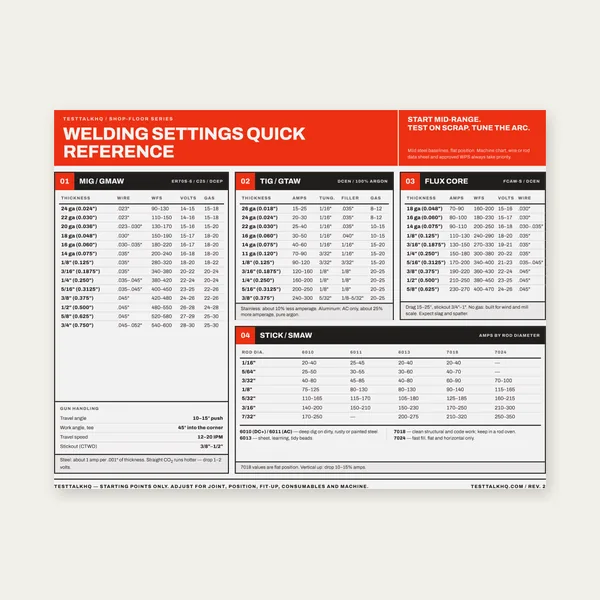
Welding Reference Card
One page. MIG, TIG, stick and flux core settings by thickness.
$3.99
Buy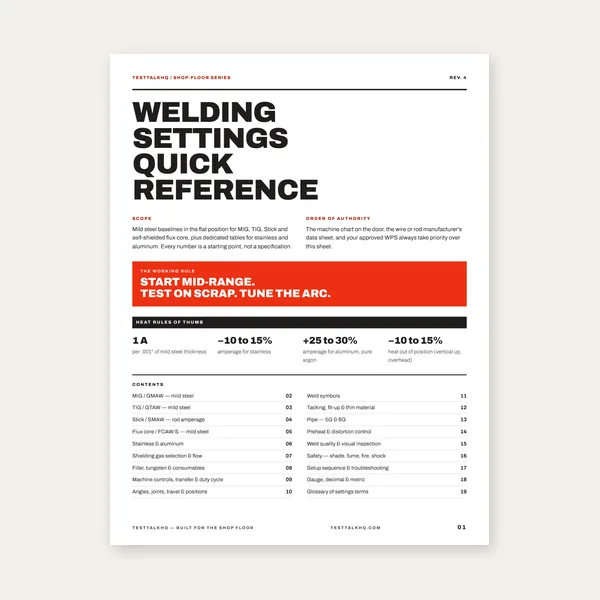
Complete Welding Settings Guide
19 pages. Four processes, stainless and aluminum, symbols and inspection.
$12.99
Buy
Welding Job Estimator
Price the job, then hand over a quote with no internal numbers.
Excel or Google Sheets. Best on a computer.
$29.00
Buy
Welding Complete Bundle
Card, 19-page guide and the estimator workbook. All six files.
Excel or Google Sheets. Best on a computer.
$34.99
$45.98 if bought separately — save $10.99
BuyCheckout opens in a new tab.