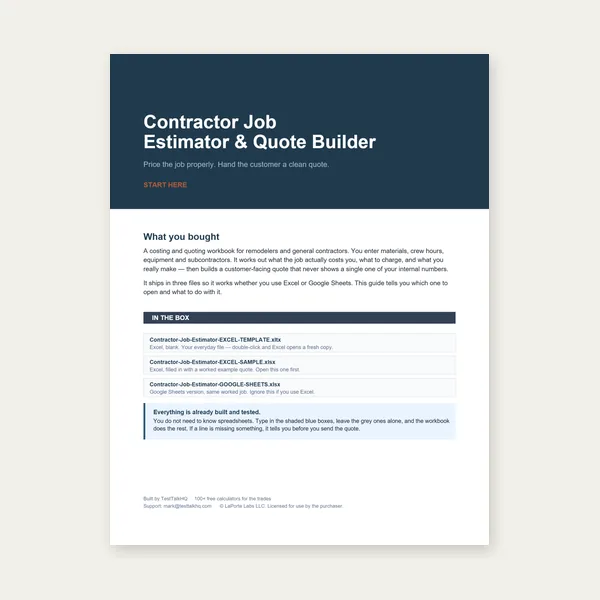
Contractor Job Estimator
Price remodels and GC work, then send a quote with no internal numbers.
Excel or Google Sheets. Best on a computer.
$29.00
BuyNominal width instead of coverage, forgotten trim lineal, and seam overlap you never put in the takeoff
Most short metal orders come from three mistakes — not from a bad pitch multiplier. Run the panel calculator with true coverage width, then audit the list below before you submit the PO.
How coverage works: guide. Metal vs asphalt: comparison. Asphalt worksheet: shingle calculator.
If the brochure says “38 in panel” and you divide the eave by 38/12, you ignored the lap. Coverage might be 36 in. On a long eave that is whole panels missing. Mid Florida Metal Roofing Supply and every manufacturer TDS call out net coverage for this reason.
Panels cover the field. Ridge, hip, valley, eave, gable, sidewall, and transition flashings are separate lineal orders — often stocked in 10–12 ft sticks with their own waste. A perfect panel count with zero ridge still leaves the roof unfinished.
Side lap is baked into coverage width when you use the TDS number. End lap (when panels do not run full eave-to-ridge) adds length you must buy. Standing seam end details and exposed-fastener end laps are different details — both consume material beyond a naive area ÷ sheet-area math if you used overall dimensions.
Buying 12 ft stock for a 16 ft run forces splices or waste. Mill-cut to slope length usually lowers field waste — but only if the length on the PO matches the measured slope run (plan depth × pitch multiplier for that plane).
Re-run the takeoff with coverage + length.Pitch multiplier and waste included.
Open Calculator →No — fastener counts are profile- and substrate-specific. Exposed-fastener roofs need painted hex-washer screws; standing seam needs clips.
Squares give area. You still need coverage width and panel length. Start from area in the panel calculator’s measured-surface mode.
Price remodels and GC work, then send a quote with no internal numbers.
Excel or Google Sheets. Best on a computer.
$29.00
BuyCheckout opens in a new tab.
A coverage-width takeoff is a number until you cut, seam, and fasten the panels. Snips, a hand seamer, and painted hex-washer screws are how standing seam and exposed-fastener roofs leave the truck.
Self-tapping hex-washer head screws with sealing washers for exposed-fastener / R-panel installs. Standing seam uses concealed clips instead — still keep stitch screws for trim.
View on Amazon →
Malco M2006 left-offset snips for flashing, valleys, and the last panel cut. Metal panels are not shingles — you trim sheet, not tear tabs.
View on Amazon →
Malco S2R hand seamer for folding hem edges and detailing standing-seam / trim bends on the roof when a full seaming machine is not on the job.
View on Amazon →
Malco TS1 drill attachment for long straight cuts in sheet. Faster than hand snips when you are trimming a stock-length panel down to a hip cut.
View on Amazon →
Asphalt is sold by the square and the bundle. Run the shingle takeoff before you pick a material.
Open Shingle Bundle Calculator →
Coverage width, custom panel length, pitch multiplier, and waste — not a shingle-bundle worksheet.
Open Metal Panel Calculator →As an Amazon Associate, TestTalkHQ earns from qualifying purchases.