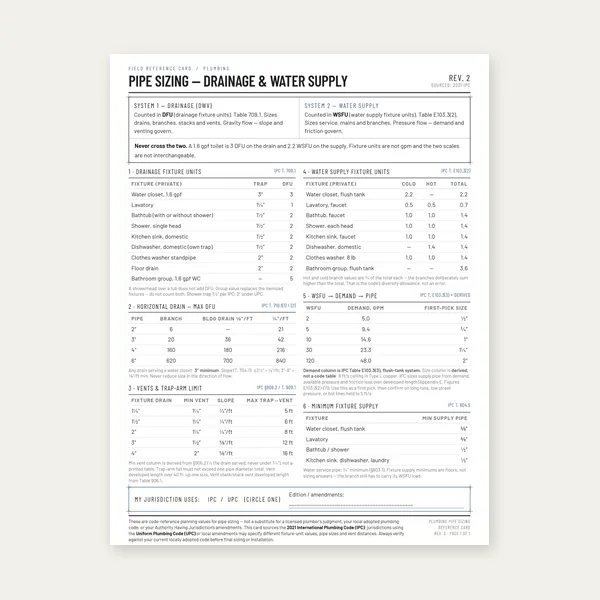
Plumbing Pipe Sizing Card
$3.99
BuyBoth methods live in NFPA 54 / IFGC. One is simple and conservative. The other can shrink short branches when you size each segment to its own load and length.
This site’s gas pipe sizing calculator implements longest-length capacity tables. Method details: guide. When the field already failed: troubleshooting. Loads: furnace, water heater. Plumbing index: hub.
Need a quick longest-length size? The widget is built for that method. Branch-length still needs a segment-by-segment worksheet.
Open Gas Pipe Calculator →Measure from the meter (or regulator) to the farthest appliance. Add fitting equivalent length. Round up to the next table row. Use that single length to size every pipe on the path that carries the total or remaining connected load, depending on how you structure the takeoff. In the common field simplification: the whole trunk is sized as if every foot were that long.
Wins: Fast, easy to check on a sketch, hard to accidentally under-size a far appliance, matches how many inspectors were taught to spot-check. The TestTalkHQ calculator is this method.
Costs: Short branches get the same length row as the long run, so you may buy larger pipe than a branch-length worksheet would allow. On a sprawling ranch with a 120 ft furnace run and a 8 ft dryer stub, longest-length is blunt.
NFPA 54 / IFGC also allow sizing each section using the length of that section and the load that section actually carries. A short branch to a 40,000 BTU water heater can use a short table row and often a smaller diameter, while the long trunk to a distant furnace still uses a long row and a larger size.
Wins: Material savings on short, light branches. Cleaner match to how pressure drop actually accumulates when loads leave the trunk.
Costs: More worksheet work. Easy to mis-assign load (forgetting that a trunk section still carries everything downstream). Harder for a rushed inspection if the drawing is messy. This website does not automate a full branch-length tree — you still need a segment sketch.
$3.99
Buy
$12.99
Buy
$29.00
Buy
$39.00
BuyCheckout opens here — you stay on this page.
After you size the pipe, prove the joints and the pressure. Leak detectors, bubble solution, thread compound, and manometers from the live TestTalkHQ affiliate CSV only.
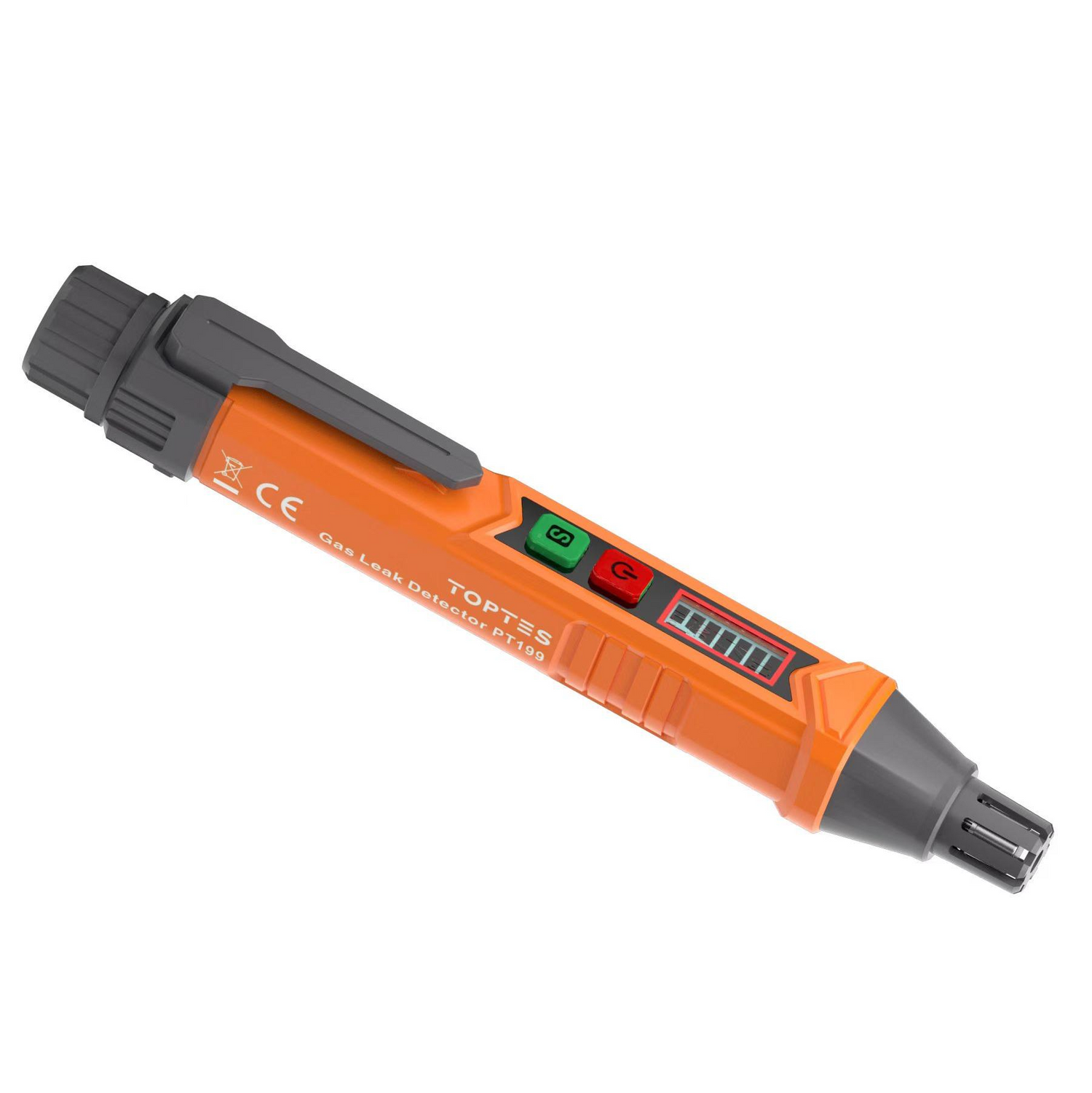
Audible/visual sniff test along joints, CSST fittings, and appliance connectors after a pressure test or a repair.
View on Amazon →
Brush-on bubble solution for threaded joints and flare fittings when the electronic sniffer is quiet but you still want eyes on the joint.
View on Amazon →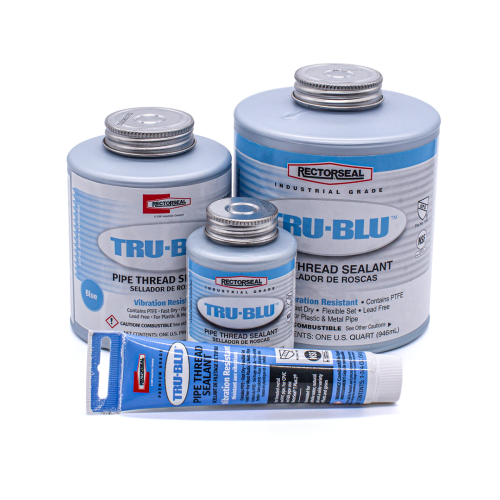
Listed pipe-thread compound for metallic gas pipe. Pair with NPT makeup from the NPT calculator — compound is not a substitute for correct thread engagement.
View on Amazon →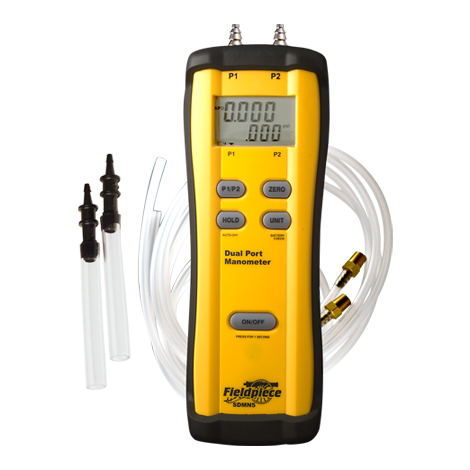
Inches of water column at the meter, manifold, and appliance inlet — the field check after a capacity table says the pipe is big enough.
View on Amazon →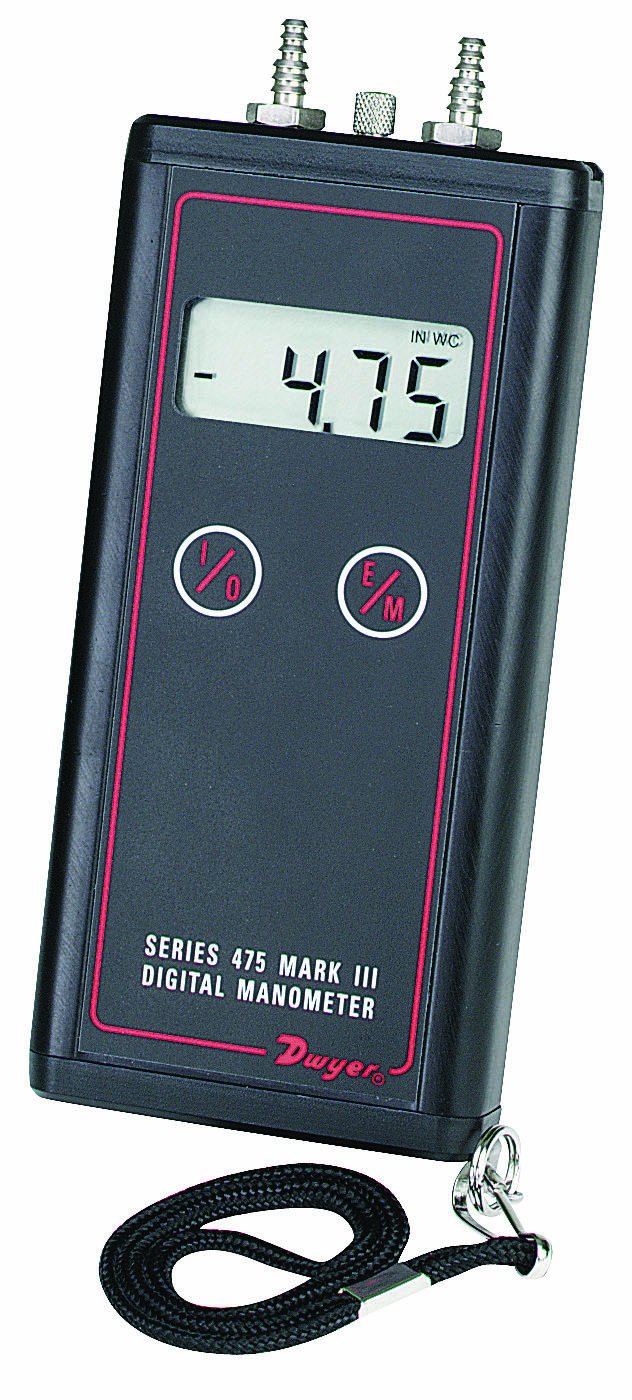
Handheld differential pressure for standing and operating pressure checks on natural gas and propane systems.
View on Amazon →As an Amazon Associate, TestTalkHQ earns from qualifying purchases. Product links are from the live TestTalkHQ affiliate CSV only.
| Question | Longest-length | Branch-length |
|---|---|---|
| What length enters the table? | Path to farthest appliance (+ fittings), used broadly on the path | Length of the segment being sized (+ fittings) |
| What load enters the table? | Connected load for that sizing step (often total on the trunk) | Load that segment actually supplies downstream |
| Speed | Fast | Slower; needs a tree |
| Risk of under-size | Lower if you measured the far appliance | Higher if a trunk load is understated |
| Risk of oversize short branches | Higher | Lower |
| Inspector familiarity | Very high | Accepted when documented |
| On TestTalkHQ calculator | Yes | Manual worksheet only |
Either method still needs the correct gas/material table (IFGC 402.4 family / IRC G2413), fitting adders, and a meter that can deliver the BTU sum. Method theory without the table walkthrough: guide.
Many designers size the main with longest-length thinking, then check short branches with branch-length to see if a size reduction is legal and worth the fitting change. Others size everything longest-length and only “optimize” when material cost or clearance forces it. Hybrid is fine when each segment’s load and length are honest.
Starting with longest-length? That is what the live calculator is built to do.
Gas Pipe Calculator →Not when done correctly. It is less forgiving of sloppy load assignment. Longest-length builds in conservatism on short branches by using a long table row.
Often yes if listings and transition fittings allow it — but size each material from its own table. Do not convert diameters by nickname.
No. It implements longest-length capacity lookup. Use a segment sketch for branch-length, or enter a single segment’s load and length as a one-off longest-length check on that piece.
Both need developed length. Undercounting elbows is a top field failure — see troubleshooting.