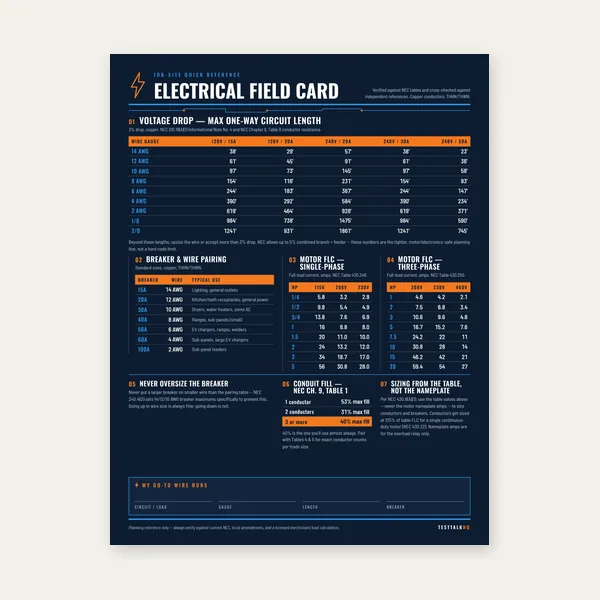
Electrical Reference Card
One page. Voltage drop lengths, breaker and wire pairing, motor FLC.
$3.99
BuyTwo different jobs — both required. Neither substitutes for the other.
Grounding and bonding sound interchangeable. They are not. Grounding (electrode system) connects the electrical system to the earth. Bonding connects metal parts together so they stay at the same potential. A ground rod alone does not make a pool, panel, or gas pipe safe if bonding is missing.
Size the grounding electrode conductor with the Grounding Electrode Conductor Calculator and read the GEC Sizing Guide for Table 250.66 details.

The grounding electrode system — ground rods, concrete-encased electrodes (Ufer), metal underground water pipe, building steel — provides a reference to earth. The grounding electrode conductor (GEC) connects the system grounded conductor (neutral) and equipment grounding system to those electrodes. Earth is not a return path for normal load current or the intended path for clearing branch-circuit faults. The electrode system stabilizes voltage to earth and helps handle lightning, surges, and accidental contact with higher-voltage systems.
NEC Article 250 Part III covers electrode types and installation. Branch-circuit fault clearing depends on the low-impedance bonding and equipment-grounding path back to the source — not on soil resistance. The grounding electrode system serves the different jobs of system voltage stabilization and dissipation of lightning and surge energy.
Bonding joins normally non-current-carrying metal parts — panel enclosures, raceways, equipment frames, metal piping systems — to the equipment grounding conductor (EGC) network. Bonding ensures that all metal parts rise to the same voltage during a fault. If a hot conductor contacts a bonded metal enclosure, the fault current returns on the EGC, trips the breaker, and the enclosure does not sit at line voltage relative to other touched metal.
Main bonding jumper, system bonding jumper, and equipment bonding jumpers are all bonding — not "grounding" in the electrode sense. The green or bare wire in branch circuits is an equipment grounding conductor that bonds devices and boxes back to the panel, where the main bonding jumper connects the EGC network to the grounded (neutral) conductor at the service.
Grounding without bonding: Electrodes connect the system to earth, but isolated metal parts — a disconnected gas pipe, an unbonded pool ladder, a separately grounded generator frame — can still float to dangerous voltage during a fault. Earth connection does not pull remote metal to the same potential as the panel enclosure.
Bonding without grounding: Metal parts may still provide a fault-return path, but the system lacks the required earth reference for voltage stabilization and surge/lightning behavior. Fault clearing remains a bonding/EGC function. NEC requires both systems for their separate jobs.
A single ground rod has resistance to earth — often 25 ohms or more in dry soil. That is far too high to clear faults by itself. Safety comes from the fault returning on the low-impedance EGC back to the panel, not from current diving into dirt. Electrodes supplement the system; they do not replace bonding and EGC paths.
At the service main bonding point, grounded (neutral) and the EGC network connect — once. On branch circuits, neutral carries return current; ground does not (except during faults). Connecting neutral to ground downstream of the service creates parallel neutral paths, dangerous on metal parts, and is a code violation.
Where metallic systems exist — even short metal stubs, water heaters, furnace cabinets — bonding requirements still apply to the metal portions. NEC 250.104 covers bonding of piping systems and structural metal.
A missing bond on a metal gas pipe or pool shell means a line-contact fault elsewhere can energize that metal at full line voltage while the breaker does not trip — because return current has no low-impedance path. Touching the energized metal and something grounded (wet concrete, grass, a kitchen sink) completes the circuit through a person. This is how bonding failures kill — not because the ground rod was too short, but because metal parts were not tied to the EGC system.
Loose main bonding jumpers, corroded ground bars, and illegal neutral-to-ground bonds in subpanels (where neutral must be isolated) are field defects inspectors flag repeatedly. Each creates a path for current on metal that should only carry fault current briefly.
The GEC is sized from NEC Table 250.66 based on the size of the largest ungrounded service-entrance conductor — not the load, not the panel rating. A 2/0 copper service entrance requires a #4 copper GEC minimum (subject to electrode-type caps in 250.66(A)–(C)). The GEC Calculator applies those table values and electrode caps automatically.
GEC sizing is separate from EGC sizing on branch circuits (Table 250.122). Confusing the two is common: the fat wire to the ground rod is not the same rule as the green wire in your 12/2 Romex. Use the EGC Calculator and EGC Guide for Table 250.122. The GEC Sizing Guide walks through both paths.
Bonding conductor sizing for specific applications (pools, transformers, hazardous locations) references other NEC sections — 680.26 for pools, 250.102 for grounded conductor and main bonding jumper sizing at the service. When in doubt, size bonding per the article governing the installation type.
Colloquially people call it the ground wire. Technically it is an equipment grounding conductor that bonds devices and boxes to the system. It becomes part of the bonding network back to the panel.
Not typically — the EGC back to the main panel provides the fault path. Separate electrodes at outbuildings are a special case (250.32). The building GEC system is established at the service, not repeated at every subpanel.
NEC 250.104(B) requires bonding of metal gas piping that could become energized. The intent is the same: keep metal at equipotential so a fault elsewhere does not leave the pipe at line voltage.
One page. Voltage drop lengths, breaker and wire pairing, motor FLC.
$3.99
Buy
15 pages. Ampacity, corrections, voltage drop, motor circuits, conduit fill.
$12.99
Buy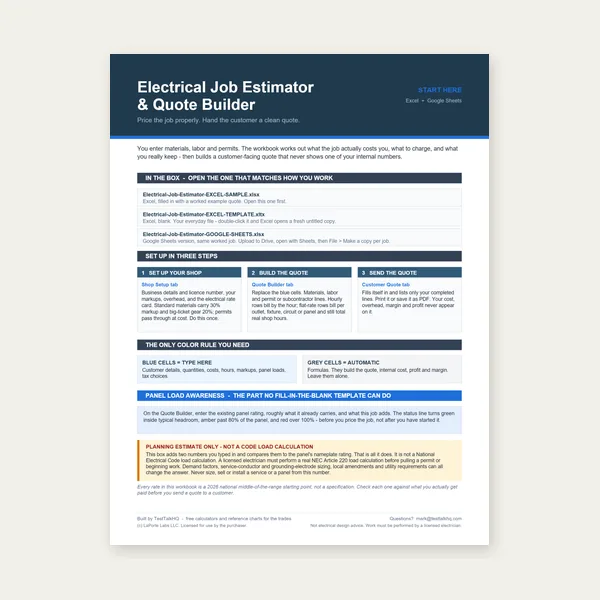
Quote electrical work and flag panel headroom before you price it.
Excel or Google Sheets. Best on a computer.
$29.00
Buy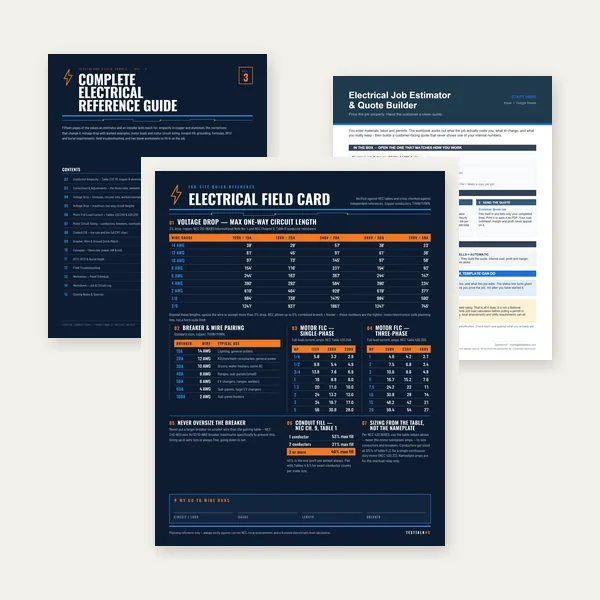
Card, 15-page guide and the estimator workbook. All six files.
Excel or Google Sheets. Best on a computer.
$34.99
$45.98 if bought separately — save $10.99
BuyCheckout opens in a new tab.
Test continuity, verify connections, and prep bonding conductors

Low-impedance ohms and continuity checks across bonding jumpers, ground bars, and electrode connections — verify the bond path is intact after service work.
Check Price
Non-contact check for unexpected voltage on metal enclosures, pipes, and pool equipment before you touch bonded surfaces during troubleshooting.
Check Price
Clean terminations on GEC and EGC conductors matter — poor crimps and nicked copper raise resistance in the bonding path you are trying to verify.
Check Price
Required at aluminum-to-copper bonding connections per manufacturer listing. Oxidation at bonding lugs is a silent failure point on GEC and EGC terminations.
Check Price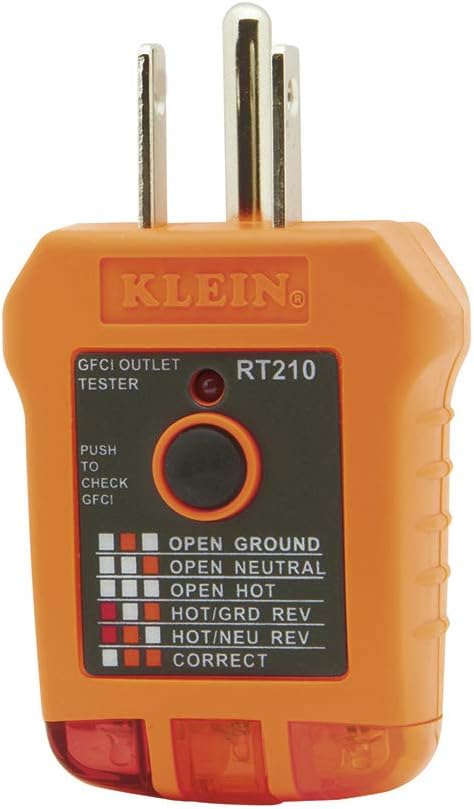
Open-ground indications on receptacles often trace back to bonding failures upstream — a fast screen before you pull covers hunting a loose EGC.
Check PriceAs an Amazon Associate, TestTalkHQ earns from qualifying purchases.
NEC 680 bonding requirements create an equipotential grid tying pool shells, ladders, pumps, and surrounding metal within prescribed distances. This is bonding logic at its most visible: every touchable metal surface must be at the same potential so swimmers never become the current path. A ground rod at the pool equipment pad does not accomplish that — the copper bonding conductor network does.
While the GEC connects to electrodes, branch-circuit equipment grounding conductors are sized from NEC Table 250.122 based on overcurrent device rating. A 20-amp circuit needs a 12 AWG copper EGC minimum. Upsizing ungrounded conductors without upsizing the EGC violates 250.122(B) when the OCPD is larger. The Wire Ampacity & Derating Calculator handles conductor ampacity; pair it with Table 250.122 for the full picture. When an EGC size “should” pass and still fails inspection or continuity, use EGC Troubleshooting — and keep electrode work on the GEC Calculator (Table 250.66), not 250.122.
Verifying bonding with a meter on de-energized equipment is within reach of informed owners. Installing main bonding jumpers, bonding gas pipe, pool grids, or correcting subpanel neutral isolation requires a licensed electrician and often a permit. Bonding errors kill quietly — get professional help for anything beyond simple continuity checks.