There is a hard minimum under every compressor: the power the job would take if the machine were perfect. It is calculable to three decimal places, it is the same for every manufacturer, and it is the only fair yardstick anyone has. The gap between that floor and what your meter actually reads is the whole of compressor efficiency, and on published machines that gap ranges from a factor of 1.2 to a factor of 1.9 for exactly the same air at exactly the same pressure. This is how to work out which end of that range you are on, and what to do about it.

Three numbers, and only one of them is comparable
Ask a compressor salesman how efficient a machine is and you will get one of three answers. Horsepower, which is a motor rating and tells you almost nothing. Specific power in kilowatts per 100 cfm, which is genuinely useful and is what your electricity bill responds to. Or isentropic efficiency, which is the only one of the three you can carry between two machines quoted at different pressures and still be making a fair comparison.
They are related, and the relationship is worth having in your head before any of the rest of this makes sense.
Specific power = package input kW ÷ capacity in cfm × 100
Isentropic efficiency = isentropic kW ÷ package input kW
P1 is the absolute inlet pressure in psia — 14.5 is one bar absolute, the reference every published sheet is written to. P2 is that plus your gauge pressure. Q1 is the capacity in actual cubic feet per minute at the inlet, and k is 1.4 for air. One horsepower is 0.7457 kW.
The first line is physics. It says what the job would cost if the machine were frictionless, leak-free and perfectly built, and nothing on earth achieves it. It is a denominator, not a target.
Why the industry bothered inventing isentropic efficiency
Specific power has one flaw and it is a serious one: it is not comparable across pressures. A machine rated at 125 psig will always look worse than an otherwise identical machine rated at 100 psig, because it is doing more work. Quote two competing 50 hp screws at 125 and 130 psig and the specific power comparison is quietly rigged.
The Compressed Air and Gas Institute added an isentropic efficiency column to its standard data sheet for exactly this reason, and it is item 13 on the current form. Because the isentropic reference scales with the pressure the machine is actually rated at, the ratio strips the pressure back out. Two machines at 125 and 130 psig can be compared on item 13 honestly.
Getting the three inputs right, which is most of the work
Capacity must be acfm at the inlet
Item 3 on a CAGI sheet is “Rated Capacity at Full Load Operating Pressure” and its footnote is explicit: measured at the discharge terminal point of the package in accordance with ISO 1217 Annex C, in actual cubic feet per minute at inlet conditions. That is a tested number with a defined method behind it.
Almost nothing else you will be handed is. A displacement figure is the swept volume of the pump and is always higher than what comes out. A free air delivery figure may be at some other pressure entirely. A brochure cfm with no pressure attached is not a specification at all. If your isentropic efficiency comes out above 100%, the capacity is the first thing to doubt, and it is wrong far more often than the power is.
Pressure must be the load setting
A load/unload machine has two pressure settings, typically about 10 psi apart. The capacity was measured at the load pressure, which is the lower one. Using the unload setting inflates the isentropic power and flatters the machine by roughly four percent — enough to move a mediocre package a quarter of the way up the published band on paper alone.
Power must be the whole package, loaded
Item 11 is total package input power: the drive motor, the cooling fan motor, the controller, everything, measured electrically at full load and at the operating pressure in item 4. It is not the motor nameplate horsepower converted to kilowatts, and it is not the motor’s rated input.
How to meter your own machine in twenty minutes
If the machine is three-phase, you need current, voltage and power factor, and the honest answer is that a proper three-phase power meter or logger is the right tool. A clamp meter and a multimeter get you close enough to know whether you have a problem, which is usually the question.
- Load it properly. Open enough demand that the machine runs fully loaded, continuously, at its normal operating pressure. A machine cycling load/unload gives you an average, not a full-load figure.
- Read the pressure at the discharge, not at some regulator downstream, and write it down. This is your P2 input.
- Clamp one phase for current with the machine loaded and settled. True RMS matters, especially on anything with a drive.
- Measure line-to-line voltage at the same moment. Supply voltage sags under load and using the nameplate voltage instead is a common few-percent error.
- Estimate kW as √3 × V × A × power factor ÷ 1000 for three-phase, or V × A × power factor ÷ 1000 for single-phase. A loaded induction motor sits around 0.85 to 0.90 power factor; if you have no better figure, use 0.88 and treat the answer as ±5%.
- For a small single-phase machine, skip all of that and put a plug-in watt meter inline. It reads true watts and totalises kilowatt-hours, which also tells you how much of the day the machine is actually running.
Then put capacity, pressure and that kW into the calculator and see where you land. If you have never done it, the result is frequently uncomfortable.
The instruments that settle it
Nearly every argument about compressor efficiency is really an argument about a number nobody has measured. The capacity came off a brochure, the power came off a nameplate, and the pressure came off a gauge that has not been checked since it was installed. Three instruments end that: something that reads current with the machine loaded, something that reads the voltage it is loaded at, and for a small single-phase unit, something that simply reads watts at the plug.

Klein Tools CL800 Digital Clamp Meter
- True RMS, so a drive-fed motor reads honestly
- Clamp one leg with the machine loaded and you have the current
- 1000V rating covers 480V three-phase compressor rooms
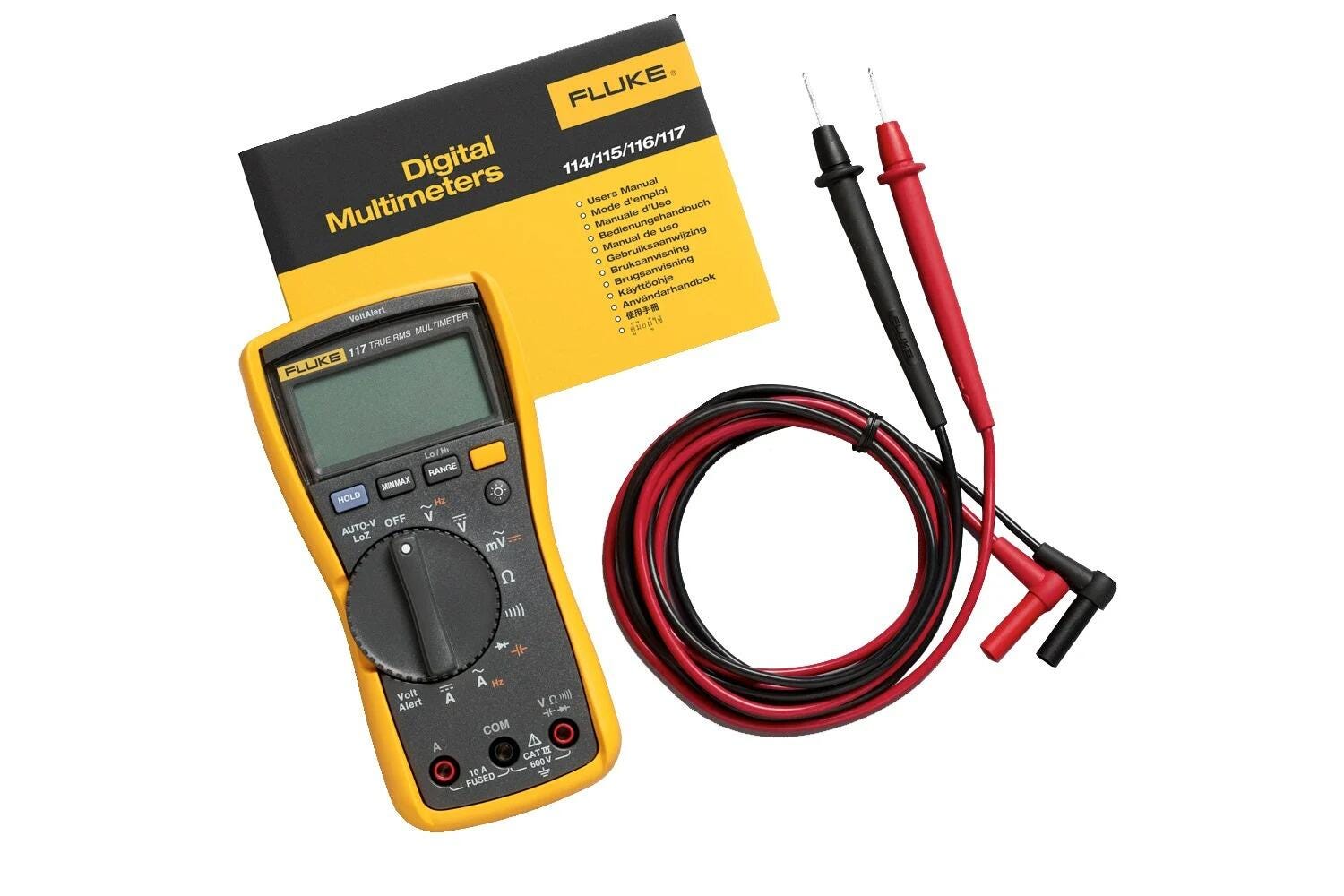
Fluke 117 Digital Multimeter
- Amps alone are not kilowatts — you need volts under load
- True RMS with a low-impedance mode that ignores ghost voltage
- The reference meter most compressor rooms already trust
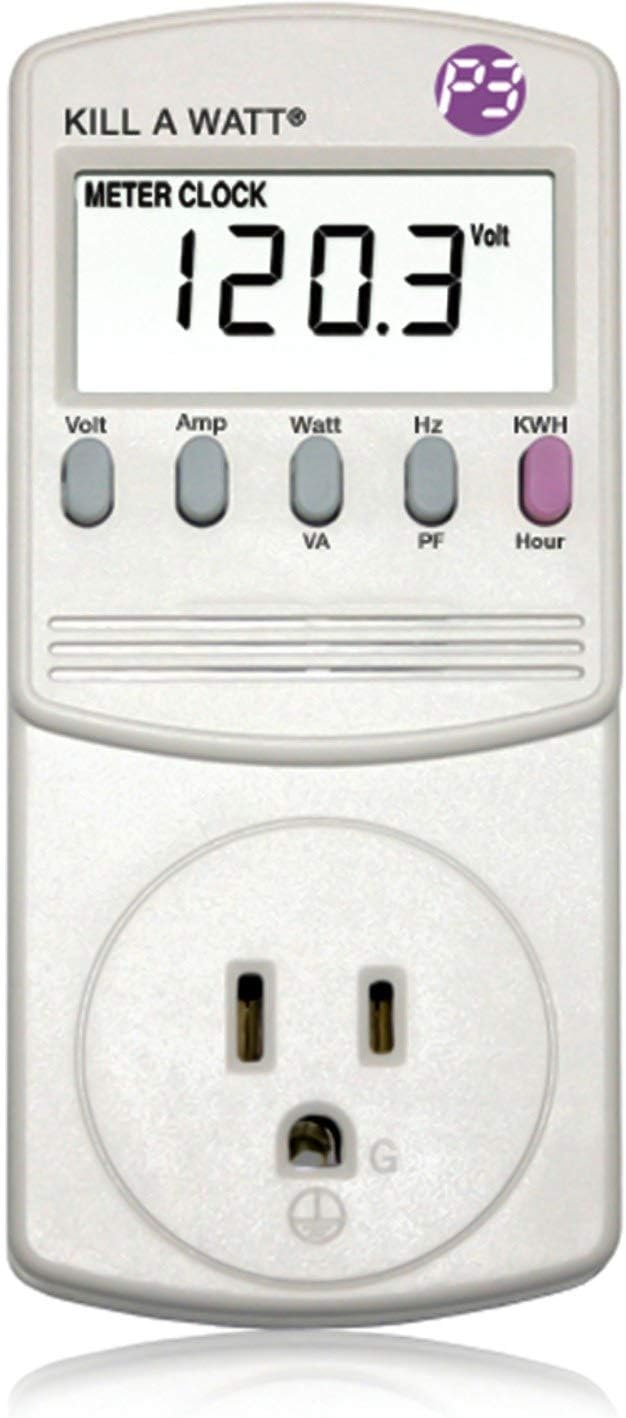
P3 P4400 Kill A Watt Monitor
- Plugs inline with a 120V compressor and reads true watts
- Totalises kWh, so you get loaded hours as well as power
- The cheapest way to find what a garage unit really costs

LE LEMATEC Regulator 0–150 PSI
- Regulate the one thirsty tool instead of the whole system
- Lets the header come down without starving the outlier
- The cheapest kilowatt is the one you never compress
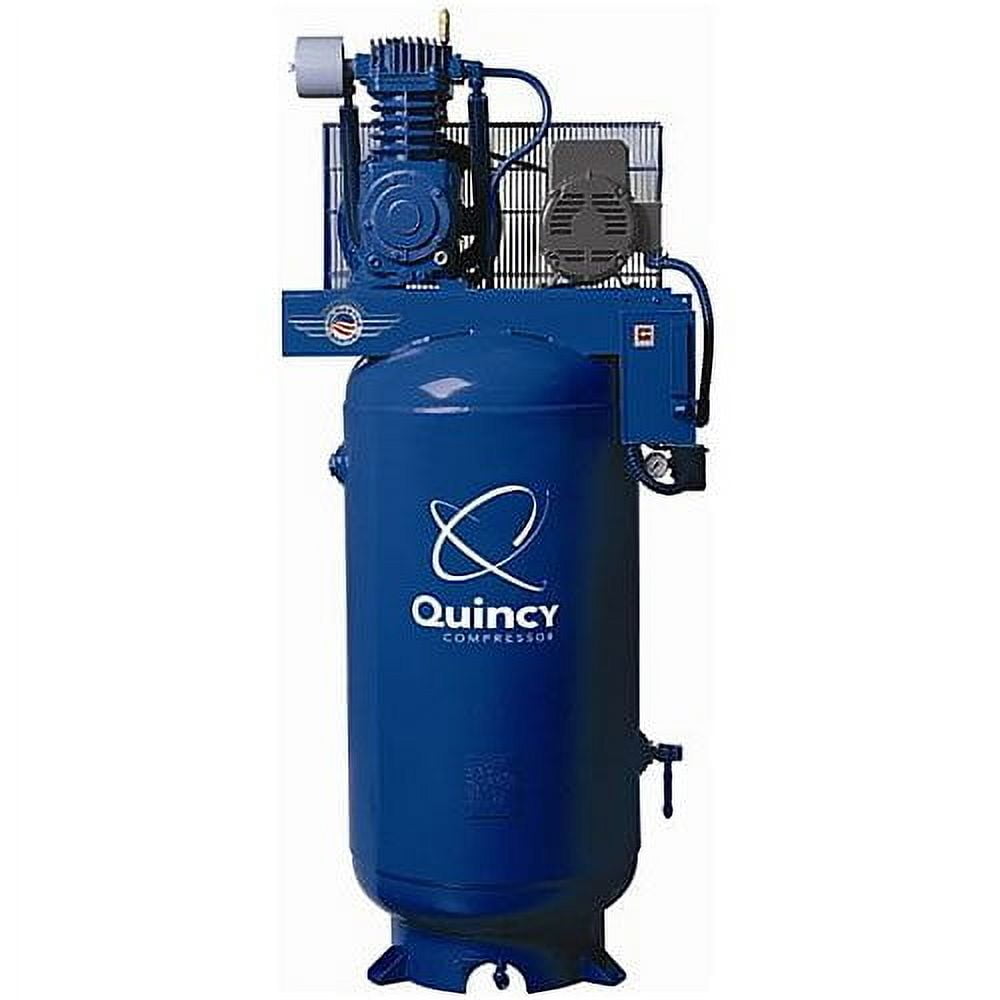
Quincy QT-7.5 Two-Stage Compressor
- Intercooled two-stage pump, the arrangement these pages explain
- 80-gallon receiver keeps the duty cycle honest
- Meter it when it arrives and you have a real baseline
As an Amazon Associate, TestTalkHQ earns from qualifying purchases. Prices and availability can change.
What the published data actually looks like
We pulled every fixed-speed CAGI data sheet published by one Performance Verification Program participant, 356 PDFs, and kept the 126 that carried a complete and internally consistent set of capacity, pressure, package power, specific power and isentropic efficiency.
isentropic efficiency 52.3% – 84.5%, median 73.3%, quartiles 66.1 / 76.4
isentropic efficiency 83.6% – 88.6%, median 86.2%, quartiles 85.1 / 87.7
The spread inside a single manufacturer’s current single-stage range is the striking part. From 52% to 84% is a factor of 1.61 in electricity for identical air at identical pressure. Nobody is going to volunteer which end of that band the machine in your compressor room sits at.
Specific power, and why it needs a pressure attached
115 psig 16.2 – 19.4 (median 18.1, n = 13)
125 psig 17.2 – 26.9 (median 20.1, n = 34)
150 psig 18.8 – 31.0 (median 22.6, n = 33)
175 psig 22.8 – 34.2 (median 27.4, n = 14)
The medians climb by more than half from 100 to 175 psig. Any rule of thumb about “good” specific power that does not name a pressure is useless, and the well-travelled figure of 18 kW per 100 cfm is a 100 psig number being quoted at people running 125.
The four cfm per horsepower rule, measured
Every shop knows it and it turns out to be roughly right in exactly one place. Using drive motor nameplate ratings from the same sheets:
115 psig 4.33 – 5.45 (median 4.73)
125 psig 2.41 – 5.12 (median 4.29)
150 psig 2.15 – 4.75 (median 3.82)
175 psig 1.93 – 3.90 (median 3.26)
Four cfm per horsepower is honest around 100 psig and about a third optimistic at 175. Size on it and then run the machine at 175 because somebody set the pressure switch there a decade ago, and you will be short of air with no obvious culprit.
Pressure, altitude and the two things that surprise people
Every psi off the top is worth real money
Power depends on the pressure ratio raised to 0.286, so the marginal saving is largest at the bottom of the pressure range:
2 psi off 125 psig → 0.86%
2 psi off 150 psig → 0.70%
2 psi off 175 psig → 0.58%
175 psig down to 125 psig → 16.1%
The familiar rule that 2 psi is worth about 1% is accurate near 100 psig and progressively conservative above it. Before acting on any of it, find the highest-pressure device on the system, because that one sets the floor for everything else — and check whether it genuinely needs the pressure or whether it is starving on undersized pipe. The compressed air pipe size calculator settles that question, and it is frequently the pipe.
Altitude does the opposite of what you expect
Drop the inlet pressure to 12.2 psia, roughly 5,000 feet, keep the capacity at 100 acfm and the same 125 psig, and the isentropic power falls from 20.14 to 18.57 hp. That is correct: thinner air means less mass in each cubic foot, so there is less to compress.
It is also a trap, because you get less usable air out. Per unit of air actually delivered, altitude costs more — the standard-air equivalent of 100 acfm at sea level needs 118.9 acfm and 22.07 hp at that inlet. The practical consequences of that are the subject of the altitude derate calculator. For this page the point is narrower: every published CAGI figure is written to a 14.5 psia inlet, so an isentropic efficiency you compute at a different inlet is not comparable with them.
What this does not tell you
Three honest limits, because a benchmark used outside its range is worse than no benchmark.
There is no verified band here for piston machines. The CAGI Rotary Compressor Performance Verification Program is open to rotary compressors from 5 to 200 hp. Reciprocating packages are not in it, so there is no equivalent set of independently verified sheets to build a band from. The isentropic power itself is valid for any compressor — it is thermodynamics, not machinery — so computing a piston machine’s isentropic efficiency from a measured power is perfectly legitimate. Judging it against the screw bands is not. If you are still choosing between the two machine types, that comparison is covered separately in rotary screw vs piston compressor.
Full load is not the whole story. Everything here is a full-load figure. A machine that is efficient loaded and then spends half its life unloaded at 25 to 35% of full power will lose on the bill to a worse machine that is properly matched to demand. Item 10 on the fixed-speed sheet — total package input power at zero flow — is the number to look at there, and it is frequently ignored.
Published figures carry real tolerances. ISO 1217 Annex C allows volume flow to be out by 4 to 7% and specific energy by 5 to 8%, on the manufacturer’s own certified figures. Two machines whose isentropic efficiencies differ by a point are not distinguishable. One that is ten points off the median is.
Once you have a kilowatt figure you trust, turning it into money is a separate and simpler job: see the compressed air cost calculator and the compressed air cost guide, which cover load factor, idle power and the electricity arithmetic properly.