
Piston (reciprocating) compressors dominate small shops. Rotary screw machines dominate continuous industrial air. Choosing wrong usually means either overspending on screw capacity you do not need — or cooking a piston unit on sanding/paint/blast duty it was never meant to sustain.
Piston (Reciprocating) Compressors
Piston units compress air with reciprocating cylinders. They are affordable, serviceable, and ideal for intermittent shop loads: impacts, nailers, occasional grinders, and short plasma cuts with recovery time between.
- Strengths: Lower purchase cost, widely available parts, fine for bursty tool use with adequate tank.
- Limits: Duty cycle ratings (often well under 100%). Long continuous loads overheat valves/rings and dump moisture as the pump runs without rest.
Rotary Screw Compressors
Rotary screw machines use meshing rotors for smoother compression and are typically designed for high duty / continuous operation when properly cooled and maintained.
- Strengths: Sustained CFM for paint booths, blast rooms, production lines; quieter in many packages; better when the pump rarely gets to unload.
- Limits: Higher capital cost, oil/air separator maintenance, and overkill for a two-bay garage that mostly runs impacts.
Which to Use
| Shop profile | Prefer | Why |
|---|---|---|
| Impacts, nailers, occasional die grinder | Piston | Intermittent duty matches piston strengths |
| Daily HVLP / DA sanding for hours | Screw (or very large piston with proven duty) | Continuous SCFM without cooking the pump |
| Sandblasting as a primary process | Screw | Nozzle CFM is relentless |
| Mixed fab shop, mostly intermittent | Piston + honest CFM sizing | Cost-effective if continuous tools are rare |
| Production booth with simultaneous guns | Screw | Overlapping continuous loads |
Start with the tool list in the per-tool CFM calculator and the reference chart. If your continuous recommended delivery CFM is high and the compressor will run most of the hour, screw architecture enters the conversation — not because it is trendy, but because duty cycle physics does not care about tank stickers.
Still Decide Tank vs CFM Separately
Architecture (screw vs piston) is not a substitute for delivery CFM. A small screw that cannot meet tool SCFM still starves the gun. A large piston with enough delivery CFM and recovery time can serve intermittent shops for decades. Read Bigger Tank vs More CFM and the buying guide after you know the load.
Quantify the load first Continuous vs intermittent SCFM tells you whether piston duty is realistic.
Related
Any trade
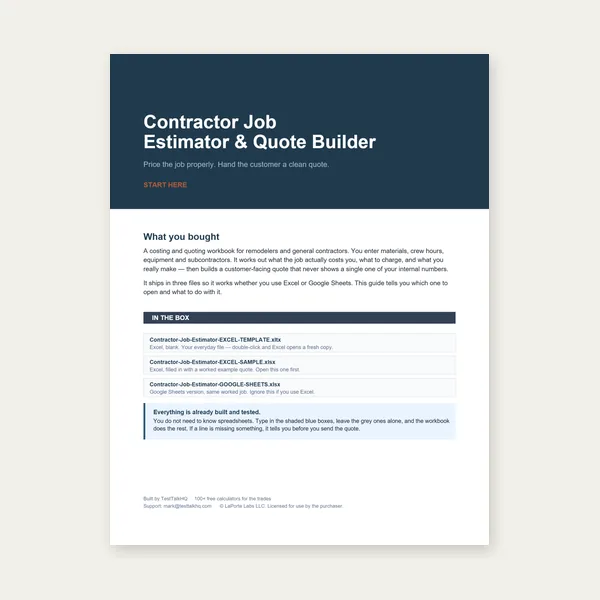
Contractor Job Estimator
Price remodels and GC work, then send a quote with no internal numbers.
Excel or Google Sheets. Best on a computer.
$29.00
BuyCheckout opens here — you stay on this page.