
A compressor room is not a room with an air quality problem. It is a room with a heat problem, and the heat is large: nearly all of the electricity going into the machine comes back out into the space around it. Ventilate it by feel and the room finds its own equilibrium temperature, which in July is usually somewhere above the number on the compressor’s data plate. This is the method that replaces the guess — work out the heat, set the temperature budget, choose whether to dilute the heat or duct it away, then size the fan and the opening the fan needs to breathe through.

What you are actually designing
Almost every mistake in compressor room ventilation comes from thinking about it as air rather than as heat. Air changes per hour, a fan somebody had spare, a louver sized to look right — none of those are connected to the thing that sets the room temperature. What sets the room temperature is a balance: heat going in from the machine, heat going out in the air that leaves. When those two are equal the room stops climbing. Whatever temperature that happens at is your room temperature, and if nobody calculated it, nobody knows what it is.
So the design has exactly two questions in it. How much heat goes in? And how much air do you need to move to carry that heat out without the room passing the temperature you are allowed to reach?
Step 1 — the heat load
The Compressed Air and Gas Institute states the headline figure in its heat recovery technical brief: “Nearly 96% of the electrical energy consumed by an industrial air compressor is converted into heat, and usually that heat is simply ejected into the compressor room or ducted outside.”
That is not a criticism of compressors. It is what a compressor is. The energy stored in the air as pressure is a small share of the input and it leaves down the pipe anyway; everything else — the heat of compression removed by the aftercooler, the oil cooler, motor losses, fan and bearing losses — ends up in the air around the machine. Work in kilowatts drawn from the wall, not in nameplate horsepower:
Heat rejected (Btu/hr) = input kW × 3,412 × fraction staying in the room
For a 25 hp machine with a 93% efficient motor that is 25 × 0.746 ÷ 0.93 = 20.05 kW, and at 96% the heat is 65,663 Btu/hr. In units people picture more easily, that is five and a half tons of cooling load coming out of one machine, which is why nobody air-conditions a compressor room.
Count everything else in the room too. A refrigerated dryer, a booster, the lighting, a second small compressor: all of it is electricity turning into heat inside the same four walls, and all of it belongs in the same balance. A 3 kW dryer adds 10,236 Btu/hr, which on a small room is not a rounding error.
Step 2 — the temperature budget
Now the subtraction that decides the size of everything:
The upper number comes off the compressor’s data plate. A maximum ambient of 104 °F (40 °C) is common on packaged machines, but it is not universal and it is not a number to assume — read the installation manual for the machine you have. The lower number is your local summer design dry-bulb, not the annual average and not what it says on the thermometer in April.
That difference is the entire budget. Required airflow is inversely proportional to it, which is the single most important fact in this whole subject: halve the allowance and you double the fan.
| Allowed rise | Exhaust for a 25 hp air-cooled machine | Comment |
|---|---|---|
| 5 °F | ~12,200 CFM | Rarely practical. Something else in the design should change first. |
| 9 °F | ~6,800 CFM | Typical when the intake is 95 °F design air and the limit is 104 °F. |
| 15 °F | ~4,100 CFM | Comfortable. Usually means a cooler intake or a higher limit. |
| 20 °F | ~3,000 CFM | Only available if the room is genuinely allowed to get that hot. |
Two things routinely bite before the compressor’s own limit does. The first is the refrigerated dryer sharing the room: it has its own maximum ambient, often lower than the compressor’s, and its capacity falls as the room heats up. A compressor room that has quietly run out of ventilation usually announces itself as water downstream rather than as a compressor fault — that chain is worked through in compressed air dryer troubleshooting. The second is the motor, whose insulation life is a temperature curve; a motor that spends its life at the top of its ambient rating does not fail this year, it fails several years earlier than it should have.
Step 3 — dilute the heat, or get rid of it
There are only three levers and it is worth naming all three before reaching for a fan catalogue.
- Move more air. Bigger fan, bigger louver. Always works, costs the most in capital and noise.
- Allow a higher room temperature. Free, but capped by the data plate and by the dryer, and it costs compressor capacity continuously — see step 6.
- Put less heat into the room in the first place. Duct the package’s cooler exhaust outside. CAGI’s heat recovery FAQ says “72% of the input energy is easily recovered from exhaust air through the coolers using ducting”, so ducting it out leaves roughly 96 − 72 = 24% radiating into the room. On that same 25 hp machine the room load falls from 65,663 to 16,416 Btu/hr, and the fan and the louver shrink with it.
The third lever is the one people forget and it is usually the cheapest. It is not a free win, though, because the same duct that saves you a fan in August is throwing away a large quantity of free building heat in January. That trade is the subject of ducting compressor heat out vs recovering it, and for most shops the answer ends up being a duct with a damper rather than a duct.
The instruments this job actually needs
Compressor room ventilation is one of the few shop problems where the diagnosis is genuinely a measurement rather than a judgement. Four readings settle almost every case: the air velocity at the louver, the temperature of the air going in, the temperature of the air coming out, and the current the machine is drawing. Fans and louvers themselves are selected from a curve and bought locally, so TestTalkHQ does not link them.
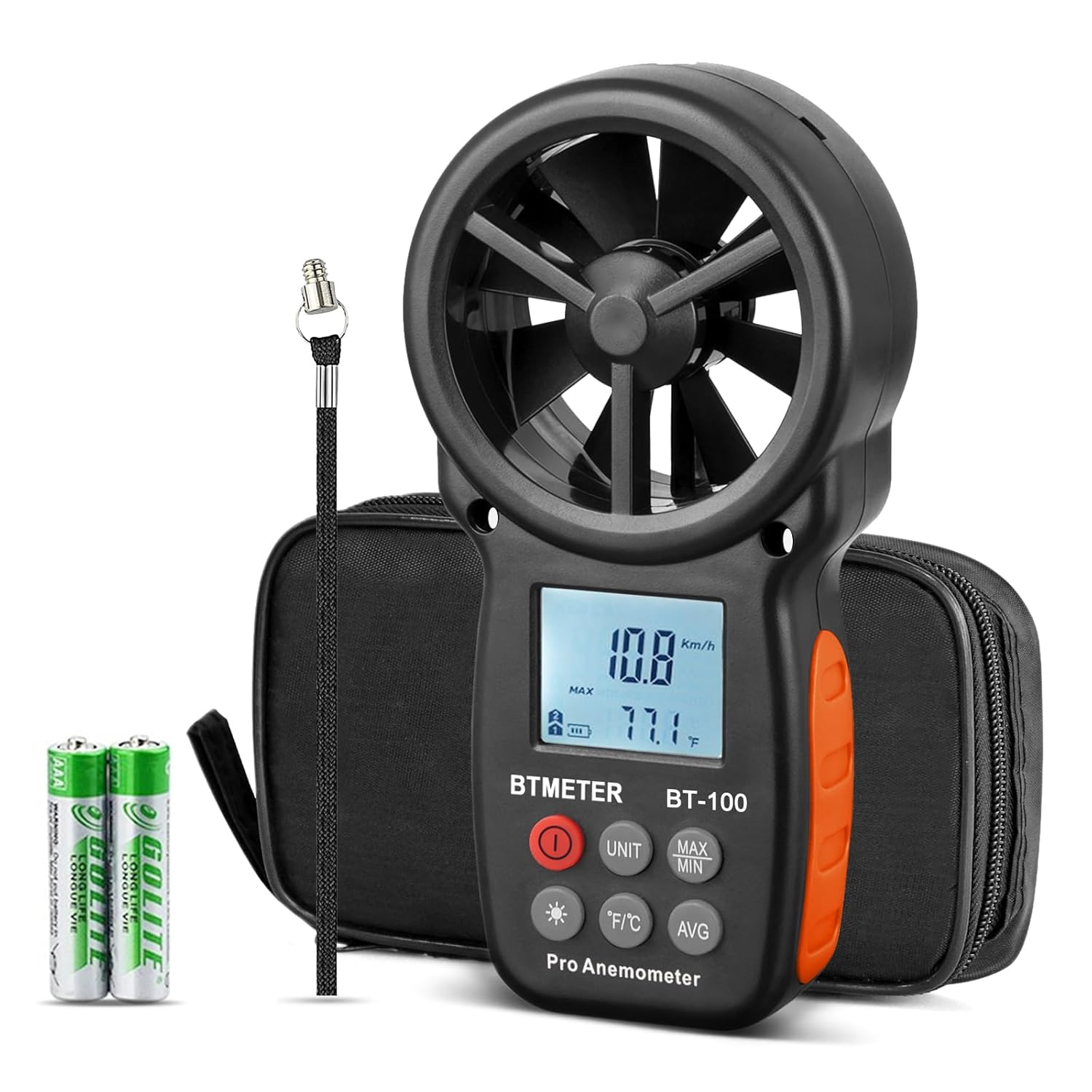
BTMETER BT-100 Handheld Anemometer
- Face velocity in fpm at the louver or the fan
- Velocity × free area is the CFM you really have
- The one reading that proves a fan is starved
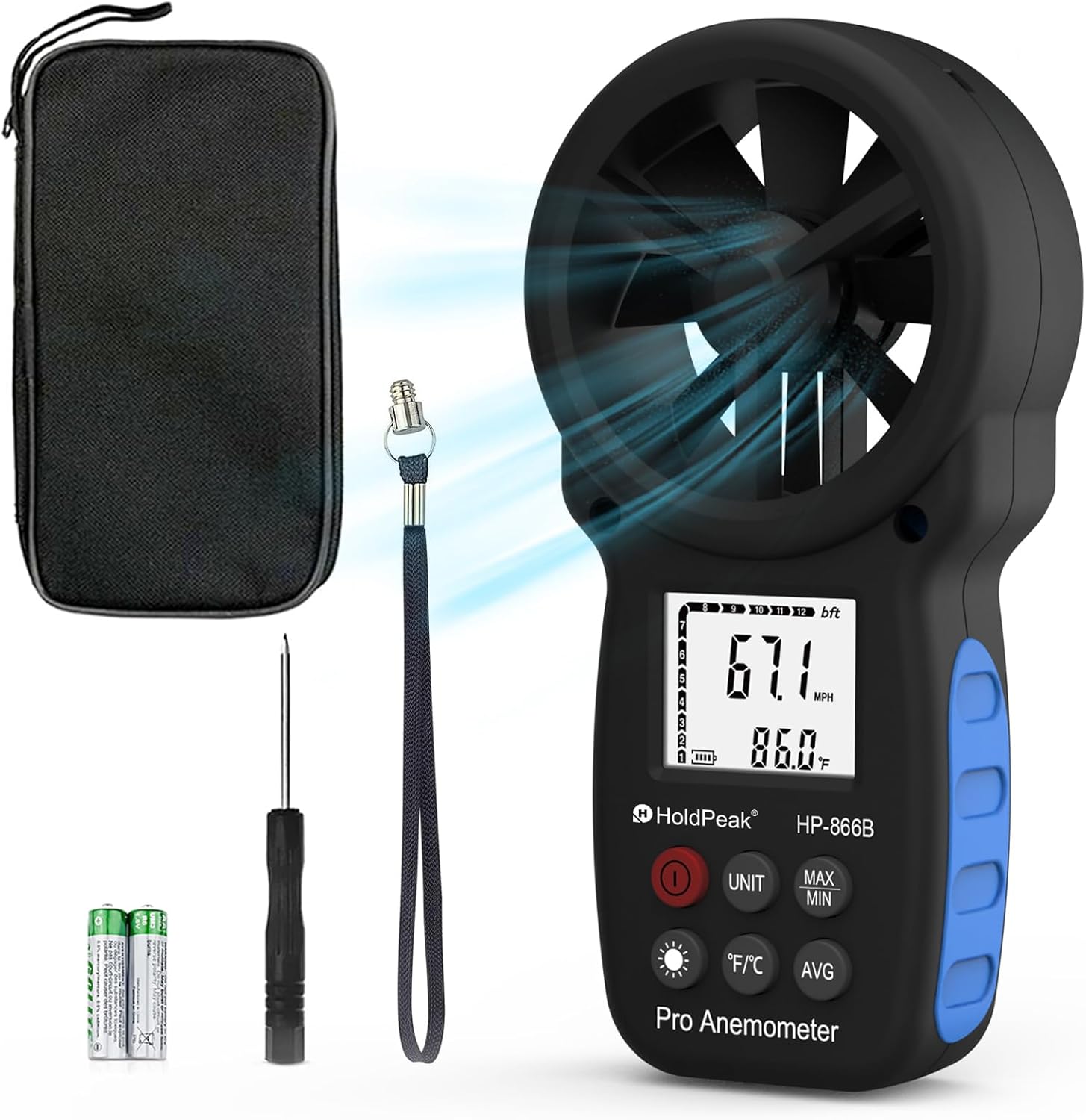
HoldPeak 866B Thermo-Anemometer
- Velocity and air temperature from one probe
- Intake and exhaust readings give you the real rise
- Cheap enough to leave in the plant room
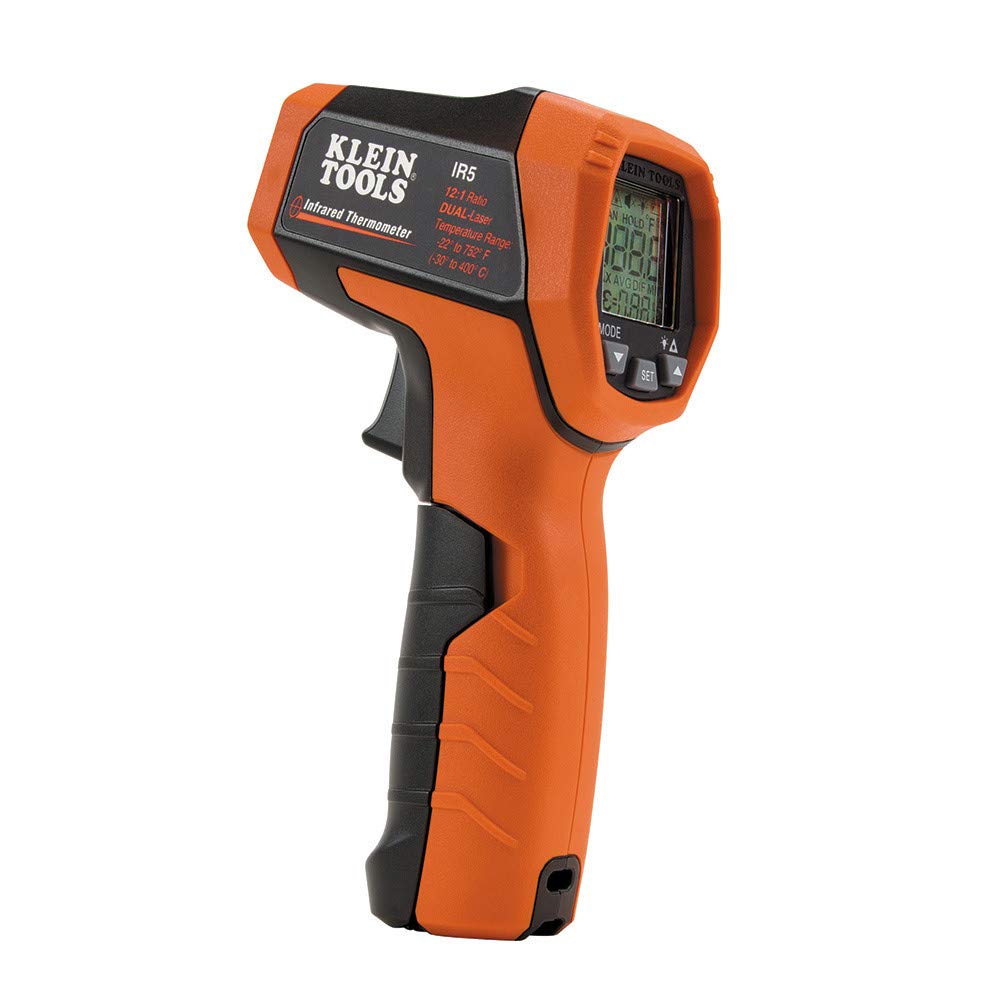
Klein Tools IR5 Infrared Thermometer
- Reads the cooler face and the enclosure without contact
- Traces a recirculation path around a packaged machine
- Dual laser keeps the spot where you aimed it
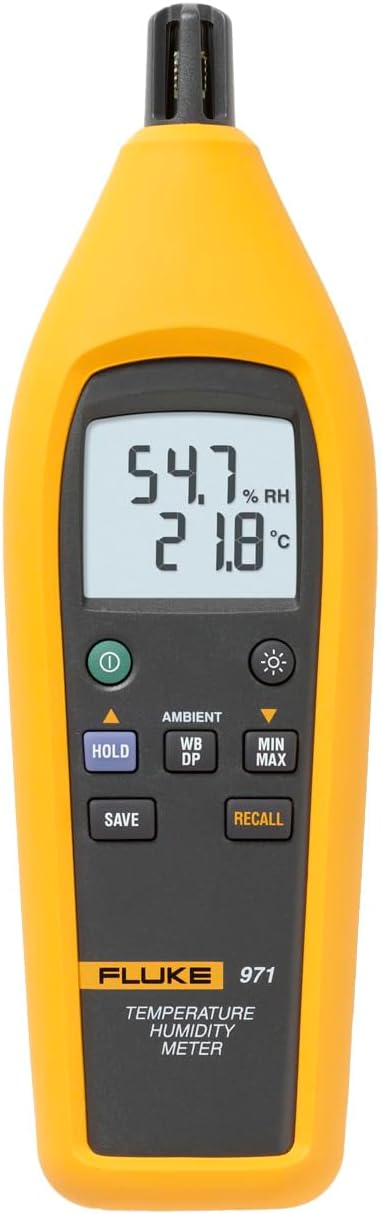
Fluke 971 Temperature / Humidity Meter
- Air temperature rather than surface temperature
- Log intake and room on the hottest afternoon of the year
- Humidity matters to the dryer sharing the room

Klein Tools CL800 Clamp Meter
- Loaded current beats a grossed-up nameplate every time
- Input power is the largest term in the heat balance
- Also settles arguments about real load factor
As an Amazon Associate, TestTalkHQ earns from qualifying purchases. Prices and availability can change.
Step 4 — size the exhaust, then size the hole it breathes through
The textbook conversion from heat to airflow is the imperial sensible-heat equation, and every HVAC tradesperson knows the constant:
1.08 = 60 min/hr × 0.075 lb/ft³ × 0.24 Btu/lb·°F
That 1.08 has sea-level, room-temperature air baked into it. It is close enough in a basement in Ohio and it is materially optimistic on a 95 °F day at 5,000 ft, where the air is nearly 20% thinner than the constant assumes. Fans move volume; heat is carried by mass. The calculator does the mass balance explicitly and divides by the real density, which is why its answer for a hot, high site is larger than the shorthand’s.
The louver is half the job
A fan rating is a promise about airflow at a stated static pressure. Starve it and it does not move what the box says; it rides back up its own curve and shifts considerably less air while drawing much the same power. The intake is where that usually happens.
Gross louver size (ft²) = free area ÷ (free area % ÷ 100)
Two errors are almost universal. The first is forgetting that a louver is mostly blade — a typical fixed louver is around 50% free, so the hole in the wall has to be roughly twice the free area the arithmetic asks for. Get the real percentage from the catalogue for the model you are buying. The second is pushing the face velocity up to make the opening smaller. Louver manufacturers publish water-penetration and pressure-drop curves against free-area velocity for a reason, and pressure drop goes with the square of velocity: run at 1.5× your design velocity and the drop is 2.25×; run at 2× and it is 4×. Somewhere past that point you have bought noise, a fan that under-delivers, and rain in the plant room.
Take CFM to a fan curve, not to a box
The number this calculation gives you is a duty, not a product. Selecting the fan means finding a point on its curve at the static pressure the system actually presents: the intake louver, the discharge grille or duct, any insect screen, and any filter. Screens are the quiet killer here — a fine mesh over an intake can be a larger resistance than the louver it is protecting, and it blocks with dust at exactly the time of year you need the airflow most.
Step 5 — layout, which decides whether any of it works
You can get every number right and still overheat the room, because ventilation is a path and not just a volume. Three rules cover most of it.
Low in, high out, and diagonally opposite
Cool air in low on one side, hot air out high on the far side. Hot air rises on its own, so a high-level exhaust is working with the room rather than against it, and putting the two openings on opposite sides forces the air to cross the machine instead of short-circuiting from the louver straight back out of the fan two feet away. An intake and an exhaust on the same wall is the classic way to build a room that is simultaneously well ventilated on paper and hot in the middle.
The exhaust must move at least what the package’s own fan moves
This one catches experienced people. An air-cooled compressor has a large cooling fan of its own. CAGI’s heat recovery FAQ notes that the discharge cooling air on these machines runs “30 °F to 40 °F higher (some up to 75 °F) than the cooling air inlet temperature”, which is enough to work out roughly what it is shifting — and the data sheet will tell you exactly.
If the room exhaust moves less air than the package fan does, the surplus has nowhere to go except round and round the machine. The compressor starts drawing air it has just heated, its intake temperature climbs above the room temperature, and no amount of correct heat-balance arithmetic saves you. This is why a room ventilated exactly to the calculated duty can still overheat: the balance was right and the fan was still too small. The calculator raises the requirement automatically whenever the package fan flow exceeds the heat-balance figure.
Do not fight the machine’s own airflow
Packaged compressors expect a clear path on the cooler side and a stated clearance all round. Pushing one against a wall to save floor space, or siting the room exhaust so it blows across the package inlet, both cost more than the space they save. And if you duct the package discharge, the duct has to be sized for the package fan’s flow at the static pressure it can actually develop — those fans are usually not built for long duct runs, and the manual will give a maximum allowable external static pressure.
Step 6 — the two things a hot room costs you continuously
Overheating is usually discussed as a trip, but the trip is the late symptom. Long before the high-temperature switch operates, a hot room is charging you rent.
Capacity. Hot air is thin air, and a compressor is a volumetric machine: it swallows the same cubic feet regardless, so thinner air means less mass per revolution and less free air delivered. Going from a 70 °F intake to a 100 °F intake costs about 5.4% of the density, and going to 110 °F costs about 7.0%. That is capacity you have already paid for, disappearing on exactly the days the shop is busiest. The same physics at altitude is handled by the altitude derate calculator.
Water. Warmer air holds dramatically more moisture, and a compressor takes in whatever the room is holding. A hot compressor room therefore makes more condensate and hands it to a refrigerated dryer that is itself losing capacity in the same hot ambient. Both ends of that chain move the wrong way at once, which is why summer moisture problems so often turn out to be a ventilation problem wearing a disguise. The load side of it is in the condensate calculator, and the removal chain is in the moisture removal guide.
And the one thing winter costs you
It is possible to over-ventilate. A compressor room sized for August, running its fan flat out in February, will pull the room down toward outside air temperature. That matters for three reasons: lubricant viscosity at start-up on a cold machine, condensate freezing in drains and drop legs, and — if there is a refrigerated dryer in there — a dryer that is now below its minimum ambient. The standard answer is a thermostatically controlled exhaust: either a two-speed or variable-speed fan, or a motorised damper that recirculates the room’s own warm air until the room reaches its setpoint. Any compressor room ventilation design that has no winter mode is only half a design.
Step 7 — commissioning: six checks that prove it works
None of this counts until it has been measured on a hot day with the machine loaded and the doors shut. Do these in order.
- Measure the louver face velocity with an anemometer and multiply by the free area. That product is your actual CFM. Compare it with the design duty; if it is short, the problem is almost always the intake or a screen, not the fan.
- Measure the air temperature at the compressor’s intake and compare it with the temperature outdoors. If the intake is meaningfully hotter than outside, the room is recirculating and no amount of extra fan will fix the layout.
- Measure the room temperature at the machine, not at the door, and not at head height in the corner. Compare with the data plate maximum ambient.
- Measure the dryer’s ambient separately if it is in the same room, and against its own rating rather than the compressor’s.
- Watch the room over a full loaded hour. A correctly ventilated room reaches equilibrium and stops. A room that is still climbing after an hour has no equilibrium below your limit and will find one above it.
- Repeat in August, at three in the afternoon. Commissioning a compressor room in April proves nothing. The design condition is the worst hour of the year, and that is the hour the measurement has to be taken in.
Frequently asked questions
How many air changes per hour does a compressor room need?
This is the wrong question, and it is worth understanding why. Air-change rules exist for rooms whose load is people and smells. A compressor room’s load is equipment heat, so the required flow depends on the machine and the temperature budget, not on the volume of the room. A small room with a large machine needs an absurd-sounding change rate and that is simply what the arithmetic says. Size on the heat; use the change rate only to sanity-check that the room is not so cramped the air cannot physically get around the package.
Can I just leave the door open?
It helps, unpredictably, and it is not a design. An open door gives you an opening of unknown effective area with a flow driven by whatever wind and stack effect are doing that day, which is why the room behaves differently every afternoon. It also defeats any noise containment and lets shop dust into the intake filter. If leaving the door open genuinely fixes the room, that is a measurement telling you the louver is undersized.
Should the compressor’s intake be ducted to outside air?
Often, yes — it is the cheapest capacity you will ever buy, because cooler intake air is denser air. DOE Tip Sheet #14 recommends it directly: “This can be accomplished by locating the inlet pipe outside the room or building.” Two cautions from the same source: size the inlet pipe up if it is a long run, because pressure drop at the inlet throttles the machine, and think about where the pipe terminates — rain, dirt, and the discharge of anything else on the roof are all things you do not want to inhale.
Does a bigger room need less ventilation?
No. A bigger room takes longer to heat up, which disguises the problem for an hour, but the steady-state balance is identical: the same heat in needs the same heat out. Thermal mass buys you time on a short run and nothing at all on a long one.
What if the room is already as ventilated as it can be?
Then reduce the heat instead of chasing the air. In order of usual cost-effectiveness: duct the cooler exhaust outside, move the dryer out of the room, duct the compressor’s own intake to outside air, and — if the machine is oversized and modulating all day — look at the control scheme, because a compressor running unloaded is still making heat for nothing.