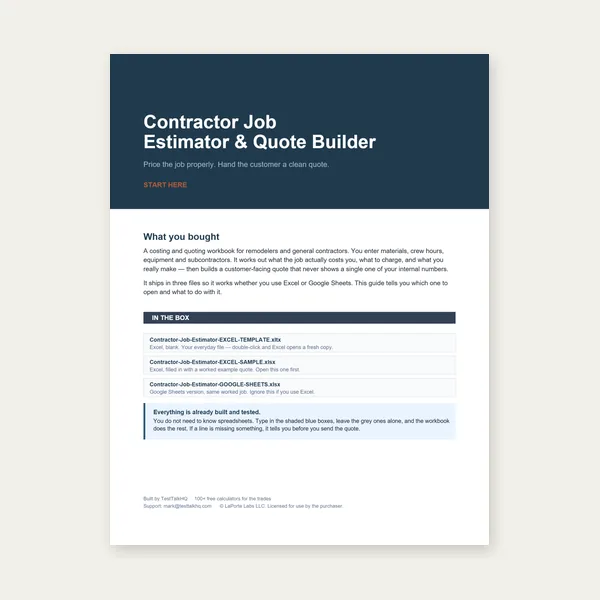
Contractor Job Estimator
Price remodels and GC work, then send a quote with no internal numbers.
Excel or Google Sheets. Best on a computer.
$29.00
BuyLinear feet of ridge and hip into hip-and-ridge bundles — editable coverage, default 25 ft/bundle (GAF Seal-A-Ridge)
Field shingles are sold by the square. Ridge and hip caps are sold by the linear foot in dedicated bundles. Enter ridge length, optional hip length, coverage per bundle, and waste. Method: ridge cap guide. Field failures: troubleshooting. Cut 3-tab vs pre-scored caps: comparison. Field squares: shingle bundle calculator. Hub: roofing tools.
Tape or measure every ridge run and every hip run that gets the same hip-and-ridge product. Leave hip at 0 on a simple gable. Confirm the linear feet printed on the wrapper you will buy — GAF Seal-A-Ridge is commonly ~25 ft per bundle at 6⅔ in exposure; TimberTex and other wider-exposure products cover fewer feet. Add a waste percentage, calculate, and order the rounded-up bundle count.
Full method write-up: ridge cap guide. Field failures: troubleshooting. Cut 3-tab vs pre-scored: comparison.
Field shingles cover the roof planes. Ridge and hip caps cover the high lines where those planes meet. Mixing the two on a material takeoff is how crews run short at the ridge while leftover field bundles sit on the driveway.
Ridge caps finish the horizontal (or near-horizontal) peak. Hip caps finish the sloping hip lines. Both are typically sold as hip-and-ridge product — the same bundle stock covers ridge and hip lineal footage — but the takeoff still has to measure both runs and add them before you divide by coverage per bundle.
Field shingles are ordered by the square (and often by the three-bundle pack). Caps are ordered by linear feet of run, then converted to bundles using the manufacturer’s published coverage. The roofing square / shingle bundle calculator handles the field. This calculator handles the high lines. Do not steal field bundles for the ridge and hope the count works out.
Hip-and-ridge coverage is exposure-driven. Shorter exposure means more pieces per lineal foot and more lineal feet per bundle. Longer exposure stretches each piece along the run — fewer total feet from the same carton size.
GAF Seal-A-Ridge is the clear published planning default on this tool: approximately 25 lineal feet per bundle, with 45 pieces at a 6⅔ in exposure. That is why the coverage input defaults to 25 ft/bundle.
GAF TimberTex and similar wider-profile products use a longer published exposure (commonly cited around 8 in). Longer exposure means each piece covers more of the run, so a TimberTex-style bundle typically covers less total lineal footage than Seal-A-Ridge. You cannot swap brands and keep the same bundle count without re-checking the label.
Wrong exposure on the roof shows up as gaps (exposure too long) or stacked-looking overlap (exposure too short). Both burn through the order differently than the calculator expected. Fixes: common ridge cap problems and solutions.
The reliable takeoff is simple:
Yards do not sell 0.36 of a hip-and-ridge bundle. Adjacent takeoffs stay on their own sheets: underlayment, nails, drip edge, and attic ventilation when the ridge is vented.
Raw lineal feet:
With 5% waste:
Bundles:
If the same roof used a product that covers only ~20 ft/bundle, the same 84 lf becomes ceil(84/20) = 5 bundles. Exposure and brand are not cosmetics on the purchase order.
Coverage math assumes the pieces are installed at the published exposure. Application details that still burn inventory:
When the ridge is open for venting, size intake/exhaust with the attic ventilation calculator before you assume a solid-ridge cap layout. Step-by-step method page: ridge cap shingle guide.
The output is a materials takeoff for purpose-made hip-and-ridge (ridge cap) bundles measured in linear feet. It is not the field-shingle bundle count from the roofing square calculator, and it is not a wind-rating, fastening schedule, or permit document.
Starter pieces, ridge vents under the caps, and color dye lots are job details outside the arithmetic — but they are why waste exists and why you always round up. Partial bundles are not a yard SKU.
Usually yes — hip-and-ridge product is sold for both. Measure ridge feet and hip feet separately, then add them before dividing by coverage per bundle. Simple gables leave hip at 0.
Field shingles are sold by the square (100 sq ft). Cap shingles are sold by linear foot with a different exposure. Mixing them undercounts or overcounts the order.
Exposure. Seal-A-Ridge publishes about 25 lin ft/bundle with 45 pieces at 6⅔ in exposure. TimberTex’s longer (~8 in) exposure changes pieces-per-foot and typically yields fewer lineal feet per bundle. Read the carton for the SKU you buy.
On simple gable ridges with few hips, 5% is a common planning default. Complex multi-hip roofs, short stub ridges, and first-time crews often warrant more. Round up to whole bundles either way.
See cut shingles vs architectural ridge cap. Pre-scored caps usually win on laminated roofs and wind warranties.
Ridge vent is a separate product under the caps. Cap linear footage still follows the ridge length; confirm the vent manufacturer’s cap instructions. Attic NFA: attic ventilation calculator.
Field squares (shingle calculator), nails (nail calculator), underlayment, drip edge, and ventilation — all on the roofing hub.
Price remodels and GC work, then send a quote with no internal numbers.
Excel or Google Sheets. Best on a computer.
$29.00
BuyCheckout opens in a new tab.
Linear footage and bundles are only the order. On the ridge you still need a coil nailer, chalk line, hook knife for cuts and starters, and a tear-off shovel if you are stripping the old caps first.

Coil nailer for field and cap fastening. Cap nails still need correct placement per the manufacturer — the gun just keeps the pace up on long ridge runs.
View on Amazon →
Snap a centerline on the ridge before the first cap course. Extra-bold 1 mm line, 100 ft, five-gear rewind.
View on Amazon →
Hook blade for trimming caps, cutting starters, and scoring 3-tab strips if you are hand-cutting ridge pieces on a budget job.
View on Amazon →
Serrated tear-off shovel for stripping old ridge and hip caps before the new linear footage goes down.
View on Amazon →As an Amazon Associate, TestTalkHQ earns from qualifying purchases.