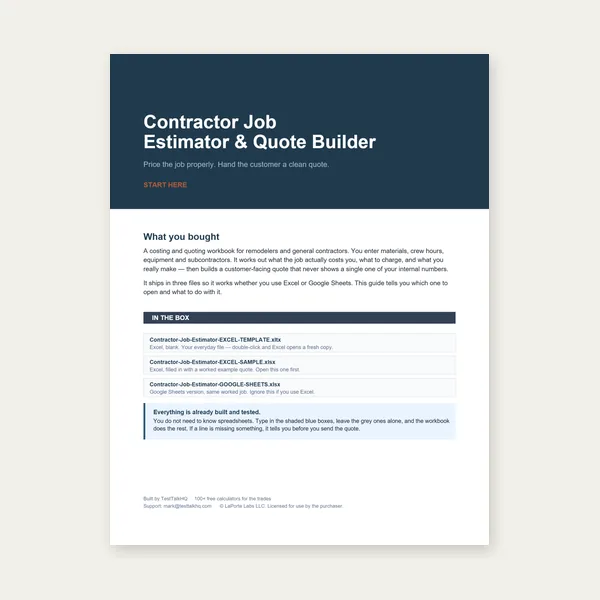
Contractor Job Estimator
$29.00
BuyCoverage per bundle is usually the same three-per-square; cut waste, weight, and designer exceptions are where the two types diverge
The roofing square calculator defaults to 3 bundles per square for both 3-tab and standard architectural, and 4 for heavy/designer. This page is why that default holds — and when it does not.
What a square is: guide. Estimating misses: troubleshooting. Roofing index: hub. Vent the attic under either shingle: attic ventilation calculator. Size the trough at the eave: gutter sizing calculator. Ice barrier under either shingle: ice & water shield coverage calculator.
Pick the type, then count squares.3-tab and standard architectural: 3/square. Heavy designer: toggle 4.
Open Calculator →A square is still 100 sq ft of deck. Standard 3-tab strip shingles have long been three bundles per square (~33.3 sq ft of coverage per bundle). Most laminated architectural lines are packaged the same way. GAF documents Timberline HDZ at three bundles per square. Owens Corning Duration and CertainTeed Landmark are in that same three-bundle camp.
The exception is heavier or artisan-shaped laminates. GAF’s Grand Sequoia example is five bundles per square. Impact-rated or extra-thick laminates sometimes ship four. ARMA notes bundles commonly come 3, 4, or 5 per square. That is why the calculator has a heavy/designer toggle at 4 — and why the wrapper still wins if it says 5.
| Type | Typical bundles / square | Notes |
|---|---|---|
| 3-tab | 3 | ~33.3 sq ft coverage per bundle |
| Standard architectural | 3 | Timberline HDZ, Duration, Landmark typical |
| Heavy / designer laminate | 4–5 | Read the spec; Grand Sequoia is 5 |
$29.00
BuyCheckout opens here — you stay on this page.
The calculator turns footprint, pitch, and waste into squares and bundles. A coil nailer, chalk line, tear-off shovel, and a rooftop harness are the tools that make the count real on the deck.

3/4 in to 1-3/4 in coil nails for asphalt shingles. The calculator counts squares and bundles; the nailer is how those bundles leave the pallet.
View on Amazon →
Snap starter and course lines on the deck after you know the square count. Extra-bold 1 mm line, 100 ft, five-gear rewind.
View on Amazon →
Serrated tear-off shovel for stripping the old roof before the new squares go down. Measure the deck after tear-off if the old planes were your only numbers.
View on Amazon →
Harness, 50 ft lifeline with shock pack, and reusable roof anchor in one bucket. Pitch math does not replace fall protection on the deck.
View on Amazon →
Roll the yard and driveway after tear-off. Loose roofing nails are why the magnet lives in the same truck as the shovel.
View on Amazon →
Footprint or measured area, X/12 pitch, waste, shingle type, and underlayment. Squares, bundles, and rolls.
Open Roofing Square Calculator →As an Amazon Associate, TestTalkHQ earns from qualifying purchases.
Bundle math can match while scrap does not. 3-tab is a single layer with a regular tab; valley and hip cuts are predictable. Architectural laminates are thicker, often random-tab, and throw more unusable offcuts at hips, valleys, and dormers. On a simple gable the waste percent can stay near 10% for both. On a hip roof or a cut-up plan, architectural often wants the higher end of 12–15% while 3-tab might live closer to 12%. That is a waste-factor choice in the calculator, not a change in bundles-per-square.
Designer shapes waste even harder because the pattern does not like short pieces. If you are on a 5-bundle-per-square product, both coverage and scrap move against you.
Same 2,000 sq ft footprint, 6/12 (multiplier 1.118), 12% waste. Surface = 2,236 sq ft = 22.36 squares. With waste = 25.04 squares.
Raise waste to 15% on the architectural hip roof (25.71 squares) and standard architectural becomes 78 bundles — still 3/square, more scrap. Run both in the calculator by toggling type and waste, not by inventing a second square size.
Most common lines yes. Designer and some impact products no. GAF says check the specs; Timberline HDZ is 3, Grand Sequoia is 5.
Often slightly, because cuts are simpler. It is still not zero. Keep ~10% on a simple gable for either type.
Some crews do with matching-width starter or dedicated starter rolls. Do not mix field courses of two products and call it one square count.