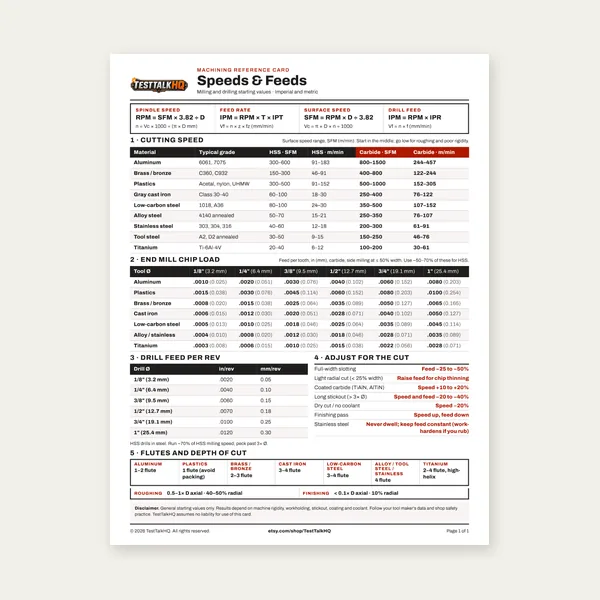
Machining Speeds & Feeds Card
One page. Speeds, chip load and drill feed, imperial and metric.
$3.99
BuyStandard sizes 1/8"–4" with TPI, tap drill, and major/minor diameter
A standalone shop chart for tapered pipe threads. This is not a reprint of the UNC/UNF/metric tap-drill chart — NPT uses a different hole because the thread is a cone. Interactive lookup: NPT Pipe Thread Calculator.
Major diameter is the basic pipe OD (D). Minor diameter is the truncated-height estimate D − 1.6P used on the shop floor. E0 is the basic pitch diameter at the end of the pipe. Tap drills are the common US carbon-steel chart (approximately 75% thread). L1 and L2 are included so you can check engagement without leaving the page.
| Nominal | TPI | Major OD | Minor (approx.) | Pitch dia E0 | Tap drill | L1 hand-tight | L2 wrench / total |
|---|---|---|---|---|---|---|---|
| 1/8" NPT | 27 | 0.405" | 0.3457" | 0.36351" | R (0.3390") | 0.1615" | 0.2639" |
| 1/4" NPT | 18 | 0.540" | 0.4511" | 0.47739" | 7/16" (0.4375") | 0.2278" | 0.4018" |
| 3/8" NPT | 18 | 0.675" | 0.5861" | 0.61201" | 37/64" (0.5781") | 0.2400" | 0.4078" |
| 1/2" NPT | 14 | 0.840" | 0.7257" | 0.75843" | 23/32" (0.7188") | 0.3200" | 0.5337" |
| 3/4" NPT | 14 | 1.050" | 0.9357" | 0.96768" | 59/64" (0.9219") | 0.3390" | 0.5457" |
| 1" NPT | 11.5 | 1.315" | 1.1759" | 1.21363" | 1-5/32" (1.1562") | 0.4000" | 0.6828" |
| 1-1/4" NPT | 11.5 | 1.660" | 1.5209" | 1.55713" | 1-1/2" (1.5000") | 0.4200" | 0.7068" |
| 1-1/2" NPT | 11.5 | 1.900" | 1.7609" | 1.79609" | 1-47/64" (1.7344") | 0.4200" | 0.7235" |
| 2" NPT | 11.5 | 2.375" | 2.2359" | 2.26902" | 2-7/32" (2.2188") | 0.4360" | 0.7565" |
| 2-1/2" NPT | 8 | 2.875" | 2.6750" | 2.71953" | 2-5/8" (2.6250") | 0.6820" | 1.1375" |
| 3" NPT | 8 | 3.500" | 3.3000" | 3.34062" | 3-1/4" (3.2500") | 0.7660" | 1.2000" |
| 3-1/2" NPT | 8 | 4.000" | 3.8000" | 3.83750" | 3-3/4" (3.7500") | 0.8210" | 1.2500" |
| 4" NPT | 8 | 4.500" | 4.3000" | 4.33438" | 4-1/4" (4.2500") | 0.8440" | 1.3000" |
Taper is 3/4" per foot on all of these sizes. Nominal size is not the major diameter — 1/2" NPT is 0.840" OD, 2" NPT is 2.375" OD.
On a straight machine thread, tap-drill diameter sets percent thread and you can trade a little strength for tap life. On NPT the hole is the blank for a cone. The tap must form a full profile at the L1 gauging plane and still have metal left to wedge at L2. That is a tighter window than “75% vs 65% on 3/8-16.”
Pick the chart drill when you are cutting carbon steel or common brass with a sharp NPT tap and cutting fluid. Go a few thousandths tighter only when a customer spec or a worn-tap recovery plan says so — and then gauge the first hole. Going tighter “to make it seal better” is how taps break in stainless and how fittings crack later because you compensated with extra wrench turns.
The hole also has to be deep enough. A blind NPT port needs chip room past L4, not just past the first full thread you can see. The sizing guide covers L3/L4 and why vanish threads are not useful engagement.
Use this chart when the callout is NPT. Use the Tap Drill Size Calculator and its imperial/metric guide when the callout is UNC, UNF, or metric. Crossing those charts is the most expensive typo in a pipe-fab shop: a 1/2"-13 hole on a part that needed 1/2"-14 NPT.
Undersize hole. The tap loads up on the first full threads, walks off axis, and either breaks or cuts a drunken taper. The L1 plug will not stand at the notch. Operators then lean on a wrench during makeup and crack the boss you just tapped.
Oversize hole. The tap spins freely and leaves a pretty-looking thread with no wedge. Hand-tight engagement runs long — sometimes past the vanish. Sealant appears to save the first assembly. Under vibration or thermal cycles the joint weeps at the last engaged thread. This is the same loose-fit pattern as a worn tap, covered in NPT problems and solutions.
Right diameter, wrong depth or no chamfer. The tap starts drunk. You get a full thread on one side and a shaved crest on the other. A caliper on the pipe OD will not catch that — only a gauge or a careful first makeup will.
NPT production inspection is not a pair of go/no-go plugs the way Unified works. You use an L1 taper plug (internal) or L1 ring (external). The notch or step on the gauge must stand flush to the face within the allowed turn tolerance in B1.20.1. Deep = oversized / worn tap / oversize drill. Proud = undersize hole or incomplete thread.
A pitch gauge only tells you TPI. It will not tell you taper or 60° vs 55°. If the part might be BSPT or parallel, identify the system first with the NPT vs BSPT vs straight-thread comparison, then gauge.
Shop sequence that actually catches bad holes:
Interactive row lookupSame ASME numbers, one size at a time, with a PDF cheat sheet of your inputs.
Open NPT Calculator →Yes, if the decimal is within a few thousandths of the chart value and you gauge the first hole. 1/8" NPT is specified here as letter R (0.3390"); 11/32" (0.3438") is the usual alternate.
No. Dryseal NPTF uses a different truncation and gauge practice. Do not tap NPTF to this hole chart unless your spec allows NPT interpolation.
Minor diameter is the theoretical root of the truncated form. Comparing it to your drilled hole shows how much metal the tap is expected to cut. A drilled hole larger than the minor is a red flag before you break a tap or ship a leaker.
One page. Speeds, chip load and drill feed, imperial and metric.
$3.99
Buy
27 pages. Milling, drilling, tapping, turning and CNC routing.
$12.99
Buy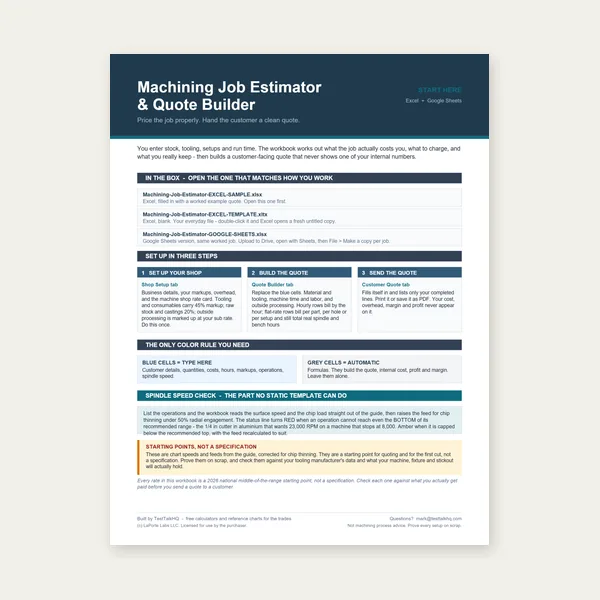
Quote shop work and check operations against your spindle's top speed.
Excel or Google Sheets. Best on a computer.
$29.00
Buy
Card, 27-page guide and the estimator workbook. All six files.
Excel or Google Sheets. Best on a computer.
$34.99
$45.98 if bought separately — save $10.99
BuyCheckout opens in a new tab.
Only products that already exist in TestTalkHQ's affiliate catalog — sealant, tap fluid, drill index, and a leak check. Dedicated NPT tap sets, PTFE tape, pipe wrenches, and NPT thread gauges are not in the current CSV, so they are not invented here.
Soft-set PTFE-filled pipe dope for NPT joints. Brush it on the male threads after you confirm size and engagement — it is not a substitute for correct makeup length.
View on Amazon →Thicker blue compound that stays put on vertical fittings. Use when T Plus 2 slumps, and still stop at the wrench-makeup length from the calculator — extra turns crack fittings.
View on Amazon →Machine-thread tap/die coverage for UN and metric holes on the same bench. It is not an NPT pipe-tap set — use a dedicated NPT tap for tapered pipe threads.
View on Amazon →Flood the tap when you cut NPT in steel or stainless. Dry taps glaze, undersize the minor, and leave a loose joint that sealant cannot save.
View on Amazon →Fractional sizes covering the common NPT tap drills from 7/16" through the larger pipe sizes you can still hand-drill. Verify the letter-R hole for 1/8" NPT with a numbered bit if you have one.
View on Amazon →Brush on after wrench makeup and pressurize. Bubbles at the last engaged thread mean you are short of L2 or the threads are the wrong form (BSPT/parallel mix-up).
View on Amazon →As an Amazon Associate, TestTalkHQ earns from qualifying purchases.