Fillet weld capacity reference: allowable load per inch of weld from Fw = 0.30 × FEXX and throat = 0.707 × leg — the same AWS D1.1 / AISC basis used by the fillet weld strength calculator.
How to Use This Chart
Pick electrode class and leg size, read lb/in of weld, then multiply by effective length and number of weld lines. For pass/fail against an applied load, use the fillet weld strength calculator. Joint selection: weld joint design guide (not a duplicate strength guide). Companion prose: strength guide, troubleshooting, sizing technique.
Where 0.30 × FEXX Comes From
FEXX is the electrode classification tensile strength in ksi — the “70” in E70XX is 70 ksi. AWS D1.1 and the AISC Specification allow fillet weld metal to be designed at 0.30 × FEXX on the effective throat (ASD). That 0.30 is not a random shop factor. It is the Code’s allowable shear stress in the weld metal, already reduced from tensile strength because a fillet fails in shear through the throat, not in tension through the face. LRFD uses a different factor (typically 0.60 × FEXX × φ on the throat); this chart and the calculator are the ASD 0.30 path that most field notes still quote as “21 ksi for 70-series.”
Matching electrode to base metal still matters. Putting 70-series on A36 is the usual case; putting 70-series on a higher-strength plate does not let you use 21 ksi if the governing limit is the base-metal fusion face instead of the weld throat. The table’s Fw is weld-metal allowable. You still check the base metal. The 1/4″ E70XX row at 3,711 lb/in is weld-metal capacity per inch of a single fillet — it is not a promise that a 1/4″ plate can carry that load into the joint.
Leg Size vs Effective Throat
The number on the drawing is almost always the leg (the two sides of the triangle against the plates). The number in the strength formula is the effective throat — the shortest distance from the root to the face, 0.707 × leg for an equal-leg 45° fillet. A 1/4″ fillet is not 1/4″ of metal in the load path; it is 0.177″ of throat. Over-welding the face without filling the root does not buy you that 0.707; a concave face or a gap at the root steals throat even when the legs gauge 1/4″.
Unequal-leg fillets use the smaller inscribed throat, not the average of the legs. Flare-bevel and flare-V joints have effective throats defined by the Code, not by 0.707 × some guessed leg. If you are not looking at a textbook equal-leg fillet, stop using this lb/in table and go to the fillet weld strength calculator or a groove calculation.
Effective Length Is Not the Tape Length
Capacity is Fw × throat × effective length × number of weld lines. Effective length is the length of the weld that actually carries load, minus end returns the Code does not let you count, minus undercut and starts/stops that did not fuse, minus the portion of an intermittent fillet that is not welded. A 6″ weld with 1/4″ craters that did not fill is not 6″. Wrap-around returns can be required for fatigue or to hold a clip; they are not always extra length you add into the formula unless the detail says so.
Two-sided fillets (the “2 welds” column) assume both sides are full length and both are sound. A stitch on the far side is not “two welds.” Longitudinal vs transverse loading also changes how you combine lines; this chart is the simple lb/in building block, not a full connection design.
When a Full-Penetration Groove Is Required Instead
A fillet cannot make a T-joint as strong as the plate in tension through the stem unless the fillets are enormous — and even then the load path is eccentric. Complete-joint-penetration (CJP) groove welds are what you use when the joint must develop the base-metal strength: moment connections, tension splices, and anything the drawing flags as CJP or “complete pen.” Fatigue categories are harsher on fillet toes than on a properly detailed CJP. If the required fillet throat from the load is approaching plate thickness, you are in groove territory; adding a 5/8″ fillet because the lb/in table says it “works” is usually the wrong joint, not a bigger fillet.
PJP grooves are not fillets with a bevel. Their effective throat is the prepared depth minus any unfused root, per the code detail. Use the groove weld strength calculator and the weld joint design chart when the question is “should this even be a fillet?” Minimum fillet legs in the last table are cooling/fusion minima on thick plate; they can force a weld larger than the strength calc, and they never authorize a fillet where the contract requires CJP.
Allowable Stress Fw by Electrode
| Electrode | FEXX (ksi) | Fw = 0.30×FEXX (ksi) |
|---|---|---|
| E60XX | 60 | 18.0 |
| E70XX | 70 | 21.0 |
| E80XX | 80 | 24.0 |
| E90XX | 90 | 27.0 |
| E100XX | 100 | 30.0 |
| E110XX | 110 | 33.0 |
Capacity P = Fw × throat × length × n, with throat = 0.707 × leg.
E70XX Capacity (lb per inch of weld)
| Leg a | Throat t | lb / in (1 weld) | lb / in (2 welds) |
|---|---|---|---|
| 1/8″ | 0.088 | 1,856 | 3,711 |
| 3/16″ | 0.133 | 2,783 | 5,567 |
| 1/4″ | 0.177 | 3,711 | 7,422 |
| 5/16″ | 0.221 | 4,639 | 9,278 |
| 3/8″ | 0.265 | 5,567 | 11,133 |
| 1/2″ | 0.354 | 7,422 | 14,844 |
Example: 1/4″ E70XX fillet, 6″ long, two sides → 7,422 × 6 = 44,532 lb weld-metal capacity (before base-metal checks).
AWS D1.1 Minimum Fillet Leg (thicker part)
| Base metal thickness | Min fillet leg |
|---|---|
| To 1/4″ inclusive | 1/8″ |
| Over 1/4″ to 1/2″ | 3/16″ |
| Over 1/2″ to 3/4″ | 1/4″ |
| Over 3/4″ to 1-1/2″ | 5/16″ |
| Over 1-1/2″ to 2-1/2″ | 3/8″ |
| Over 2-1/2″ to 6″ | 1/2″ |
Check demand/capacity for your load
WeldKit — Welding Calculators Offline
MIG, TIG, Stick, strength, and cost tools on Android.
Related
Welding
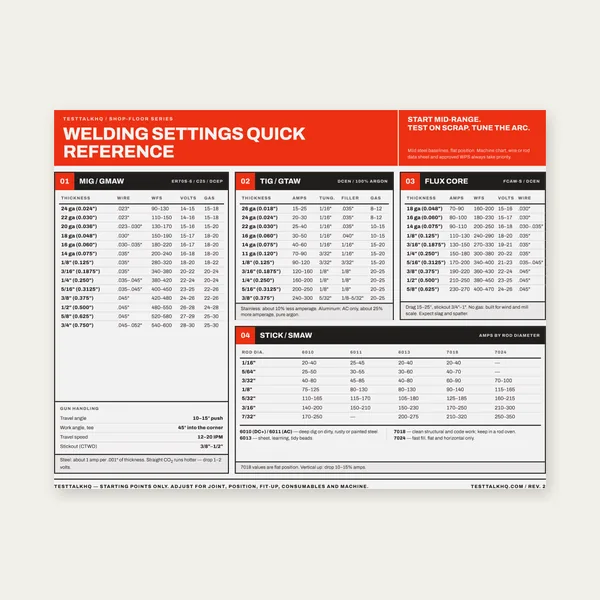
Welding Reference Card
One page. MIG, TIG, stick and flux core settings by thickness.
$3.99
Buy
Complete Welding Settings Guide
19 pages. Four processes, stainless and aluminum, symbols and inspection.
$12.99
Buy
Welding Job Estimator
Price the job, then hand over a quote with no internal numbers.
Excel or Google Sheets. Best on a computer.
$29.00
Buy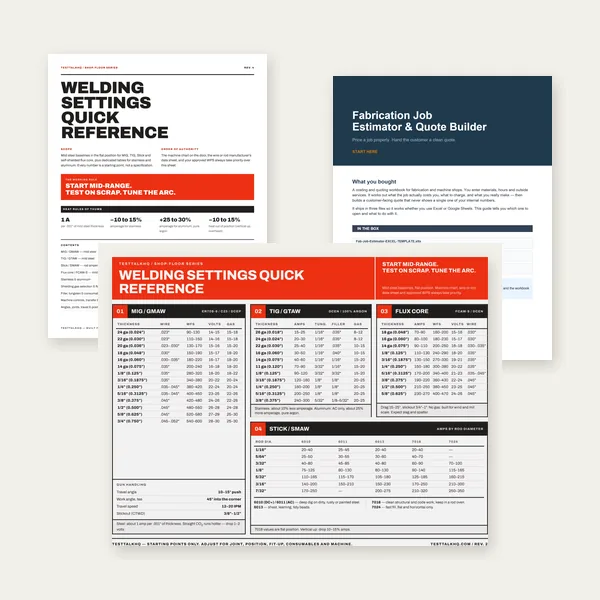
Welding Complete Bundle
Card, 19-page guide and the estimator workbook. All six files.
Excel or Google Sheets. Best on a computer.
$34.99
$45.98 if bought separately — save $10.99
BuyCheckout opens in a new tab.