
Base CFH by process, gas-type multipliers, and stickout adjustments from the shielding gas flow rate calculator.
How to Use This Chart
Recommended CFH ≈ base × gas multiplier + stickout adjustment (aluminum ×1.1; overhead −2 CFH). Calculator: shielding gas flow calculator. Guide: how to choose shielding gas.
Why CFH Scales with Nozzle Size and Process
Cubic feet per hour is volume of gas leaving the cup, not a magic number that works on every gun. A larger ID nozzle needs more CFH to keep a coherent envelope around the arc; a tight TIG cup can protect the puddle at 15–18 CFH where a ¾″ MIG nozzle on spray transfer wants the mid-20s. That is why the base table is by process, not by a single “20 CFH for everything” shop rule. MIG solid wire at 20 CFH assumes a typical ½″-class nozzle and short-circuit or light spray on steel. Flux-core sits a little higher because the arc is often longer and the slag/gas mix is less forgiving of a thin envelope. TIG (GTAW) is lower because the cup is small, the arc is tight, and extra flow mostly creates turbulence that pulls in air.
Gas density then multiplies that base. Argon is the 1.0 reference. CO₂ is heavier and often run richer (1.25×) to keep coverage in globular/short-circuit MIG. Helium is light and “floats”; you need more volume (1.5×) to hold the same envelope, which is why helium blends eat cylinders. C25 sits between argon and CO₂. None of those multipliers replace the WPS gas listed on the procedure — they are how the calculator scales a starting CFH when you change bottles.
Stickout (contact-tip-to-work) changes how far the gas has to travel before it hits turbulence and air. Longer stickout on MIG is why the chart adds CFH as you go from ⅜″ to ¾″. A ¼″ stickout can run a few CFH lower because the cup is closer to the puddle — until the cup overheats or you cannot see. Overhead gets a small reduction in the calculator because extra flow falls off the joint and you are usually in a tighter position; that is a starting bias, not a license to starve a fillet of cover.
Wind, Drafts, and Why Shop CFH Is Not Field CFH
The table assumes still air. A 5 mph draft across an open bay, a cooling fan aimed at the bench, or welding outdoors will strip the envelope no matter what the flowmeter says. GMAW and GTAW are the processes that fail first; SMAW and self-shielded FCAW exist partly because they tolerate wind. If you must MIG outside, you need a wind break, a larger cup / gas lens on TIG, and often 5–10 CFH more than the indoor base — and even then porosity is likely above a light breeze. Turning the flowmeter to 40 CFH “to beat the wind” is the other failure mode: laminar flow becomes turbulent, the jet aspirates air, and you get the same wormholes you were trying to prevent, plus a wasted cylinder.
Drafts inside a shop are sneakier. A downdraft table, an open overhead door, and a person walking past the booth all count. If porosity shows up only on one side of the shop or only when the HVAC kicks on, fix air movement before you rewrite this chart.
Porosity Troubleshooting vs This Chart
Wrong CFH is one porosity cause among many. Contaminated mill scale, paint, moisture in the gas, a cracked liner sucking air, a loose gun fitting, and a draft will all look the same on the bead: pinholes and worm tracks. If you are already in the 18–25 CFH neighborhood for steel MIG and the bead is still porous, raising flow another 10 CFH is usually the wrong first move. Check the gas path for leaks (soapy water on fittings), confirm the cylinder is actually the gas you think it is, clean the joint, and look at nozzle-to-work distance. Then read common weld defects: porosity, undercut, and overlap for the defect-side diagnosis. Process-specific gas and setting issues also live in MIG welding troubleshooting and TIG welding troubleshooting.
A useful shop test: drop CFH in 5 CFH steps on scrap until porosity appears, then add about 5 CFH back. That “minimum plus a margin” is often lower than the chart and cheaper on gas. Do it again if you change nozzle ID, gas blend, or move outdoors. The chart is the first guess; the scrap bead is the calibration.
When You Need Something Other Than This Chart
This page will not pick the gas. Argon vs C25 vs tri-mix vs helium is a metallurgy and transfer-mode decision — use how to choose shielding gas. It will not tell you how long a cylinder lasts; that is the gas cylinder duration calculator. It will not set voltage or WFS. If the question is “why is this weld full of holes,” start with the defects article, not by memorizing the multiplier table.
Base Flow by Process
| Process | Base CFH |
|---|---|
| MIG solid wire | 20 |
| MIG flux-core | 22 |
| TIG (GTAW) | 16 |
| Stick gas-shielded | 18 |
| Plasma cutting | 45 |
Gas Multipliers
| Gas | Multiplier |
|---|---|
| Argon | 1.0 |
| CO₂ | 1.25 |
| Helium | 1.5 |
| C25 (75/25) | 1.2 |
| C15 (85/15) | 1.1 |
| Ar/He blend | 1.4 |
Stickout Adjustment
1 CFH ≈ 0.472 L/min.
| Stickout | Δ CFH |
|---|---|
| 0.25″ | −3 CFH |
| 0.375″ | 0 |
| 0.50″ | +3 CFH |
| 0.75″ | +6 CFH |
CFH / L/min for your process and gas
WeldKit — Welding Calculators Offline
MIG, TIG, Stick, speeds/feeds, and more on Android.
Related Calculators & Guides
Welding
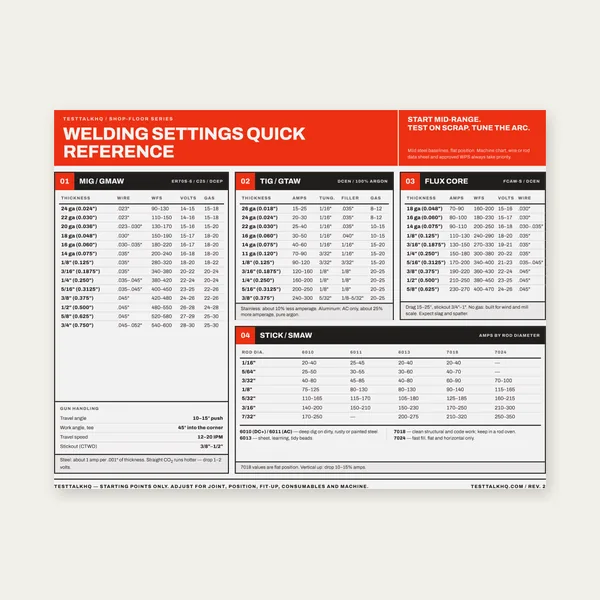
Welding Reference Card
One page. MIG, TIG, stick and flux core settings by thickness.
$3.99
Buy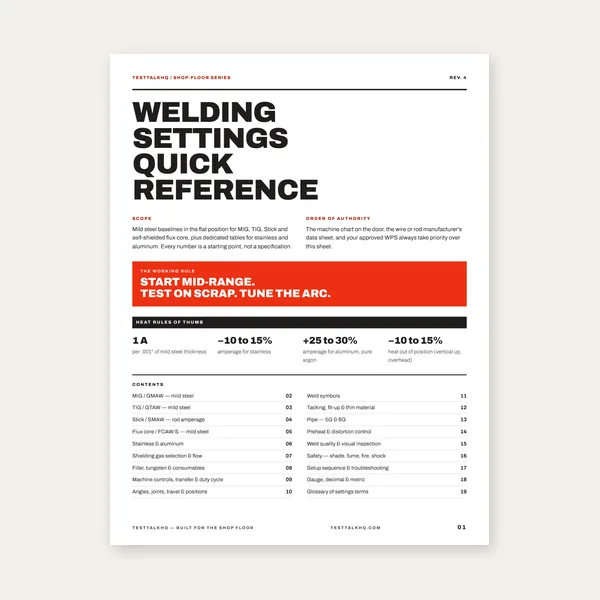
Complete Welding Settings Guide
19 pages. Four processes, stainless and aluminum, symbols and inspection.
$12.99
Buy
Welding Job Estimator
Price the job, then hand over a quote with no internal numbers.
Excel or Google Sheets. Best on a computer.
$29.00
Buy
Welding Complete Bundle
Card, 19-page guide and the estimator workbook. All six files.
Excel or Google Sheets. Best on a computer.
$34.99
$45.98 if bought separately — save $10.99
BuyCheckout opens in a new tab.