A spool is sold by weight. You burn wire by inches per minute. Runtime is just how many feet are on the spool divided by wire feed speed — once you account for diameter, material density, and how much metal actually ends up in the joint.
Feet of Wire on a Spool
Wire length comes from mass and cross-section. With density ρ (lb/in³) and wire radius r (inches):
Length (in) = Weight (lb) ÷ (ρ × π × r²)
Arc-on minutes = Length (in) ÷ WFS (IPM)
Steel is about 0.283 lb/in³, stainless about 0.290, aluminum about 0.098. That is why a 1 lb spool of aluminum holds far more feet than the same weight of steel at the same diameter — lower density means more length per pound.
Common shop spool weights are 2 lb (hobby), 10–11 lb (most MIG guns), 33 lb (bench feeders), and 44–60 lb drums for production. Diameter choices — .023, .030, .035, .045 — change feet per pound dramatically because cross-section scales with the square of diameter.
At the same weight, stepping from .030 to .035 steel drops feet on the spool by roughly 25–30%. Check the MIG wire diameter guide and welding wire gauge chart before you assume two “10 lb” spools last the same time.
Wire Feed Speed Sets Arc-On Hours
Once you know length, arc-on time is length ÷ WFS. A spool with 3,000 feet of wire at 300 IPM lasts 10 arc-on hours if you never stop — which you do. Shop calendar time depends on duty cycle the same way gas does: fit-up, grinding, and repositioning stretch the days without consuming wire.
WFS also tracks amperage for a given wire diameter and transfer mode. If you are dialing in parameters, use the wire feed speed to amps calculator so your “300 IPM” assumption matches the machine and process — not a random chart number.
| Typical setup | WFS ballpark | What it means for spool life |
|---|---|---|
| .030 steel short-circuit | 150–250 IPM | Longer arc hours per spool vs thicker wire |
| .035 steel short-circuit / spray | 200–400 IPM | Most common fab shop burn rate |
| .045 steel spray / FCAW | 250–450+ IPM | Fewer feet per pound; spool empties faster |
| Aluminum .035 / .047 | Often higher WFS | More feet per lb, but feed rates can be hot |
Deposition Efficiency — Not Every Pound Becomes Weld
Solid MIG wire typically deposits about 95% of its mass into the weld (some spatter loss). Flux-cored wire is often closer to 85% because slag and fill do not become joint metal. That matters when you convert spool weight into deposited weld feet or pounds of weld metal for quoting.
Deposition rate (lb/hr) ties WFS, diameter, density, and efficiency together. If you need pounds deposited per hour instead of spool clock time, use the weld deposition rate calculator. The spool runtime calculator can optionally estimate deposited weld feet when you give a deposition efficiency.
- Almost all spool weight becomes weld metal
- Spatter and stubs are the main losses
- Predictable for job costing
- Slag and flux fill reduce deposited metal per lb
- Higher deposition rates still win on thick work
- Use efficiency when converting spool → weld lb
Planning Spools for a Job
Estimate total weld inches (or feet), pick diameter and process, convert to wire length using deposition and joint fill assumptions, then divide by feet per spool. Add margin for starts, stops, and scrap — 10–15% is common on production; more on prototypes and out-of-position work.
- Confirm wire diameter and alloy for the WPS / material.
- Compute feet on each spool from weight and density.
- Set expected average WFS from procedure or machine chart.
- Divide total wire feet needed by feet per spool; round up.
- Stage a spare spool so a change does not stop the booth.
A half-weight spool of .045 is not half the feet of a full .030 spool. Always recalculate from diameter and density — or weigh and run the calculator — before you promise a shift’s worth of welding.
How long will this spool last? Enter diameter, material, spool weight, and wire feed speed for feet on the spool, arc-on hours, and optional deposited weld feet.
Frequently Asked Questions
Why does aluminum show more feet per pound?
Lower density. Same diameter and weight means more length. Feedability and WFS still determine how fast you burn that length.
Can I estimate runtime from amps alone?
Only roughly. Amps correlate with WFS for a given wire, but transfer mode and stickout change the relationship. Prefer IPM from the feeder display or a WFS-to-amps chart for that diameter.
Do 10 lb and 11 lb “shop” spools differ much?
About 10% by weight and length. Brand packaging varies — weigh if you are quoting tightly, or use the labeled net weight in the calculator.
How does this relate to weld cost?
Wire cost is weight × price. Labor and arc time track WFS and duty. Combine spool runtime with deposition rate when you need cost per foot of weld, not just when the spool empties.
Should I buy larger spools to save money?
Larger packs usually cut cost per pound and reduce changeovers, but only if you will use the wire before it rusts or contaminates. Small shops often stay on 10–11 lb for steel; production favors 33 lb+.
Run your spool numbers Diameter, density, weight, and WFS — get length and arc-on hours.
WeldKit — Welding Calculators for the Shop
Wire spool runtime, deposition rate, MIG settings, gas duration, and more. Free on Android. Works offline.
Related Calculators & Guides
When the Runtime Estimate Fails—or the Package Size Changes
Diagnose early-empty spools, wrong efficiency, unexpected waste, and bid overruns with Electrode & Wire Consumption Troubleshooting. For WFS, feed-path, melt-off, and deposition disagreements, use Weld Deposition Rate Troubleshooting.
When runtime is known but the purchasing choice is not, compare changeover labor, feeder compatibility, contamination risk, and inventory turnover in 10 lb vs 33 lb Welding Wire Spools. Run exact diameter, material, weight, and WFS inputs in the Wire Spool Runtime Calculator; a separate static chart would duplicate that calculation.
Welding
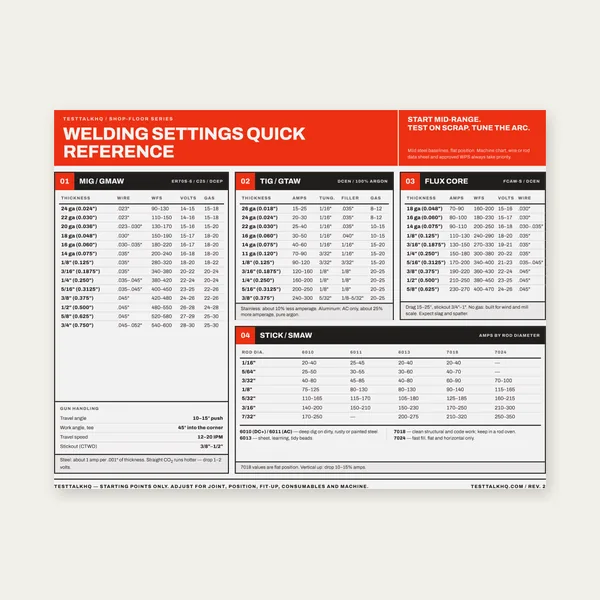
Welding Reference Card
One page. MIG, TIG, stick and flux core settings by thickness.
$3.99
Buy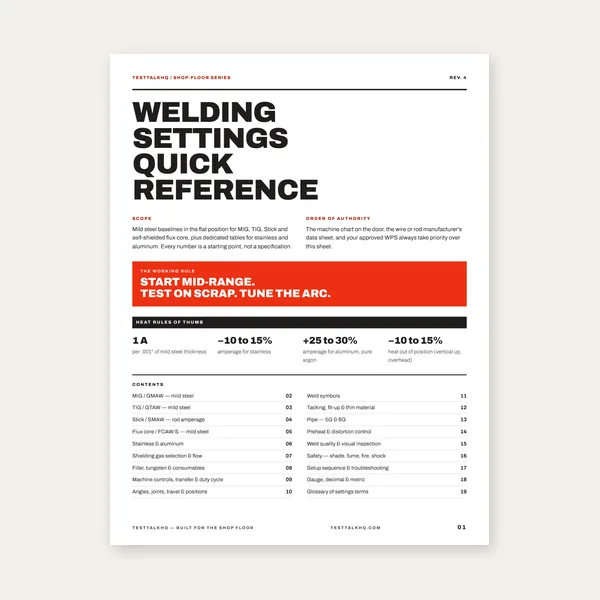
Complete Welding Settings Guide
19 pages. Four processes, stainless and aluminum, symbols and inspection.
$12.99
Buy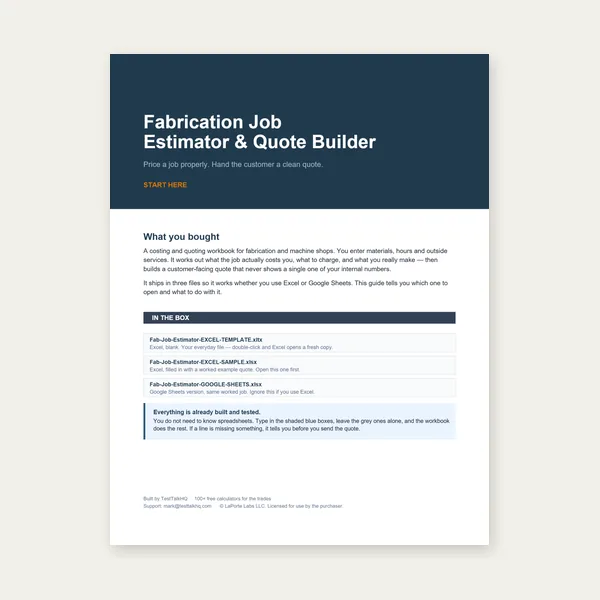
Welding Job Estimator
Price the job, then hand over a quote with no internal numbers.
Excel or Google Sheets. Best on a computer.
$29.00
Buy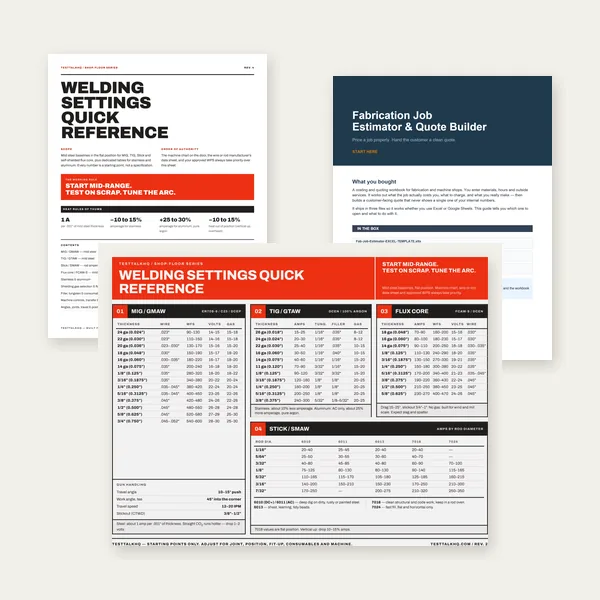
Welding Complete Bundle
Card, 19-page guide and the estimator workbook. All six files.
Excel or Google Sheets. Best on a computer.
$34.99
$45.98 if bought separately — save $10.99
BuyCheckout opens in a new tab.