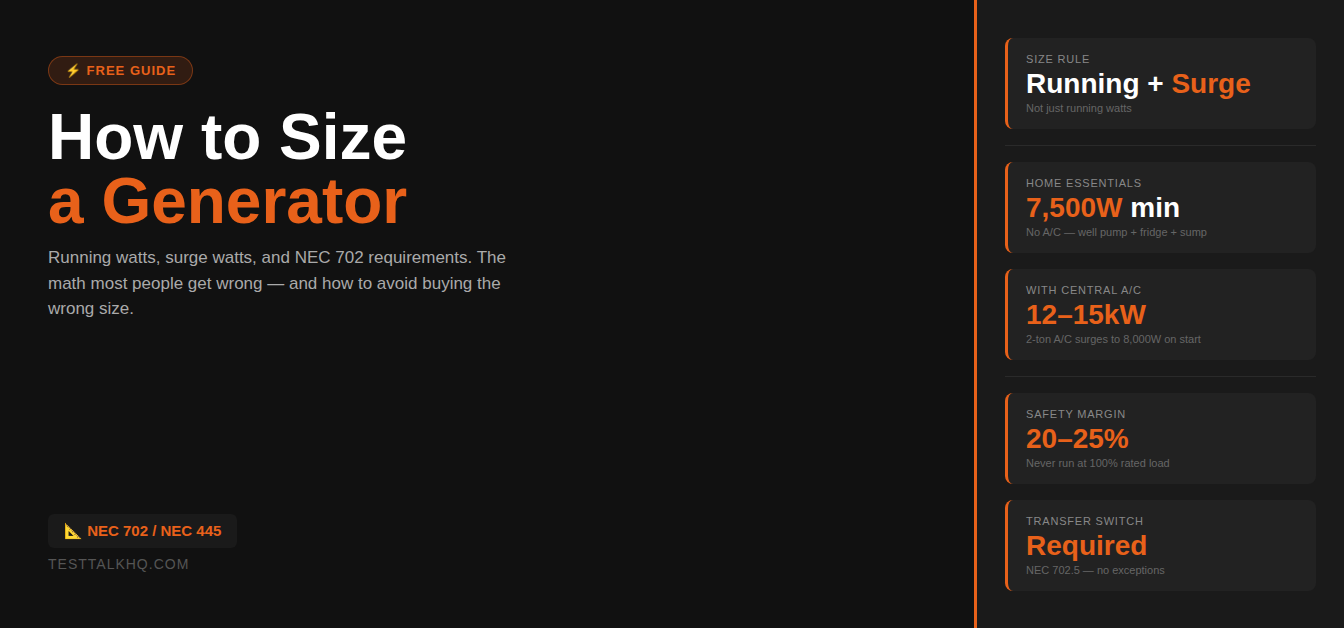
Most people buy a generator that’s too small because they only look at running watts and ignore surge watts. A 5,000W generator sounds like plenty — until your refrigerator compressor kicks on and stalls it dead at 3am during a storm. This guide walks you through the real math so you get the right size the first time.
Running Watts vs. Surge Watts — The Most Important Distinction
Every load has two numbers. Running watts is how much power it draws while it’s operating normally. Surge watts (also called starting watts or peak watts) is the brief spike of power it needs the instant it starts — typically 2 to 3 seconds.
The surge spike is the generator killer. A refrigerator running on 150 watts can demand 800 to 1,200 watts the moment the compressor starts. A 1.5 HP well pump running at 1,500 watts can surge to 4,500 watts on startup. If your generator’s surge capacity can’t handle the spike, it stalls or trips — and in a power outage, that’s a serious problem.
⚠️ The Rule Nobody Tells You
Size your generator for the highest single surge load you’ll have, plus your total running load of everything else running at the same time. Most people only add up running watts and end up with a generator that can’t start their A/C or well pump.
Surge Multipliers by Load Type
| Load Type | Running Watts | Surge Multiplier | Surge Watts (typical) |
|---|---|---|---|
| Refrigerator | 150–400W | 3–5× | 600–1,500W |
| Window A/C (10,000 BTU) | 1,200W | 3–4× | 3,600–4,800W |
| Central A/C (2 ton) | 2,000W | 3–4× | 6,000–8,000W |
| Well Pump (1/2 HP) | 750W | 3–5× | 2,250–3,750W |
| Sump Pump (1/3 HP) | 500W | 3–5× | 1,500–2,500W |
| Electric Dryer | 5,000W | 1.1× | 5,500W (resistive) |
| MIG Welder (140A) | 2,500–3,000W | 1.2× | 3,000–3,600W |
| Air Compressor (1 HP) | 1,000W | 3–4× | 3,000–4,000W |
| Lights, TVs, Phone chargers | Varies | 1.0× | No surge |
The 5-Step Method for Sizing a Generator
1
List Every Load You Want to Power
Write down everything you want to run during an outage — or during a job site use. Don’t forget the small stuff: phone chargers, LED lights, a router, a fan. They add up. For each load, find the running wattage on the nameplate or look it up.
2
Add Up Your Total Running Watts
Sum every load’s running watts. This is your continuous demand — what the generator has to sustain. This number alone tells you what the generator needs to run at steady state.
3
Find Your Largest Single Motor or Compressor Load
Identify the single highest-surge load you’ll ever start while other things are running. Usually this is your A/C compressor, well pump, or a large air compressor. Calculate its surge requirement using the multipliers in the table above.
4
Calculate Your Peak Demand
Your generator needs to handle: (Total running watts of everything else) + (Surge watts of your biggest motor). That’s the peak the generator sees at the worst-case moment — when everything is running and your largest motor kicks on.
5
Add a 20–25% Safety Margin
Never size a generator to run at its rated maximum. Heat reduces generator output — a generator loses roughly 3.5% capacity per 1,000 feet of elevation and loses additional output in hot conditions. Add 20–25% to your peak demand to get your minimum generator rating. Buy the next standard size up from that number.
Real-World Sizing Examples
Example 1: Home Essentials During a Power Outage
| Load | Running Watts | Notes |
|---|---|---|
| Refrigerator | 200W | Surge: 1,000W |
| Freezer | 150W | Surge: 600W |
| Sump pump (1/3 HP) | 500W | Surge: 1,500W |
| Lights (LED, 6 circuits) | 300W | No surge |
| Phone/laptop chargers | 100W | No surge |
| Well pump (1/2 HP) | 750W | Surge: 3,000W |
| Total running | 2,000W | |
| Worst-case peak | 4,250W | Running (1,250W) + Well pump surge (3,000W) |
| With 25% margin | 5,300W | Buy a 6,000–7,500W generator |
Example 2: Shop/Job Site with Welder and Compressor
| Load | Running Watts | Notes |
|---|---|---|
| MIG Welder (140A setting) | 2,800W | Low surge (transformer load) |
| Air compressor (1 HP) | 1,000W | Surge: 3,500W |
| Angle grinder | 1,200W | Surge: 1,400W |
| Work lights | 400W | No surge |
| Total running | 5,400W | |
| Worst-case peak | 7,100W | Running (3,600W) + Compressor surge (3,500W) |
| With 25% margin | 8,875W | Buy a 10,000W generator minimum |
✅ Welders Are Generator-Friendly
Welders are transformer or inverter-based — they have very low surge demand. A 140A MIG welder draws roughly what it says on the nameplate with minimal startup spike. The killer is always the air compressor starting while you’re mid-weld.
Generator Types and What Each Handles
Portable Generators (3,000–12,500W)
The most common for home backup and job sites. Conventional portable generators run at 3,600 RPM constantly — loud, fuel-hungry, but powerful. Size ranges from small enough for essentials to large enough for most homes. Fuel: gasoline or dual-fuel (gas + propane).
Inverter Generators (1,000–7,500W)
Run at variable speed, much quieter, significantly more fuel-efficient, and produce clean power (less than 3% THD) that’s safe for sensitive electronics including laptops, phone chargers, and modern wire feeders. The trade-off is lower maximum output. A 3,500W inverter generator is often sufficient for home essentials but won’t run large motors or whole-home A/C.
💡 Welders Prefer Inverter Generators
If you’re running an inverter-style MIG or TIG welder on a generator, clean power matters. Modern inverter welders are sensitive to voltage fluctuations. An inverter generator’s clean sine wave output prevents erratic arc behavior and protects the welder’s electronics. Avoid cheap conventional generators for sensitive inverter welders.
Standby Generators (7,500W–22,000W+)
Permanently installed, automatic transfer switch, runs on natural gas or propane. Turns on automatically within seconds of a power failure. Sized for whole-home backup including central A/C and well pump. NEC 702 governs optional standby systems — and these require a proper transfer switch. Non-negotiable.
NEC 702 — What the Code Actually Says About Backup Generators
NEC Article 702 covers Optional Standby Systems — backup power that protects property or business operations but isn’t life-safety critical. The key code requirements you need to know:
- NEC 702.4: The generator must be sized to supply all loads operated simultaneously. You can’t just hope people won’t run the dryer and the A/C at the same time — you have to calculate for the design load.
- NEC 702.5: Transfer equipment is required whenever a generator is connected to a structure’s wiring. You cannot backfeed a panel through a dryer outlet or any other makeshift connection — this is illegal and has killed utility workers.
- NEC 445.13: Conductors from the generator terminals must have an ampacity of at least 115% of the nameplate current rating of the generator.
- NEC 702.12: Outdoor generator locations must meet specific requirements for clearance from combustibles and ventilation.
⚠️ The Transfer Switch Is Not Optional
Backfeeding your panel through a dryer outlet or any other improvised connection is a code violation that can energize the utility lines — putting lineworkers’ lives at risk. NEC 702.5 requires listed transfer equipment on every permanent generator installation. A manual transfer switch starts around $200. An interlock kit for your existing panel starts around $50–80. There is no legal workaround.
Common Sizing Mistakes
Mistake 1: Sizing for Running Watts Only
You see this constantly. Someone adds up 4,000 watts of running loads, buys a 5,000W generator with 25% headroom, and then the well pump won’t start because its 3,500W surge tips the machine over the edge. Always calculate surge first, then running. Not the other way around.
Mistake 2: Ignoring Altitude and Heat Derating
Generator ratings are at sea level and typically 77°F. In the mountains or during summer heat, output drops significantly. A 10,000W generator at 6,000 feet of elevation and 95°F ambient may only produce 7,500–8,000W of usable power. Always look at the manufacturer’s derating specs for your conditions.
Mistake 3: Running the Generator at Maximum Load
Generators are most fuel-efficient and longest-lived at 50–80% of rated load. Running a generator at 95% of its rated output continuously will overheat it, trip its overload protection, and significantly shorten its life. If you’re constantly near the limit, you need a bigger generator.
Mistake 4: Forgetting Motor Starting Sequence
When power comes on or you start up the generator, don’t power up all your loads simultaneously. Start the largest motor first with nothing else running. Let it reach full speed, then add loads one at a time starting with the next largest motor. This avoids a cascade of simultaneous surge demands that no generator can handle.
⚡ Calculate Your Generator Size Instantly
Use our free Generator Sizing Calculator to enter your specific loads and get an accurate minimum generator rating — including surge capacity and safety margin.
Generator Sizing Quick Reference Chart
| Application | Typical Running Load | Minimum Generator Size |
|---|---|---|
| Home essentials (no A/C) | 2,000–3,500W | 5,000–7,500W |
| Home with window A/C | 3,500–5,000W | 7,500–10,000W |
| Home with central A/C (2-ton) | 5,000–8,000W | 12,000–15,000W |
| Whole-home standby | 6,000–12,000W | 14,000–22,000W |
| Small job site (tools, lights) | 3,000–5,000W | 7,500–10,000W |
| Job site with welder + compressor | 5,000–8,000W | 10,000–12,500W |
| Shop backup (welder, compressor, lights) | 6,000–10,000W | 12,500–15,000W |
Frequently Asked Questions
What size generator do I need for a 2,000 sq ft house?
It depends on your specific loads, not your square footage. A 2,000 sq ft home with gas heat, a well pump, refrigerator, sump pump, and lights typically needs 7,500–10,000 watts. Add central A/C and you’re looking at 12,000–15,000 watts minimum. Use our calculator with your actual appliance list for an accurate number.
Can a 7,500 watt generator run central air conditioning?
Maybe, depending on the A/C size. A 1.5-ton central A/C (18,000 BTU) requires roughly 1,500W running and may surge to 5,000–6,000W on startup. A 7,500W generator can handle that if the rest of your loads are light. A 2-ton unit (24,000 BTU) surges to 7,000–8,000W — right at the edge. A 2.5-ton or larger unit typically needs a 10,000W+ generator.
Do I need a transfer switch for a portable generator?
Yes, if you’re connecting it to your home’s wiring. NEC 702.5 requires transfer equipment. You can use a manual transfer switch, a generator interlock kit, or a transfer switch panel. Plugging appliances directly into the generator with extension cords doesn’t require a transfer switch — but backfeeding your panel does, no exceptions.
Is a 5500 watt generator enough for a house?
For basic essentials only — no A/C, no well pump, no electric dryer. Refrigerator, freezer, lights, phone chargers, a fan, and maybe a window A/C unit if you start it carefully. Most homeowners want more capacity for real comfort during extended outages. A 7,500W generator handles most essential scenarios better.
What size generator do I need to run a welder?
A 140A MIG welder (like a Lincoln 210i or similar) draws about 2,500–3,000W at typical settings. Add your air compressor surge (3,000–4,000W), some lights, and other small loads — you need at least an 8,000–10,000W generator for a basic welding setup. Use an inverter generator for clean power if you’re running an inverter-style welder. See our full guide on shop generator sizing above.
What is the difference between rated watts and peak watts on a generator?
Rated watts (also called running watts) is the continuous output the generator can sustain indefinitely. Peak watts is the maximum surge output for a few seconds to start motors. Always size based on rated watts for your continuous load, and verify the peak watts are sufficient for your largest motor’s startup surge. Never plan to run your generator at its peak watt rating — that’s only for brief motor starts.
Any trade
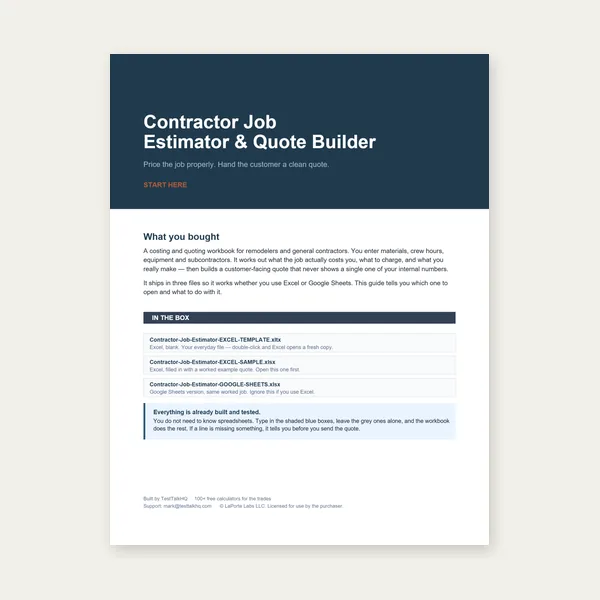
Contractor Job Estimator
Price remodels and GC work, then send a quote with no internal numbers.
Excel or Google Sheets. Best on a computer.
$29.00
BuyCheckout opens in a new tab.