
WeldKit Terms and Conditions
Terms & Conditions
These terms and conditions apply to the WeldKit app (hereby referred to as “Application”) for mobile devices that was created by TestTalk (hereby referred to as “Service Provider”) as a Freemium service.
Upon downloading or utilizing the Application, you are automatically agreeing to the following terms. It is strongly advised that you thoroughly read and understand these terms prior to using the Application.
Unauthorized copying, modification of the Application, any part of the Application, or our trademarks is strictly prohibited. Any attempts to extract the source code of the Application, translate the Application into other languages, or create derivative versions are not permitted. All trademarks, copyrights, database rights, and other intellectual property rights related to the Application remain the property of the Service Provider.
The Service Provider is dedicated to ensuring that the Application is as beneficial and efficient as possible. As such, they reserve the right to modify the Application or charge for their services at any time and for any reason. The Service Provider assures you that any charges for the Application or its services will be clearly communicated to you.
The Application stores and processes personal data that you have provided to the Service Provider in order to provide the Service. It is your responsibility to maintain the security of your phone and access to the Application. The Service Provider strongly advise against jailbreaking or rooting your phone, which involves removing software restrictions and limitations imposed by the official operating system of your device. Such actions could expose your phone to malware, viruses, malicious programs, compromise your phone’s security features, and may result in the Application not functioning correctly or at all.
Please note that the Application utilizes third-party services that have their own Terms and Conditions. Below are the links to the Terms and Conditions of the third-party service providers used by the Application:
Please be aware that the Service Provider does not assume responsibility for certain aspects. Some functions of the Application require an active internet connection, which can be Wi-Fi or provided by your mobile network provider. The Service Provider cannot be held responsible if the Application does not function at full capacity due to lack of access to Wi-Fi or if you have exhausted your data allowance.
If you are using the application outside of a Wi-Fi area, please be aware that your mobile network provider’s agreement terms still apply. Consequently, you may incur charges from your mobile provider for data usage during the connection to the application, or other third-party charges. By using the application, you accept responsibility for any such charges, including roaming data charges if you use the application outside of your home territory (i.e., region or country) without disabling data roaming. If you are not the bill payer for the device on which you are using the application, they assume that you have obtained permission from the bill payer.
Similarly, the Service Provider cannot always assume responsibility for your usage of the application. For instance, it is your responsibility to ensure that your device remains charged. If your device runs out of battery and you are unable to access the Service, the Service Provider cannot be held responsible.
In terms of the Service Provider’s responsibility for your use of the application, it is important to note that while they strive to ensure that it is updated and accurate at all times, they do rely on third parties to provide information to them so that they can make it available to you. The Service Provider accepts no liability for any loss, direct or indirect, that you experience as a result of relying entirely on this functionality of the application.
The Service Provider may wish to update the application at some point. The application is currently available as per the requirements for the operating system (and for any additional systems they decide to extend the availability of the application to) may change, and you will need to download the updates if you want to continue using the application. The Service Provider does not guarantee that it will always update the application so that it is relevant to you and/or compatible with the particular operating system version installed on your device. However, you agree to always accept updates to the application when offered to you. The Service Provider may also wish to cease providing the application and may terminate its use at any time without providing termination notice to you. Unless they inform you otherwise, upon any termination, (a) the rights and licenses granted to you in these terms will end; (b) you must cease using the application, and (if necessary) delete it from your device.
Changes to These Terms and Conditions
The Service Provider may periodically update their Terms and Conditions. Therefore, you are advised to review this page regularly for any changes. The Service Provider will notify you of any changes by posting the new Terms and Conditions on this page.
These terms and conditions are effective as of 2026-02-02
Contact Us
If you have any questions or suggestions about the Terms and Conditions, please do not hesitate to contact the Service Provider at [email protected].
This Terms and Conditions page was generated by App Privacy Policy Generator
Welding Wire Size Chart Guide: How to Choose the Right MIG Wire Diameter
You’re standing in the welding supply store staring at spools of MIG wire labeled .023″, .030″, .035″, .045″, and thinking “which one do I actually need?”—and the wrong choice means either burning through thin material like paper (wire too large) or struggling with poor penetration and constant spatter on thick steel (wire too small). Most hobby welders buy .035” wire because it’s labeled “general purpose,” then discover it’s too large for the 1/16″ sheet metal body panels they’re trying to repair or too small for the 1/4″ structural steel they’re fabricating. The difference between wire sizes isn’t subtle: .030″ wire runs optimally at 80-130 amps for thin materials, while .045″ wire needs 140-250 amps for thick plate—run .045″ wire at 100 amps and you’ll get cold laps, poor fusion, and frustration.
Wire diameter directly determines amperage range, deposition rate, penetration depth, and what material thickness you can successfully weld. Thinner wire (.023″-.030″) enables welding sheet metal as thin as 24-gauge (0.024″) without burn-through, while thicker wire (.045″-.052″) deposits more metal per pass for faster welding on 3/8″-1/2″ plate. But here’s the catch: you can’t just “turn down the power” on .045″ wire to weld thin material—the wire diameter itself creates a minimum stable arc voltage that’s too hot for sheet metal, resulting in blow-through regardless of settings.
This guide shows you how to select wire diameter based on material thickness (sheet metal, structural steel, or heavy plate), match wire size to your welder’s amperage output (120V, 240V single-phase, or 3-phase machines), and understand the difference between solid wire and flux-core sizing (flux-core typically runs one size larger for equivalent thickness). You’ll learn why .035″ wire is actually NOT “universal” despite marketing claims, how contact tip size must match wire diameter exactly (using .035″ tips with .030″ wire causes erratic feeding and burn-back), and the five telltale signs you’re using the wrong wire diameter for your application.
Use our free Wire Gauge Calculator for Welders to determine optimal wire size for your material thickness and welder capacity.
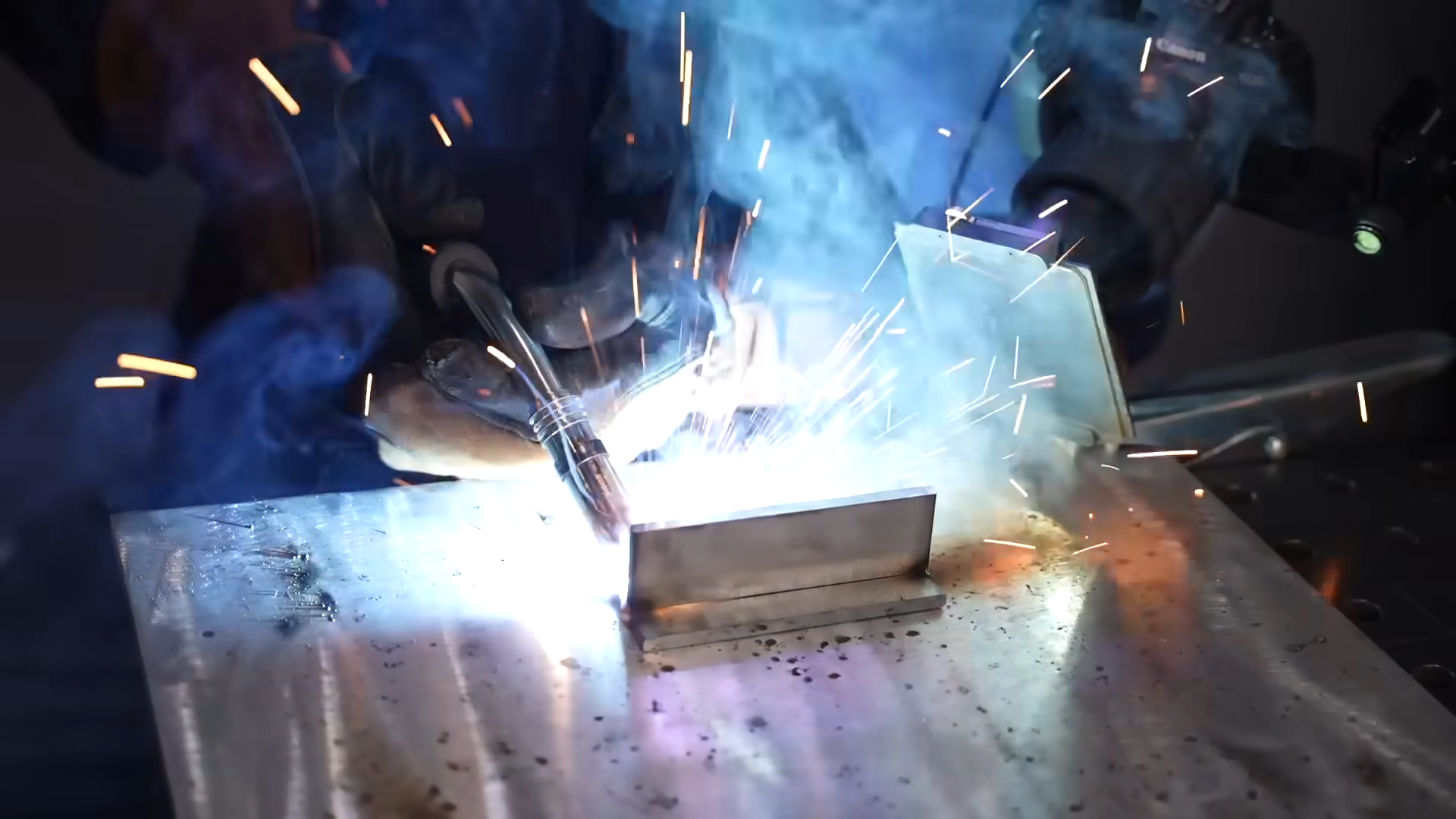
Table of Contents
Why Wire Size Matters
Wire diameter isn’t just about how thick the wire looks—it fundamentally determines what you can weld, how fast you can weld it, and whether you’ll get good penetration or blow holes through your material.
The Three Critical Effects of Wire Diameter
1. Amperage Range (Heat Output)
Each wire diameter has an optimal amperage range where the arc is stable and controllable:
- .023″ wire: 30-90 amps (extremely low heat, thin materials only)
- .030″ wire: 40-145 amps (sheet metal to light structural)
- .035″ wire: 50-180 amps (general purpose range)
- .045″ wire: 75-250 amps (structural to heavy plate)
- .052″ wire: 100-300+ amps (heavy industrial only)
You can’t effectively run .045″ wire at 60 amps (arc too unstable, poor penetration) or .023″ wire at 200 amps (wire melts before leaving contact tip, instant bird’s nest).
2. Deposition Rate (How Much Metal is Laid Down)
Thicker wire deposits more filler metal per inch of weld:
- .030″ wire @ 100 amps: ~3-4 lbs/hour deposition
- .035″ wire @ 130 amps: ~5-6 lbs/hour deposition
- .045″ wire @ 180 amps: ~8-10 lbs/hour deposition
Higher deposition means faster welding on thick material, but it also means more heat input that can cause burn-through on thin material.
3. Penetration Depth (How Deep the Weld Goes)
Larger wire diameters create deeper penetration at equivalent amperages because they carry more current density:
- .030″ wire @ 100 amps: 1/16″-3/32″ penetration (suitable for 16-18 gauge sheet)
- .035″ wire @ 100 amps: 3/32″-1/8″ penetration (suitable for 14-16 gauge to 1/8″ plate)
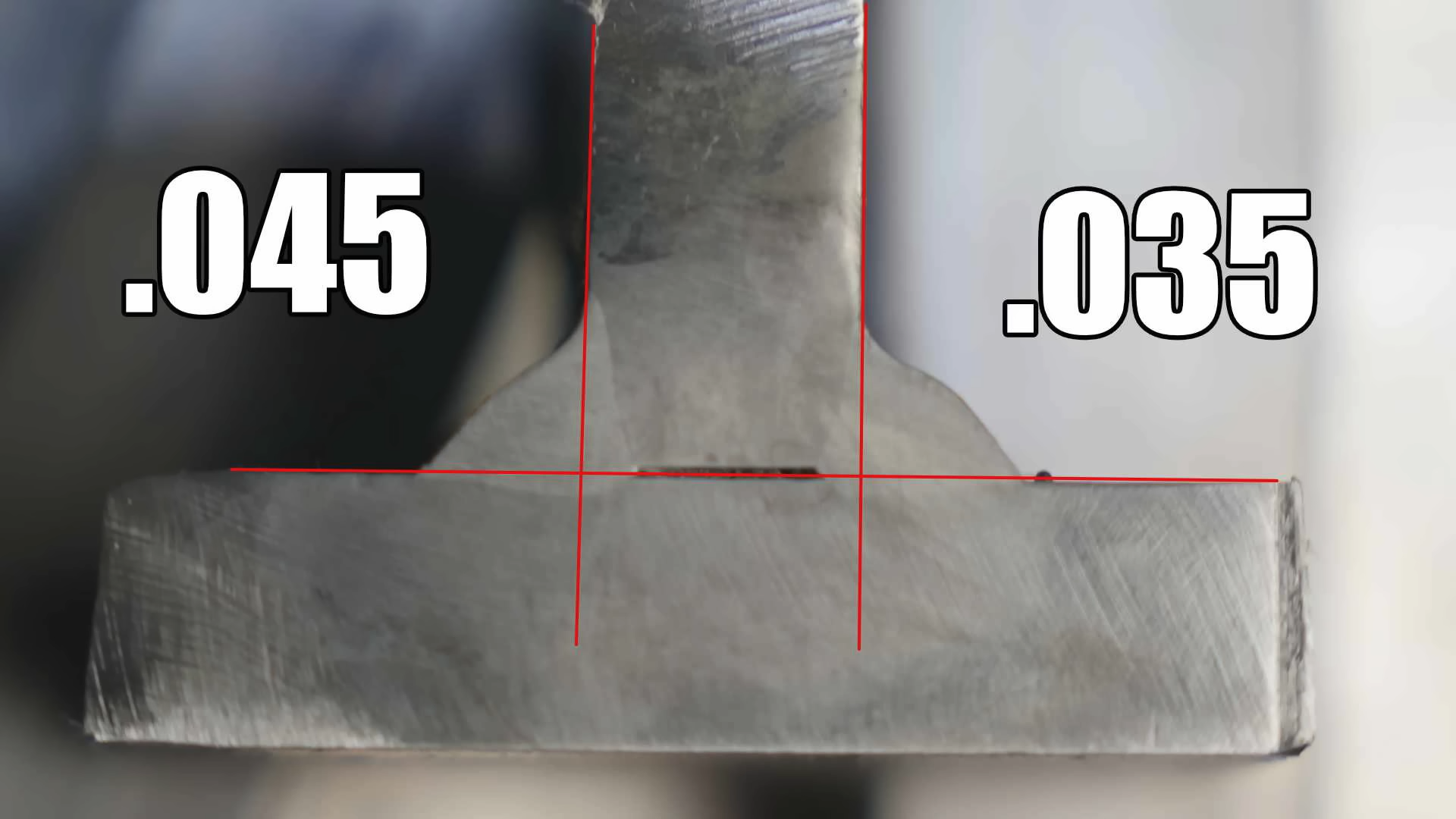
- .045″ wire @ 100 amps: Too much penetration for thin material, not enough for thick plate (wrong range)
Real-World Example: Wrong Wire Size Consequences
Scenario: Welding 1/8″ structural steel brackets
Using .030″ wire (too small):
- Need to run 140+ amps to get adequate penetration
- Wire burns back into contact tip (too much heat for wire diameter)
- Excessive spatter (arc unstable at high amperage for this wire)
- Weld takes longer (low deposition rate requires multiple passes)
- Frequent wire feeding issues (wire too small for heavy feed pressure)
Using .045″ wire (too large):
- Minimum stable arc requires 120+ amps
- Blows holes through thin areas or gaps in fit-up
- Weld bead too large, excessive reinforcement
- Difficult to control puddle (too much metal depositing)
Using .035″ wire (correct size):
- Runs smoothly at 110-140 amps (perfect range)
- Good penetration without burn-through
- Controllable puddle, proper bead size
- Fast, clean welds with minimal cleanup
Wire Sizes Explained (.023″ to .052″)
MIG wire comes in five common diameters, each designed for specific material thickness ranges and welder capacities.
.023″ Wire (0.6mm) – Ultra-Thin Sheet Metal
Best for:
- 22-24 gauge sheet metal (0.024″-0.030″ thick)
- Auto body panels, HVAC ductwork
- Precision thin metal fabrication
Amperage range: 30-90 amps
Typical welder: 120V machines, spool guns
Gas: 100% CO2 or 75/25 Ar/CO2
Characteristics:
- Very low heat input (minimal distortion on thin material)
- Requires extremely clean material (rust/paint causes porosity)
- Fast wire feed speeds (200-400 IPM typical)
- Difficult to feed through long gun cables (use spool guns)
Limitations:
- Maximum thickness: ~1/16″ (anything thicker lacks penetration)
- Not available in all wire types (limited to mild steel, some stainless)
- More expensive per pound than larger sizes
.030″ Wire (0.8mm) – Light Sheet Metal & Thin Plate
Best for:
- 18-22 gauge sheet (0.040″-0.060″ thick)
- Up to 1/8″ plate in single pass
- Auto body repair, light fabrication, ornamental work
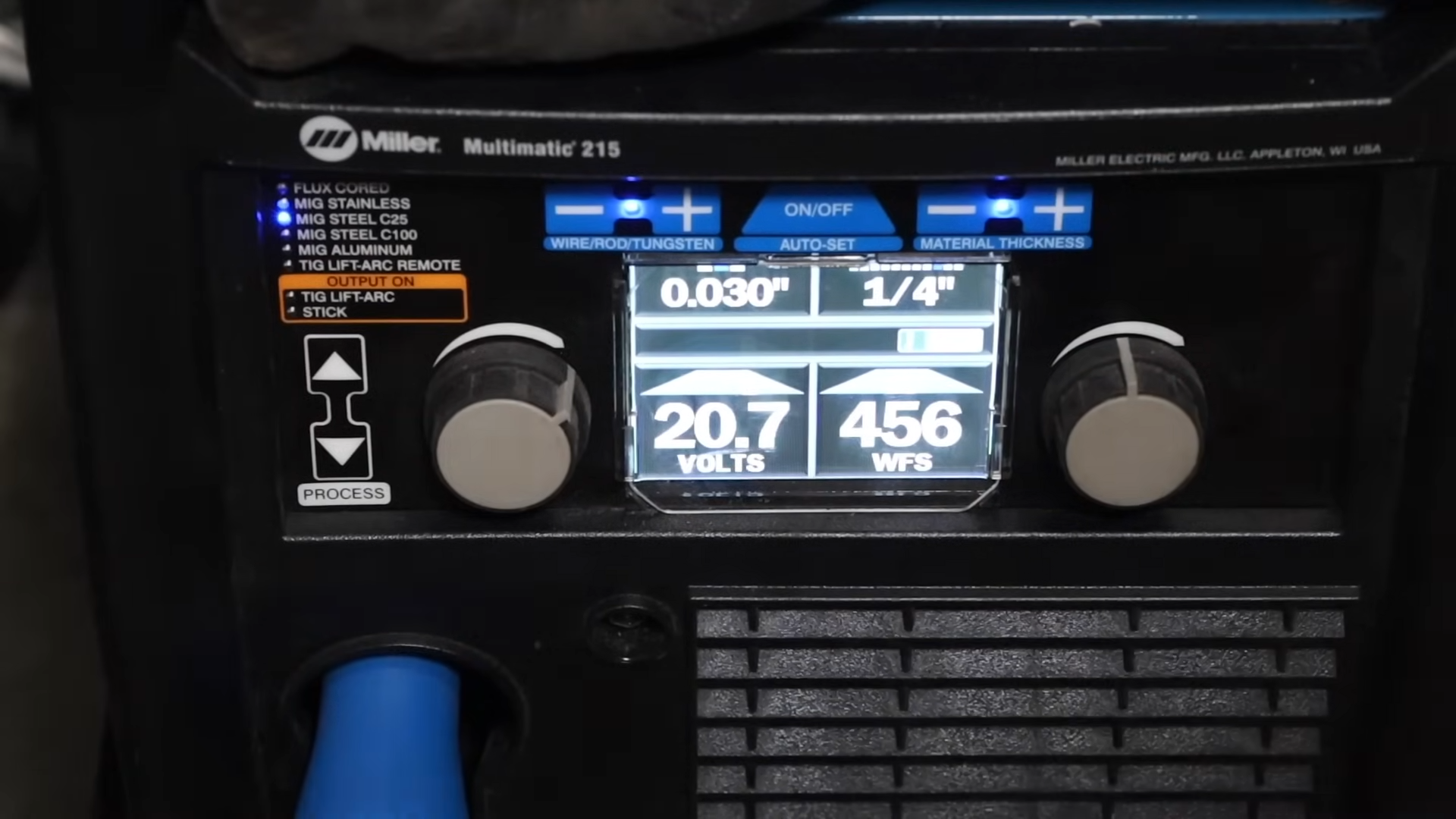
Amperage range: 40-145 amps
Typical welder: 120V or 240V machines up to 180 amps
Gas: 75/25 Ar/CO2 recommended, 100% CO2 acceptable
Characteristics:
- Low heat input (good for thin material, minimal warping)
- Smooth arc characteristics
- Good for out-of-position welding (vertical, overhead)
- Feeds reliably through standard 10-15 ft gun cables
Sweet spot: 20 gauge to 1/8″ material
Maximum thickness: 3/16″ with multiple passes
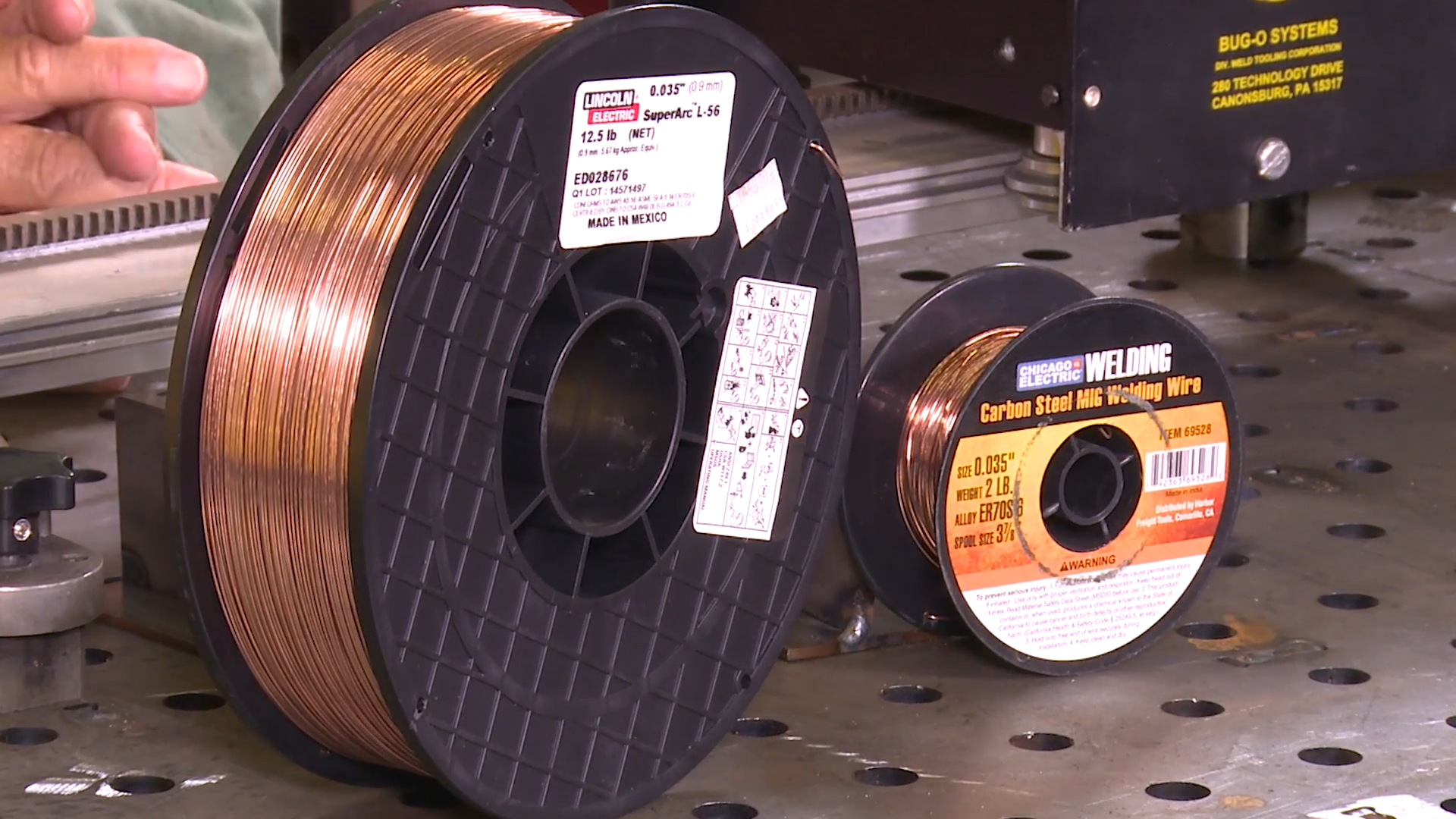
.035″ Wire (0.9mm) – “General Purpose” Size
Best for:
- 16 gauge sheet (0.060″) to 1/4″ plate
- Structural steel, frame rails, brackets
- Most common all-around fabrication work
Amperage range: 50-180 amps
Typical welder: 240V machines, 140-180 amp output
Gas: 75/25 Ar/CO2 or 90/10 Ar/CO2 (cleaner)
Characteristics:
- Most versatile diameter (handles widest thickness range)
- Available in all wire types (mild steel, stainless, flux-core)
- Good balance of penetration and control
- Readily available, most economical per pound
Why it’s called “general purpose”:
.035″ wire covers the most common material thicknesses in fabrication (14 gauge to 1/4″), making it the best single wire size if you can only stock one diameter.
Limitations:
- Too hot for sheet metal thinner than 18 gauge (causes burn-through)
- Slower on heavy plate than .045″ (lower deposition rate)
.045″ Wire (1.2mm) – Heavy Structural & Plate
Best for:
- 3/16″ to 1/2″ plate
- Heavy structural steel, trailer frames, farm equipment
- High-production welding (fast deposition)
Amperage range: 75-250 amps
Typical welder: 240V machines, 180-250 amp output minimum
Gas: 75/25 or 90/10 Ar/CO2
Characteristics:
- High deposition rate (welds thick material faster)
- Deep penetration (good for heavy plate, thick-wall tubing)
- Handles dirty/rusty material better than thin wire
- Excellent for flat/horizontal position welding
When to use .045″ over .035″:
- Welding 1/4″ plate or thicker routinely
- Production environment (speed matters)
- Welder has sufficient amperage (200+ amps available)
Limitations:
- Minimum thickness: 1/8″ (burns through anything thinner)
- Difficult for out-of-position work (large puddle to control)
- Requires higher-capacity welder
.052″ Wire (1.4mm) – Heavy Industrial Only
Best for:
- 3/8″ to 1″ plate and beyond
- Shipbuilding, heavy equipment, structural beams
- Submerged arc welding (SAW) applications
Amperage range: 100-300+ amps
Typical welder: Industrial 3-phase machines, 300+ amp capacity
Gas: 90/10 Ar/CO2 or specialized mixes
Characteristics:
- Maximum deposition rate (fastest filling of thick joints)
- Very deep penetration
- Typically used in flat/horizontal positions only
Not for typical fabrication shops: Most hobbyists and small shops never need .052″ wire—it requires industrial welding equipment and is only cost-effective for high-volume heavy plate work.
Wire Size by Material Thickness
The single most important factor in wire size selection is the thickness of material you’re welding.
Complete Material Thickness Chart
| Material Thickness | Gauge (Sheet) | Best Wire Size | Alternative Size |
|---|---|---|---|
| 0.024″-0.030″ | 24-22 ga | .023″ | .030″ (light touch) |
| 0.030″-0.048″ | 22-20 ga | .030″ | — |
| 0.048″-0.060″ | 20-18 ga | .030″ | .035″ (careful) |
| 0.060″-0.075″ | 18-16 ga | .030″ or .035″ | Either works well |
| 0.075″-0.105″ | 16-14 ga | .035″ | .030″ (slow travel) |
| 1/8″ (0.125″) | 11 ga | .035″ | .045″ (high heat) |
| 3/16″ (0.1875″) | — | .035″ or .045″ | Either works |
| 1/4″ (0.25″) | — | .045″ | .035″ (multiple passes) |
| 5/16″ (0.3125″) | — | .045″ | — |
| 3/8″ (0.375″) | — | .045″ or .052″ | .035″ (many passes) |
| 1/2″ (0.50″) and up | — | .052″ | .045″ (production) |
Single-Pass vs. Multi-Pass Welding
Material thickness recommendations assume single-pass welding for optimal efficiency. You can weld thicker material with smaller wire using multiple passes, but it’s slower:
Example: Welding 1/4″ plate
- .045″ wire: Single pass, 180-200 amps, 15 seconds per foot
- .035″ wire: 2-3 passes, 140-160 amps, 35-45 seconds per foot
- .030″ wire: 3-4 passes, 120-130 amps, 60+ seconds per foot
For occasional thick welds, smaller wire with multiple passes works. For regular production, match wire size to thickness for single-pass capability.
Thin Material Overlap Zone (16-18 Gauge)
The 16-18 gauge range (.060″-.075″) is where both .030″ and .035″ wire work well:
Use .030″ wire when:
- Material varies in thickness (some areas thinner)
- Fit-up has gaps (lower heat prevents burn-through)
- Doing out-of-position work (easier puddle control)
Use .035″ wire when:
- Material is uniform thickness
- Tight fit-up, no gaps
- Welding flat/horizontal (faster deposition desired)
Wire Size by Amperage Range
Each wire diameter has an optimal amperage range. Outside this range, the arc becomes unstable or the wire can’t handle the current.
Amperage Range by Wire Diameter
| Wire Size | Minimum Amps | Optimal Range | Maximum Amps |
|---|---|---|---|
| .023″ | 30 | 40-75 | 90 |
| .030″ | 40 | 60-120 | 145 |
| .035″ | 50 | 80-160 | 180 |
| .045″ | 75 | 120-220 | 250 |
| .052″ | 100 | 150-280 | 300+ |
What Happens Outside Optimal Range
Running wire below minimum amperage:
- Arc sputters and becomes unstable
- Wire stubbing (wire pushes into work instead of melting)
- Cold welds with poor penetration
- Excessive spatter
- Wire feeding becomes erratic
Running wire above maximum amperage:
- Wire melts back into contact tip (burn-back)
- Contact tip overheats and expands (wire feeding issues)
- Excessive smoke and spatter
- Bird’s nesting in drive rolls (wire melts before leaving gun)
- Shortened contact tip life
Matching Wire to Welder Output
120V welders (90-140 amp output):
- Best: .023″ or .030″ wire
- Maximum: .035″ wire (limited to thin material)
- Don’t use: .045″ wire (insufficient amperage)
240V light-duty welders (140-180 amp output):
- Best: .030″ or .035″ wire
- Can use: .045″ wire on 3/16″ maximum
240V professional welders (200-250 amp output):
- Best: .035″ or .045″ wire
- Can use: .030″ for thin work, .052″ for heavy plate
Use our MIG Welding Calculator to determine optimal settings for your wire size and material.
Solid Wire vs. Flux-Core Sizing
Flux-core wire sizes don’t directly correspond to solid wire sizes for the same material thickness. Understanding this prevents frustration.
Why Flux-Core Runs Larger
Flux-core wire is tubular with flux inside, so the actual metal cross-section is smaller than solid wire of the same diameter:
- .035″ solid wire: 100% metal, full current-carrying capacity
- .035″ flux-core: ~75% metal (25% flux), reduced current capacity
To achieve equivalent deposition and penetration, flux-core typically runs one size larger than solid wire for the same material thickness.
Solid Wire vs. Flux-Core Size Equivalents
| Material Thickness | Solid Wire | Flux-Core Wire |
|---|---|---|
| 18-20 gauge | .030″ | .030″ or .035″ |
| 16 gauge | .030″ or .035″ | .035″ |
| 14 gauge – 1/8″ | .035″ | .035″ or .045″ |
| 3/16″ – 1/4″ | .035″ or .045″ | .045″ |
| 5/16″ – 3/8″ | .045″ | .045″ or .052″ |
Flux-Core Specific Considerations
Self-shielded flux-core (no gas):
- Runs hotter than gas-shielded wire at same amperage
- More spatter, deeper penetration
- Typically use .030″ or .035″ for most hobby/farm work
- Not recommended for sheet metal under 16 gauge
Gas-shielded flux-core (75/25 or 100% CO2):
- Cleaner than self-shielded, less spatter
- Higher deposition rates than solid wire
- Good for out-of-position work (slag supports puddle)
- Available in .035″, .045″, .052″ commonly
Key difference from solid wire: Flux-core creates slag that must be chipped off between passes on multi-pass welds. This makes it slower for thick material requiring many passes.
Contact Tip Selection
Contact tips MUST match wire diameter exactly. Using wrong-size tips causes feeding problems, burn-back, and erratic arcs.
Contact Tip Sizing Rules
Rule #1: Exact size match required
- .030″ wire → .030″ contact tip
- .035″ wire → .035″ contact tip
- .045″ wire → .045″ contact tip
Contact tips are sized in 0.005″ increments specifically to match wire diameters. Using a .035″ tip with .030″ wire (or vice versa) creates problems.
Problems from Wrong-Size Contact Tips
Tip too large for wire (e.g., .035″ tip with .030″ wire):
- Wire rattles inside tip, causing erratic arc
- Poor electrical contact (inconsistent amperage)
- Wire can curl inside tip, causing jams
- Arc wander (unstable arc position)
Tip too small for wire (e.g., .030″ tip with .035″ wire):
- Wire cannot feed through tip (jams immediately)
- Tip wears rapidly from friction
- Wire scrapes oxide coating, causing porosity
- Won’t work—wire physically won’t fit
Contact Tip Life by Wire Size
Smaller wires wear contact tips faster due to higher electrical resistance and more friction:
| Wire Size | Typical Tip Life | Tip Cost |
|---|---|---|
| .023″ | 10-20 lbs wire | $3-5 each |
| .030″ | 20-35 lbs wire | $2-4 each |
| .035″ | 35-50 lbs wire | $1.50-3 each |
| .045″ | 50-75 lbs wire | $1.50-3 each |
Replace contact tips when:
- Opening becomes oval or worn (visible inspection)
- Arc becomes erratic or sputtering
- Wire feeding becomes inconsistent
- Burn-back occurs frequently
Pro tip: Buy contact tips in 10-packs to save money. They’re consumables like wire—you’ll replace them regularly.
Contact Tip Types
Standard copper tips:
- Most common, inexpensive
- Good electrical conductivity
- Wear moderately fast
Heavy-duty copper tips:
- Thicker walls, longer life
- 2-3x lifespan of standard tips
- Cost 1.5-2x more but worth it for production
Chrome-zirconium tips:
- Hardened alloy, maximum life
- 5-10x lifespan of copper
- Cost 3-5x more, best for continuous production
Matching Wire Size to Welder Capacity
Your welder’s maximum amperage output limits which wire sizes you can effectively use.
Welder Capacity by Wire Size
120V Welders (80-140 amps)
Recommended wire sizes: .023″, .030″
Maximum wire size: .035″ (thin material only, <1/8")
Why limited: 120V welders can’t generate enough amperage for larger wire diameters to run in optimal range. Using .035″ wire on a 120V welder limits you to 50-140 amps, which is the very bottom of .035″ wire’s range and only suitable for thin material.
Best practice: Stock .030″ wire for 120V welders. Handles 20 gauge to 1/8″ material well.
240V Light-Duty Welders (140-180 amps)
Recommended wire sizes: .030″, .035″
Maximum wire size: .045″ (3/16″ material maximum)
Sweet spot: .035″ wire at 120-160 amps for general fabrication (14 gauge to 3/16″ material).
Can use .045″ wire but: Limited to lower end of .045″ amperage range (120-180 amps), so maximum material thickness is 3/16″ comfortably, 1/4″ with slow travel speed.
240V Professional Welders (200-300 amps)
Recommended wire sizes: .035″, .045″
Can use: .030″ (thin work), .052″ (heavy plate)
Optimal setup: Keep both .035″ and .045″ wire on hand. Use .035″ for material up to 3/16″, switch to .045″ for 1/4″ and thicker.
Industrial Welders (300+ amps, 3-phase)
Recommended wire sizes: .045″, .052″
Can use: Any size, but overkill for thin material
Typical application: Heavy structural, shipbuilding, pressure vessels. These machines are designed for .045″-.052″ wire on 1/4″ to 1″ plate.
Wire Size Decision Tree
If you can only stock ONE wire size:
- 120V welder → .030″ wire
- 240V welder (140-180A) → .035″ wire
- 240V welder (200-250A) → .035″ or .045″ (choose based on typical material thickness)
If you can stock TWO wire sizes:
- 120V welder → .023″ and .030″
- 240V welder → .030″ and .035″ OR .035″ and .045″ (choose based on material range)
Calculate wire consumption and costs with our Wire Consumption Calculator.
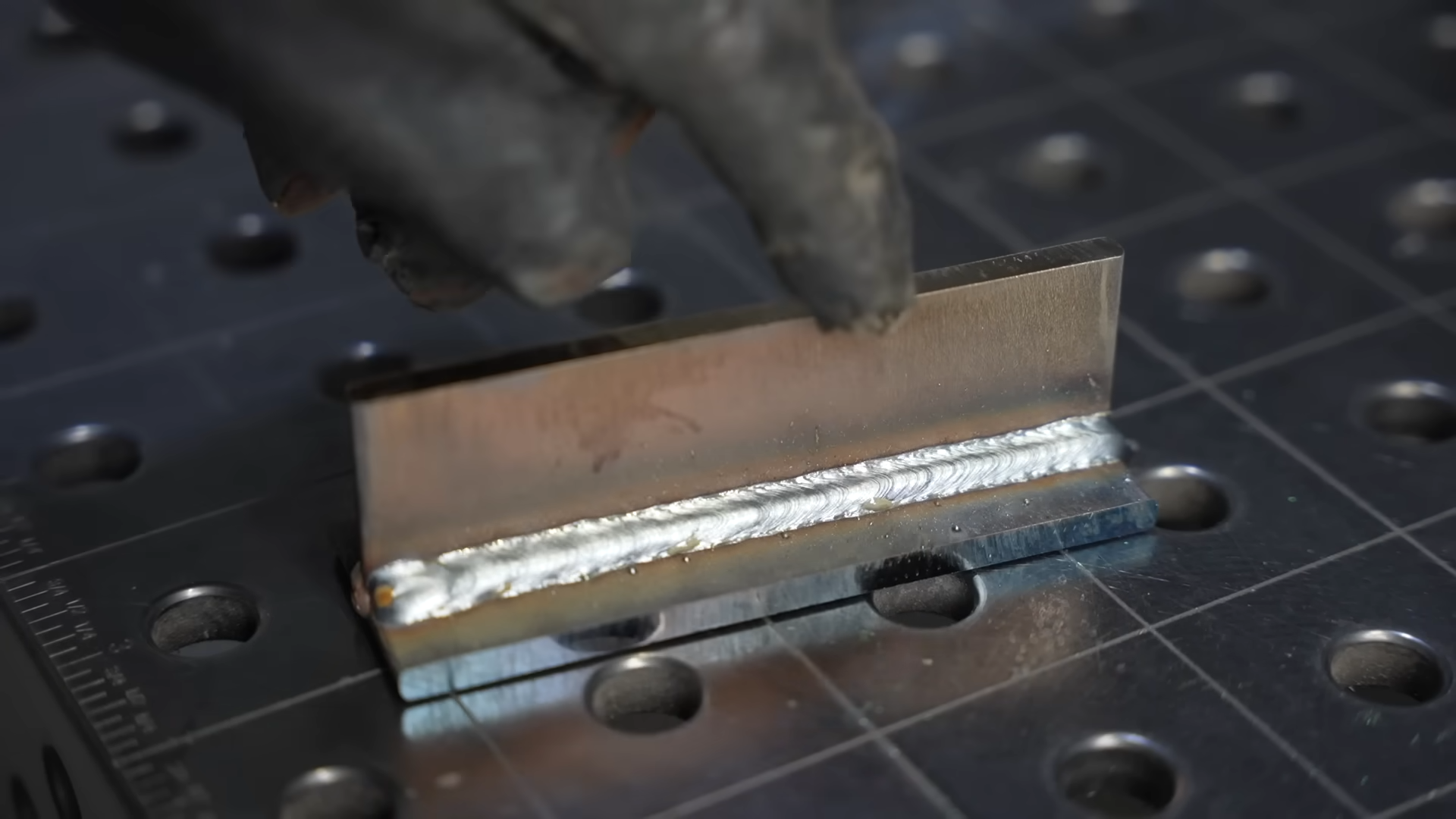
Complete Wire Size Charts
These charts provide quick reference for wire selection by material type and thickness.
Mild Steel Wire Size Chart
| Material Thickness | Wire Size | Amperage Range | Voltage | Gas |
|---|---|---|---|---|
| 24 ga (0.024″) | .023″ | 40-60 | 14-16V | 75/25 |
| 22 ga (0.030″) | .023″ or .030″ | 45-70 | 15-17V | 75/25 |
| 20 ga (0.036″) | .030″ | 50-80 | 16-18V | 75/25 |
| 18 ga (0.048″) | .030″ | 60-90 | 17-19V | 75/25 |
| 16 ga (0.060″) | .030″ or .035″ | 70-110 | 18-20V | 75/25 |
| 14 ga (0.075″) | .035″ | 90-130 | 19-21V | 75/25 |
| 1/8″ (0.125″) | .035″ | 110-160 | 20-23V | 75/25 |
| 3/16″ (0.1875″) | .035″ or .045″ | 140-200 | 22-25V | 75/25 or 90/10 |
| 1/4″ (0.25″) | .045″ | 180-230 | 24-27V | 90/10 |
| 3/8″ (0.375″) | .045″ or .052″ | 220-280 | 26-29V | 90/10 |
Stainless Steel Wire Size Chart
| Material Thickness | Wire Size | Amperage Range | Gas | Notes |
|---|---|---|---|---|
| 20 ga (0.036″) | .023″ or .030″ | 45-75 | Tri-mix | Low heat to prevent warping |
| 18 ga (0.048″) | .030″ | 60-95 | Tri-mix | Pulse if available |
| 16 ga (0.060″) | .030″ or .035″ | 75-115 | Tri-mix | Back purge for food grade |
| 14 ga (0.075″) | .035″ | 95-140 | Tri-mix | Argon-rich mix preferred |
| 1/8″ (0.125″) | .035″ | 120-170 | Tri-mix or 98/2 | Multi-pass recommended |
| 3/16″ (0.1875″) | .035″ or .045″ | 150-210 | 90/8/2 Ar/He/CO2 | Back purge critical |
| 1/4″ (0.25″) | .045″ | 190-240 | 90/8/2 | Preheat may help |
Stainless note: “Tri-mix” = 90% Ar / 7.5% He / 2.5% CO2 (most common stainless shielding gas)
Aluminum Wire Size Chart (Spool Gun or Push-Pull)
| Material Thickness | Wire Size | Amperage Range | Gas | Special Notes |
|---|---|---|---|---|
| 1/16″ (0.0625″) | .030″ | 80-120 | 100% Argon | Spool gun recommended |
| 1/8″ (0.125″) | .030″ or .035″ | 110-160 | 100% Argon | Clean thoroughly |
| 3/16″ (0.1875″) | .035″ | 140-190 | 100% Argon | Preheat 200-250°F |
| 1/4″ (0.25″) | .035″ or .045″ | 170-230 | 100% Argon | Preheat 250-300°F |
| 3/8″ (0.375″) | .045″ | 220-280 | 100% Argon or Ar/He | Preheat 300-350°F |
Aluminum critical note: Aluminum wire is soft and tangles easily. Spool guns (wire spool mounts on gun) or push-pull gun systems work much better than standard wire feeders for aluminum.
Aluminum Wire Sizing (Different Rules)
Aluminum wire sizing follows different rules than steel because of aluminum’s physical properties.
Why Aluminum is Different
1. Soft metal = feeding problems
Aluminum wire is much softer than steel wire, so it tends to bird’s nest in drive rolls and tangle in liner:
- Standard push-through gun systems struggle with aluminum wire
- Wire kinks and jams in liner (especially on guns >10 feet)
- Drive rolls must be very carefully adjusted (too tight = wire flattens and jams)
Solution: Use spool gun (wire mounts on gun, eliminating liner problems) or push-pull gun system (motor in gun pulls wire while feeder pushes).
2. Higher amperage required
Aluminum conducts heat 2x better than steel, so it requires 20-30% more amperage for equivalent penetration:
- 1/8″ aluminum @ .035″ wire: 140-160 amps (vs. 110-140 for steel)
- Requires welder with higher amperage capacity
3. Different wire alloys
Aluminum wire comes in different alloys that don’t directly correspond to base metal alloys:
- 4043 wire: General purpose, welds 3003, 6061, 6063 (most common)
- 5356 wire: Higher strength, welds 5052, 5083, 5086, 6061 (marine, structural)
Wire size selection is the same, but alloy matching matters for mechanical properties.
Aluminum Wire Size Recommendations
Thin aluminum (1/16″-1/8″): .030″ wire
Medium aluminum (1/8″-1/4″): .035″ wire
Thick aluminum (1/4″+): .045″ wire
Don’t use .023″ wire for aluminum: Too soft, tangles immediately in most feeders.
Spool gun users: Most spool guns use .030″ or .035″ wire. Check gun specifications—some only accept one size.
5 Common Wire Size Mistakes
These mistakes waste wire, damage equipment, and produce poor welds. Avoid them and save time and money.
Mistake #1: Using .035″ Wire for Everything (“It’s General Purpose!”)
The problem: Buying only .035″ wire because it’s labeled “general purpose” and trying to weld both sheet metal and thick plate with it.
Why it fails:
- Burns through 20 gauge sheet metal (too much heat)
- Struggles on 3/8″ plate (insufficient deposition, many passes required)
- Not actually “universal” despite marketing
Fix: .035″ wire is “general purpose” for 14 gauge to 1/4″ material. Stock .030″ for thinner material or .045″ for thicker plate if you work outside this range regularly.
Mistake #2: Wrong Contact Tip Size
The problem: Using .035″ contact tips with .030″ wire (or vice versa) because “it’s close enough.”
Why it fails:
- Erratic arc, inconsistent penetration
- Wire rattles in oversized tip (poor electrical contact)
- Wire jams in undersized tip
- Premature tip wear
Fix: Always match contact tip size exactly to wire diameter. Tips are cheap ($1.50-3 each)—don’t compromise.
Mistake #3: Running Wire Outside Its Amperage Range
The problem: Trying to run .045″ wire at 100 amps on thin material or .030″ wire at 180 amps on thick plate.
Why it fails:
- .045″ @ 100 amps: Arc too cold, sputters, poor penetration
- .030″ @ 180 amps: Wire melts in contact tip, burn-back, bird’s nest
Fix: Match wire size to amperage range needed for material thickness. If you need 100 amps, use .030″ or .035″ wire, not .045″.
Mistake #4: Using Steel Wire Sizes for Aluminum
The problem: Selecting aluminum wire size based on steel wire recommendations.
Why it fails:
- Aluminum requires 20-30% more amperage than steel
- Wire feeding is completely different (spool gun needed)
- 1/8″ aluminum needs .035″ wire at 140+ amps, not .030″ @ 110 amps
Fix: Use aluminum-specific recommendations and invest in spool gun for reliable feeding.
Mistake #5: Not Switching Wire When Material Changes
The problem: Welding 20 gauge with .035″ wire because “that’s what’s on the machine” from welding 3/16″ yesterday.
Why it fails:
- Blows holes through thin material
- Wastes time fighting settings that can’t work
- Damages material
Fix: Change wire size when material thickness changes significantly. Keep multiple spools on hand for production work, or accept that you’ll be limited to the material range your current wire handles.
When to Switch Wire Sizes
Knowing when to invest time in changing wire spools improves efficiency and weld quality.
When Wire Change is Worth It
Change wire when:
- Material thickness changes >50%: Going from 14 gauge to 3/16″ (switch .030″ → .035″ or .045″)
- Doing production work: 20+ pieces of same thickness justifies setup time
- Quality is critical: Automotive, structural, or customer work requiring best results
- Current wire struggles: Constant burn-back, spatter, or penetration issues
Don’t change wire when:
- One-off quick job: Single piece, current wire “works” even if not optimal
- Material in wire’s range: Welding 1/8″ with .035″ wire works fine (no need to switch to .030″)
- Time-sensitive repair: Getting job done matters more than perfect settings
How to Change Wire Sizes Efficiently
Step 1: Run out remaining wire on current spool (or save for later)
Step 2: Remove spool, install new size
Step 3: Change contact tip to match new wire size (CRITICAL!)
Step 4: Adjust drive roll tension (lighter for smaller wire, heavier for larger)
Step 5: Feed wire through, trim, adjust settings
Time required: 5-10 minutes
Pro tip: Some fabricators keep second MIG welder with different wire size to avoid constant spool changes. A $400-600 entry-level 240V welder dedicated to .030″ or .045″ wire pays for itself quickly in time saved.
Frequently Asked Questions
What is the most common MIG wire size?
.035″ wire is the most common MIG wire size because it handles the widest range of material thicknesses (14 gauge to 1/4″) in a single wire diameter. This “general purpose” designation makes it the default choice for fab shops welding mixed material thicknesses. However, .030″ wire is equally common in auto body shops where thin sheet metal dominates, and .045″ wire is standard in structural steel shops working with 3/16″ to 1/2″ plate. Choose wire size based on the material you weld most frequently, not just popularity.
Can I use .030″ wire instead of .035″?
Yes, .030″ wire works well as a substitute for .035″ on material up to 1/8″ thick, and it’s actually better than .035″ for thin sheet metal (18-20 gauge) because of lower heat input. The main limitation is that .030″ wire has lower deposition rate, so welding 3/16″-1/4″ material takes longer with multiple passes versus single-pass capability with .035″ wire. If your welder has adequate amperage (120+ amps), .030″ wire handles 90% of general fabrication. Use our Wire Gauge Calculator to determine if .030″ is suitable for your specific application.
What wire size for welding 1/8″ steel?
.035″ wire is optimal for welding 1/8″ steel plate, running at 110-160 amps with 75/25 or 90/10 Ar/CO2 gas mix. .030″ wire also works well at 120-140 amps and offers better puddle control for out-of-position welding (vertical, overhead). .045″ wire is overkill for 1/8″ material unless you’re using a high-output welder and want maximum deposition speed. For single-pass fillet welds on 1/8″ material, .035″ wire at 130-150 amps provides the best balance of penetration, speed, and control.
Does wire diameter affect amperage?
Yes, wire diameter determines the amperage range where the wire runs stably. .030″ wire operates optimally at 60-120 amps, .035″ wire at 80-160 amps, and .045″ wire at 120-220 amps. Running wire outside its optimal range causes problems: too low and the arc sputters with poor penetration, too high and wire melts back into the contact tip causing burn-back and bird’s nests. You cannot effectively weld 1/4″ plate (requiring 180+ amps) with .030″ wire, nor can you weld 20 gauge sheet (requiring 60-80 amps) with .045″ wire regardless of machine settings.
What contact tip size do I need?
Contact tips must match wire diameter exactly: .030″ wire requires .030″ tips, .035″ wire requires .035″ tips, and .045″ wire requires .045″ tips. Using wrong-size tips causes erratic arcs, poor electrical contact, wire feeding problems, and premature tip wear. Contact tips are sized in 0.005″ increments specifically to match wire diameters—there’s no “close enough.” Tips cost $1.50-3 each and are consumables that should be replaced every 20-50 pounds of wire depending on wire size and welding conditions. Buy tips in 10-packs to save money and ensure you always have correct sizes on hand.
Can I weld thick steel with thin wire?
Yes, but it requires multiple passes and is much slower than using appropriately-sized wire. Welding 1/4″ plate with .030″ wire requires 3-4 passes versus single-pass with .045″ wire—you’ll spend 3-4x longer on the weld. Additionally, thin wire run at high amperage (needed for thick material) risks burn-back where wire melts in the contact tip causing feeding problems. For occasional thick welds, smaller wire with multi-pass technique works. For production or regular thick material welding, match wire size to thickness: use .045″ for 1/4″-3/8″ plate, not .030″.
Is .035″ wire really “general purpose”?
.035″ wire is “general purpose” only for the 14 gauge to 1/4″ material thickness range, which represents the majority of light fabrication and structural work. It’s NOT universal—it burns through sheet metal thinner than 18 gauge and requires multiple passes on plate thicker than 1/4″. The “general purpose” designation means it handles the widest range of common thicknesses in a single wire size, not that it works equally well for all applications. Stock .030″ wire if you work with sheet metal regularly or .045″ wire if you weld structural plate frequently.
What wire size for flux-core welding?
Flux-core wire typically runs one size larger than solid wire for equivalent material thickness because the tubular flux-core design has less metal cross-section. Use .035″ flux-core for 14 gauge to 3/16″ material (where you’d use .030″-.035″ solid wire), or .045″ flux-core for 1/4″-3/8″ material (where you’d use .035″-.045″ solid wire). Self-shielded flux-core (no gas) runs hotter than gas-shielded varieties and isn’t recommended for sheet metal under 16 gauge due to burn-through risk. Most hobby welders use .030″ or .035″ flux-core for general farm and outdoor work.
How does wire size affect weld penetration?
Larger wire diameters create deeper penetration at equivalent amperages because they carry higher current density and deposit more heat into the joint. .045″ wire at 150 amps penetrates deeper than .030″ wire at 150 amps—this is why thin wire burns through thin material even at supposedly “low” settings. Wire size determines both minimum and maximum material thicknesses you can successfully weld: .030″ wire can’t adequately penetrate 1/4″ plate (insufficient current capacity), while .045″ wire over-penetrates and burns through 16 gauge sheet (minimum stable arc is too hot).
Should I stock multiple wire sizes?
Stock multiple wire sizes if you regularly weld material thicknesses spanning more than one wire’s optimal range. For example, if you weld both 18 gauge sheet metal and 3/16″ plate, keep both .030″ and .035″ wire on hand. If you only work within a narrow thickness range (like auto body repair on 20-18 gauge), one wire size (.030″) is sufficient. The wire change process takes 5-10 minutes including contact tip replacement, so having the right wire readily available saves significant time on production work. Calculate wire needs and costs with our Wire Consumption Calculator.
Conclusion: Choose Wire Size by Material Thickness and Welder Capacity
Wire diameter selection determines whether you achieve clean, properly-penetrated welds or struggle with burn-through, cold laps, and feeding problems. The fundamental rule is simple: match wire size to material thickness and ensure your welder has adequate amperage output for the wire diameter. .030″ wire excels on sheet metal (18-20 gauge) at 60-120 amps, .035″ wire handles general fabrication (14 gauge to 1/4″) at 80-160 amps, and .045″ wire tackles heavy plate (1/4″-3/8″) at 120-220 amps—attempting to use .045″ wire on 20 gauge sheet or .030″ wire on 1/4″ plate fails regardless of machine adjustments because wire diameter fundamentally controls minimum and maximum heat input.
Key takeaways for wire size selection:
- Wire diameter determines amperage range, deposition rate, and penetration—not just “wire thickness”
- Contact tips MUST match wire diameter exactly (.030″ wire = .030″ tip, .035″ = .035″)—wrong size causes erratic arcs and feeding problems
- .035″ “general purpose” wire only covers 14 gauge to 1/4″ material—stock .030″ for thinner or .045″ for thicker if working outside this range
- Flux-core wire runs one size larger than solid wire for equivalent material (use .045″ flux-core where you’d use .035″ solid wire)
- Aluminum requires spool guns or push-pull systems regardless of wire size due to soft metal feeding challenges
For hobbyists with single-size wire inventory, .030″ wire on 120V welders or .035″ wire on 240V welders covers most applications. For professional shops, stock both .030″ and .035″ (or .035″ and .045″) to handle full material thickness range without compromising weld quality or fighting equipment limitations.
Related calculators and tools:
- Wire Gauge Calculator for Welders – Select optimal wire diameter for your material
- MIG Welding Calculator – Calculate voltage and amperage settings
- Wire Consumption Calculator – Estimate wire usage for jobs
- Weld Cost Calculator – Calculate total welding costs including wire
- Shielding Gas Calculator – Optimize gas flow for wire size
- Welding Gas Cost Calculator – Track gas expenses
Have questions about welding wire sizes? Drop a comment below or reach out—we’re here to help!