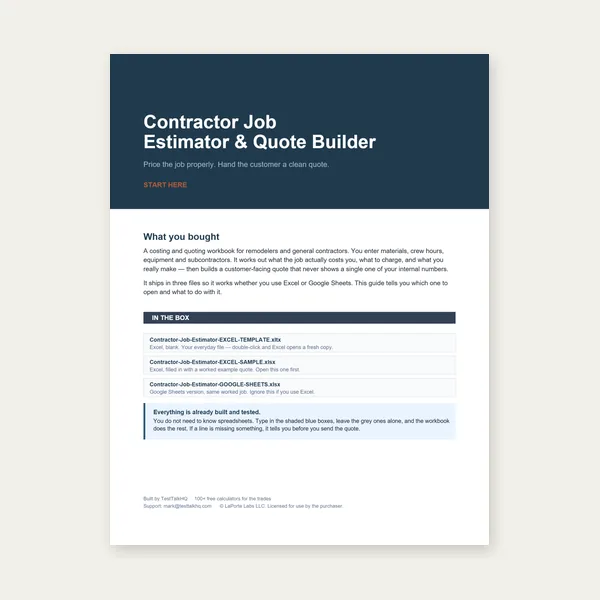
Contractor Job Estimator
Price remodels and GC work, then send a quote with no internal numbers.
Excel or Google Sheets. Best on a computer.
$29.00
BuyWrinkling that telegraphs through shingles, short laps, wrong product for the slope, wind damage before shingling, moisture traps, and fastener tear-through
Pair this page with the underlayment calculator for quantities and the guide for pitch and overlap rules. Ice-barrier mistakes at the eave are a different worksheet: ice-barrier troubleshooting.
Product choice: 15# vs 30# vs synthetic. Hub: roofing calculators.
Re-ordering after a mistake? Double-check pitch doubling and waste before you buy again.
Open Calculator →Symptom: Visible ridges or bubbles in the finished shingle field that follow underlayment seams or wrinkles.
Why it fails: Felt installed wet, walked on before it relaxes, or pulled tight over a crown in the sheathing. Synthetic with insufficient fastening can shift and bunch.
Fix: Install dry sheathing; let felt relax flat before cap nails. Snap straight courses; do not stretch synthetic like a drum. Replace wrinkled sections before shingling — shingles will mirror the bump forever.
Symptom: Water at ceiling or wall lines after wind-driven rain, often away from obvious shingle damage.
Why it fails: Side laps under 4 inches, end laps under 6 inches, or aligned end joints on adjacent courses create a direct path for water.
Fix: Follow manufacturer minimums (typically 4–6 in horizontal, 6 in vertical). Stagger end laps at least one course width. Re-run takeoff with 12–15% waste if cut-up geometry forced short pieces: calculator.
Symptom: Chronic slow leaks on a porch, shed, or addition at 3:12 while the main roof stays dry.
Why it fails: IRC R905.1.1 requires double underlayment on 2:12 to under 4:12. Single-layer felt on those slopes sheds water too slowly.
Fix: Strip to sheathing on the low-slope section; install double coverage per code and manufacturer. Use the calculator’s low-slope toggle so the order reflects 2× material.
Symptom: Synthetic underlayment torn, flapping, or peeled back after a wind event while the roof sat dry-in.
Why it fails: Exposure-rated synthetics still have limits; under-fastening or using non-cap fasteners at edges lets wind get under the roll.
Fix: Use manufacturer-approved cap nails or staples on the pattern printed on the roll; add temporary edge weights only if the label allows. Do not leave felt or synthetic exposed beyond the rated window if rain is forecast.
Symptom: Sheathing moisture readings stay high, or mold appears on deck underside after synthetic dry-in sat for weeks.
Why it fails: Synthetics are less vapor-permeable than felt. In some climates and venting setups, trapping drying paths causes problems during long exposure.
Fix: Match product to manufacturer climate guidance; shingle promptly; ensure attic ventilation is sized (ventilation calculator). When in doubt, use a product line your supplier recommends for local exposure duration.
Symptom: Wind pulls torn circles around staples; underlayment rips at fasteners under foot traffic.
Why it fails: Plain staples without caps on synthetic, overdriven cap nails, or wrong length for the deck thickness.
Fix: Use cap nails or cap staples where the synthetic label requires them. #15 felt on steep slopes may allow non-cap fasteners per local practice — read the label. Shingle fasteners are a separate count: nail calculator.
Active leaks with saturated sheathing, multiple low-slope sections with unknown original layering, or code questions on a permitted reroof need eyes on the deck. These pages name common underlayment failures; they do not replace a site visit.
Right-size the reorder.Pitch, product, and waste in one pass.
Underlayment Calculator →Price remodels and GC work, then send a quote with no internal numbers.
Excel or Google Sheets. Best on a computer.
$29.00
BuyCheckout opens in a new tab.
Roll counts are step one. Cutting, fastening, and lapping the field layer is where jobs win or leak. These roofing-relevant tools are on the TestTalkHQ affiliate list — hook knife for roll cuts, coil nailer for cap fasteners on synthetic, chalk line for straight courses, and butyl tape for detail transitions.

Stanley FatMax hook knife for cutting felt or synthetic underlayment around vents and at rake returns without tearing the roll edge.
View on Amazon →
BOSTITCH RN46-1 coil roofing nailer for cap nails or staples on synthetic underlayment per manufacturer instructions — not the same as shingle nailing.
View on Amazon →
TAJIMA Chalk-Rite jam-free chalk line for snapping horizontal courses so side laps stay parallel and end laps stagger correctly.
View on Amazon →
Cofair Quick Roof butyl seam tape for sealing transitions at walls, chimneys, and where field underlayment meets peel-and-stick membrane.
View on Amazon →
Grace Ice & Water Shield for the eave/valley band — separate from field underlayment. Size the band with the ice-barrier calculator.
View on Amazon →
Underlayment covers the deck; shingles cover the underlayment. Run the square calculator for bundles after you have rolls ordered.
Open Shingle Bundle Calculator →As an Amazon Associate, TestTalkHQ earns from qualifying purchases. No dedicated #15 or #30 felt roll SKU was on the live affiliate CSV — hook knife, nailer, chalk, tape, and ice-barrier roll are the roofing-relevant tools that matched.