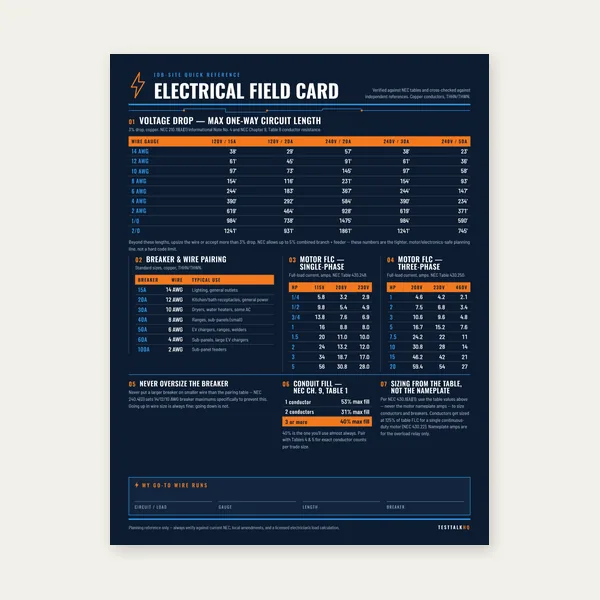
Electrical Reference Card
One page. Voltage drop lengths, breaker and wire pairing, motor FLC.
$3.99
BuyDiagnose bogging tools, hot cords, nuisance trips, coiled-cord heat, generator sag, and cord chains that look fine until they are loaded
This is not fixed-wiring branch-circuit troubleshooting. Extension cords fail in more portable, jobsite-specific ways: rolled-up reels, mixed gauges, worn plugs, undersized generator leads, and temporary daisy chains. Use this page with the Extension Cord Voltage Drop Calculator after you know the cord length, gauge, and real load amps. For panel-to-load building wire, see voltage drop troubleshooting and the voltage drop calculator.
Use this table when the tool at the end of the cord feels weak, hot, or unpredictable.
| Symptom | What it usually means | First fix | Next check |
|---|---|---|---|
| Motor bogs or tool lacks power | Cord voltage drop is starving torque, especially at 120 V | Shorten the run or move to heavier AWG | Cord VD Calculator |
| Cord or plug gets hot | Current is above cord rating, connections are worn, or cord is coiled | Stop, uncoil, inspect ends, replace damaged cord | Gauge Chart |
| Breaker trips after minutes | Tool current rises as voltage sags; compressor/motor start current is high | Use shorter/heavier cord and measure real amps | Clamp meter reading |
| Generator/compressor sags hard | Source voltage and cord drop are stacking together | Measure generator output and load-end voltage under load | Meter at both ends |
| Daisy chain works unloaded, fails running | Connector losses plus mixed gauges add resistance and heat points | Use one continuous heavy cord instead | Cord chain decision |
What it looks like: circular saw slows in the cut, grinder sounds lazy, portable compressor takes longer to recover, or a 120 V welder loses arc stiffness even though the wall receptacle is fine.
Likely causes: The cord is too small for the running amps and distance. At 120 V, even a few volts matter because motor torque falls as voltage sags. Inrush makes it worse: a compressor that draws 12 A running can pull much more at start, so the cord that “passes” at nameplate current may collapse during startup.
Fixes: Shorten the physical run first. If you need the distance, step up from 14 AWG to 12 AWG, or from 12 AWG to 10 AWG for heavy 15–20 A loads. If the equipment supports 240 V, use it with the proper cord and plug because the same wattage at higher voltage needs less current and loses fewer volts in the cord.
What it looks like: plug blades are too hot to hold, female connector softens, jacket feels warm along the coil, or you smell plastic near the reel.
Likely causes: Heat is current squared times resistance. Undersized conductors heat along the length; worn plugs heat at the contact point; coiled cords trap heat because the jacket cannot shed it to air. A cord reel rating may be much lower when wound than when fully unrolled.
Fixes: Unplug and let it cool. Fully unroll cord reels under load. Inspect plug blades and female contacts for discoloration, looseness, melting, or dirt. Replace any cord with soft insulation or heat damage. Upsizing the cord helps voltage drop, but it does not repair a loose molded connector.
What it looks like: compressor starts once or twice, then trips; pressure washer runs until the pump loads; saw trips only on long cuts; generator breaker opens before the tool's usual job is done.
Likely causes: Low voltage can raise motor current as the equipment works harder. Long cords also add heat at connectors, and repeated starts stack thermal stress. If a GFCI trips instead of an overcurrent breaker, suspect moisture, damaged cord jackets, or leakage through beat-up adapters rather than voltage drop alone.
Fixes: Measure actual running amps with a clamp meter and compare to the tool nameplate. Try the same equipment on a short heavy cord. If nuisance trips disappear, the long cord was part of the fault. If trips remain, the tool, breaker, or GFCI may be the real problem.
What it looks like: a 50 ft reel is only pulled out 15 ft because the tool is close, but the remaining cord stays wound and gets hot after the compressor or welder runs.
Likely causes: A coiled cord cannot dissipate heat like a straight cord in open air. The inner wraps warm each other, and the reel shell can trap heat. Voltage drop math might still look acceptable while thermal margin is gone.
Fixes: Pull the cord fully off the reel for motor, heater, welder, and compressor loads. Check the reel's wound and unwound amp ratings if published. For high current work, use a straight heavy cord instead of treating a storage reel as a loaded extension run.
What it looks like: generator sounds loaded, lights dim, compressor hums before starting, or inverter generator overloads when a long cord feeds the equipment.
Likely causes: Source sag and cord voltage drop stack. A soft generator output plus a small cord can put the tool below its happy operating voltage even when either one alone would pass. Long cords on generators are also commonly chosen by convenience, not actual load current.
Fixes: Measure generator voltage at the receptacle while the load starts, then measure at the tool end under the same condition. If both sag, reduce load or use a larger generator. If the generator holds but the tool end collapses, the cord is the problem. Keep compressor and welder cords short and heavy.
What it looks like: a yellow 12 AWG cord starts the run, then a lighter orange 16 AWG cord finishes it at the tool. The label people remember is the heavier cord, but the current flows through every piece in the chain.
Likely causes: The smallest gauge and weakest connector control the chain. Every extra male/female joint adds contact resistance and another heat point. A tight bend, dirty connector, or worn adapter can become the hottest point even if the copper size looks acceptable.
Fixes: Read the printing on every cord in the chain. Size the whole run by the lightest gauge and full one-way length. Better: replace the chain with one continuous cord of the right gauge and length, then verify with the calculator.
Need to choose a cord strategy? Use the comparison page when you are deciding between one long heavy cord and multiple shorter cords.
Compare Cord ChoicesOne page. Voltage drop lengths, breaker and wire pairing, motor FLC.
$3.99
Buy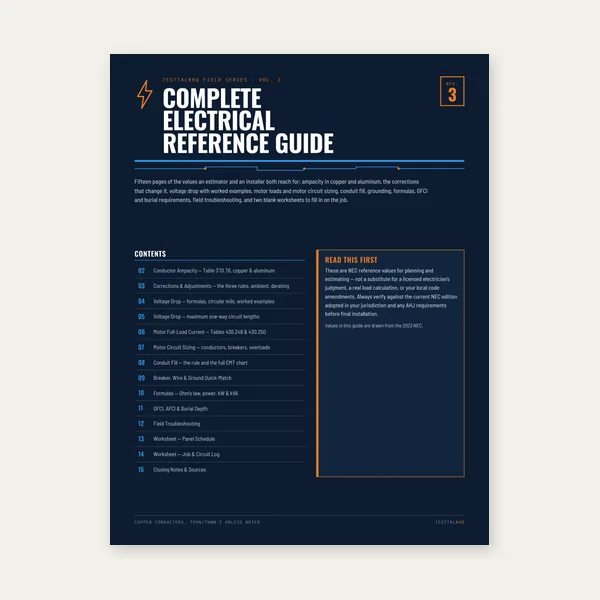
15 pages. Ampacity, corrections, voltage drop, motor circuits, conduit fill.
$12.99
Buy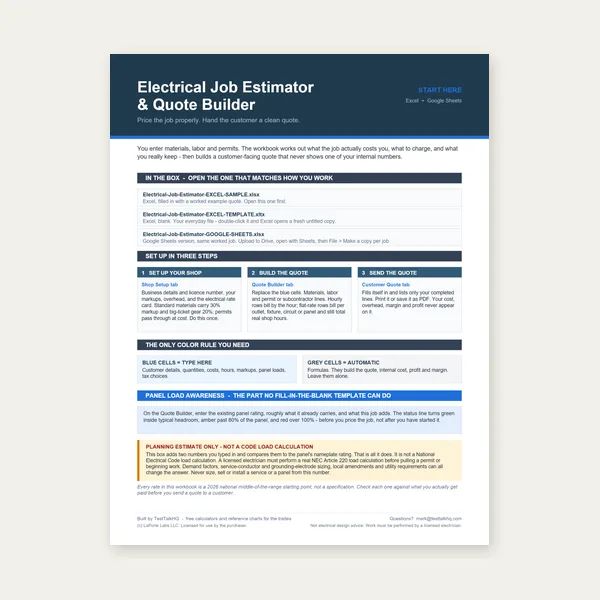
Quote electrical work and flag panel headroom before you price it.
Excel or Google Sheets. Best on a computer.
$29.00
Buy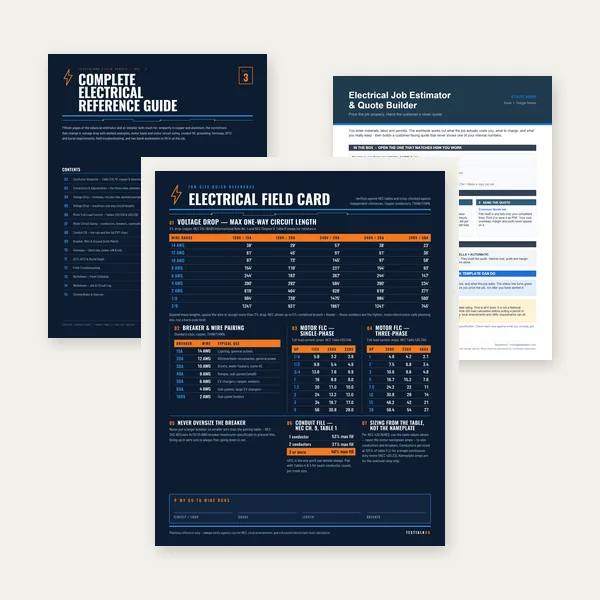
Card, 15-page guide and the estimator workbook. All six files.
Excel or Google Sheets. Best on a computer.
$34.99
$45.98 if bought separately — save $10.99
BuyCheckout opens in a new tab.
Five genuinely relevant products from the live TestTalkHQ affiliate CSV: clamp meters and multimeters for measuring cord voltage and actual tool current.


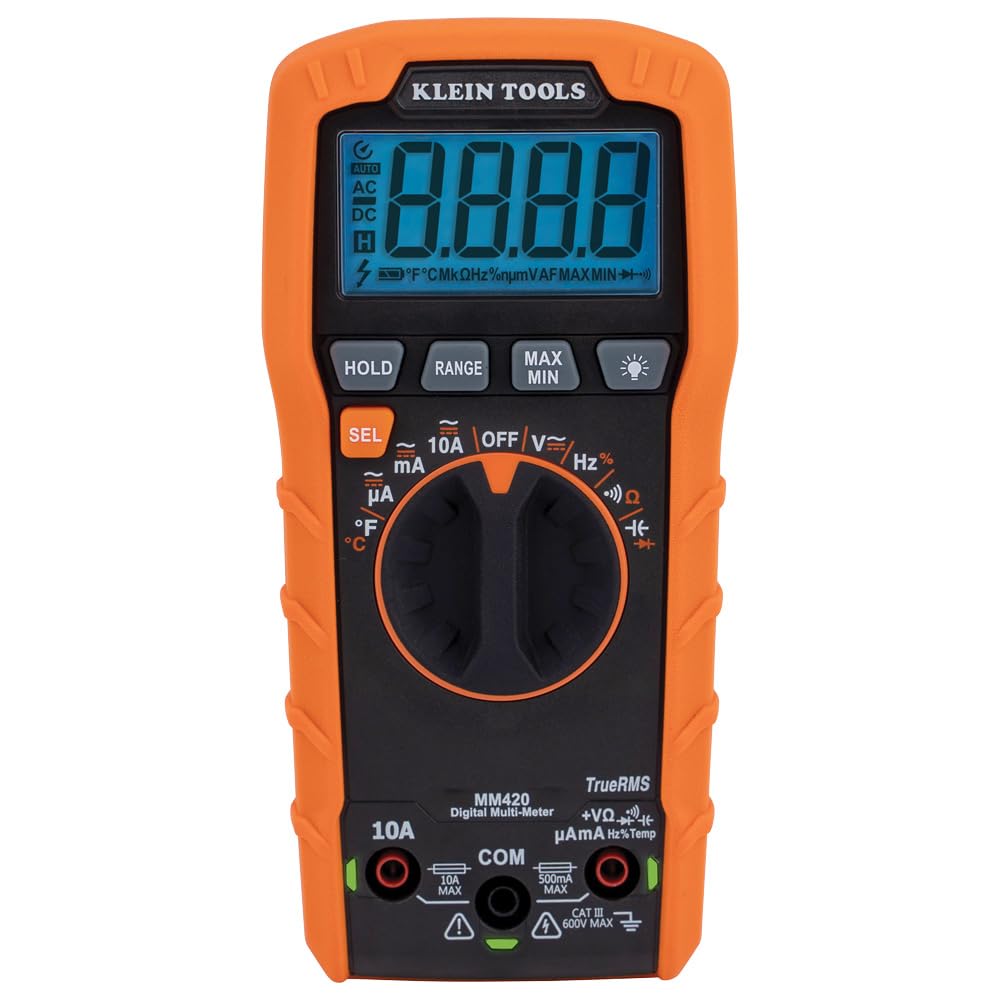
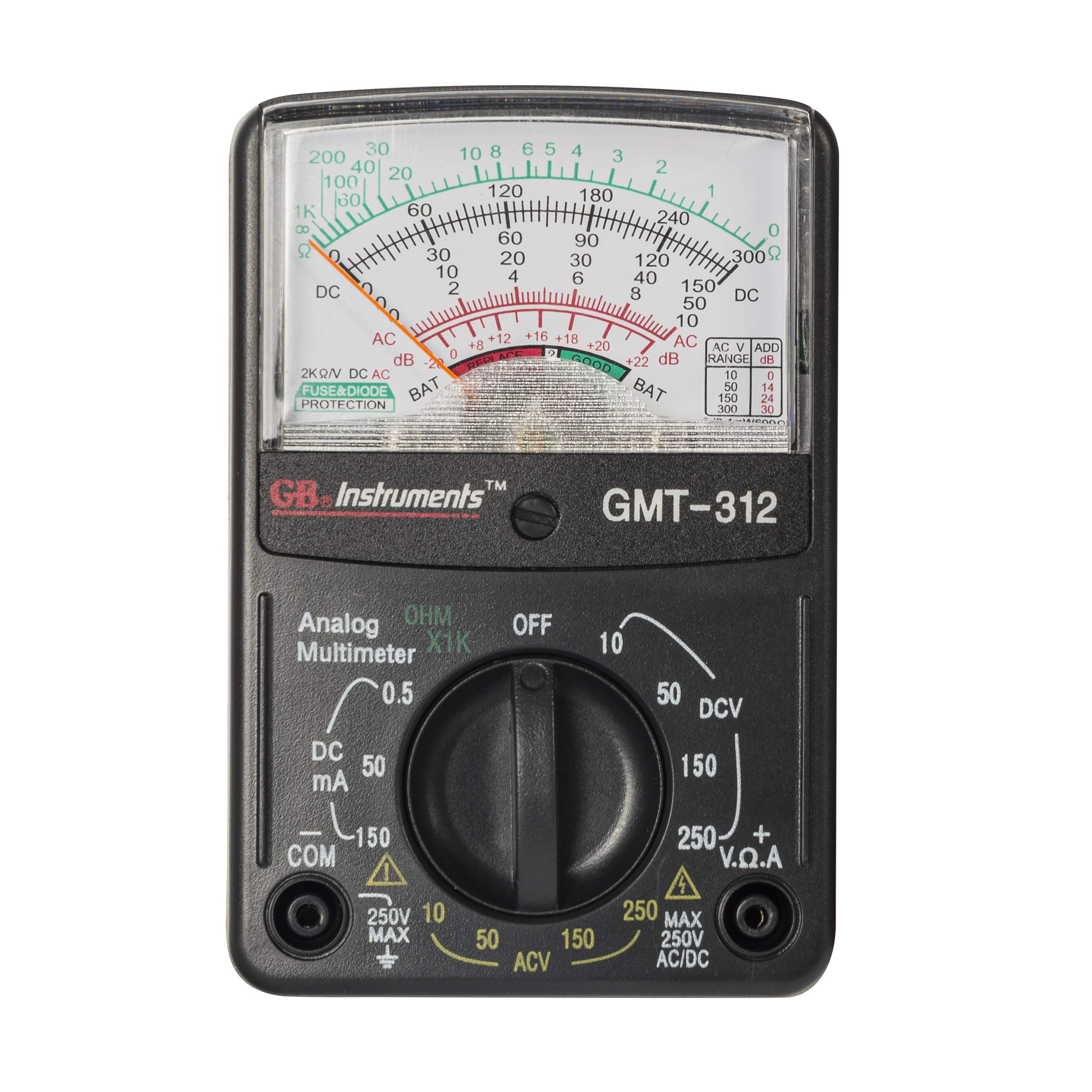
As an Amazon Associate, TestTalkHQ earns from qualifying purchases. Catalog gap remains: no extension cords, cord reels, GFCI adapters, or wire-gauge testers were present in the live CSV.
The long cord adds resistance. Under load, that resistance drops voltage before it reaches the motor, so torque and starting performance suffer.
Treat it as a stop-and-diagnose condition. It may be undersized, overloaded, damaged, coiled, or making poor contact at a plug.
Indirectly, yes. Low voltage can make motors draw more current under load or struggle longer during startup, which can trip thermal protection.
Not quite. The copper length may be similar, but the chain adds connector resistance and more places to heat or loosen.
For panel-to-receptacle building wire, use nameplate input current with the Wire Gauge Calculator for Welders. Then use the canonical Welding Wire Gauge Chart to keep branch wire, extension cords, welding leads, and MIG/TIG filler sizes separate.