
Contractor Job Estimator
Price remodels and GC work, then send a quote with no internal numbers.
Excel or Google Sheets. Best on a computer.
$29.00
BuyBox types, volumes, depth requirements, and how conductor count drives every sizing decision.
The right box is large enough for every conductor, device, clamp, and ground you’re putting inside it — with room to work. Pick too small and you get code violations, damaged insulation, and terminations that fail under stress.
Use the Box Fill Calculator to verify volume before you install, or read our Box Fill Calculations Guide for the full NEC 314.16 math.

An electrical box that is too small causes three problems, any one of which is enough reason to fix it. First, heat: conductors crammed tightly together generate and trap heat that degrades insulation over years. Second, NEC violation: Section 314.16 requires that the total fill volume of all conductors, devices, clamps, and grounds not exceed the box's rated cubic inch capacity — a box that fails this calculation is a code violation regardless of whether an inspector ever measures it. Third, bad terminations: you cannot make clean, tight connections when you are fighting for space inside a box. Loose wire nuts and back-stab connections under tension are exactly what causes arcing and fires.
The fix is always the same: use a box large enough to hold everything you're putting in it. The difficult part is knowing which box that is before you open the wall or pull the wire. This guide gives you the decision framework to get it right the first time.
Single-gang plastic boxes are the most common device box in residential new construction. Manufacturers mark the cubic inch volume on the box — look for a number stamped or molded into the interior. Standard single-gang new-work boxes range from 18 cubic inches (2¾" depth) to 22.5 cubic inches (3½" depth). The deeper the box, the more volume. For any circuit with more than one cable entering the box, or any circuit with a GFCI or AFCI device, the 3½" depth (22.5 in³ or close to it) is the better default choice and costs the same at the supply house.
Plastic boxes often include integral cable clamps — small plastic tabs that grip NM cable at the entry knockouts. These do count as one fill unit under NEC 314.16(B)(2), even if they are not securing a cable at every position.
Two-gang plastic boxes are used where two devices share the same wall opening. Volume ranges widely by depth and brand: standard 2-gang new-work boxes are typically 30–34 cubic inches at normal depth and up to 42 cubic inches on the deepest versions. Check the marking on the box before buying — the same brand may offer two or three depth options that look nearly identical on the shelf but differ by 8–10 cubic inches. With two devices, four or more cables, and a full complement of EGCs, a 2-gang installation can easily exceed 30 cubic inches of fill. Buy the deepest 2-gang box your framing will accommodate.
Metal device boxes are listed in NEC Table 314.16(A) by their trade dimensions. The table gives you the volume directly without relying on a marking. Common sizes:
The smaller metal device boxes — 12.5 and 14.0 in³ — are undersized for almost every modern installation once device fill and EGC fill are accounted for. The 18.0 in³ version (3½" deep) is the minimum practical choice for any box holding a device and two or more cables. Even then, three cables with a device can push up against the limit; verify with a fill calculation before installing.
Four-inch square boxes are the workhorses of commercial wiring and the right answer whenever a single-gang or 2-gang device box runs short on volume. Mounted with a single-gang, 2-gang, or blank mud ring (plaster ring) at the front, they accommodate far more fill than any device box while presenting the same face at the wall surface.
The 4-11/16" × 2⅛" at 42.0 in³ is the solution when a heavily loaded junction point or multi-circuit device location has exceeded what any standard device box can hold. It fits the same framing cavity as the smaller versions and accepts standard mud rings.
Octagon boxes (also called 4-inch octagons or round boxes) are primarily used for ceiling-mounted fixtures and junction points in attic or ceiling spaces.
The 1½" depth is often insufficient once you factor in the fixture's own wires and the supply cable conductors. The 2⅛" octagon is the better default for any ceiling fixture location with more than one cable.
New work boxes (also called nail-on boxes) have mounting brackets that fasten to studs before drywall is installed. Old work boxes (also called cut-in or retrofit boxes) are inserted through a hole cut in finished drywall; plastic ears or wings expand and clamp against the back of the drywall surface to hold the box in place.
Old work boxes are typically slightly more compact than equivalent new work boxes because they must fit through the opening they create. Volumes for old work single-gang boxes commonly range from 20 to 22.5 in³. Old work 2-gang boxes are available in volumes from roughly 28 to 34 in³. Always read the marking on the box — old work and new work boxes of the same brand and gang count frequently have different volumes even when they look similar.
The single biggest predictor of required box volume is the number of cables entering the box. Each 12/2 NM cable brings two insulated conductors and one EGC. At 12 AWG, each insulated conductor requires 2.25 in³. Three cables into a single-gang box with one device works out to 6 conductors (13.50 in³) plus device fill (4.50 in³) plus one EGC unit (2.25 in³) plus clamp fill (2.25 in³) — 22.50 in³ total, already at the limit of the largest standard single-gang box on the market.
Add a fourth cable — common in switch loops that also carry a receptacle feed — and you need a larger box. This is not edge-case wiring; it is routine residential work, and the box size selection must account for it before the wire is pulled.
As a working rule: one cable with a device fits any standard single-gang box. Two cables with a device fit a 3½"-deep single-gang box at 14 AWG; verify the math at 12 AWG. Three cables with a device require a 4" square box with a mud ring. Four or more cables with devices require a 4-11/16" square box or a separate junction box.
The NEC requires you to add up fill units from six categories: each insulated conductor counts individually by its AWG volume; all internal clamps combined count as one unit at the largest conductor AWG; each luminaire stud or hickey counts as one unit; each device yoke counts as two units at the largest conductor AWG connected to it; all EGCs combined count as one unit at the largest EGC AWG; and isolated EGCs each count separately. The sum must be at or below the box's rated cubic inch volume.
The per-conductor volumes from NEC Table 314.16(B): 14 AWG = 2.00 in³, 12 AWG = 2.25 in³, 10 AWG = 2.50 in³, 8 AWG = 3.00 in³.
For any box where the conductor count is above two or the installation has mixed gauges, use the Box Fill Calculator at TestTalkHQ to run the numbers before committing to a box size. It takes the conductor counts by AWG, device count, EGC count, and clamp presence and returns total fill in cubic inches with the minimum required box volume — takes about 30 seconds and eliminates the guesswork.
Box volume and box depth are not the same thing, but depth drives two real problems that cubic inch ratings do not capture.
The first is physical fit. A standard duplex receptacle is approximately 1.2 inches deep from the mounting yoke to the back of the wiring compartment. A GFCI receptacle is typically 1.75 to 1.85 inches deep. An AFCI outlet device runs similarly deep. Install a GFCI in a 1½"-deep metal box and the device body contacts the back of the box before the yoke screws seat — the device bows, the mounting screws strip, and the outlet face is not flush with the wall. A 2¾"-deep box gives clearance. A 3½"-deep box gives comfortable clearance plus room for the wire bundle behind the device.
The second is wire management. In a shallow box, conductors have nowhere to fold. Coiling 14 AWG NM cable behind a device in 1½" of depth requires tight bends that stress the conductor insulation at the point where it enters the box. Shallow boxes also make it harder to achieve the 6 inches of free conductor length the NEC requires at outlets and switch points (Section 300.14). Use a depth of at least 2¾" for any device box, and prefer 3½" on any circuit where a GFCI, AFCI, or smart device will be installed.
In new construction, upsizing to a 4" square or 4-11/16" square box is almost always the right answer. The boxes cost a dollar or two more than a standard device box, install the same way, and accept standard mud rings at the face. There is no scenario in new construction where adding a separate junction box is easier than using a larger box at the device location.
In existing construction, the choice gets more complicated. A cut-in box is limited by the hole already in the drywall and the depth available in the wall cavity. If the existing box is overfilled and the wall cavity will not accept a larger box, a junction box in the accessible space above or behind the installation — attic, crawlspace, unfinished basement — is the right answer. Feed a single cable from the junction box to the device location, keeping the device box fill simple, and handle the branching and splicing in the accessible junction box where space is not a constraint. Junction boxes must remain permanently accessible; do not bury them in a wall cavity or above a finished ceiling without an access panel.
Pull the existing device, count all conductors entering the box, add the device fill and clamp fill, and run the fill calculation against the box's marked volume. In most cases, an existing single-gang box in a finished wall is at or near its fill limit with the original wiring. Adding another cable to a full box is not possible without either replacing the box with a larger one (invasive in a finished wall) or re-routing the additional circuit through a new junction box in accessible space. Do not splice additional conductors into a full box — the NEC violation is real and the consequences of arcing in an overfilled box are not theoretical.
A standard 4" octagon box is rated to support a luminaire (light fixture) but is not rated to support a ceiling fan unless the box carries a specific fan-support listing. Ceiling fans generate dynamic loading — vibration and wobble — that a standard box is not designed to handle. A fan-rated box or a fan-rated brace assembly (the kind that expands between joists from below the ceiling) is required for any fan installation. These are available at any electrical supply house and most hardware stores.
On fill: a ceiling fan location typically has one or two supply cables plus the fan's own lead wires inside the canopy. The fan leads that stay in the canopy and connect to the box's conductors inside the canopy cover still require fill accounting for the box conductors. Verify that the supply cable conductors, EGC, and clamp fill fit within the box's volume — the 4" × 2⅛" octagon at 21.5 in³ handles most single-feed fan installations comfortably.
A junction box serving as a distribution point for multiple circuits in an attic or basement is a common and practical installation — as long as the fill calculation passes and the box remains accessible. Six 12/2 NM cables entering a junction box add 12 insulated conductor fill units (27.00 in³), one combined EGC unit (2.25 in³), and clamp fill (2.25 in³) for a total of 31.50 in³. A standard 4" × 2⅛" square box at 21.0 in³ fails. A 4-11/16" × 2⅛" square box at 42.0 in³ passes with room to spare. Use the larger box. Junction box cover plates must be secured without fasteners that require tools to remove — a standard single-screw cover plate is code-compliant and readily available.
AFCI receptacle devices and GFCI receptacles are physically larger than standard duplex receptacles in every dimension that matters for box installation. They are deeper (typically 1.75"–1.85" vs. 1.2" for a standard device), and their larger bodies leave less room in the box for the wire bundle behind them. The NEC fill calculation treats a GFCI or AFCI device identically to a standard receptacle — two units at the largest conductor AWG — so the cubic inch math does not change. The practical problem is physical, not mathematical.
A GFCI or AFCI device in a 1½"-deep box will contact the back wall of the box, preventing proper seating of the yoke. In a 2"-deep box it clears the back but leaves very little room for the wire fold. In a 2¾"-deep or 3½"-deep box it installs properly and leaves adequate room for conductors. Any installation point where a GFCI or AFCI device is planned — bathrooms, kitchens, garages, outdoor locations, and increasingly all 15A and 20A receptacle circuits under recent NEC editions — should use a box with at least 2¾" of depth. This is not a fill calculation issue; it is a physical clearance issue that causes failed installations and callbacks.
Yes. Extension rings (also called raised covers or extension boxes) add their listed cubic inch volume to the base box when assembled together, and the combined volume is what you compare against the fill calculation total. A 4" square box at 18.0 in³ with a 1½" extension ring adding another 9.0 in³ gives you 27.0 in³ of usable fill capacity. Extension rings must be listed for use with the base box and must be secured to the base box per the manufacturer's instructions. They are commonly used when an existing box is flush-mounted and an additional cable needs to be added — the extension ring brings the box face forward to accommodate the additional volume without opening the wall.
NEC Table 314.16(A) lists the maximum conductor count for boxes containing nothing but conductors of a single size — no devices, no internal clamps, no EGC fill beyond the conductors themselves. For a 3 × 2 × 3½" single-gang metal box (18.0 in³), the table allows 8 conductors at 12 AWG (8 × 2.25 = 18.0 in³ — exactly at capacity with no other fill). Add a single duplex receptacle and those 8 conductor slots drop to 5 before the box is full. Add internal clamps and the available count drops to 4. Table 314.16(A) is a shortcut for simple cases; for any box with devices, use the full six-category fill calculation or the Box Fill Calculator.
For most residential NM cable installations, plastic boxes are code-compliant and practical. Metal boxes are required when the wiring method is conduit, armored cable (AC/MC), or metal-clad cable, because the metallic wiring system depends on box-to-conduit continuity for grounding. Metal boxes are also required in some commercial applications per local amendments. For residential work with NM-B cable, plastic boxes with their integral cable clamps are the standard and are fully compliant. The choice of plastic vs. metal does not affect fill calculations — the same NEC Table 314.16(B) volumes apply to both.
No. NEC 314.28(C) and 314.25 require that all boxes used as junction boxes, pull boxes, or outlet boxes be closed with a listed cover or faceplate secured to the box. A tape closure is not a listed cover, is not mechanically secure, and will not pass inspection. In existing work where an old-work box has been installed in drywall and the cover is missing, the correct fix is to install a listed blank cover plate with the appropriate screw. On surface-mounted metal junction boxes, a listed steel cover secured with at least two screws is required. There is no workaround for this requirement — accessible junction boxes must have properly installed, secured covers at all times.
Price remodels and GC work, then send a quote with no internal numbers.
Excel or Google Sheets. Best on a computer.
$29.00
BuyCheckout opens in a new tab.
Verify wiring, confirm de-energization, and measure box dimensions on every installation
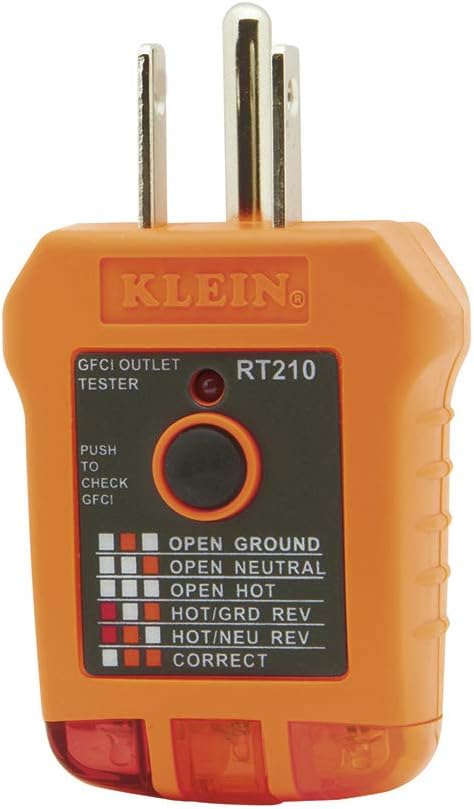
After installing any new box and device, verify correct wiring before closing the wall. The Klein RT210 checks open ground, open neutral, open hot, reversed polarity, and GFCI function in seconds. A fast final check that confirms your new installation is correct before the drywall goes up.
Check Price
Verify circuits are de-energized before opening any box for inspection or modification. The Fluke 117 reads true RMS voltage with non-contact detection — the right tool for confirming a box is safe to work in before your hands go anywhere near the conductors inside.
Check Price
Non-contact voltage detection keeps your hands safe when checking existing boxes. The built-in laser distance meter is useful for measuring box setback depth in finished walls and confirming box dimensions on unmarked boxes where the cubic inch rating isn’t stamped. Two tools electricians reach for constantly.
Check PriceAs an Amazon Associate, TestTalkHQ earns from qualifying purchases.
Bargain-bin electrical boxes are typically the minimum volume they can legally stamp on the box — 18 cubic inches for a single-gang, the absolute floor for most residential wiring. That leaves almost no margin for a standard two-cable switch loop with a device. Spend the extra dollar and get a deeper box — 20 or 22 cubic inches — on every new installation. The difference in material cost is negligible. The difference in working space when you’re terminating devices and troubleshooting years later is significant. Boxes are not where you save money on an electrical installation.
Old work boxes (also called cut-in boxes) are designed for existing finished walls — they clamp to the drywall from behind using wing brackets or rotating ears that tighten against the back of the wall surface. They’re the standard solution for adding outlets and switches without opening the wall. The trade-off is volume — most old work plastic boxes are 18–20 cubic inches, which limits how many conductors you can bring in. Before cutting a hole for an old work box, count your conductors and verify the box you’re installing has enough volume. If it doesn’t, a surface-mounted raceway or conduit extension is sometimes more practical than squeezing an undersized box into a finished wall.
Single-gang device boxes get all the attention, but 4-inch square boxes with single-gang mud rings solve a lot of problems that single-gang boxes can’t. A standard 4-inch square box at 21 cubic inches gives you more volume than any standard single-gang box, and a 4-11/16 inch square at 42 cubic inches handles almost any residential conductor count comfortably. They’re the default choice in commercial work for exactly this reason. On residential projects where a circuit passes through a location with a device, using a 4-inch square with a single-gang ring gives you the device footprint you need with the volume you actually require. They cost about the same as a standard device box and eliminate fill problems entirely.
Ceiling fan boxes have two requirements that standard light fixture boxes don’t: adequate cubic inch volume for the conductors and a weight/motion support rating for the fan. A standard plastic octagon box at 12.9 cubic inches may have enough volume for a simple fan circuit, but it is not rated to support a ceiling fan unless it’s specifically listed for that purpose. NEC 314.27(C) requires that boxes supporting ceiling fans be listed for fan support — typically rated for 35 lbs static and 35 lbs in motion. The box rating is stamped on the box or listed in its specifications. Using an unlisted box to hang a ceiling fan is a code violation and a safety hazard regardless of whether the fill calculation passes.