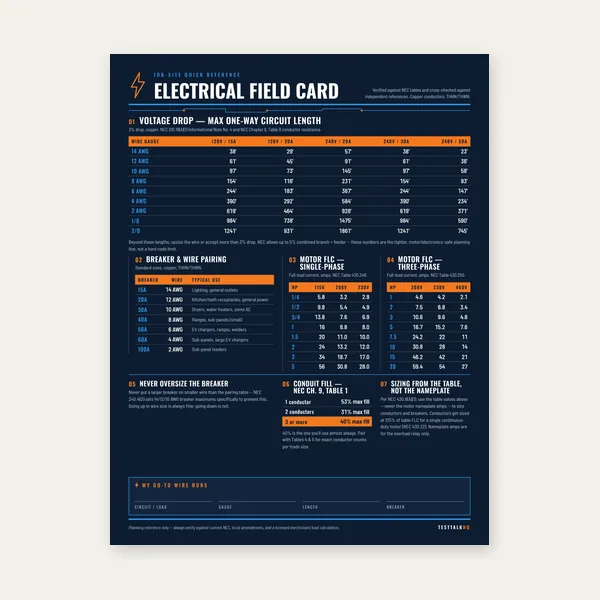
Electrical Reference Card
One page. Voltage drop lengths, breaker and wire pairing, motor FLC.
$3.99
BuyNEC 314.16 complete guide — how to count conductors, calculate fill, and avoid the most common box overfill mistakes.
Every conductor, clamp, device yoke, and equipment ground in a box consumes cubic inches of volume. NEC 314.16 requires the total fill to stay within the box’s listed capacity — and inspectors flag overfilled boxes more often than almost any other visible violation.
Use the Box Fill Calculator to run the six-category fill math automatically, or work through the full guide below.

Every electrical box has a fixed internal volume measured in cubic inches. Every conductor, device, clamp, and fitting you put inside that box occupies a portion of that volume. Box fill is the NEC's method of accounting for that occupied space to prevent overcrowding — too many conductors crammed into too small a box generate heat, damage insulation, make terminations difficult to make properly, and create the conditions for arc faults and failures.
NEC Section 314.16 governs box fill for outlet boxes, device boxes, pull boxes, and junction boxes. It requires that the total calculated fill volume of everything inside the box not exceed the box's listed cubic inch capacity. The capacity is either stamped into the box by the manufacturer or determined from NEC Table 314.16(A) for standard trade-size boxes. If the box doesn't have a marked volume and isn't listed in Table 314.16(A), you cannot use it — the code requires a known capacity to compare against the fill calculation.
The fill calculation is not optional. Inspectors check it. More practically, overfilled boxes are one of the most common field violations in residential wiring because electricians frequently count only the conductors and forget that devices, clamps, and grounds all have fill requirements too.
The NEC breaks box fill into six distinct categories. Each category is counted differently. Getting any one of them wrong produces a wrong answer — usually an undercounted one that makes an overfilled box look compliant.
Each conductor that originates outside the box and either terminates or is spliced inside counts as one fill unit. The fill volume assigned to that unit comes from NEC Table 314.16(B) based on the conductor's AWG size. A 14 AWG conductor counts as 2.00 cubic inches. A 12 AWG conductor counts as 2.25 cubic inches. The sizes are fixed in the table — see the full table in the next section.
Conductors that originate and terminate entirely inside the box — pigtails and jumpers that never leave — do not count. A bare copper pigtail added to join three EGCs at a wire nut, where all three ends stay inside the box, adds zero fill. Conductors that loop through the box without a splice count as one conductor per entry — a cable that enters and exits without being touched contributes one conductor per wire per direction. In most wiring, this distinction rarely comes up, but it matters in pull boxes and through-feed junction boxes.
All internal cable clamps in the box, combined, count as a single fill unit — regardless of how many there are. One internal clamp counts the same as four internal clamps: one unit. The volume assigned to that unit is based on the largest conductor in the box.
External connectors — the kind that secure a cable at the knockout from outside the box — do not add fill. Only internal clamps, which project inside the box cavity, count. Many plastic boxes use internal clamps; most metal boxes with knockouts use either internal clamps or external connectors depending on the brand. If your box uses only external connectors or has no internal cable restraint mechanism that projects into the interior, the clamp fill is zero.
Each luminaire stud (the threaded stud used to hang a fixture) and each hickey (a fixture-mounting fitting) adds one fill unit sized at the largest conductor in the box. This category almost never applies to standard device or junction boxes — it's primarily relevant for outlet boxes supporting luminaires that use these fittings. If your box has no studs or hickeys inside it, this category is zero.
This is the category most often forgotten or undercounted. Every device yoke or strap — the metal mounting plate that screws to the ears of the box — counts as two fill units. A single-gang switch: two units. A duplex receptacle on a single yoke: two units. A GFCI receptacle: two units. A 2-gang device plate carrying two separate devices, each on its own yoke: four units total.
The volume assigned to each of those two units is based on the largest conductor connected to the device, not the largest conductor in the box. If a 12 AWG circuit feeds a device and a 14 AWG circuit connects through the same box, the device fill uses 12 AWG volume (2.25 in³) because 12 AWG is the largest conductor connected to the device yoke. A single duplex receptacle on a 12 AWG circuit adds 2 units × 2.25 in³ = 4.50 cubic inches to the fill total.
All equipment grounding conductors (EGCs) in the box — bare or green — are combined and counted as a single fill unit. It doesn't matter if there are two EGCs or twelve: one unit total. That unit is sized based on the largest EGC in the box. If all EGCs are 14 AWG, the unit is 2.00 in³. If you have a mix of 12 AWG and 14 AWG EGCs in the box, the unit is 2.25 in³ because the largest EGC is 12 AWG.
Isolated EGCs — the separate grounding conductors used with isolated ground receptacles in sensitive electronic installations — are counted individually, not combined. Each isolated EGC adds one fill unit based on its own AWG size. This category is uncommon in standard residential and light commercial work but is worth knowing for commercial and industrial installations where isolated ground systems appear.
Every fill calculation bottoms out at this table. The volume allowance per conductor is fixed by the NEC based on AWG size:
| Conductor AWG | Volume Allowance (in³) |
|---|---|
| 18 AWG | 1.50 |
| 16 AWG | 1.75 |
| 14 AWG | 2.00 |
| 12 AWG | 2.25 |
| 10 AWG | 2.50 |
| 8 AWG | 3.00 |
| 6 AWG | 5.00 |
Clamps, support fittings, and EGCs use the volume from this table based on the largest conductor in the box. Devices use the volume based on the largest conductor connected to that device's yoke. Individual conductors use the volume corresponding to their own AWG.
The procedure is always the same: count every fill unit in each of the six categories, assign each its appropriate cubic inch volume from Table 314.16(B), add all of them together, and compare the total to the box's listed or marked cubic inch capacity. If the total fill is less than or equal to the capacity, the box passes. If it exceeds the capacity, you need a larger box — or fewer conductors in that box.
For mixed-gauge boxes, count each conductor at its own AWG volume. Clamp, support fitting, and EGC fill use the largest conductor size in the box. Device fill uses the largest conductor size connected to each device. Work category by category, then sum the results.
The Box Fill Calculator at TestTalkHQ handles the arithmetic automatically — enter the conductor counts by gauge, the device count, whether internal clamps are present, and the number of EGCs, and it returns the total fill in cubic inches alongside the minimum box volume required. This is the fastest way to verify fill on complex boxes with mixed gauges or multiple devices without working through the table math by hand.
A single-gang switch box wired with three 14/2 NM cables: one from the panel, one to the light fixture, one continuing to a downstream outlet. The box has internal clamps. One single-pole switch is installed. All conductors are 14 AWG.
Fill count:
Total fill: 20.00 in³
A 3 × 2 × 3½" single-gang device box has a volume of 18.0 in³ — this box fails by 2.0 in³. The very common 3 × 2 × 2¾" box at 14.0 in³ fails by 6.0 in³. To pass, this switch needs a 4" square box with a single-gang mud ring (minimum volume approximately 21.0 in³ depending on depth) or a listed deep single-gang box with marked volume ≥ 20.0 in³.
This is the most common box fill violation in residential wiring: a standard three-cable switch with an internal-clamp box, where the installer used a box that is too shallow. The calculation looks manageable until you add the device fill and clamp fill that most people forget to count.
A 2-gang device box on a 12 AWG circuit with four 12/2 NM cables feeding through and two duplex receptacles installed. The box has internal clamps. All conductors are 12 AWG.
Fill count:
Total fill: 31.50 in³
A standard 2-gang device box with a marked volume of 20.0–22.0 in³ fails badly. Even the larger 4" square boxes at 21.0 in³ don't make it. This installation needs a 4-11/16" × 2⅛" square box (42.0 in³) with a 2-gang mud ring — which passes at 31.50 in³ with room to spare. Alternatively, split the load: two 2-cable boxes side by side, each with one receptacle, which reduces the fill calculation for each to well under any standard box's capacity.
A junction box in an attic distributing power to six branch circuits. Six 12/2 NM cables splice together inside. No devices. Internal clamps are present. All conductors are 12 AWG.
Fill count:
Total fill: 31.50 in³
A 4" × 2⅛" square box at 21.0 in³ fails. A 4-11/16" × 1½" square box at 29.5 in³ also fails — short by 2.0 in³. The minimum box for this junction point is a 4-11/16" × 2⅛" square at 42.0 in³, which provides adequate volume with significant margin for any additional conductors added later. When sizing junction boxes for multiple splices, go to the largest standard box available for the trade size before assuming it's sufficient — the device-free calculation still adds up fast with six cables.
Device fill is the most commonly missed category. Two units per yoke at the conductor size attached to that device adds significant volume — 4.50 in³ for a single receptacle on a 12 AWG circuit. On a box with two devices, that is 9.00 in³ of fill that many installers simply don't count. Skipping device fill in a calculation is not a shortcut; it is an arithmetic error that fails inspection and creates a real fire risk.
All EGCs combined count as one unit. A box with five cables has five EGCs, but they contribute a single 2.00 in³ or 2.25 in³ fill allowance depending on the largest EGC gauge — not five separate allowances. Counting each EGC as a separate conductor fill unit overstates the fill by a significant margin and causes confusion about why a box that should comply appears to be over capacity. The rule is specifically designed to reduce fill accounting burden for grounds, since in practice all the EGCs are bonded together and occupy roughly the space of one conductor.
A box without visible internal cable clamps has no clamp fill. A box with internal clamps — even one clamp, even clamps on knockouts that aren't being used — has a clamp fill of one unit at the largest conductor size. Electricians working with plastic boxes that have the small integral clamp wings often forget these count. They do. One unit, largest conductor AWG, added to the total.
NEC Table 314.16(A) lists the maximum number of conductors of a single gauge a standard box can hold if it contains nothing else — no devices, no clamps, no EGC allowance. This table is only useful when the box contains only conductors of a single AWG with no other fill components. In practice this scenario almost never exists. Using Table 314.16(A) directly for a box with a device, internal clamps, and multiple EGCs will give a result that is not conservative enough. Use Table 314.16(A) only to quickly sanity-check simple junction boxes. For any box with devices or mixed components, work through the full six-category calculation using Table 314.16(B).
In the conductor fill category (314.16(B)(1)), individual circuit conductors — hot and neutral — each count as one unit at their AWG volume. EGCs, whether bare or green insulated, are handled under their own category (314.16(B)(5)), where all EGCs combined count as a single unit sized at the largest EGC in the box. A bare 12 AWG EGC from a 12/2 NM cable does not count as a conductor fill unit; it counts toward the single combined EGC fill unit. This is why the fill calculation splits into six separate categories rather than just counting every wire in the box.
Mixed-gauge boxes are handled conductor by conductor. Each 12 AWG insulated conductor contributes 2.25 in³; each 14 AWG insulated conductor contributes 2.00 in³. For clamps, support fittings, and the combined EGC fill unit, use the volume of the largest conductor in the box — in this case 12 AWG, so 2.25 in³. For device fill, use the largest conductor connected to that device's yoke. If the device connects to the 12 AWG circuit, use 2.25 in³ per unit. Add the categories together after assigning the correct volume to each unit.
No. An unused knockout — one that is still closed or has had a blank installed — contributes no fill. Only conductors, clamps, fittings, and devices actually inside the box contribute to the fill calculation. However, if a box has internal clamps at every knockout position (a common design in certain plastic boxes), those clamps count as one combined clamp fill unit even if none of them are securing a cable. The clamp mechanism is inside the box regardless of whether a cable uses it.
Check the box itself first — most metal boxes and many plastic boxes have the volume stamped or molded into them, typically on an interior wall or the back of the box. If the box has no marking, look it up in NEC Table 314.16(A) using the box's trade dimensions. If the box is a listed type not covered by Table 314.16(A) — such as a specialty box, an extension ring, or a sectional metal box — the volume should be on the packaging or in the manufacturer's listing documentation. Extension rings add their listed volume to the base box volume when the two are assembled together. If you cannot determine the box volume from any of these sources, the box cannot be used — NEC 314.16(A) requires a known volume as the basis for the fill calculation.
One page. Voltage drop lengths, breaker and wire pairing, motor FLC.
$3.99
Buy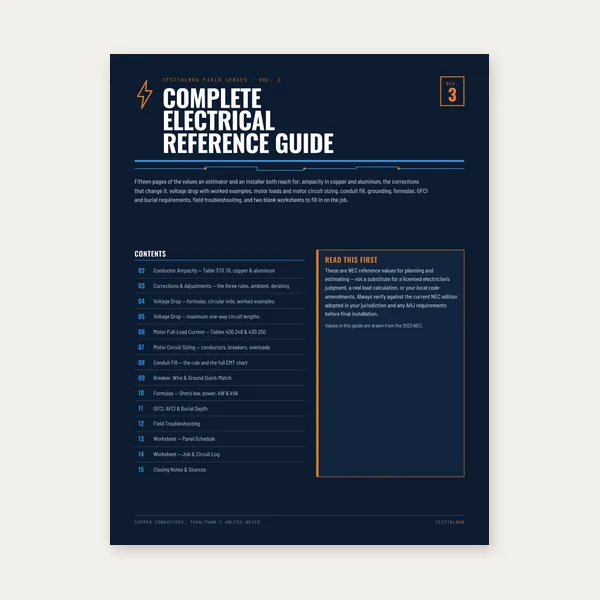
15 pages. Ampacity, corrections, voltage drop, motor circuits, conduit fill.
$12.99
Buy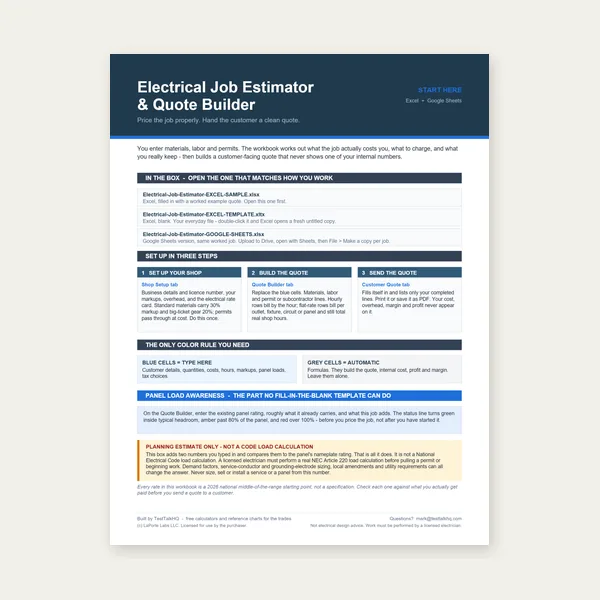
Quote electrical work and flag panel headroom before you price it.
Excel or Google Sheets. Best on a computer.
$29.00
Buy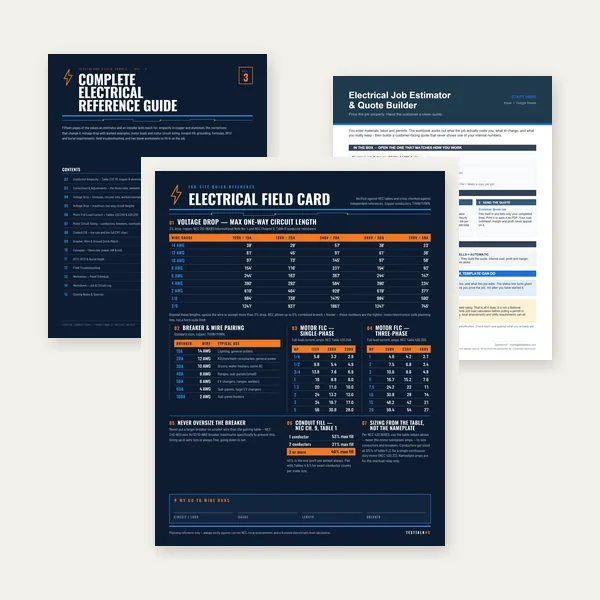
Card, 15-page guide and the estimator workbook. All six files.
Excel or Google Sheets. Best on a computer.
$34.99
$45.98 if bought separately — save $10.99
BuyCheckout opens in a new tab.
Verify circuits, confirm de-energization, and measure box dimensions before counting fill
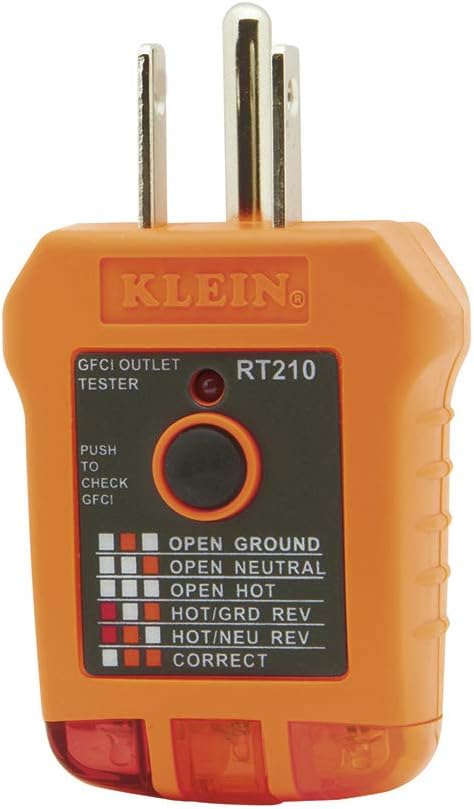
Before opening any box to check fill, verify the circuit is dead and correctly wired. The Klein RT210 confirms open hot, open neutral, open ground, reversed polarity, and GFCI function in seconds. Know the circuit status before your hands go in the box.
Check Price
Confirm voltage is absent before working in any electrical box. The Fluke 117 reads true RMS voltage with non-contact detection — the right tool for verifying a circuit is de-energized before you open a crowded box and start counting conductors. Industry standard for a reason.
Check Price
Non-contact voltage detection confirms a box is de-energized safely without touching any conductors. The built-in laser distance meter helps when measuring box dimensions to verify cubic inch capacity on unmarked boxes. Two tools that belong on every electrician’s belt.
Check PriceAs an Amazon Associate, TestTalkHQ earns from qualifying purchases.
Box fill violations are one of the most commonly cited NEC deficiencies on residential and light commercial inspections. The reason is simple — they’re visible. An inspector opening a device box that’s clearly jammed with conductors doesn’t need to do math to know something is wrong. Overfilled boxes are also genuinely dangerous: conductors crammed together can’t dissipate heat properly, insulation gets damaged as wires are forced in and out during device installation, and connections are harder to make cleanly when there’s no working space. The NEC fill calculation exists because box fill is a real safety issue, not a paperwork exercise.
On new construction, box selection happens before the wall is closed and it’s easy to upsize. On retrofit work — adding a circuit, moving a device, adding a receptacle to an existing box — you’re working with whatever box is already in the wall. Old work plastic boxes are typically 18–20 cubic inches, which is marginal for any circuit with more than two cables. Before pulling new wire into an existing box, count what’s already there. If the box is at or near capacity, the right answer is a larger old-work box or a surface-mounted extension ring, not jamming more wire into what’s already there and hoping the inspector doesn’t open it.
A junction box is the right solution when you need to splice conductors without a device — extending a circuit, splitting a home run, or making a mid-run splice that code requires to remain accessible. Junction boxes must be sized for their conductor fill just like device boxes, and they must remain accessible — you cannot bury a junction box behind drywall. For a typical splice of two 14/2 cables, a standard 4-inch square box at 21 cubic inches is adequate. For larger conductor counts or bigger wire, step up to a 4-11/16 inch square box at 42 cubic inches. When in doubt, use the larger box — junction box space is cheap, and accessibility is non-negotiable.
Most box fill calculations assume all conductors are the same gauge, which simplifies the math significantly. When you have mixed gauges in one box — common when a 20-amp circuit feeds a device while a 15-amp circuit passes through — the calculation gets more complex. Each conductor is counted at its own cubic inch volume per NEC Table 314.16(B): 14 AWG at 2.00 in³, 12 AWG at 2.25 in³, 10 AWG at 2.50 in³. The equipment grounding conductor allowance is based on the largest EGC in the box. Add each conductor’s volume individually rather than using a single per-conductor figure, and the Box Fill Calculator handles mixed gauges automatically.
These common residential scenarios use 12 AWG volume (2.25 in³ per unit). Count insulated conductors, one combined EGC unit, clamps if present, and two units per device yoke — then multiply by 2.25 and compare to the stamped box volume.
| Scenario | Units | Required cu in |
|---|---|---|
| One 12-2 w/gnd + duplex (2 cond + 1 gnd + 2 device) | 5 | 11.25 |
| Two 12-2 w/gnd + duplex | 7 | 15.75 |
| Three 12-2 w/gnd, splice only (6 + 1 gnd) | 7 | 15.75 |
| Five 12-2 splice only (10 + 1 gnd) | 11 | 24.75 |
A standard single-gang plastic box at 20.3 cu in clears the first three examples; five 12-2 splices need a deeper single-gang, a 4″ square, or a junction box with marked volume ≥ 24.75 cu in.