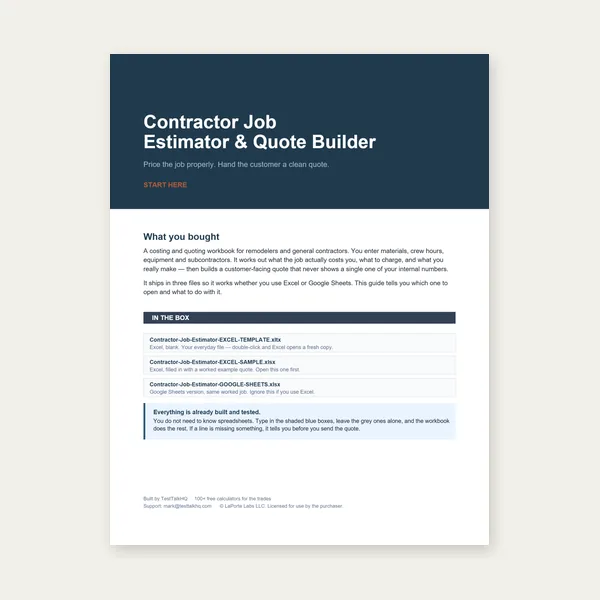
Contractor Job Estimator
Price remodels and GC work, then send a quote with no internal numbers.
Excel or Google Sheets. Best on a computer.
$29.00
BuyCommon installation mistakes — rakes omitted, underlayment lap order reversed, short overlaps, gutter conflicts, and fastener lift
Same angle as common MIG welding problems: name the failure, explain why it bites, and give the fix. Pair with the drip edge calculator for the takeoff and the guide for correct eave vs rake order.
Aluminum vs steel: comparison. Gutters: gutter calculator. Hub: roofing calculators.
Still sizing the order?Lineal feet and 10-ft sticks with 3 in overlap.
Open Calculator →Symptom: Eaves look finished; gable edges show bare sheathing or underlayment only. Common because eaves get the gutter story and more attention on the punch list.
Why it fails: IRC R905.2.8.5 (where adopted) requires drip edge at eaves and rakes. Rake edges take wind-driven rain. Bare plywood edges suck water.
Fix: Measure both eaves and rakes on the takeoff. The calculator has a dedicated rake field on purpose. If the job is already shingled without rake metal, remediation may mean carefully lifting edge shingles — budget that as a repair, not a free punch.
Symptom: Same lap detail used at eaves and rakes. Water stains at gables after wind-driven rain, or eave leaks where underlayment sits under the metal.
Why it fails: At eaves, underlayment should lap over the drip edge. At rakes, drip edge should lap over the underlayment. Reverse either edge and you open a path for water under the stack. Details: guide — install order.
Fix: Correct the sequence on new work. On existing work, assess whether the edge can be reworked without destroying the field; sometimes the honest answer is a localized tear-off at the edge.
Symptom: Short flange that barely covers the sheathing edge, or butt joints with little or no end lap. Pieces blow or wick at the joint.
Why it fails: R905.2.8.5 calls for minimum 2 in onto the deck and 3 in at end joints. The calculator’s 9.75 ft usable coverage assumes that 3 in joint lap — skipping it to “save” a stick is how joints open.
Fix: Order enough sticks (use the calculator). Cut and lap joints properly; do not stretch one stick across a gap with a hairline butt.
Symptom: Metal hangs into the gutter trough, fights hangers, or sits so high water shoots over the gutter. Or the vertical leg is buried behind a fascia that was never sized for it.
Why it fails: Drip edge and gutters are adjacent systems. A takeoff that ignores the gutter line creates an install fight on day one.
Fix: Dry-fit before nailing off long runs. Size the trough with the gutter & downspout calculator. Adjust profile, hang height, or hanger placement so the drip kicks into the gutter, not past it or into the hanger.
Symptom: Edge metal flutters, nails back out, or the vertical leg lifts in storms. Gaps open at joints.
Why it fails: R905.2.8.5 caps fastener spacing at 12 in o.c. Under-driven nails, missing nails at ends, or fasteners only in soft fascia without deck engagement leave the metal free to work.
Fix: Fasten into solid deck/framing per the adopted code and manufacturer instructions. Re-nail lifted sections; replace damaged pieces rather than hoping a single nail holds a waving stick.
Prevent the short order.Count eaves, rakes, and joints before the truck rolls.
Drip Edge Calculator →Price remodels and GC work, then send a quote with no internal numbers.
Excel or Google Sheets. Best on a computer.
$29.00
BuyCheckout opens in a new tab.
A linear-foot takeoff is useless until you can cut, fold, and fasten edge metal. These are roofing-relevant tools already on the TestTalkHQ affiliate list — tin snips for field cuts, a seamer for hems, seam tape for transitions, and a coil nailer for deck fastening nearby.

Malco M2006 left-offset snips for cutting aluminum or galvanized drip edge, rake returns, and short transition pieces without crushing the profile.
View on Amazon →
Malco AV73 long-cut right-offset snips for the opposite hand/curve. Pair with left-offset so inside and outside corners cut clean.
View on Amazon →
Malco S2R hand seamer for folding hems and dressing cut ends so the drip edge sits tight to fascia and deck without a wavy lip.
View on Amazon →
Malco TS1 drill attachment for long straight cuts in edge metal when you are trimming stock 10-ft sticks down for rake returns.
View on Amazon →
Cofair Quick Roof butyl seam tape for sealing transitions at valleys, walls, and where drip edge meets ice & water or underlayment details.
View on Amazon →
Drip edge is edge metal. Squares and bundles are a different worksheet — run the shingle calculator for the field.
Open Shingle Bundle Calculator →As an Amazon Associate, TestTalkHQ earns from qualifying purchases. No dedicated “drip edge stock” or coil-roofing-nailer SKU was on the live affiliate CSV for this page — snips, seamer, TurboShear, and butyl tape are the roofing-relevant hand tools that matched.