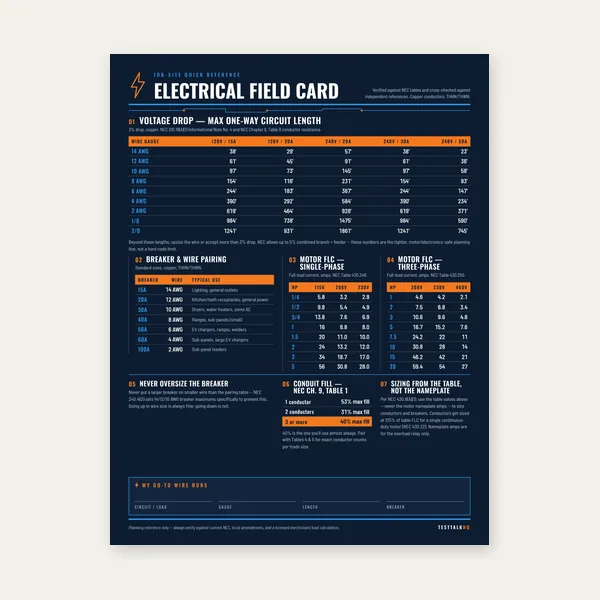
Electrical Reference Card
One page. Voltage drop lengths, breaker and wire pairing, motor FLC.
$3.99
BuyThe arc flash boundary is the distance from exposed energized parts where incident energy drops to 1.2 cal/cm² — the onset of a second-degree burn for unprotected skin. This guide explains what that number means on a job, not how to republish NFPA 70E.
When a bolted fault becomes an arcing fault, the plasma and radiant heat deliver incident energy that falls off with distance. Standards define an arc flash boundary (AFB) as the radius at which incident energy equals 1.2 cal/cm² under the study assumptions. Outside that boundary, ordinary work clothing may be acceptable for the thermal hazard; inside it, you need arc-rated PPE matched to the calculated incident energy or the applicable PPE category from the risk assessment.
The boundary is a result of analysis (or method tables), not a fixed tape-measure distance for every panel. Same 480V gear can have very different AFB values depending on available fault current, clearing time, and working distance.
NFPA 70E also defines shock protection boundaries (limited and restricted approach) based on system voltage. Those are about shock, not thermal energy. Arc flash PPE and shock PPE can both apply on the same task. Do not treat the arc flash boundary as a substitute for approach limits or lockout/tagout.
An arc flash boundary calculator estimates AFB and incident energy from simplified IEEE/NFPA-style inputs (bolted fault current, clearing time, working distance, system voltage, etc.). Use results to:
Available fault current feeds both arc flash and equipment rating. Pair this with the short-circuit current calculator when you are estimating bolted fault levels for planning discussions — final studies still belong to a qualified engineer.
Boundary distance alone does not pick your clothing. Match arc rating (ATPV/EBT) to incident energy at the working distance, or follow the employer’s PPE category method. For process-based PPE thinking in shops, see the PPE selection guide by process and the arc flash PPE category chart.
Elevated panels, mezzanines, and platform access add a fall-arrest problem on top of the thermal one — check required clearance with the fall clearance calculator before you clip a lanyard above an open bay or lower level.
Energized electrical work near welding or cutting still needs hot-work controls. Use the hot work / fire watch permit checklist when ignition sources are present outside pure electrical tasks.
Clearing time dominates many studies — a fuse or breaker that clears in 3 cycles vs 30 cycles can change incident energy by an order of magnitude. Available bolted fault current sets how hard the arc can burn. Working distance is where your chest or face actually sits during the task. Changing any one without updating the assessment is how labels go stale after a transformer upgrade or protective-device swap.
Estimate arc flash boundary Enter fault current, clearing time, and working distance for a planning estimate of AFB and incident energy.
Arc Flash Boundary Calculator →It is the defined threshold for the arc flash boundary for unprotected skin — not a license to work energized without a risk assessment. Follow your program and labels.
Clearing time and available fault current dominate. A slow fuse or high available kA pushes energy (and the boundary) out.
Short-circuit estimates, voltage drop, wire sizing, and more for the field.
One page. Voltage drop lengths, breaker and wire pairing, motor FLC.
$3.99
Buy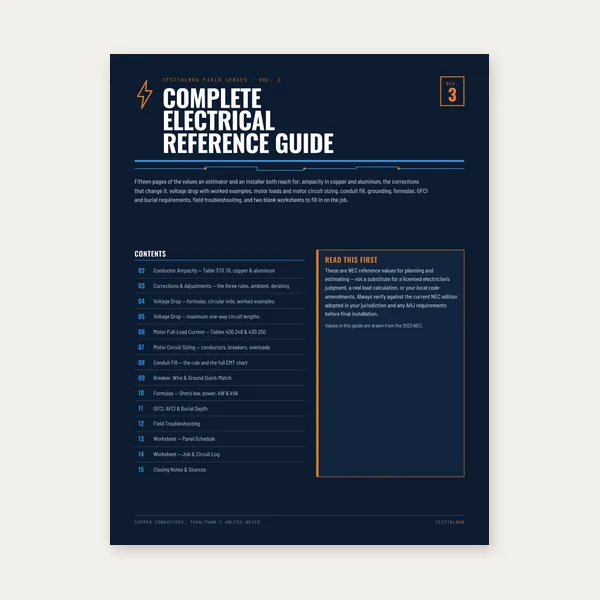
15 pages. Ampacity, corrections, voltage drop, motor circuits, conduit fill.
$12.99
Buy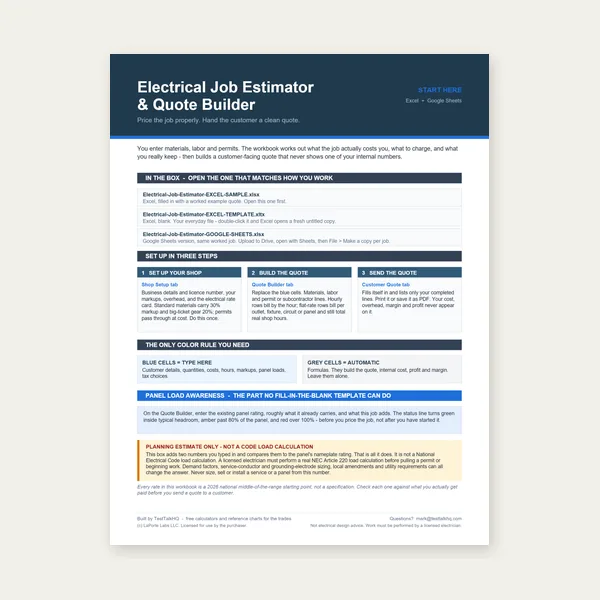
Quote electrical work and flag panel headroom before you price it.
Excel or Google Sheets. Best on a computer.
$29.00
Buy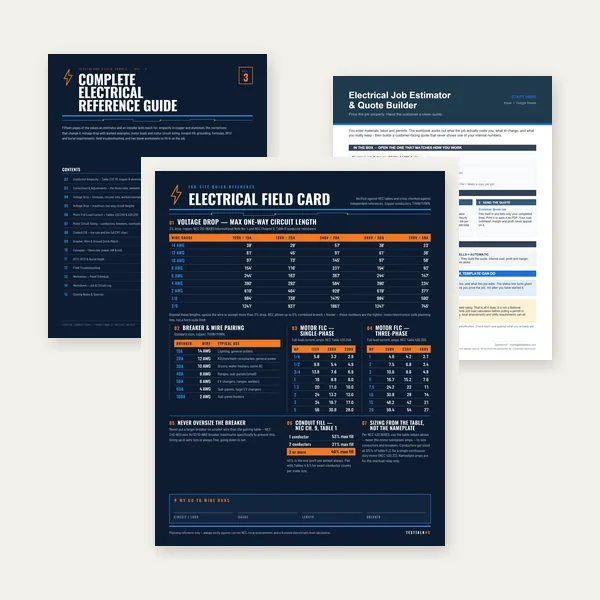
Card, 15-page guide and the estimator workbook. All six files.
Excel or Google Sheets. Best on a computer.
$34.99
$45.98 if bought separately — save $10.99
BuyCheckout opens in a new tab.