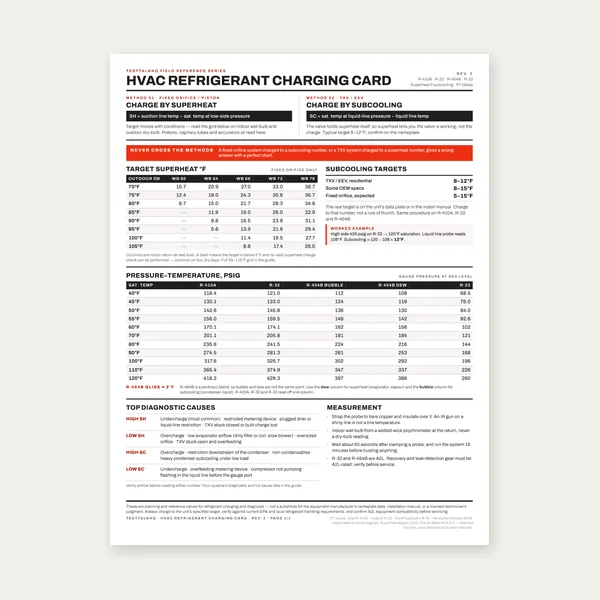
HVAC Refrigerant Charging Card
$3.99
BuyLoaded labor, materials, overhead, and markup — the same stack as welding job cost, adapted to change-outs and service
The HVAC Job Cost Calculator does the arithmetic. This page is how you pick the inputs so the quote is real money, not a hope. After a bid that lost: pricing mistakes. Whether that number is flat-rate or T&M: contract choice.
Take-home wage is not a quote rate. A $38/hr tech costs you payroll taxes, workers comp, truck, unused hours between calls, and the warranty callback you will eat. Either (A) put a loaded $/hr in the calculator and keep overhead percent modest, or (B) use wage-ish rates and a higher overhead percent. Do not do both.
Helpers are a separate line. An apprentice on a change-out is not free because they are “learning.” Put helper hours and helper rate on the quote the same day you put the lead. A $22/hr apprentice with burden and a second set of tools is still $35–$55 loaded. The job-cost calculator has a helper row for that reason.
Service techs and install leads rarely share a loaded rate. Windshield time, parts-house runs, and no-convert diagnostics live on the van. Install crews stack recovery, crane, and permit waits. If you use one number for both, the service book will look profitable on paper while the van loses money every Tuesday.
Equipment is your invoice cost, not MSRP. Distributor “list” is a catalog number; your quote uses the landed cost on this week’s invoice, including freight and any core. Refrigerant is the dollars for the ounces you will actually weigh in — extra line-set mass comes from the charge calculator, then you convert ounces to what you pay per pound this month. Ductwork and “other parts” (pad, thermostat, fittings, nitrogen, condensate) are where change-outs leak if you quote the box and forget the install kit.
Build a default kit for the jobs you actually sell. A 2–3 ton change-out kit is not the same as a 5-ton with a new return drop. If Other parts is $0 on a change-out, you quoted a condenser, not an install. Nitrogen, brazing rod, and a wet rag are not free because they came from the truck.
This page does not size the system. Cooling tons: BTU / tonnage. Heat: furnace sizing. Ductless heads: mini-split sizer. Price after you know what you are hanging. An oversized unit you already bought is still the wrong quote if the load calc said 2.5 tons.
A diagnostic fee is not overhead. It is a line item for driving to a house that may not buy. Credit it toward the repair if that is your policy; write the policy down. Old-unit disposal is a dump/recovery cost, not “included.” Permits are whatever the AHJ charges plus the inspection wait that belongs in hours if you sit there.
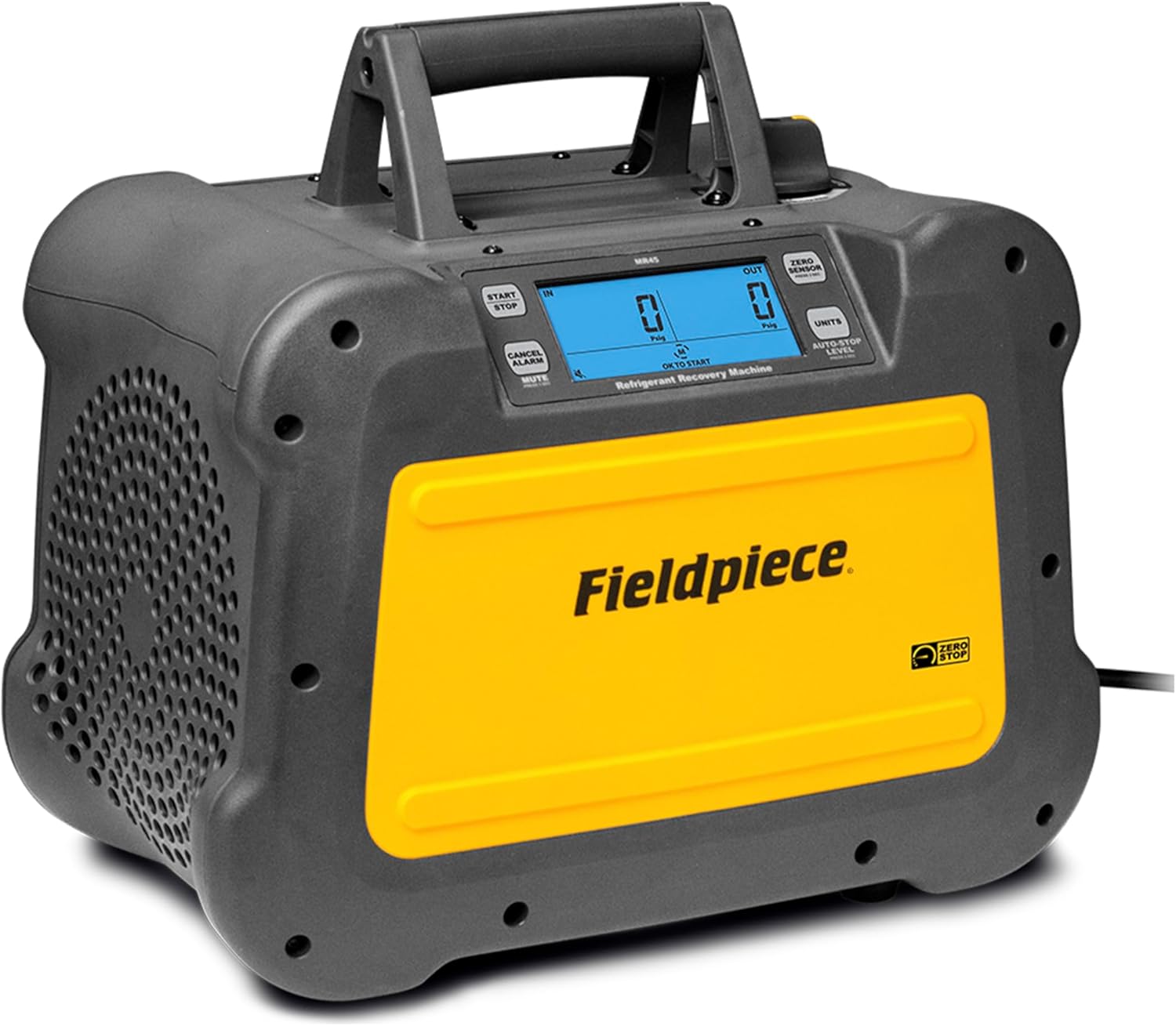
Recovery time is not the disposal fee. Disposal is the scrap yard, the EPA paperwork, and the trailer. Recovery is the machine on the driveway before you cut the old unit. If you put $175 in disposal and zero extra hours, the “easy swap” still ate a half day. Put recovery in lead-tech hours.
Overhead in this model is a percent of direct cost (labor + materials + fees). It is the unused time, the second truck, the software, the bad debt. If you already fully loaded the hourly rate, keep this small (or zero) so you do not double-count. If the hourly is closer to wage, 15–25% is a common shop starting band — tune it from last year’s P&L, not from a Facebook thread.
A shop that loads $125/hr and then adds 25% overhead on a materials-heavy change-out is stacking profit on the condenser, not covering unused hours. Equipment already has freight and distributor margin in it. Overhead percent is for the business that exists whether this job sells or not. If last year’s overhead was $180k on $900k of direct cost, start near 20% and stop guessing.
Markup is percent on job cost. Margin is percent of the selling price. They are not the same number:
| Markup on cost | Implied margin on quote |
|---|---|
| 20% | 16.7% |
| 35% | 25.9% |
| 50% | 33.3% |
| 100% | 50% |
The calculator lets you enter either. Pick one language for the whole company. “We need 35%” without saying which one is how two owners quote the same job $1,400 apart.
These are the install-preset numbers on the job-cost calculator. Override every field with your invoices. The arithmetic is here so you can see what “35% markup” actually prints.
| Line | Input | Dollars |
|---|---|---|
| Lead tech | 8 h × $125 | $1,000.00 |
| Helper | 8 h × $45 | $360.00 |
| Equipment | condenser + air handler (your cost) | $4,500.00 |
| Refrigerant | weigh-in extras | $180.00 |
| Ductwork materials | transitions / takeoffs | $350.00 |
| Other parts | pad, thermostat, fittings, nitrogen | $220.00 |
| Disposal | old-unit haul | $175.00 |
| Permit | AHJ fee | $85.00 |
| Direct cost | labor + materials + fees | $6,870.00 |
| Overhead 18% | 18% of $6,870 | $1,236.60 |
| Job cost | direct + overhead | $8,106.60 |
| Customer quote | 35% markup on job cost | $10,943.91 |
If the owner said “we need 35% margin,” the quote is $8,106.60 ÷ (1 − 0.35) = $12,471.69 — about $1,500 more. That is why the calculator asks markup vs margin instead of one unlabeled percent. After three completed change-outs, compare quoted hours and refrigerant dollars to actuals and retune the preset.
Run the numbers on a real change-out. Presets are a starting point — override hours and invoices.
Open HVAC Job Cost CalculatorService calls die on windshield time and parts runs. Install crews die on recovery, crane, permit waits, and “while you’re here” extras. Use higher hours or a trip fee on service; use helper hours + disposal + permit on installs. Do not use one default 8-hour block for both.
A diagnostic that converts still used 40 minutes of drive time and 20 minutes of setup. If you credit the trip fee to the repair, the repair quote has to carry that time or you gave away the visit. After-hours and weekend multipliers belong on the rate card, not as a surprise on the invoice.
Labor-only (customer bought the Amazon condenser) is still a job: recovery, line set, vacuum, weigh-in, startup, haul-away. Price those hours and fees even when equipment cost is $0. Full-service includes the box. Do not mix them in your head and then wonder why the “easy swap” lost money.
Labor-only also transfers warranty risk. If the customer-supplied condenser is wrong-size or DOA, your hours still happened. Write that the equipment is theirs, the startup is yours, and callbacks on a mismatched coil are T&M. Contract shape for that fight is flat-rate vs T&M.
Forgotten disposal, permit, refrigerant, recovery time, helper, and callbacks. Diagnosis after the fact lives on pricing mistakes. This page is how you set the model so those mistakes are visible before you text the customer a number.
No. Add tax in invoicing for the jurisdiction. Mixing tax into markup hides whether the job made money.
Most residential shops do, same visit only. Write it down so a helper does not waive it on a $90 part swap.
Lead-tech hours, not the disposal field. Disposal is scrap/haul. Recovery is clock time with a machine.
No. 35% markup is about 25.9% margin. Use the table above or the calculator’s implied-margin line.
You can send a range. Do not lock a flat change-out until cooling and heat are sized. Wrong tons is a materials and callback problem, not a rounding error.
$3.99
Buy
$12.99
Buy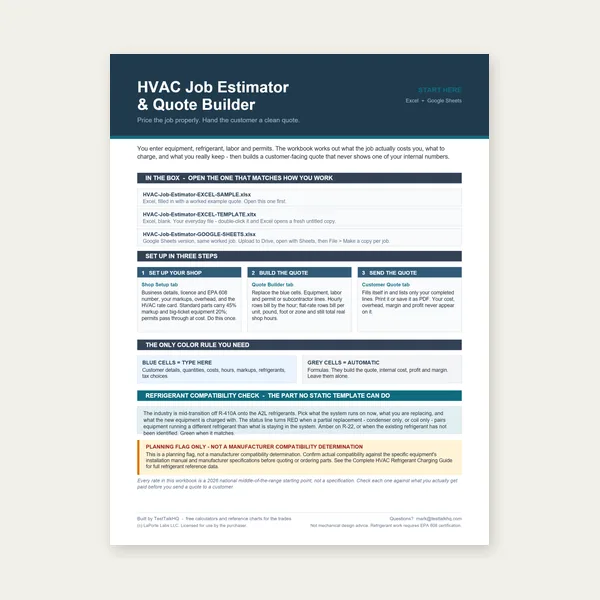
$29.00
Buy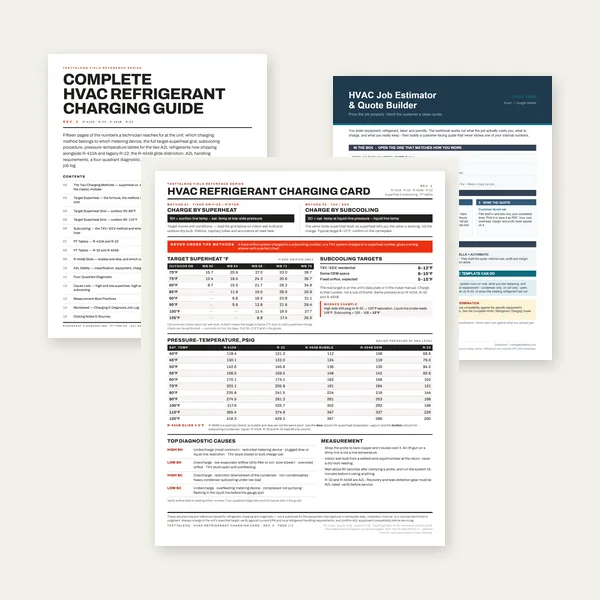
$39.00
BuyCheckout opens here — you stay on this page.
If you cannot recover, weigh, or prove the charge, the refrigerant and callback lines are fiction.
As an Amazon Associate, TestTalkHQ earns from qualifying purchases.