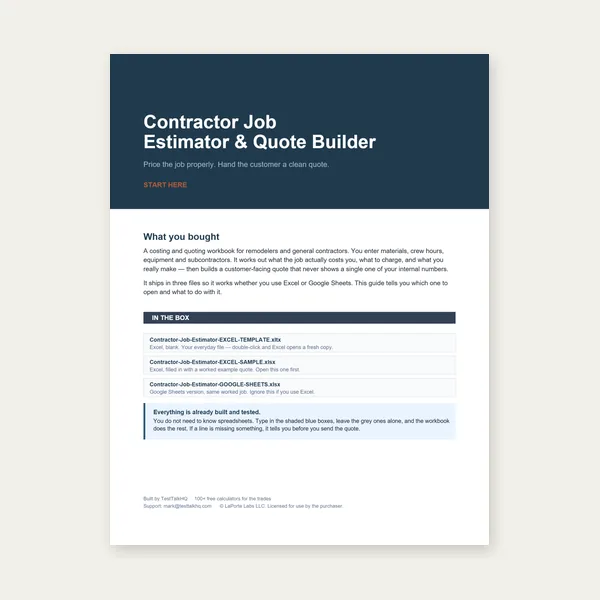
Contractor Job Estimator
Price remodels and GC work, then send a quote with no internal numbers.
Excel or Google Sheets. Best on a computer.
$29.00
BuyCompare felt weight classes and synthetic underlayment by cost, durability, exposure tolerance, and typical use case — within the field-underlayment category
This is a within-category comparison: which field layer to buy. It does not repeat the ice & water shield vs felt/synthetic article, which compares peel-and-stick membrane against field underlayment by location on the roof. Use the underlayment calculator for roll counts once you pick a product.
Install depth: underlayment guide. Failures: troubleshooting. Hub: roofing calculators.
Know your pick? Run roll counts for 15#, 30#, or synthetic with pitch doubling and waste.
Open Calculator →15# felt — budget steep-slope jobs, short dry-in windows, traditional crews.
30# felt — heavier deck protection, longer exposure tolerance than #15, fewer rolls than #15 but more than synthetic.
Synthetic — tear strength, longer UV/exposure rating on many lines, fewer rolls to haul; confirm cap-nail pattern and label coverage.
All three are field underlayment. Ice-and-water shield at eaves/valleys is still separate where code requires: ice-barrier calculator.
Standard residential roll sizes below are industry-typical starting points. Always confirm the printed coverage on the roll you are buying — especially synthetics, which vary more by manufacturer than felt does.
| Product | Typical roll size | Nominal coverage | Effective after overlap | Typical exposure window* | Approx. cost tier |
|---|---|---|---|---|---|
| 15# felt | 36 in × 144 ft | ~432 sq ft (4 sq) | ~380–400 sq ft | Short (often days, not weeks) | $ |
| 30# felt | 36 in × 72 ft (typical) | ~200 sq ft (2 sq) | ~200 sq ft | Moderate vs #15 | $$ |
| Synthetic | Varies (often ~4 ft wide) | ~1,000 sq ft (10 sq) | ~1,000 sq ft (confirm label) | Longer on many SKUs | $$–$$$ |
*Exposure tolerance is manufacturer-specific. Do not leave any underlayment exposed beyond the label limit.
Nominal vs effective: Boxes print optimistic square footage. Laps eat 10–15% on felt. The calculator uses effective numbers so orders survive real install overlap.
Roll count vs cost: Synthetic may need four rolls where #15 needs ten, but price per square covered can still favor felt on a small gable roof. Compare total dollars per square covered, not roll count alone.
Low-slope doubling: Any product still needs double coverage on 2:12–3:12 per IRC. That doubles material regardless of felt vs synthetic.
Lightest common felt class. Standard roll covers about four squares nominal, roughly 380–400 sq ft effective after laps. Economical on straightforward steep-slope replacements where the roof will be shingled within a few days.
Strengths: Low cost, familiar install, adequate when exposure is brief.
Weaknesses: Tears more easily under foot traffic; wrinkles if installed wet; not the choice for long dry-in or low-slope double layers if crew speed is slow.
Heavier asphalt-saturated felt, typically about two squares per roll (~200 sq ft). Stiffer and more abuse-tolerant under foot traffic than #15.
Strengths: Better deck protection during install; moderate exposure tolerance vs #15.
Weaknesses: More rolls to carry than synthetic; still asphalt felt limitations on tear strength vs woven synthetics.
Woven or scrim-reinforced sheet, usually ~10 squares per roll on common SKUs. Higher tear resistance and longer rated exposure on many product lines.
Strengths: Fewer rolls; walks better; often specified on premium installs.
Weaknesses: Higher material cost; requires cap nails/staples per label; coverage and exposure vary by brand — read the package.
Compare roll counts side by side.Change the product dropdown and recalculate.
Underlayment Calculator →No. Ice & water shield vs felt/synthetic compares peel-and-stick membrane to field underlayment by location on the roof. This page compares 15# vs 30# vs synthetic within field underlayment.
The square calculator bundles quick underlayment rolls with shingles. This dedicated calculator adds pitch doubling, overlap-adjusted effective coverage, and editable waste.
Price remodels and GC work, then send a quote with no internal numbers.
Excel or Google Sheets. Best on a computer.
$29.00
BuyCheckout opens in a new tab.
Roll counts are step one. Cutting, fastening, and lapping the field layer is where jobs win or leak. These roofing-relevant tools are on the TestTalkHQ affiliate list — hook knife for roll cuts, coil nailer for cap fasteners on synthetic, chalk line for straight courses, and butyl tape for detail transitions.

Stanley FatMax hook knife for cutting felt or synthetic underlayment around vents and at rake returns without tearing the roll edge.
View on Amazon →
BOSTITCH RN46-1 coil roofing nailer for cap nails or staples on synthetic underlayment per manufacturer instructions — not the same as shingle nailing.
View on Amazon →
TAJIMA Chalk-Rite jam-free chalk line for snapping horizontal courses so side laps stay parallel and end laps stagger correctly.
View on Amazon →
Cofair Quick Roof butyl seam tape for sealing transitions at walls, chimneys, and where field underlayment meets peel-and-stick membrane.
View on Amazon →
Grace Ice & Water Shield for the eave/valley band — separate from field underlayment. Size the band with the ice-barrier calculator.
View on Amazon →
Underlayment covers the deck; shingles cover the underlayment. Run the square calculator for bundles after you have rolls ordered.
Open Shingle Bundle Calculator →As an Amazon Associate, TestTalkHQ earns from qualifying purchases. No dedicated #15 or #30 felt roll SKU was on the live affiliate CSV — hook knife, nailer, chalk, tape, and ice-barrier roll are the roofing-relevant tools that matched.