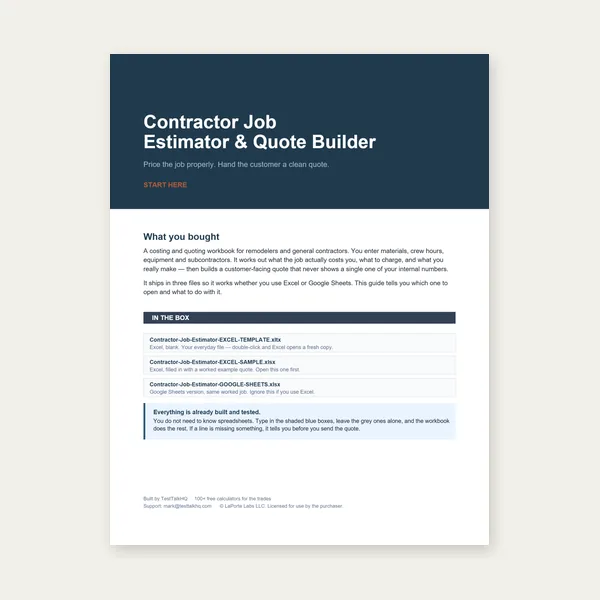
Contractor Job Estimator
Price remodels and GC work, then send a quote with no internal numbers.
Excel or Google Sheets. Best on a computer.
$29.00
BuyWhat field underlayment does on the deck, why IRC doubles coverage on low slopes, overlap rules, and how to turn roll coverage into an order
The underlayment coverage calculator turns roof area into roll counts. This guide is the why: product roles, pitch rules, laps, and waste. Ice-and-water shield at eaves is covered separately — see the ice-barrier calculator and ice barrier vs field underlayment comparison (different angle from 15# vs 30# vs synthetic below).
Mistakes: troubleshooting. Product pick within underlayment: 15# vs 30# vs synthetic. Hub: roofing calculators.
Need roll counts now? Squares or sq ft, pitch single/double, felt or synthetic, waste.
Open Underlayment Calculator →Field underlayment is the water-shedding layer between roof sheathing and shingles. It is not decorative. It backs up the primary roof covering when wind drives rain under shingle tabs, when cap nails miss, or when ice forces water uphill at the eave before shingles are installed.
Two product families dominate residential asphalt-shingle work:
Both are field layers. Ice-and-water shield is a self-adhering rubberized membrane used at eaves, valleys, and penetrations in designated climates — not a substitute for covering the rest of the deck. That distinction is the subject of the existing ice barrier vs underlayment article; this guide stays on field coverage math and install practice.
IRC R905.1.1 requires underlayment for asphalt shingles unless the manufacturer and local code provide a specific exception (uncommon on residential steep-slope). Inspectors look for it on new work and reroofs where tear-off exposes sheathing.
Manufacturers tie warranty coverage to approved underlayment types and install methods. Skipping it or using the wrong product for the slope can void coverage even when water has not entered yet.
On slopes of 4:12 and steeper, one layer of approved underlayment is the usual field requirement. On 2:12 through 3:12 (under 4:12), IRC R905.1.1 requires double underlayment applied per code methods — effectively roughly double the material of a single-layer steep roof.
The calculator models this as 2× deck area before waste when you select the low-slope option. Some crews run two full courses with offset laps; others use products rated for double coverage in one pass. Confirm what your AHJ and the shingle manufacturer accept.
Measure surface area with the pitch / slope calculator if you only have footprint dimensions.
Rolls do not butt edge-to-edge. Laps shed water downslope and sideways:
Nominal roll coverage on the box (e.g., 432 sq ft for a standard #15 roll) assumes some overlap. Effective coverage after standard laps is lower — about 380–400 sq ft for #15 felt, about 200 sq ft for #30, about 1,000 sq ft for many synthetics (confirm the label). The calculator uses those effective numbers so you do not over-order from nominal specs alone.
The square calculator includes a bundled underlayment roll estimate with shingles — useful for a quick quote. Use this dedicated calculator when pitch doubling, overlap-adjusted roll sizes, or product-specific felt vs synthetic counts matter.
Run the numbers on your roof.Pitch toggle, waste, and felt vs synthetic presets built in.
Open Underlayment Calculator →No. The existing ice & water shield vs felt/synthetic page explains where peel-and-stick is required vs field underlayment. This guide and the 15# vs 30# vs synthetic comparison explain which field product and how much.
No. Ice-and-water shield is a specific self-adhering product at defined locations. Synthetic field underlayment does not replace that code band unless local code and manufacturer explicitly allow a listed substitute.
Synthetic rolls often cover ~10 squares vs ~4 for #15 felt. Fewer rolls does not always mean lower cost — compare price per square covered.
Price remodels and GC work, then send a quote with no internal numbers.
Excel or Google Sheets. Best on a computer.
$29.00
BuyCheckout opens in a new tab.
Roll counts are step one. Cutting, fastening, and lapping the field layer is where jobs win or leak. These roofing-relevant tools are on the TestTalkHQ affiliate list — hook knife for roll cuts, coil nailer for cap fasteners on synthetic, chalk line for straight courses, and butyl tape for detail transitions.

Stanley FatMax hook knife for cutting felt or synthetic underlayment around vents and at rake returns without tearing the roll edge.
View on Amazon →
BOSTITCH RN46-1 coil roofing nailer for cap nails or staples on synthetic underlayment per manufacturer instructions — not the same as shingle nailing.
View on Amazon →
TAJIMA Chalk-Rite jam-free chalk line for snapping horizontal courses so side laps stay parallel and end laps stagger correctly.
View on Amazon →
Cofair Quick Roof butyl seam tape for sealing transitions at walls, chimneys, and where field underlayment meets peel-and-stick membrane.
View on Amazon →
Grace Ice & Water Shield for the eave/valley band — separate from field underlayment. Size the band with the ice-barrier calculator.
View on Amazon →
Underlayment covers the deck; shingles cover the underlayment. Run the square calculator for bundles after you have rolls ordered.
Open Shingle Bundle Calculator →As an Amazon Associate, TestTalkHQ earns from qualifying purchases. No dedicated #15 or #30 felt roll SKU was on the live affiliate CSV — hook knife, nailer, chalk, tape, and ice-barrier roll are the roofing-relevant tools that matched.