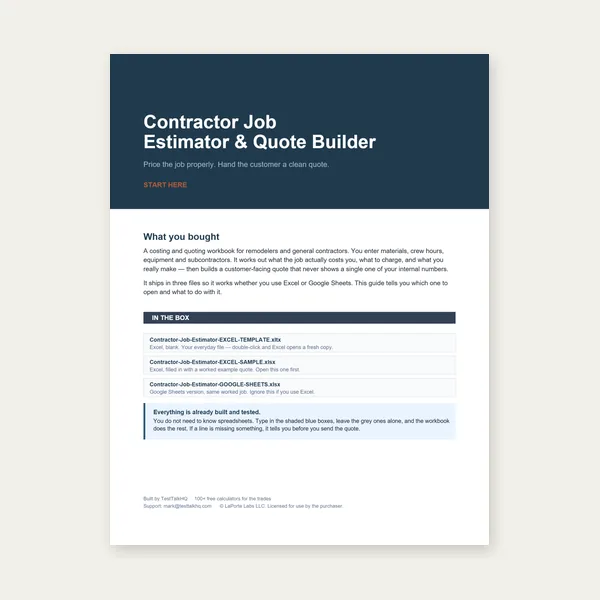
Contractor Job Estimator
Price remodels and GC work, then send a quote with no internal numbers.
Excel or Google Sheets. Best on a computer.
$29.00
BuyTypical kerf by method, why under-kerfing runs you short, and how to measure yours
A clear explainer on kerf allowance for metal and wood cutting — typical widths by saw and process, why under-estimating kerf causes mid-job shortages, and how to measure your own tool’s kerf.

There is no natural either/or product choice here. The useful question is: what kerf does your process actually remove, and did you enter it?
Open Cut List Optimizer →Kerf is the width of material removed by the cutting tool — the slot the blade, kerf of the plasma jet, or laser beam leaves behind. On a multi-piece bar, every cut between pieces costs one kerf of length. Ignore it and your cut list over-promises how many pieces fit on a stick.
These are shop ballparks — measure your own tool when it matters:
Suppose you pack four 24" pieces on a 96" bar with kerf entered as 0. Real world with 0.125" kerf needs 24×4 + 0.125×3 = 96.375" — the last piece does not fit. The software layout looked perfect; the floor ran short. That is why the Cut List Optimizer charges kerf between pieces and why the guide pushes you to enter a realistic value.
On scrap of the same material: mark a known length, make one cut with your production setup, and measure the lost width (or cut two faces and compare remaining length to expected). Enter that value in the optimizer. Re-check when you change blades, amperage, or blade type.
Tape measures, speed squares, soapstone, and bandsaw blades are the usual shop companions for marking and cutting stock to a cut list.
Price remodels and GC work, then send a quote with no internal numbers.
Excel or Google Sheets. Best on a computer.
$29.00
BuyCheckout opens in a new tab.