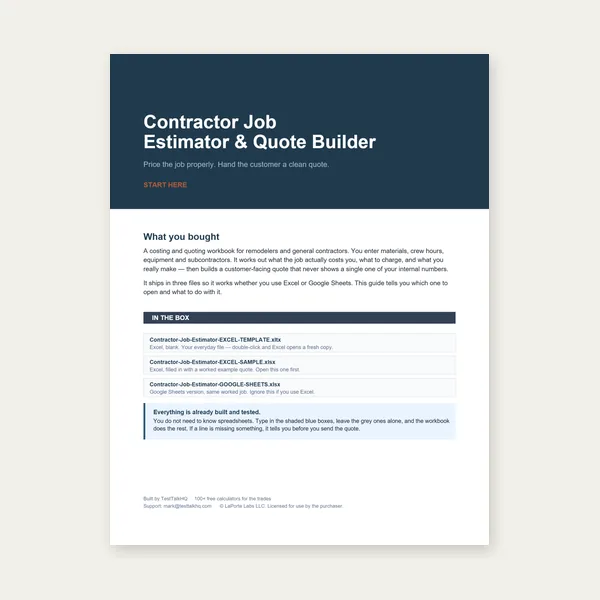
Contractor Job Estimator
Price remodels and GC work, then send a quote with no internal numbers.
Excel or Google Sheets. Best on a computer.
$29.00
BuyWhen the tag said enough capacity but the lift still failed — angle derating, uneven legs, wrong hitch, and damage you missed
Use this when rigging looked fine on paper but the load swung, a leg shook, or someone questioned the setup. Start with the Sling Angle Load Calculator. Background on angle factor and hitch derates is in the Sling Angle Load Guide. Hitch selection forks live on Choker vs Basket vs Vertical Hitch.

Most field failures trace to one of four roots: tag capacity used without angle math, unequal leg loading, hitch mode that does not match load geometry, or damaged hardware still in service.
| Symptom | Likely cause | First fix | Next tool |
|---|---|---|---|
| "Tag says 4 ton — we only lifted 3" | Rated capacity used without sin(angle) reduction; wide bridle angle | Measure angle from horizontal; recalculate system capacity | Sling Calculator |
| One leg tight, one slack at rest | Center of gravity offset; unequal leg length; twisted basket | Re-rig from CG; equalize leg geometry; use spreader if needed | Sling Guide |
| Load rolled or slipped in hitch | Choker on smooth round stock; basket on unbalanced load | Switch hitch type; add friction pads / scotch block; tag line | Hitch Decision |
| Web folded, wire kinked, chain gouged | Damage ignored; edge contact; shock load | Remove from service; inspect per ASME B30.9; replace | Tag Reading |
| Shackle pin bent; hook throat spread | Side loading; overload; wrong WLL hardware in path | Replace hardware; verify tension path is in-line | Sling Calculator |
| Lift "jerked" at breakaway | Shock load; snatch lift; load stuck to floor | Slow controlled tension; derate capacity; never shock-load |
What it looks like: Rigger reads "2,000 lb per leg" on a two-leg bridle, sees a 3,000 lb load, and assumes 4,000 lb system capacity. The lift runs with legs at ~45–60° included angle (each leg ~22–30° from horizontal). At 30° from horizontal, sin(30°) = 0.5 — system capacity is only 2,000 lb, not 4,000 lb.
Why it happens: Tags often emphasize vertical WLL. Training slides show vertical legs. On the floor, crane height and hook spacing flatten the bridle unless someone designs leg length and pick point height for angle.
First fix: Measure or estimate angle from horizontal on the loaded legs (not from vertical). Run the calculator. If angle < 30°, stop and re-engineer pick height, use a spreader bar, or reduce load.
What it looks like: One leg bar-tight, one leg visibly slack at the same hook height. Load swings when lifted. Multi-leg tag capacity assumes equal load share — unequal geometry puts more than half the load on one leg.
Common causes: Center of gravity not under the hook; legs of different length; obstructions forcing one leg shorter; three-leg bridle on a four-corner load (one leg carries near zero until shift).
First fix: Rig from the actual CG — use a single vertical leg, adjust pick points, or add a spreader beam so each leg sees planned share. Recalculate using the worst-case leg angle and highest-tension leg, not average geometry.
Three- and four-leg bridles do not automatically share evenly on stiff loads. ASME and rigging texts warn that on rigid loads one leg may unload entirely. Plan as if one leg is redundant unless the rigger proves equal share.
Vertical: Best when load hangs plumb from a single top attachment aligned with CG. Fails when pick point is off-center — load tilts immediately.
Choker: Tightens on the load; good for bundles and pipe when friction holds. Poor on polished cylinders unless rigged to prevent roll-out. Choker rating ~75–80% of vertical on most tags.
Basket: Doubles vertical capacity in ideal vertical-leg geometry; supports long loads under center. Bad when load can slide toward center, folding the sling, or when legs cannot stay vertical.
First fix: Match hitch to load shape and friction — see the full decision fork on Choker vs Basket vs Vertical. Then apply angle factor on the actual leg geometry.
Remove slings from service when inspection finds any of the following (consult ASME B30.9 for material-specific limits):
Edge protection is not optional on sharp loads — a cut web fails at the edge while the tag still reads full WLL elsewhere. Document daily / frequent inspections per your program.
Dynamic forces from accelerating the load, hitting obstructions, or "popcorn" breakaway from the floor can exceed static calculations by multiples. Tags and calculators assume gradual, controlled loading.
First fix: Slow hoist speed at pick; rig tag lines; clear path; never exceed static WLL hoping momentum "will not matter." If shock is possible, treat capacity as unknown until a qualified rigger derates or re-rigs.
Plug rated WLL, legs, angle from horizontal, and load weight. Compare tension per leg to tag rating and hardware WLL in the entire path.
Sling Angle Load Calculator → Sling Angle Load Guide →This pack and OSHA rigging practice use angle from horizontal for the sine factor. Confirm your site standard — mixing conventions is a common calculation error.
No — use the choker column on the tag (typically ~75–80% of vertical). Then apply angle reduction if legs are not vertical.
Not on rigid loads. One leg may carry little or no load. Do not assume 4× vertical WLL without qualified rigging analysis.
Many sites treat 30° from horizontal as a practical minimum for planning. Below that, tension rises sharply. Always follow site lift plan and manufacturer guidance.
Price remodels and GC work, then send a quote with no internal numbers.
Excel or Google Sheets. Best on a computer.
$29.00
BuyCheckout opens in a new tab.