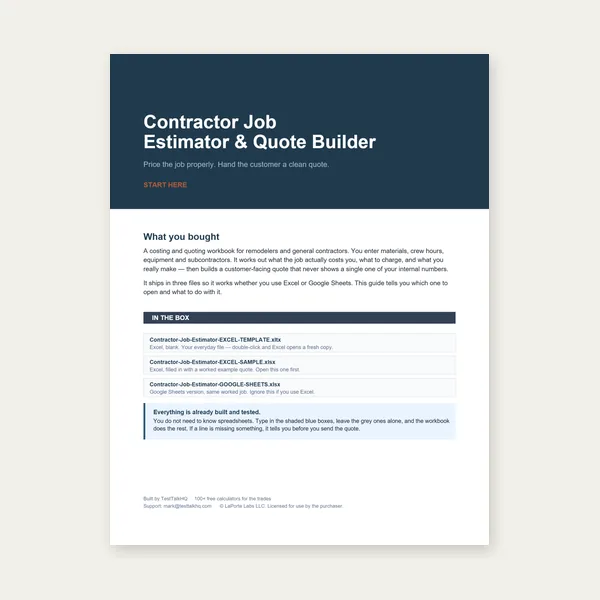
Contractor Job Estimator
Price remodels and GC work, then send a quote with no internal numbers.
Excel or Google Sheets. Best on a computer.
$29.00
BuyAngle factor math, hitch-type capacity differences, and how to read sling tags before you lift
Bridle sling capacity is not the number printed on the tag when the legs run at an angle. This guide explains why lower angles reduce capacity dramatically, how vertical / choker / basket hitches change the baseline rating, and how to apply OSHA and ASME thinking on the floor. Run numbers in the Sling Angle Load Calculator, pick hitches on the Choker vs Basket vs Vertical decision page, and troubleshoot failures on the Sling Angle Load Troubleshooting page.

When two or more legs share a load, each leg contributes vertical support proportional to the sine of its angle from horizontal. At 90° from horizontal (legs vertical), sin(90°) = 1.0 — the full tag rating applies per leg. As the included bridle angle opens and legs flatten toward horizontal, the sine drops and each leg carries more tension for the same load weight.
This is separate from hitch type. A basket hitch doubles vertical capacity when legs are vertical, but angle factor still applies to each leg in the bridle geometry. Do not stack derates blindly — apply hitch rating first, then angle reduction on the resulting leg tension.
The relationship is nonlinear in tension. Dropping from 60° to 30° from horizontal cuts the angle factor from 0.866 to 0.500 — nearly halving system capacity and nearly doubling leg tension for the same load. Below 30°, tension spikes fast enough that many job sites treat it as a hard planning limit unless engineered.
Quick lookup for planning — verify with the calculator before the lift.
| Angle from horizontal | sin(θ) — angle factor | 2-leg system @ 2,000 lb/leg |
|---|---|---|
| 30° | 0.500 | 2,000 lb |
| 35° | 0.574 | 2,296 lb |
| 40° | 0.643 | 2,572 lb |
| 45° | 0.707 | 2,828 lb |
| 50° | 0.766 | 3,064 lb |
| 55° | 0.819 | 3,276 lb |
| 60° | 0.866 | 3,464 lb |
| 65° | 0.906 | 3,624 lb |
| 70° | 0.940 | 3,760 lb |
| 75° | 0.966 | 3,864 lb |
| 80° | 0.985 | 3,940 lb |
| 85° | 0.996 | 3,984 lb |
| 90° | 1.000 | 4,000 lb |
Last column shows 2 × 2,000 lb × sin(θ). Your tag WLL and leg count will differ — plug your values into the calculator.
Manufacturer tags and ASME B30.9 list ratings by hitch mode. Typical industry planning factors (verify on your tag):
Angle factor applies on top of whichever hitch mode you chose. A basket doubles vertical capacity only when legs stay near vertical; a wide bridle angle erodes that margin the same way it does for a straight two-leg bridle.
Hitch selection tradeoffs — load stability, hardware clearance, and damage to finished surfaces — live on the Choker vs Basket vs Vertical decision page.
OSHA 1910.184 (general industry) and 1926.251 (construction) require slings to be marked with rated capacity, inspected, and used by trained personnel within those limits. ASME B30.9 governs sling design, marking, and inspection intervals. A qualified or competent rigger evaluates center of gravity, hitch selection, shock loading, and environmental factors — none of which a basic angle calculator replaces.
Enter rated WLL per leg, leg count, angle from horizontal, and load weight. The calculator shows angle factor, system capacity, tension per leg, pass/fail, and explicit formula steps.
Sling Angle Load Calculator → Pick Hitch Type →Price remodels and GC work, then send a quote with no internal numbers.
Excel or Google Sheets. Best on a computer.
$29.00
BuyCheckout opens in a new tab.