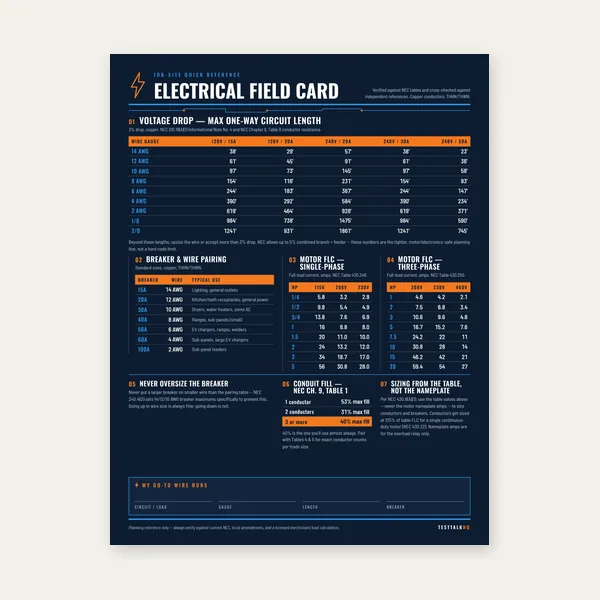
Electrical Reference Card
One page. Voltage drop lengths, breaker and wire pairing, motor FLC.
$3.99
BuyInverse-time breaker, dual-element time-delay fuse, or motor circuit protector — which short-circuit and ground-fault device belongs on your motor branch circuit
All three are legal short-circuit/ground-fault devices under NEC 430.52 — but they behave differently on inrush, coordinate differently, and protect differently against single-phasing. This page is the decision fork referenced from Motor Circuit Sizing Troubleshooting. Size the actual values in the Motor Circuit Sizing Calculator and learn the full method in the Motor Circuit Sizing Guide.

All three protect only against short circuits and ground faults on a motor branch circuit — the overload relay always handles sustained overload separately (NEC 430.32). The choice is about starting margin, coordination, single-phasing, and serviceability.
| Device | 430.52 max | Best when | Watch out for |
|---|---|---|---|
| Inverse-time breaker | 250% Table FLA | Resettable, common in panelboards, easy for maintenance staff | Lower let-through control; may need next-size-up for hard starts |
| Dual-element (time-delay) fuse | 175% Table FLA | Tight let-through, good motor start ride-through, high interrupting rating | Single-phasing risk if one fuse opens; carry spares; sized lower (175%) |
| Non-time-delay fuse | 300% Table FLA | Rarely first choice for motors; used where time-delay unavailable | Needs high % to survive inrush; poor overload discrimination |
| Motor circuit protector (MCP) | 800% (up to 1300% adj.) | Compact combination starters; instantaneous-only magnetic trip | Legal ONLY in a listed combination motor controller; no overload function |
The inverse-time breaker is the default on most branch panels. NEC Table 430.52 permits it at up to 250% of the Table FLA, which gives it enough headroom to ride through the 6–8× locked-rotor inrush without tripping, while its instantaneous magnetic element still clears a bolted fault. It is resettable — a plant electrician clears a fault and closes it back in without stocking parts.
The trade-off is coordination and let-through. A thermal-magnetic breaker generally allows more fault energy through than a current-limiting fuse of equivalent rating, which matters for downstream withstand ratings and arc energy. On hard-starting or high-inertia loads you may need the 430.52(C)(1) Exception to step up to the next standard size, and on very hard starts a plain inverse-time breaker can still nuisance-trip where a time-delay fuse would ride through.
Dual-element time-delay fuses are the connoisseur's choice for motor branch protection. The time-delay element rides through starting inrush, so the fuse can be sized as low as 175% of Table FLA per 430.52 — closer to the actual load — which means tighter, faster fault clearing and lower let-through energy. Their high interrupting ratings and current-limiting behavior are valuable on services with high available fault current.
The two catches are single-phasing and logistics. On a three-phase motor, if one fuse opens, the motor can continue to run single-phased on the remaining two legs, overheating unless the overload relay (or a dedicated single-phasing/phase-loss relay) drops it out. And a blown fuse is not resettable — you must stock the correct class and rating. Mixing fuse classes or grabbing a wrong-rating spare defeats the coordination you designed for.
An MCP is an instantaneous-trip-only breaker — it has a magnetic element but no thermal (overload) element. Because it provides no overload protection at all, NEC 430.52 lets it be set very high (800%, adjustable higher for special cases), and it is legal only as part of a listed combination motor controller where the manufacturer has tested the MCP, contactor, and overload relay together as an assembly. You cannot drop a bare MCP onto a branch circuit the way you would a breaker or fuse.
MCPs shine in compact combination starters and motor control centers: they give adjustable instantaneous fault protection in a small footprint, coordinated by the manufacturer with the overload relay. The failure mode to avoid is treating an MCP as a general OCPD — without the overload relay present and correctly set, the motor has no running-overload protection whatsoever.
Start with the installation. Panelboard branch circuit for a general-purpose motor with normal starting? An inverse-time breaker is the low-friction default. Building a combination starter or populating an MCC bucket? You're almost certainly using an MCP that the assembly is listed for, or a fusible switch.
Then weigh fault energy and coordination. On services with high available fault current, or where downstream equipment withstand ratings are tight, current-limiting dual-element fuses reduce let-through and can be the difference between a coordinated system and a cascade trip. Run the numbers with the Short-Circuit Current Calculator.
Then weigh single-phasing and service logistics. If unattended three-phase motors are a concern, either accept the breaker's inherent three-pole common trip or pair fuses with a phase-loss relay. If your maintenance team can't reliably stock and install the correct fuse, the resettable breaker lowers downtime risk.
Always size from Table FLA, and set the overload from nameplate FLA. Whichever device you pick, the branch OCPD comes off the Table FLA (430.248/430.250) × the 430.52 percentage, rounded up to the next standard size where allowed. The overload relay is a separate device sized from nameplate FLA (430.32). Confirm both in the Motor Circuit Sizing Calculator.
One page. Voltage drop lengths, breaker and wire pairing, motor FLC.
$3.99
Buy
15 pages. Ampacity, corrections, voltage drop, motor circuits, conduit fill.
$12.99
Buy
Quote electrical work and flag panel headroom before you price it.
Excel or Google Sheets. Best on a computer.
$29.00
Buy
Card, 15-page guide and the estimator workbook. All six files.
Excel or Google Sheets. Best on a computer.
$34.99
$45.98 if bought separately — save $10.99
BuyCheckout opens in a new tab.
Five CSV catalog picks — confirm available fault current, measure inrush and running amps, and verify de-energization before you land the device
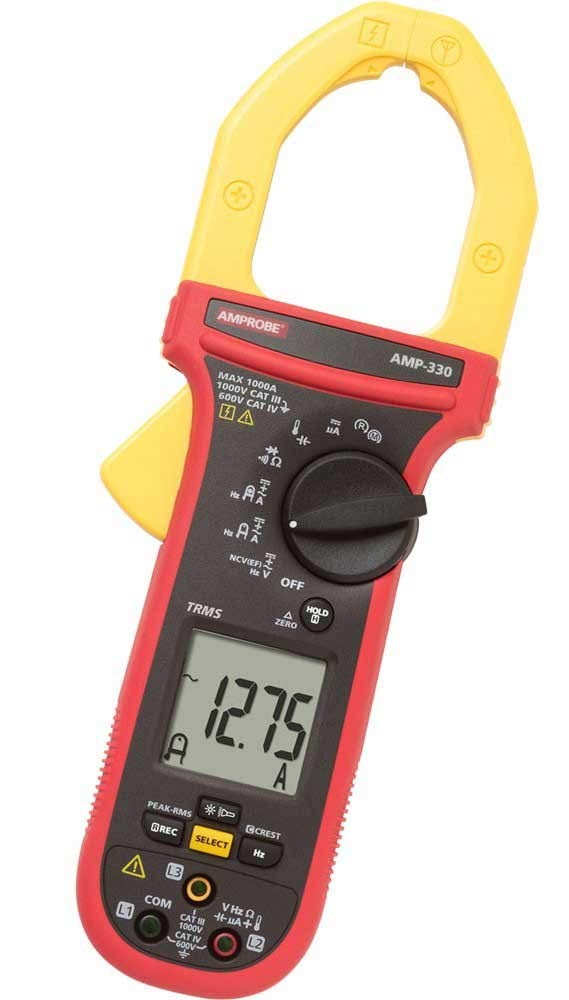


As an Amazon Associate, TestTalkHQ earns from qualifying purchases. All five cards are sourced only from the affiliate CSV. Catalog gaps flagged by name: no dual-element Class RK5/J motor fuse SKU and no listed combination motor controller / MCP SKU currently exist in the CSV — both are central to this decision and would round out the cluster.
No. The overload relay is always sized from nameplate FLA per 430.32, independent of whether the branch device is a breaker, fuse, or MCP. The OCPD only handles short-circuit and ground-fault.
Because the MCP provides no overload protection at all — it's instantaneous-only and legal only inside a listed combination controller where the overload relay handles running protection. The high setting exists to ride through inrush without an overload element.
Current-limiting dual-element fuses generally offer lower let-through energy and very high interrupting ratings, which helps downstream withstand and coordination. Verify with the Short-Circuit Current Calculator.
On a three-phase motor, one fuse can open while the other two stay closed, letting the motor run single-phased and overheat. Rely on the overload relay's phase-loss response or add a dedicated phase-loss relay.