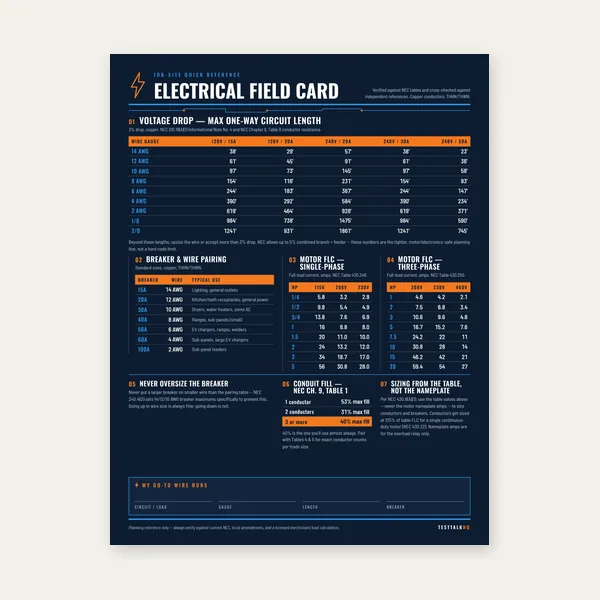
Electrical Reference Card
One page. Voltage drop lengths, breaker and wire pairing, motor FLC.
$3.99
BuyWhen the full-load amps number itself is wrong — wrong table, formula guesswork, service-factor amps, and voltage mix-ups — before it poisons every downstream sizing step
This page diagnoses how the FLA value goes wrong. Get the number from the Motor FLA Calculator and learn the method in How to Size Every Motor Circuit with NEC 430. Once the FLA is right, circuit-level failures (trips, hot conductors, overloads, disconnects) live on Motor Circuit Sizing Troubleshooting.

Every conductor, breaker, overload, and disconnect downstream inherits the FLA you started with. If the FLA is wrong, all four are wrong — and the calculator can't catch it, because it trusts the number you feed it. These are the field failures that live in the FLA value itself.
| Symptom | What it usually means | First fix | Next tool |
|---|---|---|---|
| FLA looks low vs a sister motor | Read single-phase Table 430.248 for a three-phase motor (or wrong voltage row) | Confirm phase; use 430.250 for 3φ, 430.248 for 1φ | Motor FLA Calculator |
| Your FLA is lower than the NEC table | HP×746 formula used with optimistic efficiency/PF instead of the table | Use Table FLA for sizing; formula is only a sanity check | NEC 430 Guide |
| Overload set high, motor cooks | Nameplate "max amps"/service-factor amps read as FLA | Use base nameplate FLA for overload, not SFA | Motor Circuit Calculator |
| FLA right on paper, wrong in panel | Nameplate FLA at 230V applied on a 208V system (or 460/480) | Match FLA to the actual system voltage | kW/kVA/Amps Troubleshooting |
| Clamp reads below FLA — is FLA wrong? | Motor at part load; measured amps ≠ full-load amps | Load the motor or use table/nameplate FLA, not idle amps | Motor FLA Calculator |
What it looks like: Your FLA is oddly low or high compared with a similar motor, and every downstream size looks off by roughly √3 or more. Someone pulled the number from the single-phase table (430.248) for a three-phase motor, grabbed a synchronous-motor row for an induction motor, or read the wrong voltage column.
Likely causes: NEC gives separate full-load current tables by machine type: 430.248 for single-phase AC motors, 430.250 for three-phase AC motors (and 430.247/430.249 for DC and synchronous). Three-phase FLA at the same HP and voltage is much lower than single-phase, so cross-reading the tables throws the whole circuit off. Reading the 200 V column for a 208 V motor, or 440/460/480 rows interchangeably without care, adds smaller but real errors.
Fixes: Confirm phase at the motor, then read the matching table and the correct voltage row. Re-run the Motor FLA Calculator with the right phase toggle. Remember these are design table values, not the specific motor's nameplate — they're intentionally standardized for sizing.
What it looks like: Your FLA is a few percent to 15% below the NEC table value, so the calculated conductor and OCPD come out one size small and the inspector or a sister install disagrees with you.
Likely causes: Deriving FLA from I = HP × 746 / (V × η × PF × √3) requires assumed efficiency and power factor. Optimistic η/PF guesses yield a current lower than reality. NEC 430.6(A)(1) is explicit: for general motor applications you size conductors and OCPD from the table values (430.248/430.250), not a calculated or nameplate current. The formula is a sanity check, not the design basis.
Fixes: Use the NEC table FLA for all sizing. Keep the formula only to flag gross data errors. Confirm with the NEC 430 guide, then feed the table FLA into the Motor Circuit Sizing Calculator.
What it looks like: The overload was set from the biggest current number on the nameplate, and the motor now runs hot without ever tripping the overload, or trips erratically. The number used was the service-factor amps (the current at the service-factor load), not the base full-load amps.
Likely causes: Nameplates often list both base FLA and a higher current at service factor (e.g., SF 1.15). SFA is the current when the motor is pushed into its service factor — it is not the value NEC 430.32 uses to set the overload. Using SFA (or a "max amps"/"MAX" figure) sets the overload window too high and defeats thermal protection. Multi-speed, part-winding, and dual-rated motors carry several FLAs; grabbing the wrong one has the same effect.
Fixes: Set the overload from the base nameplate FLA and apply the 430.32 multiplier (1.25 for SF ≥ 1.15 or a 40 °C-rise motor, otherwise 1.15). Reserve SFA for understanding the motor's short-term capability, not for protection. For multi-speed motors, protect each winding per its own FLA. Cross-check the overload target in the Motor Circuit Sizing Calculator, and see the circuit-side consequences on Motor Circuit Sizing Troubleshooting.
What it looks like: The FLA was correct for the nameplate voltage but the motor is on a different system — 230 V nameplate on a 208 V panel, or 460 V vs 480 V — and the running current is higher than expected, or the sizing comes out marginal.
Likely causes: A motor's current draw scales with the applied voltage for a given HP. A 230 V motor on a 208 V system draws proportionally more current and behaves differently than the 230 V FLA predicts. Nominal-vs-utilization voltage confusion (208/230/240 and 460/480) leads people to pick a table row that doesn't match the real service. Wye-delta and dual-voltage nameplates compound it when the wrong connection's FLA is used.
Fixes: Pick the FLA for the motor as connected to the actual system voltage. For a 230 V motor on 208 V, account for the higher current and confirm the motor is rated for that service. When the confusion is really about power units (kW vs kVA vs amps) or phase, work it on kW / kVA / Amps Troubleshooting.
What it looks like: A clamp meter on a lightly loaded motor reads well below the nameplate FLA, so someone "corrects" the FLA downward — then the circuit and overload end up undersized when the machine finally runs at full load.
Likely causes: Motors draw current in proportion to mechanical load. A pump or fan running against a throttled load, or a conveyor with no product on it, pulls far less than FLA. That measured value is the present operating current, not the full-load amps used for sizing. Using it to set overloads or size conductors leaves no margin for full-load or upset conditions.
Fixes: Size from table/nameplate FLA. Use measured amps to confirm the motor is not over FLA and to spot imbalance or single-phasing across the three legs — not to redefine FLA downward. If the measured current exceeds FLA at normal load, that's a real problem to chase (mechanical binding, voltage imbalance), not a reason to change the FLA.
Measured amps above FLA at normal load? Check voltage balance and the driven load before touching the circuit.
Circuit DiagThe recurring fork on every motor job is which FLA to use where. The short version: NEC Table FLA (430.248/430.250) sizes the circuit — conductor, OCPD, and disconnect — per 430.6(A)(1); nameplate FLA sizes the overload per 430.32. This decision is covered in depth by the NEC 430 guide's table sections and applied on the circuit-troubleshooting page, so rather than duplicate it here, use those:
NEC 430 Guide → Motor Circuit Troubleshooting → Breaker vs Fuse vs MCP →
One page. Voltage drop lengths, breaker and wire pairing, motor FLC.
$3.99
Buy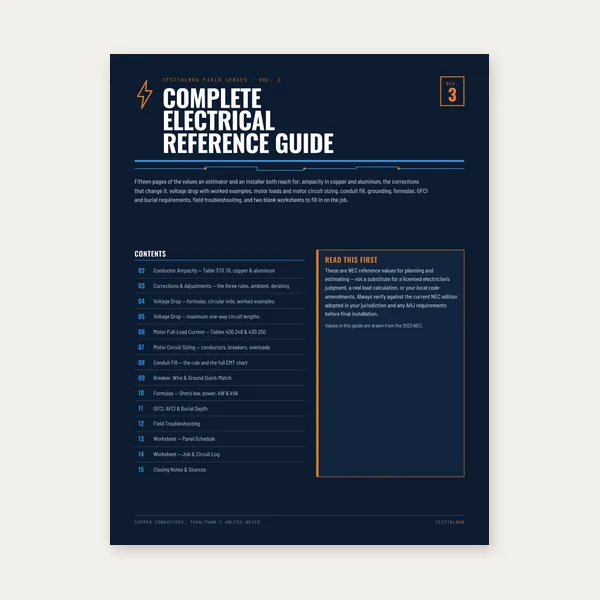
15 pages. Ampacity, corrections, voltage drop, motor circuits, conduit fill.
$12.99
Buy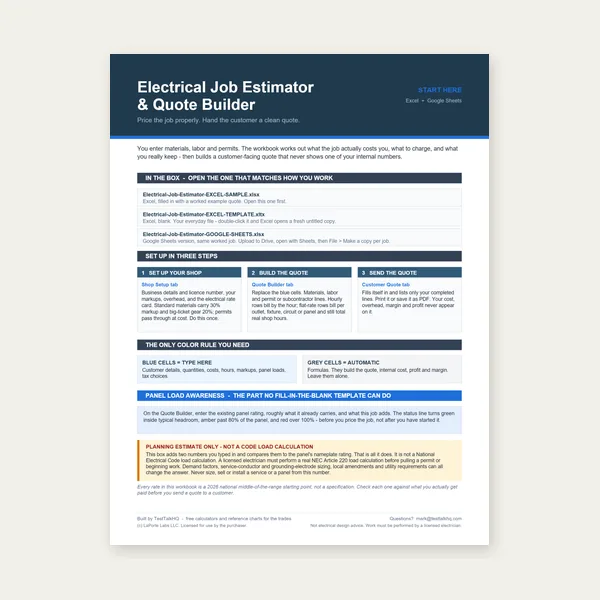
Quote electrical work and flag panel headroom before you price it.
Excel or Google Sheets. Best on a computer.
$29.00
Buy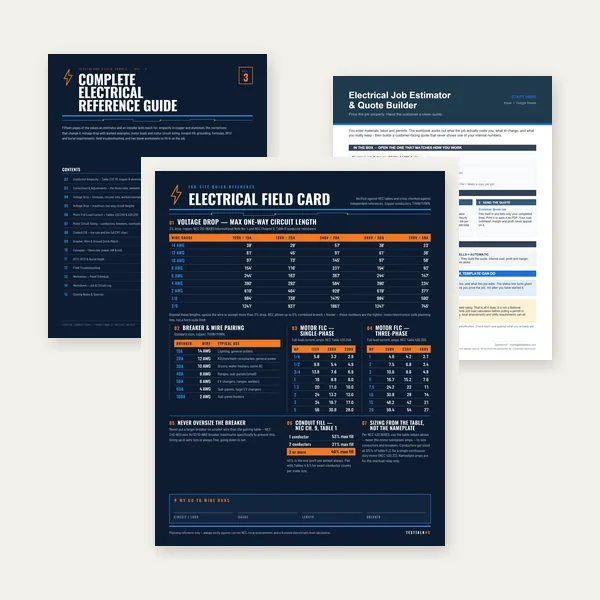
Card, 15-page guide and the estimator workbook. All six files.
Excel or Google Sheets. Best on a computer.
$34.99
$45.98 if bought separately — save $10.99
BuyCheckout opens in a new tab.
Five CSV catalog picks — measure running amps on each leg, confirm voltage, and check the value against the NEC table

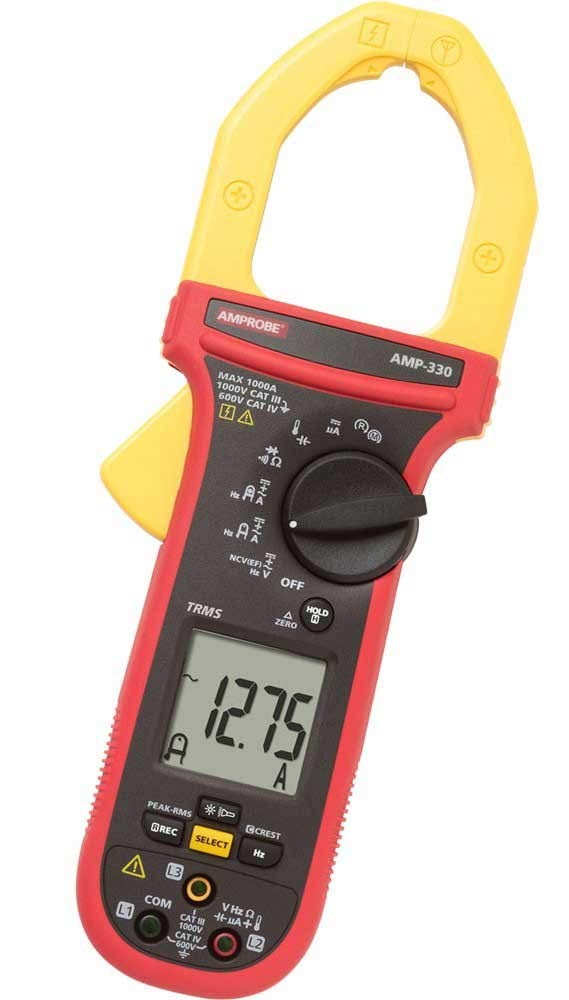

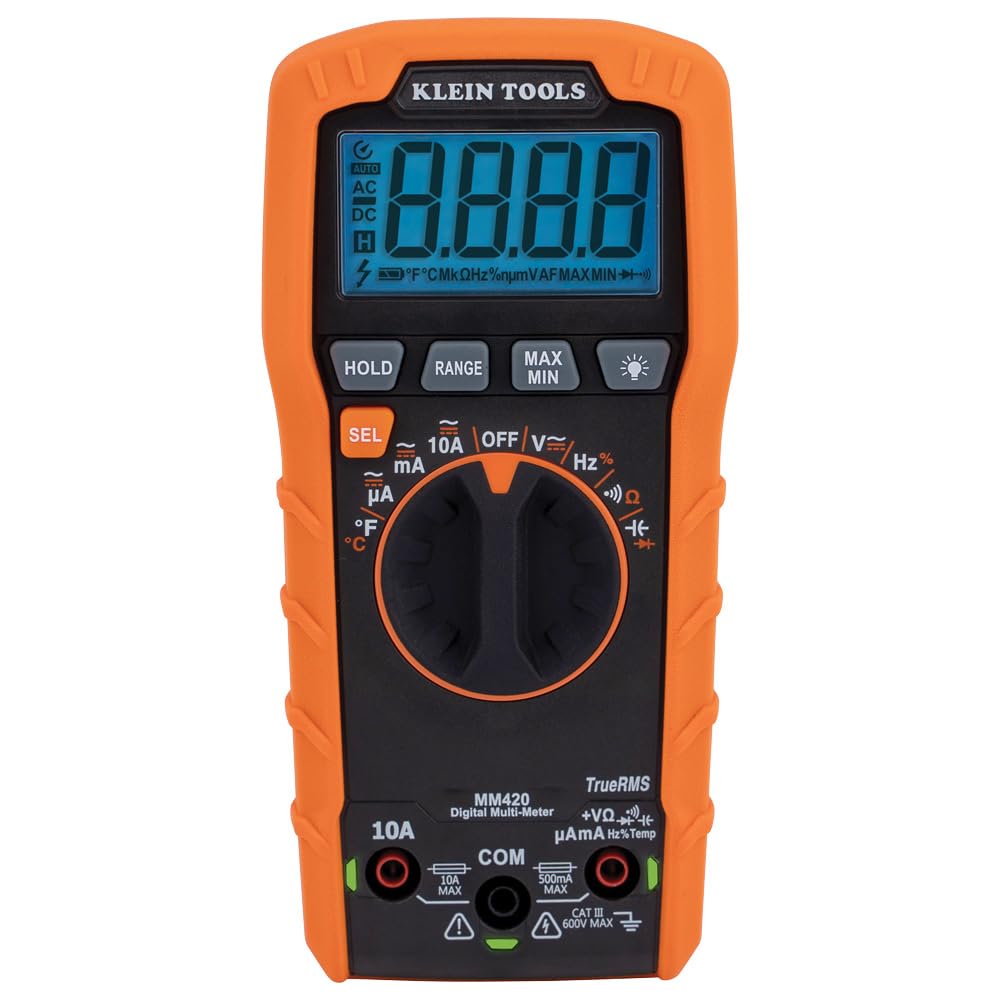

As an Amazon Associate, TestTalkHQ earns from qualifying purchases. All five cards are sourced only from the affiliate CSV. Catalog gap flagged by name: no motor/insulation resistance tester (megohmmeter) or dedicated motor rotation/phase tester SKU with a verified image currently exists in the CSV — either would strengthen FLA and motor-condition verification.
Generally no. NEC 430.6(A)(1) says size conductors and OCPD from the Table FLA (430.248/430.250). Nameplate FLA is used to set the overload relay (430.32). Two numbers, two jobs.
The HP×746 formula depends on assumed efficiency and power factor, which are usually optimistic. The NEC table values are standardized and typically higher, which is why the code requires them for sizing.
Base FLA is the full-load current at rated load. Service-factor amps (SFA) is the higher current when the motor runs into its service factor. Use base FLA for overload sizing, not SFA.
No. This page fixes the FLA value. Once FLA is correct, Motor Circuit Sizing Troubleshooting handles conductor, OCPD, overload, and disconnect failures.
No — a motor draws current in proportion to load. A light load reads below FLA. Size from table/nameplate FLA; use measured amps to check for over-FLA operation and imbalance.