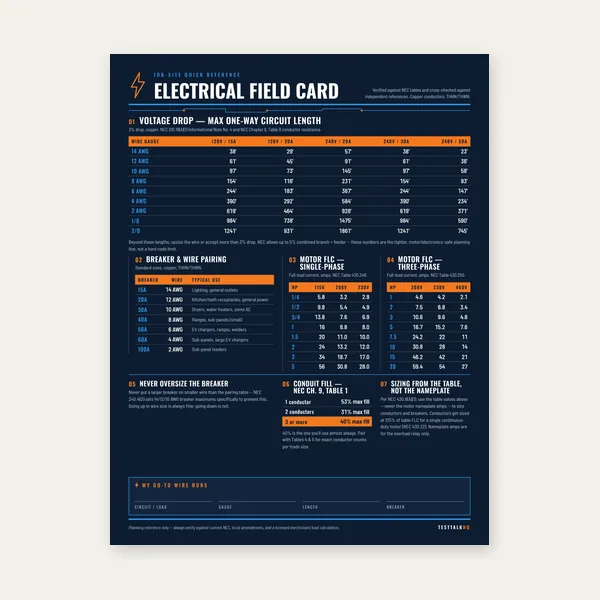
Electrical Reference Card
One page. Voltage drop lengths, breaker and wire pairing, motor FLC.
$3.99
BuyWhy the breaker trips on start, the overload nuisance-trips, the conductor runs hot, or the inspector red-tags the disconnect — after the NEC 430 math already checked out
This is field diagnosis, not a formula refresher. Run it when the Motor Circuit Sizing Calculator gave clean numbers but the installed circuit still misbehaves. For the full method (conductor at 125%, OCPD per 430.52, overload at nameplate, disconnect at 115%), use the Motor Circuit Sizing Guide. This page stays on what breaks and how to find it.

Use this when every number matched NEC 430 on paper but the installed branch circuit trips, overheats, or fails inspection. The most common root cause is mixing up which FLA drives which device — and skipping conductor derating after the 125% step.
| Symptom | What it usually means | First fix | Next tool |
|---|---|---|---|
| Breaker/fuse trips on almost every start | OCPD sized like a general circuit (125%) instead of NEC 430.52 (up to 250%) | Re-size OCPD on Table FLA × 430.52 %; step up to next standard size | Motor Circuit Sizing Calculator |
| Overload relay trips after minutes of running | Overload set from Table FLA, not nameplate FLA; or SF multiplier wrong | Reset overload to nameplate FLA × 1.15/1.25 per 430.32 | Motor FLA Calculator |
| Conductor or lug runs hot, insulation discolored | 310.15 derating skipped after 430.22; or 60°C termination column ignored | Re-check ampacity with fill/ambient + termination temp | Wire Ampacity & Derating Calculator |
| Numbers don't match the inspector's | Nameplate/measured amps used for conductor & OCPD instead of Table FLA | Use Table 430.248/430.250 FLA for circuit; nameplate only for overload | Motor FLA Calculator |
| Motor bogs/low voltage on long run, amps normal | Voltage drop, not ampacity — conductor "big enough" but run too long | Check VD at starting and running current; upsize for distance | Voltage Drop Troubleshooting |
| Inspector red-tags the disconnect | General-use switch used; no HP rating; not within sight of motor | Install motor-rated disconnect, HP + amp rated, per 430.102/430.110 | Motor Circuit Sizing Guide |
What it looks like: The motor tries to start, you hear it grunt, and the branch breaker trips instantly or within the first second — every time, or intermittently on a warm restart. Steady-state running current is well within the conductor's rating. Someone "protected the wire" with a breaker at 125% of FLA like a receptacle circuit.
Likely causes: Motor inrush (locked-rotor current) is typically 6–8× FLA for a fraction of a second to a few seconds. NEC 430.52 exists precisely because a general 125% OCPD cannot ride through that surge. An inverse-time breaker is permitted up to 250% of Table FLA (dual-element time-delay fuse 175%, non-time-delay fuse 300%, MCP up to 800%). Sizing the branch OCPD at 125% guarantees start trips. Second cause: the calculated value wasn't rounded up to the next standard size per 430.52(C)(1) Exception, so a borderline device trips on a hot restart or a stiff belt load.
Fixes: Re-size the OCPD from the Table FLA (Tables 430.248/430.250), not nameplate amps, using the correct 430.52 multiplier for your device type. If the first standard size below the calculated max still trips on start, 430.52(C)(1) Exception 1 lets you go up to the next standard size (and Exception 2 gives higher ceilings for hard-starting loads). Remember the OCPD only covers short-circuit and ground-fault here — sustained overload is the overload relay's job, so a "large" breaker is correct, not dangerous. Re-run it in the Motor Circuit Sizing Calculator with the right OCPD type.
What it looks like: Starts are fine, but the overload relay drops out after several minutes of normal running — or, the opposite, the motor cooks and the overload never opens. The heater/dial was set from the NEC Table FLA, or from the branch breaker size, instead of the actual motor nameplate FLA.
Likely causes: NEC 430.32 sizes the overload on the motor's nameplate FLA (× 1.25 for SF ≥ 1.15 or a 40 °C-rise motor; × 1.15 otherwise), because the overload must model the specific motor's thermal reality — not a standardized table value. Using Table FLA (which is deliberately conservative and often higher than nameplate) sets the overload too high and it never protects; using the branch breaker size is wildly too high. Nuisance trips come the other way: overload set below nameplate, controller mounted in a hot enclosure or high-ambient location without temperature compensation, or a solid-state overload with the wrong class (Class 10 on a high-inertia load that needs Class 20/30).
Fixes: Set the overload from the nameplate FLA and service factor, verified with the Motor FLA Calculator. Confirm the trip class matches the load's acceleration time. If the controller sits in a hot room, use ambient-compensated overloads or the manufacturer's temperature correction. Clamp the actual running current on all three legs — a single leg reading high points to voltage imbalance or single-phasing, not an overload setting problem.
What it looks like: The circuit passes on paper, but the conductor insulation is discolored, a lug is browned, or a thermal camera shows the run climbing well above ambient at normal load. The conductor was picked to meet 125% of FLA — and nothing after that.
Likely causes: NEC 430.22 sets the minimum conductor ampacity at 125% of Table FLA, but that is the starting point, not the final size. If four or more current-carrying conductors share the raceway, or ambient exceeds 30 °C, the 310.15(C) adjustment and correction factors reduce usable ampacity — often below the 430.22 minimum. Second cause: terminations. Per 110.14(C), the circuit ampacity is limited by the lowest-rated termination — commonly 60 °C on equipment ≤100 A. Sizing to the 75 °C column while landing on 60 °C-rated lugs overloads the connection even when the copper is technically big enough. Loose or un-torqued lugs and missing anti-oxidant on aluminum add resistance and heat.
Fixes: After the 430.22 minimum, apply 310.15 fill and ambient derating and re-confirm the conductor still meets the minimum — bump size if it doesn't. Match the ampacity column to the actual termination temperature rating (110.14(C)). Torque every lug to spec and use an anti-oxidant compound on aluminum terminations. Verify with the Wire Ampacity & Derating Calculator.
Long conductor run and the motor still bogs? If amps are normal but voltage sags at the motor, it's voltage drop, not ampacity.
Voltage Drop DiagWhat it looks like: The plan review or AHJ flags your conductor and breaker as undersized, even though your calc "used the motor's amps." You sized the branch circuit from the nameplate FLA or a clamp-meter reading instead of the NEC Table FLA.
Likely causes: NEC 430.6(A)(1) requires that conductor sizing, OCPD, and ampacity be based on the values in Tables 430.248 (single-phase) and 430.250 (three-phase) — not the nameplate current — for general motor applications. Table FLA is usually higher than nameplate, so building the circuit from nameplate amps yields conductors and OCPD that are legitimately too small. The mirror-image error is picking the wrong table (using 430.248 single-phase values on a three-phase motor, or reading the wrong voltage row), which throws every downstream number off.
Fixes: Size conductor, OCPD, and disconnect from the correct Table FLA for the motor's phase and voltage; reserve nameplate FLA for the overload only. Confirm the FLA you're pulling with the Motor FLA Calculator, and if the FLA value itself is in question (HP-to-amps, code letters, service-factor amps, efficiency), work the Motor FLA Troubleshooting page — that's where FLA-determination failures live. This page assumes the FLA is known and focuses on how it's applied to the circuit.
What it looks like: The disconnect ampere rating meets the 115% figure from the calculator, but it still fails inspection — or worse, arcs and welds when someone opens it under load. A general-use snap switch, AC-rated toggle, or an ampere-only rated switch was installed.
Likely causes: NEC 430.110 requires the disconnecting means to carry an ampere rating of at least 115% of Table FLA and an HP rating at the operating voltage equal to or greater than the motor. A device with only an ampere rating cannot safely interrupt locked-rotor current; it lacks the tested interrupting capability for motor loads. Related red-tags: the disconnect isn't within sight of the motor and controller (430.102(B)) with no compliant lockable provision, or a single motor-circuit switch is shared across multiple motors without meeting the grouping rules.
Fixes: Use a disconnect listed for motor service with both an adequate ampere rating and an HP rating at the system voltage — a horsepower-rated safety switch, molded-case switch, or listed manual motor controller. Place it within sight of the motor/driven machinery, or provide a lockable disconnect where the code allows out-of-sight with lockout. Confirm the 115% ampere minimum in the Motor Circuit Sizing Calculator, then verify the HP rating on the device label.
Which OCPD you choose changes the trip behavior, the coordination, and the single-phasing protection of the whole motor branch. There is a genuine fork here — see the companion decision piece for the trade-offs (nuisance-trip margin, backup overload protection, replaceability, and when an MCP is only legal inside a listed combination controller). For determining the FLA that feeds all of this, use the calculator and guide.
Breaker vs Fuse vs MCP → Motor Circuit Sizing Calculator → Motor Circuit Sizing Guide →
One page. Voltage drop lengths, breaker and wire pairing, motor FLC.
$3.99
Buy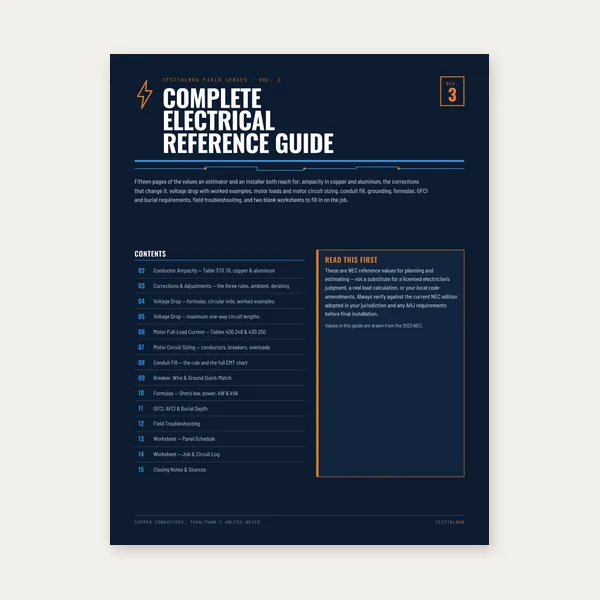
15 pages. Ampacity, corrections, voltage drop, motor circuits, conduit fill.
$12.99
Buy
Quote electrical work and flag panel headroom before you price it.
Excel or Google Sheets. Best on a computer.
$29.00
Buy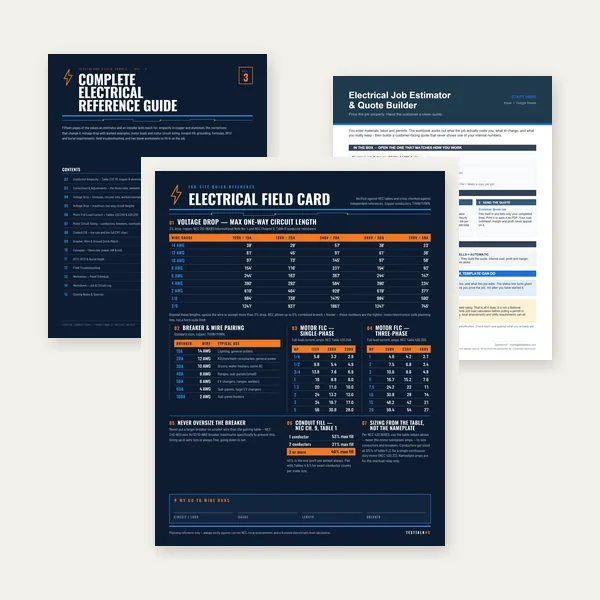
Card, 15-page guide and the estimator workbook. All six files.
Excel or Google Sheets. Best on a computer.
$34.99
$45.98 if bought separately — save $10.99
BuyCheckout opens in a new tab.
Five CSV catalog picks — capture inrush, confirm running amps against FLA, verify voltage, and land terminations that won't overheat
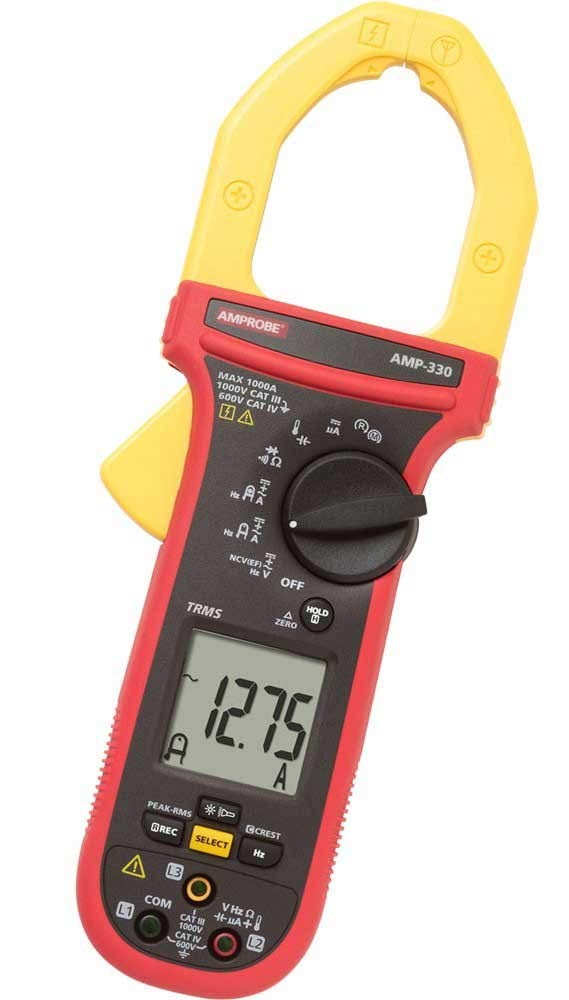


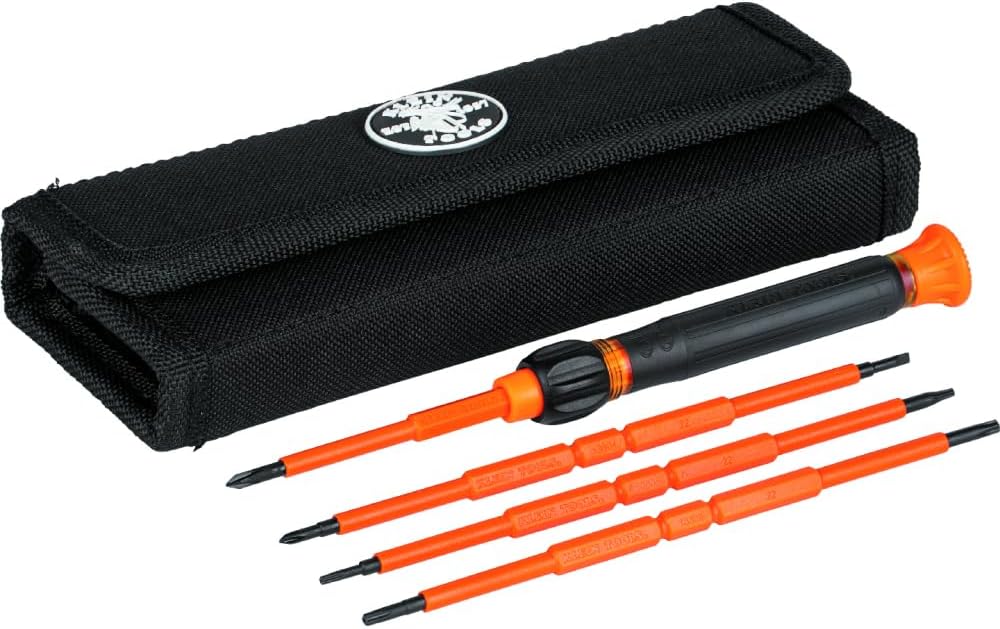

As an Amazon Associate, TestTalkHQ earns from qualifying purchases. All five cards are sourced only from the affiliate CSV. Catalog gaps flagged by name: no calibrated terminal-torque screwdriver SKU (for 110.14(C) lug torque) and no motor overload relay / HP-rated safety-switch SKU currently exist in the CSV — both would strengthen this cluster.
Almost always the OCPD was sized like a general 125% circuit instead of per NEC 430.52 (up to 250% for an inverse-time breaker), or it wasn't stepped up to the next standard size. Motor inrush is 6–8× FLA and needs that headroom; the overload relay handles running overload.
On a motor branch circuit the OCPD only provides short-circuit and ground-fault protection. Overload protection for the conductor and motor comes from the separately sized overload relay (430.32). Both are required; the "oversized" breaker is intentional.
Nameplate FLA, per 430.32. Table FLA (430.248/430.250) sizes the conductor, OCPD, and disconnect. Using Table FLA for the overload usually sets it too high to protect the motor.
No. This page diagnoses circuit failures — conductor, OCPD, overload setting, and disconnect. The Motor FLA troubleshooting covers determining the FLA value itself (HP-to-amps, code letters, service factor amps, efficiency, table selection).
Apply 310.15 derating for conduit fill and ambient after the 430.22 minimum, and match the ampacity column to your termination temperature rating (110.14(C)). If the derated ampacity drops below the 430.22 minimum, increase the conductor size.