AWS D1.1–style groove defaults and minimum fillet leg sizes from the weld joint design calculator and guide.
How to Use This Chart
Fillet throat ≈ 0.707 × leg. Use the larger of code minimum and calculated required throat. Calculator: weld joint design calculator. Guide: weld joint design guide.
Why AWS D1.1 Groove Defaults Look the Way They Do
The groove table is in the spirit of AWS D1.1 prequalified joint details (the “Table 3.3 style” note): angles, root openings, and root faces that have a long history of producing complete fusion when welded with the matching process and WPS limits. A 60° included single-V with about ¼″ opening and ⅛″ face is a compromise. Narrower included angles save weld metal but make it harder to get the electrode to the root and easier to leave slag or lack of fusion on the bevel walls. Wider angles are easy to weld and expensive in filler and distortion. The 45–75° band on the single-V row is the qualified window, not an invitation to pick 45° on thick plate because it “uses less wire.”
Square-groove (butt, no bevel) is limited to thin material — this chart’s “opening equal to t, t ≤ 3/16″” — because there is no prepared wall to fuse against once the gap is filled. Double-V and double-bevel exist to cut the weld volume roughly in half on thick plate and to balance shrinkage from both sides. U- and J-grooves cost machining time and pay it back in filler on heavy members; the tight 20° U included angle only works if the machined radius is actually there. If you flame-cut a sloppy V and call it a U, you have neither the access nor the volume the table assumed.
These numbers are prequalified geometry, not a strength calc. Required throat still comes from load, length, and allowable stress. Pair this page with the fillet weld strength chart when the joint is a fillet, and with an engineer when the joint is a CJP groove carrying primary tension.
When a Fillet Is Chosen Over a Groove
Fillets win when you can use a T, lap, or corner and the required throat is small compared with plate thickness: clips, stiffeners, brackets, light shear connections, and a lot of shop fabrication. They need little joint prep (mill scale off, gap controlled), they are fast, and D1.1 publishes minimum legs so you do not put a 1/8″ fillet on ¾″ plate and call it done. Grooves win when you need the full thickness of the plate to carry load (complete joint penetration), when a fillet would be huge (a ¾″ fillet is a lot of metal compared with a modest single-bevel CJP), or when fatigue and inspection requirements want a flush, fused joint.
Partial-joint-penetration (PJP) grooves sit in the middle: some prepared depth, some unfused land. They are not “a fillet on a bevel.” Effective throat is defined by the prep, not by 0.707 × leg. If you are looking at this chart’s fillet minimums and wondering whether to bevel instead, the question is usually load path and inspection, not which table is easier to read. The calculator will size volume either way; it will not tell you which joint the drawing should have used.
Fit-Up Tolerance Is Part of the Joint
Root opening and root face in the table assume the parts actually arrive that way. A ¼″ opening that opens to ⅜″ because of camber or a bad cut changes the root pass from “fill the gap” to “bridge a hole.” Extra gap means more weld metal, more heat, more distortion, and a real chance of burn-through or a sunk root. A closed-up V with no opening is the opposite defect: lack of penetration that still looks fine from the cap. AWS D1.1 allows specified as-fit tolerances; treating the chart’s ¼″ as “somewhere between 0 and ½″” is how production welds fail UT.
Fillet fit-up is a gap at the root of the T. A gap eats effective throat: the 0.707 × leg formula assumes the legs meet the surfaces with no root opening. A 1/16″ gap on a 3/16″ fillet is a large fraction of the throat. Either close the gap, increase the weld size, or change the joint. The minimum-leg table does not add extra size for sloppy fit-up — you have to.
Distortion Implications of Joint Type
Weld metal shrinks as it cools. A single-V on thick plate puts all of that shrinkage on one side and will rotate the joint (angular distortion) unless you restrain it or back-gouge and weld the other side. Double-V balances that if the two sides are sequenced, not if you dump all the metal on the first side “because it was faster.” Fillets on a T-joint pull the stem; long, thin plates with a continuous fillet on one side become banana-shaped. Intermittent fillets, back-stepping, and balanced welds are process controls this geometry chart cannot show.
More included angle and more root opening mean more weld metal mean more shrinkage. That is a reason not to over-bevel “for access” on a member that cannot be straightened. If distortion is already the failure mode on the job, stop adding weld size from the fillet-minimum table “for extra strength” and talk to the designer about a smaller weld, a different joint, or a machining/prep change. Strength calcs belong on the fillet-strength page; this page is the shape of the joint, not a license to overweld.
Groove Defaults (AWS D1.1 Table 3.3 style)
| Groove | Angle | Root opening | Root face |
|---|---|---|---|
| Square groove | — | Equal to t (t ≤ 3/16″) | — |
| Single V | 60° (45–75°) | 1/4″ | 1/8″ |
| Double V | 60° each side | 0–1/8″ | 1/8″ |
| Single bevel | 45° (30–60°) | 1/4″ | 1/8″ |
| Double bevel | 45° each side | 0–1/8″ | 1/8″ |
| Single U | 20° (10–30°) | 0 | 1/8″ |
| Single J | 45° typ. | 1/8″ | 1/8″ |
Minimum Fillet Leg (thicker part)
Throat = 0.707 × leg for equal-leg fillet.
| Base metal thickness | Min fillet leg |
|---|---|
| To 1/4″ inclusive | 1/8″ |
| Over 1/4″ to 1/2″ | 3/16″ |
| Over 1/2″ to 3/4″ | 1/4″ |
| Over 3/4″ | 5/16″ |
These minima are about cooling rate and fusion into thick plate, not about matching the load. A 5/16″ minimum on thick material can still be far below what the strength calc requires — and a light clip on 1″ plate still should not get a 1/8″ fillet just because the load is small.
Groove depth, throat, and filler volume
WeldKit — Welding Calculators Offline
MIG, TIG, Stick, speeds/feeds, and more on Android.
Related Calculators & Guides
Welding
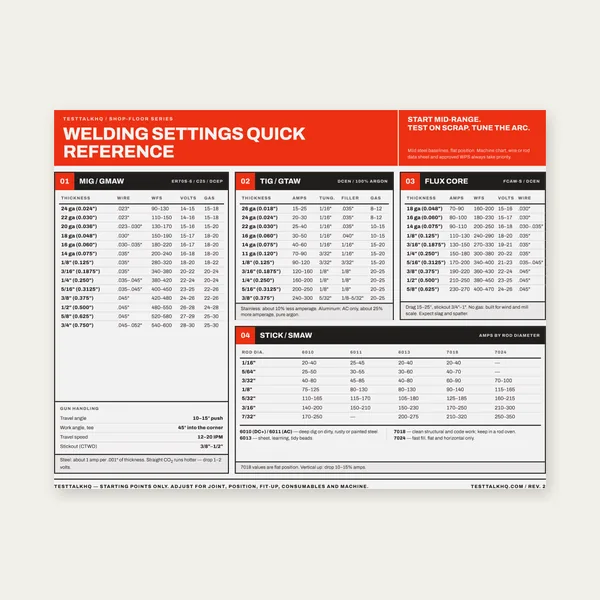
Welding Reference Card
One page. MIG, TIG, stick and flux core settings by thickness.
$3.99
Buy
Complete Welding Settings Guide
19 pages. Four processes, stainless and aluminum, symbols and inspection.
$12.99
Buy
Welding Job Estimator
Price the job, then hand over a quote with no internal numbers.
Excel or Google Sheets. Best on a computer.
$29.00
Buy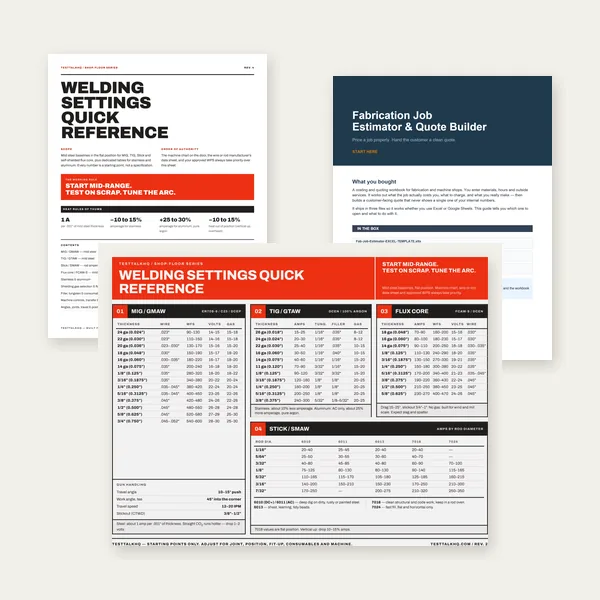
Welding Complete Bundle
Card, 19-page guide and the estimator workbook. All six files.
Excel or Google Sheets. Best on a computer.
$34.99
$45.98 if bought separately — save $10.99
BuyCheckout opens in a new tab.