Branch-circuit voltage drop and extension-cord voltage drop are related but not the same job. Cord runs are temporary, round-trip, and often undersized for welders and tools — this guide is for that problem.
Why Extension Cords Are Different
Permanent branch circuits are sized with NEC Chapter 3 conductors, ambient correction, and continuous-load rules. An extension cord is a portable assembly: copper conductors in a flexible jacket, often smaller than the breaker feeding the receptacle, and always carrying current out and back through the same cable length.
That last point matters. If you lay out 100 feet of cord between the receptacle and the tool, the conductor length in the voltage-drop formula is 200 feet (out and return). Using one-way distance understates drop by roughly half and is a common field mistake.
Always use 2 × one-way cord length in the voltage-drop calculation. A 50 ft cord to a welder is a 100 ft conductor path for VD math.
The Cord Voltage Drop Formula
For single-phase (typical cord loads):
VD = (2 × L × I × R) / 1000
Where L is one-way length in feet, I is load amps, and R is ohms per 1,000 ft for the AWG (copper). Percent drop is (VD / V) × 100. Shop extension cords feeding 120/240V tools are almost always treated as single-phase round-trip.
Typical copper resistance values used for planning (approximate Ω/kft): 16 AWG ≈ 4.99, 14 AWG ≈ 3.14, 12 AWG ≈ 1.98, 10 AWG ≈ 1.24, 8 AWG ≈ 0.778, 6 AWG ≈ 0.491. Cord manufacturers publish exact values — use them when available.
3% and 5% Limits — What They Mean for Cords
NEC Informational Notes discuss 3% branch and 5% feeder-plus-branch as design targets for reasonable operation — they are not hard code limits for every temporary cord. In practice:
- ~3% or less — preferred for motors, compressors, and anything that must start under load.
- ~5% — common ceiling for lighting and general tools before heat, torque loss, and nuisance trips become likely.
- Above 5% — expect soft starts, overheating at connections, and welders that refuse to hold arc voltage at the machine.
At 120V, 3% is only 3.6V; at 240V, 3% is 7.2V. Low-voltage tools feel cord drop first.
Voltage drop does not replace ampacity. A cord must also be rated for continuous load current. Thin long cords can pass VD math for a short duty cycle and still overheat.
Welder Cords and High Inrush Tools
Stick and MIG machines often draw high primary current, especially on 120V units. A 15A nameplate welder on a 14 AWG 100 ft cord can lose enough voltage that the arc becomes unstable even though the breaker holds. Prefer:
- Shorter runs — move the receptacle or use a closer temporary distribution point.
- Heavier AWG — 10 AWG or 8 AWG for long welder feeds when ampacity allows.
- 240V when available — same watts at half the amps halves I×R loss for the same cable.
For permanent welding cable sizing (electrode/work leads), use the wire gauge calculator for welders — that is secondary cable, not SOOW extension cord, but the voltage-at-the-arc problem is the same idea.
Quick Field Checks
Run the numbers for your cord Enter length, AWG, volts, and load amps — get volts dropped and percent drop for round-trip cord runs.
Frequently Asked Questions
Do I double the length for voltage drop on extension cords?
Yes. Current flows to the load and back through the same cord length, so use 2 × one-way feet in the single-phase formula.
Is 12 AWG always enough for a 15A tool at 100 feet?
Often no at 120V. Check percent drop for the actual amps — many 12–15A tools exceed 5% on a 100 ft 12 AWG cord.
How is this different from the branch-circuit voltage drop calculator?
Branch-circuit tools model fixed wiring and feeders. This guide and calculator focus on portable cord round-trip sizing for tools and welders.
VoltKit — Electrical Calculators Offline
Voltage drop, wire gauge, breaker sizing, and more. Free on Android. Works without signal.
Related Calculators & Guides
Electrical
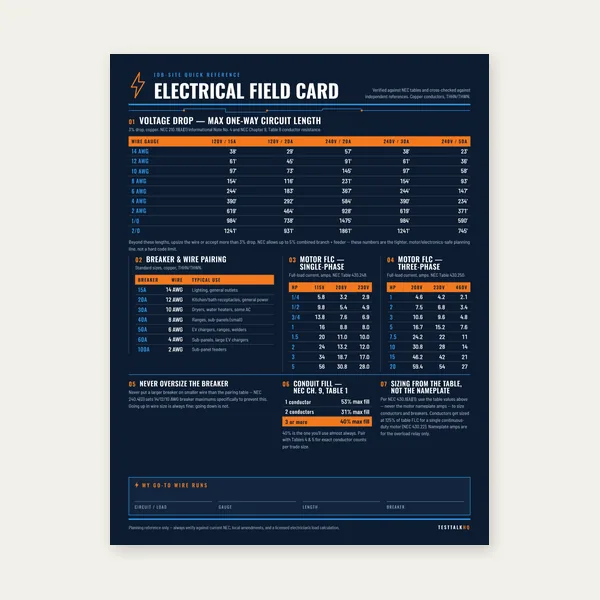
Electrical Reference Card
One page. Voltage drop lengths, breaker and wire pairing, motor FLC.
$3.99
Buy
Complete Electrical Reference Guide
15 pages. Ampacity, corrections, voltage drop, motor circuits, conduit fill.
$12.99
Buy
Electrical Job Estimator
Quote electrical work and flag panel headroom before you price it.
Excel or Google Sheets. Best on a computer.
$29.00
Buy
Electrical Complete Bundle
Card, 15-page guide and the estimator workbook. All six files.
Excel or Google Sheets. Best on a computer.
$34.99
$45.98 if bought separately — save $10.99
BuyCheckout opens in a new tab.