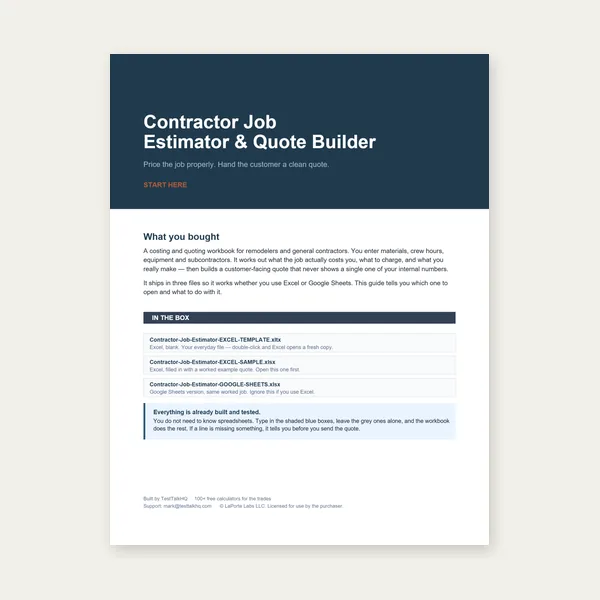
Contractor Job Estimator
Price remodels and GC work, then send a quote with no internal numbers.
Excel or Google Sheets. Best on a computer.
$29.00
BuyClamping force, lubrication corrections, torque sequences, and the mistakes that strip threads and blow gaskets.
Torque is not tightness — it is a proxy for bolt preload, the clamping force that holds a joint together. Get the friction wrong, skip the sequence, or reuse a torque-to-yield fastener and the spec on paper means nothing in the field.
When you apply torque to a fastener, roughly 85–90% of the input energy goes to overcoming thread and under-head friction. Only 10–15% actually stretches the bolt and produces clamping force (preload). That is why torque is an indirect measurement — it estimates preload based on assumed friction conditions, not measures it directly.
Tight does not mean correct. A bolt can feel wrench-tight with almost no preload if threads are galled, washers are binding, or you are fighting prevailing torque on a nyloc nut. Conversely, a properly torqued joint can feel less aggressive than an overtightened dry joint because the clamping force is distributed correctly across the gasket or faying surfaces.
For critical joints — cylinder heads, structural connections, pressure flanges — the goal is repeatable preload within the bolt's elastic range. Torque is the practical field method to get there when you account for lubrication, sequence, and fastener type. When absolute preload matters, engineers specify direct tension methods (stretch bolts, hydraulic tensioners) or angle-of-turn after a snug torque. For everything else in the shop, a calibrated click wrench and the right correction factors get you where you need to be.
Published torque specs almost always state a friction condition. Automotive and industrial tables typically assume dry, clean, unplated threads unless noted otherwise. If you lubricate threads and apply the dry spec, you over-clamp. If you run dry when the spec assumes oil or assembly lube, you under-clamp.
Dry torque: Higher friction, more torque required for a given preload. Standard for many structural specs when threads are clean and free of oil. Galvanized and plated fasteners can behave differently from plain black oxide — friction varies with coating.
Oiled or assembly lube: Reduces friction 15–25%. Required torque drops proportionally. Engine assembly lube (moly-based) is common on rod and main bolts where the OEM spec is written for that condition.
Anti-seize: Reduces friction more aggressively — typically reduce dry torque by 20–30%. Critical on stainless-to-stainless and exhaust hardware where galling is a risk. Never apply dry spec to anti-seized threads.
Thread locker (anaerobic): Acts as a lubricant during assembly, then cures and adds resistance to loosening. Many specs call for a reduced torque when using Loctite; follow the product and OEM guidance — blue (242) and red (271) behave differently.
| Thread condition | Typical adjustment vs. dry spec | Notes |
|---|---|---|
| Dry, clean threads | Baseline (100%) | Default for most published charts |
| Light machine oil | 75–85% | Common on engine fasteners |
| Anti-seize compound | 70–80% | Never skip reduction on stainless |
| Moly assembly paste | 70–80% | OEM rod/main bolt specs often assume moly |
| Thread locker (wet) | 75–90% | Check Loctite and OEM tables |
Use the Bolt Torque Calculator to look up grade and size, then apply lubrication factors automatically. Cross-check against the Bolt Torque Specifications Chart for full metric and SAE reference values.
Anti-seize (copper, nickel, or graphite-based) prevents galling on stainless, titanium, and aluminum-threaded joints and makes future disassembly possible on exhaust manifolds, turbo hardware, and chemical-process flanges. The trade-off is dramatically lower friction — the same wrench click produces significantly higher preload.
Rule of thumb: Reduce dry torque by 25% when both threads are coated with standard copper anti-seize. Some manufacturers specify 20%, others 30% — when a service manual gives a number, use it. When it does not, 25% reduction is a conservative starting point for non-critical work; verify on critical joints against engineering data.
Apply a thin, even coat to threads only — not so much that it squeezes into the joint face and contaminates a gasket surface. On stainless fasteners, anti-seize is nearly mandatory; without it, you risk tearing threads on the first install. On hardened Grade 8 or Class 10.9 bolts in carbon steel, anti-seize is optional unless the environment demands corrosion protection.
Torque sequence distributes clamp load evenly across a flange, head, or wheel hub. Tightening bolts in a random clockwise circle loads one side of the joint first, warps the part, and leaves the far side under-clamped even when every bolt clicks at spec.
Star or cross pattern: Standard for 4-, 6-, and 8-bolt patterns (wheels, flanges, covers). Jump across the pattern, not around the circle. For a 4-bolt square: 1 → 3 → 2 → 4 (or equivalent diagonal pairs).
Spiral from center: Common on multi-bolt cylinder heads and large flanges. Start at the center (or center pair) and work outward in stages so the gasket seats progressively.
Multi-stage tightening: Critical joints use 2–4 stages — e.g., 30% → 60% → 100% of final torque, or a snug torque followed by a final pass. Staged tightening lets the gasket compress and the joint settle before final preload. Skipping stages is how you get false torque readings on soft gaskets.
Final pass: After the first full torque cycle, make one more pass at final torque in sequence. Bolts relax slightly as the joint settles; the follow-up pass catches any that dropped preload.
Torque-to-yield bolts are designed to stretch into the plastic region slightly during final tightening. That stretch produces very high, consistent clamping force on gaskets that would otherwise leak if clamp load varied bolt to bolt. TTY fasteners are common on modern engine cylinder heads, some connecting rods, and suspension components.
Identification: Service manuals specify TTY explicitly or describe a procedure with an initial torque plus angle-of-turn (e.g., "torque to 22 ft-lb plus 90°"). Any angle-after-torque procedure on head bolts is almost certainly TTY. TTY bolts are often longer and slimmer than standard grade equivalents for the same application.
Never reuse TTY fasteners. After the first cycle they have reduced ductility and unpredictable clamp load on the second install. The cost of new bolts is trivial against a blown head gasket or rod failure.
TTY procedure: Clean threads and block, verify correct length, apply specified lube, torque to the initial value in sequence, then add the specified angle with a degree wheel or angle socket — not by guessing flats. Substituting a click-torque-only procedure on a TTY joint is a common failure mode.
Using dry spec on lubricated threads: Over-clamping, stripped threads, cracked castings, blown head gaskets, warped flanges. Always match the spec to the actual thread condition.
No torque sequence: Uneven gasket load, leaks, warped covers, broken exhaust flanges. Always follow star, cross, or spiral patterns from the manual.
Impact gun for final torque: Inconsistent preload, stretched threads, cracked wheels. Run fasteners down with an impact if you must, then finish with a calibrated torque wrench.
Reusing TTY or stretched bolts: Unpredictable clamp load, joint failure miles later. Replace when the manual says replace.
Wrong wrench range: Torquing a 15 ft-lb spec with a 50–250 ft-lb wrench loses accuracy at the bottom of the scale. Use a wrench whose range includes your target in the middle third of the scale — inch-pound wrenches for small fasteners.
Ignoring prevailing torque: Nyloc and stiff nuts consume torque before clamping. Measure running torque and add it to the spec, or use a spec written as "torque after seating."
Dirty or damaged threads: Rust, paint, and burrs change friction and produce false preload. Chase threads, clean with solvent, and inspect for pull-out or cross-threading before torquing.
Torque whichever element rotates during tightening. On a through-bolt with a nut, torque the nut if the bolt head is held stationary. If the bolt head turns and the nut is fixed, torque the head. Friction under the rotating element's bearing surface is part of the torque calculation — reversing roles changes friction and preload.
Yes: Nm = ft-lb × 1.356. Metric tables are often published in Nm; SAE in ft-lb. Use the system that matches your wrench scale, but verify grade and size against the correct table — metric Class 8.8 is not interchangeable with SAE Grade 5 by size alone.
Snug means all fasteners contact the joint with zero gap — washers seated, gasket compressed lightly — with no meaningful preload yet. For soft gaskets, snug by hand plus a short wrench pull is typical. OEM angle-torque procedures assume a defined snug torque (often 15–30% of final) before the angle step begins.
Most click wrenches are reversible and work on left-hand threads when set to the CCW direction. Verify your wrench is rated for both directions; some older designs are CW-only. The torque value does not change for left-hand threads — only the rotation direction.
Price remodels and GC work, then send a quote with no internal numbers.
Excel or Google Sheets. Best on a computer.
$29.00
BuyCheckout opens in a new tab.
Calibrated torque wrenches and anti-seize for fasteners where spec matters

A calibrated click-type torque wrench is non-negotiable for fastener work where spec matters. The CDI 2503MFRPH covers the range used for most structural and engine fasteners — from cylinder head bolts to suspension components. Dual-direction ratchet, clear scale markings, and a reputation for accuracy that holds up over time.
Check Price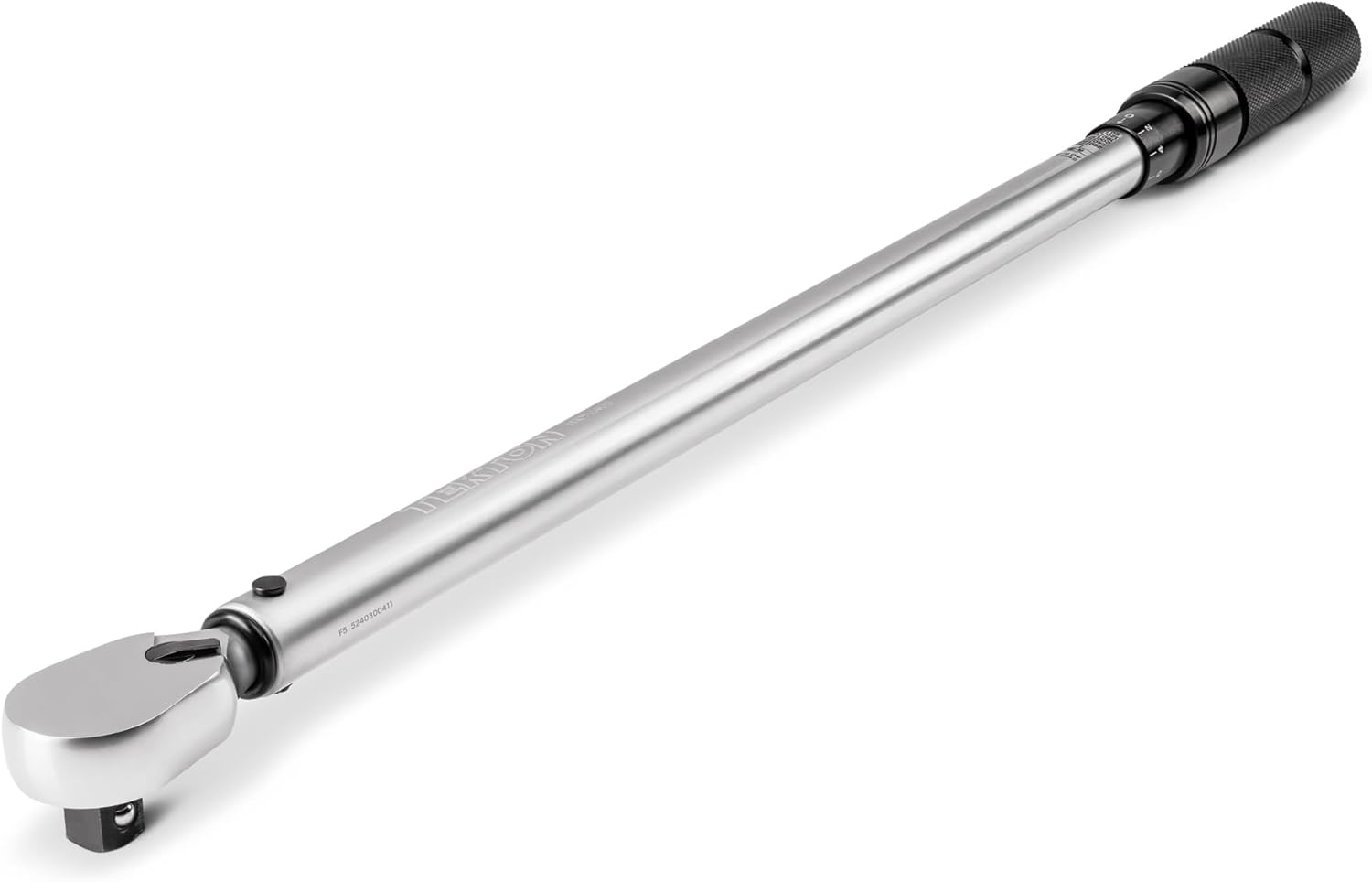
A high-tooth-count ratchet in the torque wrench you reach for most often means tighter working angles in cramped spaces. The TEKTON TRQ52403 covers the full range of heavy fastener work with a dual-scale graduated handle. Solid construction for the price and accurate enough for production shop use.
Check Price
Anti-seize on stainless fasteners, exhaust hardware, and aluminum-threaded joints prevents galling and makes future disassembly possible. Remember to reduce torque spec by 20-30% when using anti-seize — the reduced friction means the same torque produces significantly higher clamping force than the dry spec assumes.
Check PriceAs an Amazon Associate, TestTalkHQ earns from qualifying purchases.
Symptom-based diagnosis: Bolt Torque Troubleshooting. Decision fork for elastic torque charts vs torque-to-yield angle procedures: Torque Spec vs Torque-to-Yield.
A torque wrench that's out of calibration is worse than no torque wrench — it gives you false confidence while under or over-clamping every fastener you touch. Click-type torque wrenches drift from impacts, drops, and the normal wear of the internal spring mechanism. Industry standard is annual calibration or every 5,000 cycles, whichever comes first. Store the wrench backed off to its lowest setting — leaving it set at a working torque compresses the spring continuously and accelerates drift. If your wrench has been dropped, recalibrate before using it on anything that matters. A calibration check against a known load is inexpensive and worth doing if you're in doubt.
Most standard fasteners can be reused if they're in good condition — threads clean, no visible stretch or necking, no corrosion that would change friction characteristics. Torque-to-yield fasteners are never reused — they've been stretched past yield and have reduced ductility remaining. TTY fasteners are common in modern engine cylinder heads, connecting rods, and some suspension components. The service manual will specify "replace" if the fastener is TTY. When in doubt: if the torque procedure calls for angle-of-turn steps after an initial torque value, it's almost certainly TTY and should be replaced. The cost of a new fastener is trivial against the cost of a failure.
Impact wrenches drive fasteners fast and break them loose easily, but they provide no torque control whatsoever. "Impact tight" is not a torque spec. Using an impact wrench to final-torque structural fasteners, wheel lug nuts, or engine components produces inconsistent and unverifiable clamping force — sometimes under, sometimes over, depending on battery charge, anvil wear, and surface friction. Torque sticks (torque-limiting extension bars) reduce the worst-case impact output but are not a substitute for a calibrated torque wrench on critical fasteners. Use an impact to run fasteners down quickly, then finish to spec with a click-type or digital torque wrench. That's the correct workflow, not a shortcut.
Prevailing torque fasteners — nyloc nuts, all-metal stiff nuts, thread-locking inserts — resist rotation by design. The torque required to run them down before seating (called prevailing torque or running torque) must be accounted for when applying a torque spec. If a nyloc nut requires 5 ft-lb to run down and you torque it to 25 ft-lb total, you've only applied 20 ft-lb of clamping torque. The correct approach: measure the running torque with a torque wrench before the nut contacts the bearing surface, then add that value to the target fastener torque. For critical applications, the service documentation will often specify the torque value as "torque after seating" — meaning the running torque is excluded and the full spec value goes toward clamping force.